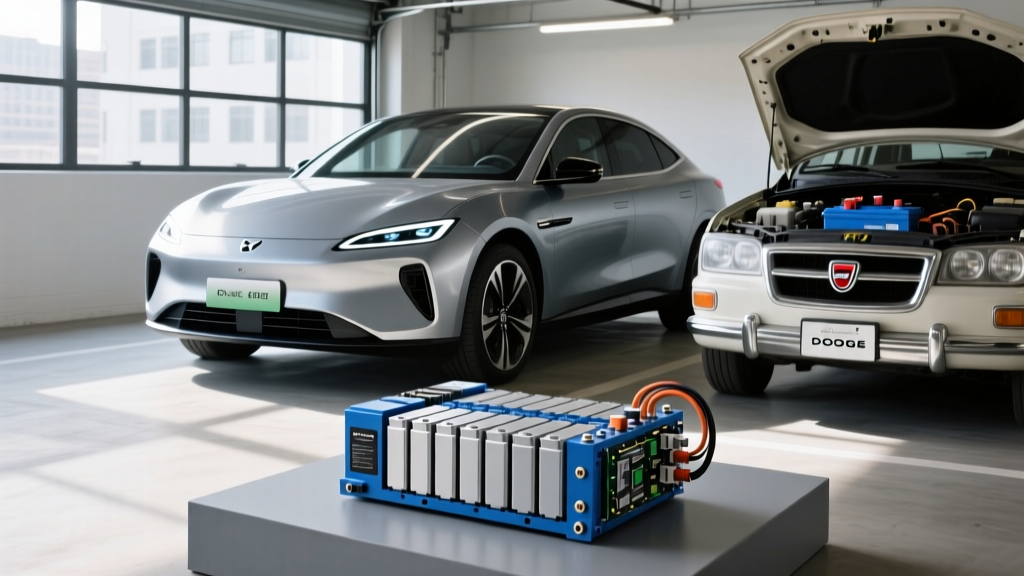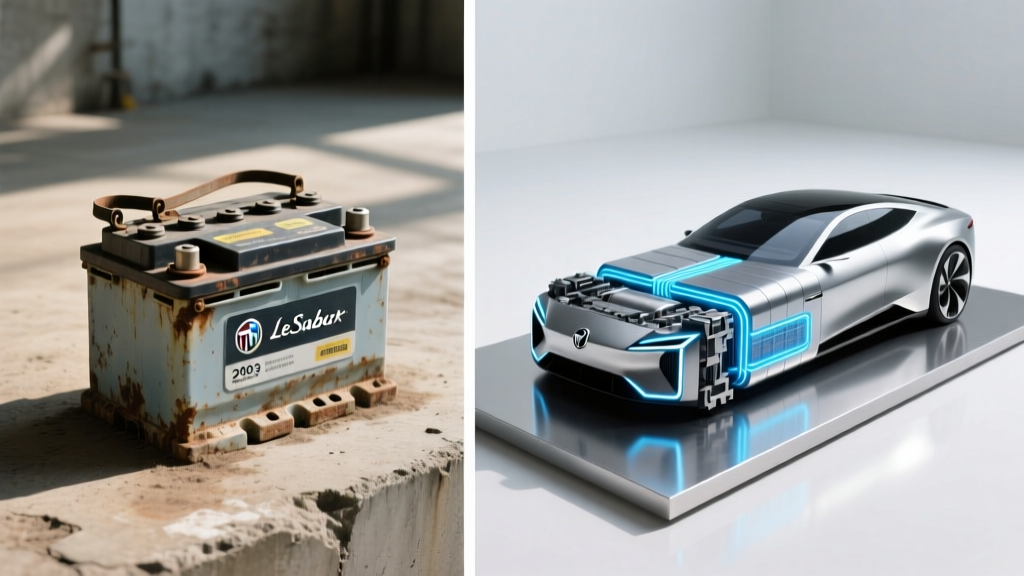
If you've ever searched for a 2003 Buick LeSabre battery, you already know what a conventional 12V lead-acid replacement involves: roughly $120–$180 at an auto-parts store, a few minutes with a wrench, and a battery that weighs about 35 pounds and stores less than 1 kWh of energy. That Group 78 flooded-cell battery was designed to crank a 3.8L V6 and run the radio — nothing more.
Compare that to a modern EV traction battery: 60–100+ kWh of usable energy, 700–1,200 pounds, liquid-cooled thermal management, and a price tag between $6,000 and $22,000 depending on the vehicle. The engineering gap between a 2003 LeSabre's 12V battery and a 2026 EV's high-voltage pack is one of the most dramatic technology leaps in automotive history.
This guide breaks down everything EV owners and shoppers need to know about modern lithium-ion traction batteries — chemistry, degradation, warranties, replacement costs, and how to maximize longevity — while using that humble lead-acid battery as a reference point for just how far we've come.
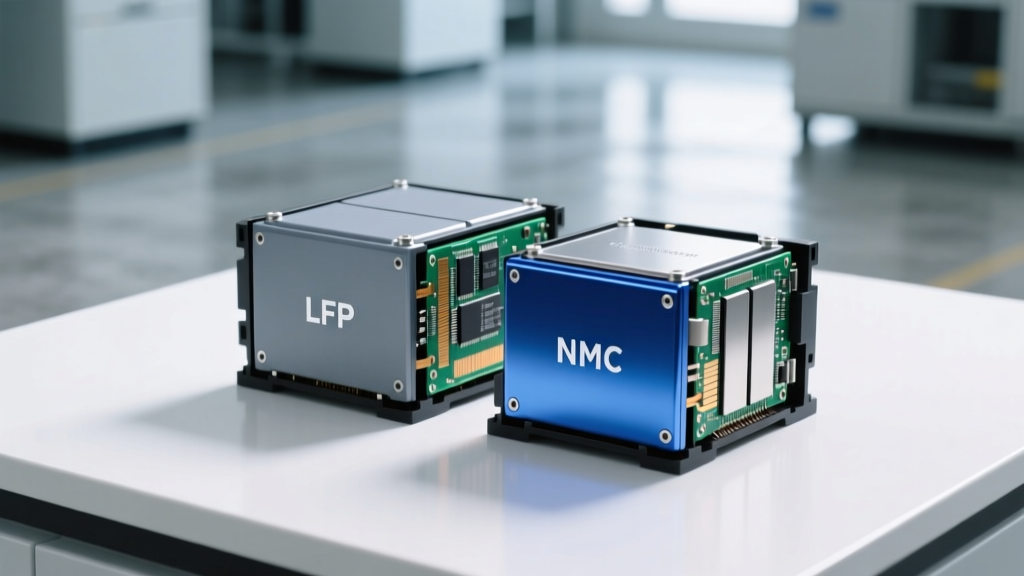
LFP vs NMC vs NCA: EV Battery Chemistry Explained
Not all lithium-ion batteries are the same. The cathode chemistry determines energy density, cycle life, thermal stability, cold-weather performance, and cost. As of 2026, three chemistries dominate the EV market:
- NMC (Nickel Manganese Cobalt): Used in most long-range EVs — Hyundai Ioniq 5, Ford Mustang Mach-E Extended Range, BMW iX. High energy density, good cold performance, moderate cycle life.
- NCA (Nickel Cobalt Aluminum): Tesla's chemistry of choice for Model 3/Y Long Range and Performance variants. Very high energy density, similar trade-offs to NMC.
- LFP (Lithium Iron Phosphate): Found in Tesla Model 3/Y Standard Range (RWD), base Ford Mustang Mach-E Select, and many Chinese-market EVs. Lower energy density but significantly longer cycle life, better thermal stability, and lower cost.
| Attribute | LFP | NMC | NCA |
|---|---|---|---|
| Energy Density (Wh/kg) | 160–200 | 220–280 | 240–300 |
| Typical Cycle Life | 3,000–5,000+ | 1,000–2,000 | 1,000–1,500 |
| Cold Performance (below 32°F) | Moderate — slower charging, more range loss | Good — better low-temp conductivity | Good |
| Thermal Stability | Excellent — higher runaway threshold | Moderate | Moderate |
| Cost per kWh (pack-level) | ~$80–$100 | ~$110–$140 | ~$110–$135 |
| Cobalt Content | None | Some (reducing over time) | Some |
| Recommended SoC for Daily Use | 100% acceptable | 80% preferred for daily | 80% preferred for daily |
The practical takeaway: LFP is better for owners who want maximum longevity and don't need the longest single-charge range. NMC/NCA is better when you need every mile of EPA range and regularly drive in cold climates. Tesla explicitly recommends charging LFP packs to 100% at least weekly, while NMC/NCA owners should target 80% daily and 100% only before road trips.
How Long Do EV Batteries Actually Last?
This is the question that generates the most anxiety — and the most misinformation. Let's look at real data rather than speculation.
Typical degradation trajectory for liquid-cooled lithium-ion packs (2020–2026 models):
- Year 1 / 15,000 miles: 2–5% capacity loss (initial formation loss)
- Year 3 / 45,000 miles: 6–10% total loss
- Year 5 / 75,000 miles: 8–13% total loss
- Year 8 / 120,000 miles: 10–17% total loss
- Year 10 / 150,000 miles: 12–20% total loss (varies heavily by chemistry and use)
According to data aggregated by Recurrent Auto from over 15,000 EVs in their fleet-monitoring program, the median range loss at 100,000 miles is approximately 10–12% for NMC packs and 6–8% for LFP packs. The degradation curve is not linear — it's steepest in the first year, then flattens considerably.
For context: a 2026 Hyundai Ioniq 5 with a 77.4 kWh NMC battery and an EPA range of 305 miles would realistically deliver roughly 275–285 miles after five years and 75,000 miles of typical use. That's still ample for most daily driving.
The contrast with a 2003 Buick LeSabre's lead-acid battery is stark. That 12V battery typically lasted 3–5 years before sulfation and plate degradation made replacement necessary. A modern EV traction battery is engineered for 15–20 years of service — and in many cases will outlast the vehicle itself.
What Does the EV Battery Warranty Actually Cover?
Federal law (EPA emissions warranty requirements) effectively mandates that EV battery packs carry a minimum warranty of 8 years / 100,000 miles. Most automakers match or exceed this. Here's how the major warranties compare as of 2026:
| Manufacturer | Warranty Period | Capacity Retention Threshold | Notes |
|---|---|---|---|
| Tesla (Model 3/Y NMC) | 8 yr / 120,000 mi | 70% | Long Range & Performance |
| Tesla (Model 3/Y LFP) | 8 yr / 100,000 mi | 70% | RWD / Standard Range |
| Hyundai / Kia | 10 yr / 100,000 mi | 70% | Among the longest coverage |
| Ford (Mach-E, F-150 Lightning) | 8 yr / 100,000 mi | 70% | Components + capacity |
| GM (Ultium-based) | 8 yr / 100,000 mi | 70% | Includes thermal management |
| BMW | 8 yr / 100,000 mi | 70% | Covers cell modules + BMS |
| Volkswagen (ID.4) | 8 yr / 100,000 mi | 70% | Net usable capacity |
Critical detail: The warranty threshold matters. A 70% retention guarantee means the manufacturer will repair or replace the battery (or individual modules) only if the pack's usable capacity drops below 70% of its original spec during the warranty period. A 10% loss at 60,000 miles, while frustrating, is not a warranty claim.
Also note that warranties typically cover defects and abnormal degradation — not damage from accidents, flooding, or improper charging equipment. Always review the specific warranty booklet for your vehicle.
EV Battery Replacement Cost: What to Expect
This is where the comparison to a 2003 Buick LeSabre battery replacement ($120–$180) becomes almost comical. EV traction battery replacement is a major service event — but it's also far less common than most buyers fear.
| Vehicle / Pack Size | Battery Capacity | Estimated Replacement Cost | Typical Replacement Timeline |
|---|---|---|---|
| Tesla Model 3 RWD (LFP) | ~60 kWh | $8,000–$12,000 | Rarely needed; 15+ yr expected life |
| Tesla Model Y Long Range (NMC) | ~75 kWh | $12,000–$16,000 | Rarely needed under normal use |
| Hyundai Ioniq 5 (NMC) | 77.4 kWh | $10,000–$15,000 | Module-level repair often possible |
| Ford F-150 Lightning Ext. Range | 131 kWh | $18,000–$25,000 | Largest consumer packs; modular |
| Chevrolet Bolt EV/EUV | 65 kWh | $6,500–$9,000 | Recall-replaced packs; lower cost |
| Nissan LEAF (air-cooled) | 40–62 kWh | $6,500–$10,000 | Earlier degradation; replacement more common |
Key context that reduces the fear factor:
- Most EV batteries never need full replacement. Data from fueleconomy.gov and fleet operators shows that the vast majority of packs retain 75–85% capacity at 150,000 miles — well above the point where replacement would be necessary.
- Module-level repair is increasingly common. Many packs (Hyundai/Kia, BMW, GM Ultium) allow individual cell modules to be replaced rather than the entire pack, reducing costs to $1,500–$4,000 for a targeted repair.
- Pack costs continue to decline. Battery pack prices have fallen from over $1,000/kWh in 2010 to approximately $100–$130/kWh in 2026, according to BloombergNEF. A replacement pack in 2030 will cost significantly less than today.
- Used and refurbished packs are emerging as a cost-effective option for older vehicles, often at 40–60% of new-pack pricing.
Factors That Accelerate (or Preserve) Battery Life
Not all miles are created equal when it comes to battery wear. Here's what actually moves the needle on degradation:
Battery Care Checklist: Maximize Your Pack's Lifespan
- Avoid frequent DC fast charging above 150 kW. Occasional road-trip fast charging is fine, but daily 250 kW sessions generate sustained heat that accelerates degradation. Level 2 home charging (7–11 kW) is the gentlest method.
- Keep SoC between 20% and 80% for daily driving (NMC/NCA). LFP owners can charge to 100% regularly — Tesla recommends it weekly for cell balancing.
- Don't let the battery sit at 100% SoC for extended periods. If you charge to full, drive within a few hours. Storage at 100% in hot weather is particularly damaging.
- Precondition the battery before fast charging in cold weather. Most EVs do this automatically when you navigate to a charger; it warms the cells to optimal temperature (~70–95°F) for faster, safer charging.
- Avoid deep discharges below 10% SoC when possible. The low-voltage cutoff protects cells, but repeatedly running the pack near empty stresses the chemistry.
- Use the vehicle's scheduled charging feature to finish charging just before you leave, rather than sitting at high SoC overnight in hot weather.
- Park in shade or a garage during extreme heat. Battery thermal management systems work harder (and consume energy) when ambient temps exceed 95°F. Prolonged heat exposure without active cooling is the single biggest environmental degradation factor.
Cold weather note: While cold temperatures reduce range temporarily (expect 20–30% range loss below 20°F due to increased internal resistance and cabin heating), cold itself does not cause permanent degradation. The battery recovers its full capacity once warmed. The real risk is attempting to fast-charge a cold battery without preconditioning — this can cause lithium plating on the anode, which is permanent damage.
How to Check Your EV Battery's State of Health (SoH)
Unlike a 2003 Buick LeSabre, where you'd test the 12V battery with a $30 multimeter, monitoring EV battery health requires software-level access. Here are the methods available to owners:
1. In-vehicle battery health display. Some manufacturers (Hyundai, Kia, BMW) provide a battery health percentage or bar graph in the infotainment system. Tesla does not natively display SoH percentage in-vehicle, though it shows estimated range at full charge, which serves as a proxy.
2. Third-party apps and OBD-II readers. Tools like Recurrent, Tessie (for Tesla), and ABRP (A Better Route Planner) can pull SoH data from the vehicle's CAN bus via OBD-II dongles or API connections. These provide degradation curves over time.
3. Dealer diagnostic scan. Any authorized dealer can run a full battery diagnostic that reads individual cell voltages, internal resistance, and overall pack capacity. Request this during routine service — most dealers will provide it at no charge.
4. Range tracking over time. The simplest method: note your vehicle's displayed range at 100% SoC when new, then compare it periodically. If your 305-mile Ioniq 5 now shows 280 miles at full charge after 40,000 miles, that's approximately 8% degradation — well within normal expectations.
5. Charging data analysis. Track how many kWh it takes to charge from a known SoC to full. If your 77.4 kWh pack previously accepted 62 kWh from 20% to 100% but now only accepts 56 kWh for the same interval, you can calculate approximate capacity loss.
Emerging Battery Technologies: Solid-State and Beyond
While today's lithium-ion batteries are mature and reliable, several next-generation technologies are in development. It's important to understand what's real now versus what's still years away.
Solid-state batteries replace the liquid electrolyte with a solid material (ceramic, sulfide, or polymer), promising higher energy density (potentially 400–500 Wh/kg), faster charging, and improved safety. Toyota has announced a solid-state battery targeting 2027–2028 production with a claimed 466-mile range, but no solid-state EV is currently available for purchase. Nissan and Samsung SDI have similar timelines. Expect limited, premium-vehicle availability no earlier than 2028, with mainstream adoption likely in the 2030s.
Silicon-dominant anodes replace graphite anodes with silicon, which can store roughly 10x more lithium ions per unit mass. Companies like Sila Nanotechnologies and Group14 are supplying silicon-composite anodes to automakers now, with incremental energy-density improvements of 10–20% appearing in 2025–2027 model-year vehicles. This is an evolution, not a revolution — but it's real and shipping.
Sodium-ion batteries use abundant, cheap sodium instead of lithium. CATL has begun producing sodium-ion packs for lower-cost Chinese-market EVs. Energy density is lower (~120–160 Wh/kg), making them suitable for city cars and budget models. US-market availability is not yet confirmed for any major model.
Realistic timeline summary: Today's NMC and LFP batteries will remain the dominant chemistries through at least 2030. Solid-state is genuinely promising but remains pre-commercial for automotive use. Buyers should not delay an EV purchase waiting for solid-state — today's batteries are proven, warrantied, and will serve well for 15+ years.
EV Battery FAQ: Answers to the Most Common Questions
How long do EV batteries last in years and miles?
Most modern liquid-cooled EV batteries are designed to last 15–20 years and 150,000–200,000+ miles while retaining 70–80% of original capacity. Fleet data from Recurrent Auto shows median degradation of 10–12% at 100,000 miles for NMC packs and 6–8% for LFP. The battery will typically outlast other major vehicle components.
How much does it cost to replace an EV battery?
Full pack replacement ranges from roughly $6,500 (Chevrolet Bolt) to $25,000 (Ford F-150 Lightning Extended Range), depending on battery size and vehicle. However, full replacements are rare — most packs last the life of the car, and module-level repairs ($1,500–$4,000) are increasingly available. Pack costs continue to decline year over year.
What does the EV battery warranty cover?
Federal requirements effectively mandate 8 years / 100,000 miles of battery warranty coverage (Hyundai/Kia offer 10 years). The warranty guarantees that the battery will retain at least 70% of its original usable capacity. If degradation exceeds 30% within the warranty period, the manufacturer will repair or replace the battery or affected modules at no cost.
LFP vs NMC — which battery chemistry is better?
Neither is universally better; it depends on your priorities. Choose LFP if you want maximum longevity (3,000–5,000+ cycles), lower cost, can charge to 100% daily, and don't need the longest single-charge range. Choose NMC/NCA if you need maximum range per charge, better cold-weather performance, and are comfortable keeping daily charge at 80%. For most commuters, LFP is the pragmatic choice; for road-trippers and cold-climate drivers, NMC delivers where it counts.
Does fast charging damage the battery?
Occasional DC fast charging (road trips, a few times per month) causes negligible additional degradation in modern liquid-cooled packs. Daily high-power fast charging (250+ kW) does accelerate wear over time due to sustained heat. The biggest risk is fast-charging a cold battery without preconditioning, which can cause lithium plating. For daily use, Level 2 home charging at 7–11 kW is ideal.
Can I check my EV battery health myself?
Yes. Track your displayed range at 100% SoC over time, use third-party apps like Recurrent or Tessie for detailed SoH data, or ask your dealer for a diagnostic scan. Compare your current full-charge range to the original EPA figure — a 5–10% drop over the first 3–5 years is normal and not a cause for concern.
How does an EV battery compare to a conventional car battery?
A conventional 12V lead-acid battery (like the one in a 2003 Buick LeSabre) stores about 0.7–1.0 kWh, costs $120–$180, lasts 3–5 years, and weighs ~35 lbs. A modern EV traction battery stores 60–131 kWh (60–130x more energy), costs $6,500–$25,000, lasts 15–20+ years, and weighs 700–1,200 lbs. EVs also have a separate 12V battery for accessories, but the traction battery is the core of the vehicle.
For authoritative data on EV efficiency and range, refer to the EPA's fueleconomy.gov database. For federal tax credit rules that may affect your EV purchase decision, consult the IRS clean vehicle credits page. Battery technology continues to improve, but today's packs are already robust enough that battery replacement should rank low on your list of ownership concerns.