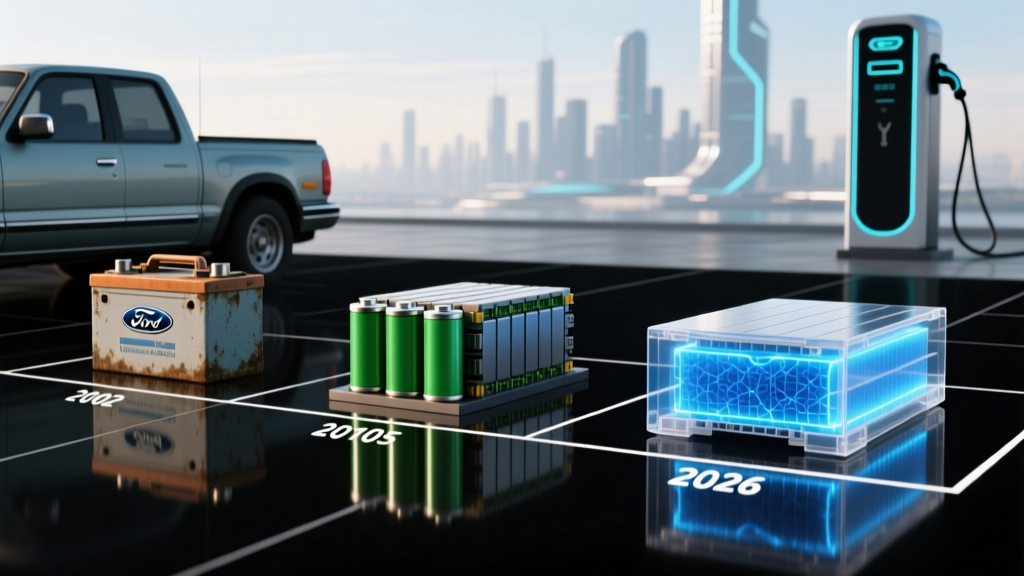
If you've ever searched for a 2002 Ford Ranger battery, you might have stumbled into an unexpected corner of automotive history. The 2002 Ford Ranger EV — one of the last battery-electric pickups from that era — used a nickel-metal hydride (NiMH) traction pack rated at roughly 35 kWh. Ford produced only a few thousand of these trucks, leasing most of them before famously crushing many under the same ZEV-mandate pressures that killed the GM EV1. That early Ranger battery degraded noticeably within a few years, offered barely 60 miles of range, and cost upward of $15,000 to replace even then — a figure that would be absurd for the vehicle's value.
Fast-forward to 2026, and EV battery technology is almost unrecognizable by comparison. Modern lithium-ion packs deliver 250–400 miles of EPA-rated range, retain over 90% of their capacity after 100,000 miles, and come with federally mandated 8-year/100,000-mile warranties. The chemistry, thermal management, and manufacturing scale behind today's packs would have seemed like science fiction to the engineers who built the Ranger EV.
This guide breaks down everything you need to know about EV battery technology in 2026 — chemistry choices, real degradation data, warranty coverage, replacement costs, and the emerging tech on the horizon.
LFP vs. NMC: Choosing Your Battery Chemistry in 2026
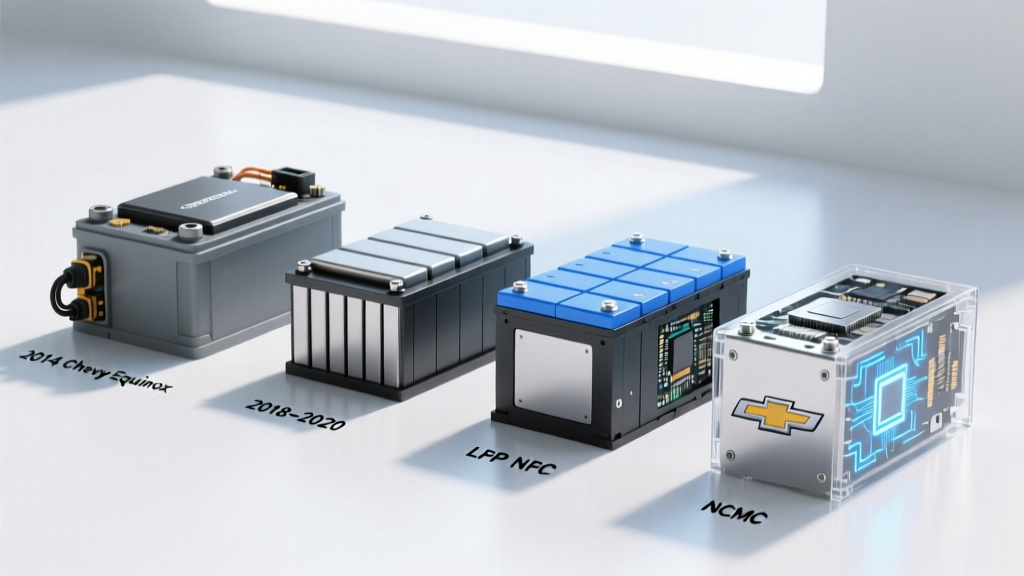
The two dominant lithium-ion chemistries in today's EV market are LFP (Lithium Iron Phosphate) and NMC/NCA (Nickel Manganese Cobalt / Nickel Cobalt Aluminum). The chemistry inside your pack determines range, longevity, cold-weather behavior, and price. Here's how they stack up:
| Attribute | LFP (Lithium Iron Phosphate) | NMC / NCA |
|---|---|---|
| Energy Density | ~160–180 Wh/kg (lower) | ~250–300 Wh/kg (higher) |
| Typical Cycle Life | 3,000–5,000+ cycles | 1,500–2,500 cycles |
| Cold-Weather Performance | Moderate — slower charge below 32°F | Better — more tolerant of sub-freezing temps |
| Cost per kWh (pack-level) | ~$90–$110 | ~$120–$145 |
| Recommended SoC Ceiling | 100% daily is fine | 80% daily for longevity |
| Common 2026 Vehicles | Tesla Model 3 RWD, Model Y RWD, Rivian Standard, Ford Mustang Mach-E Select | Hyundai Ioniq 5 Long Range, Chevy Equinox EV, BMW iX, Porsche Taycan |
| Thermal Stability | Excellent — lower runaway risk | Good — requires robust BMS |
The practical takeaway: LFP is the longevity champion. If you plan to keep your EV for 10+ years and 150,000+ miles, LFP's superior cycle life and tolerance for 100% daily charging make it the pragmatic choice — especially in milder climates. NMC/NCA wins on energy density, giving you more range in a lighter, smaller pack, which matters for long-range trims, towing-heavy vehicles, and cold-climate buyers who need every mile of winter range.
The 2002 Ford Ranger EV's NiMH pack, by contrast, had roughly half the energy density of today's NMC cells and degraded far faster under thermal stress. The leap in chemistry alone explains why a modern F-150 Lightning carries a 131 kWh (extended range) NMC pack with an EPA rating of 320 miles — a figure that would have required a battery weighing over 3,000 lbs in NiMH form.
How Long Do EV Batteries Actually Last? Real Degradation Data
This is the single most common question from prospective EV buyers, and the answer is better than most people expect. The fear of a $20,000 battery swap at 80,000 miles is largely a myth in 2026.
- Year 1 / 15,000 mi: ~2–5% capacity loss (initial "break-in" drop)
- Year 3 / 45,000 mi: ~6–9% total loss
- Year 5 / 75,000 mi: ~8–12% total loss
- Year 8 / 120,000 mi: ~10–15% total loss
- Year 10+ / 150,000+ mi: ~12–20% total loss (varies heavily by chemistry and habits)
Sources: Geotab fleet degradation study, Recurrent Auto battery health reports.
Several patterns emerge from real-world fleet data. First, degradation is not linear — the steepest drop occurs in the first year or two, then the curve flattens considerably. Second, LFP packs tend to show slower long-term degradation than NMC, though both chemistries have improved markedly since the early 2020s. Third, vehicles with active liquid thermal management — which includes virtually every 2026 EV on the market — degrade far slower than older passively-cooled packs like the early Nissan Leaf.
For context, a 2026 Hyundai Ioniq 5 Long Range with its 77.4 kWh NMC pack and EPA rating of 305 miles will likely still deliver 260–275 miles of range at 120,000 miles. That's still more usable range than many brand-new EVs from 2018.
The 2002 Ford Ranger EV, with its primitive air-cooled NiMH pack, often lost 30–40% of capacity within 5 years and 50,000 miles — a stark illustration of how far thermal management and chemistry have come.
What Does the Battery Warranty Actually Cover?
Federal law in the United States mandates that all EV manufacturers provide a minimum battery warranty of 8 years or 100,000 miles (whichever comes first). In California and states that follow CARB (California Air Resources Board) emissions standards, that extends to 10 years or 150,000 miles.
| Manufacturer | Warranty Term | Capacity Threshold | Chemistry |
|---|---|---|---|
| Tesla (Model 3/Y RWD) | 8 yr / 100,000 mi | 70% retention | LFP |
| Tesla (Model 3/Y Long Range, S/X) | 8 yr / 120,000 mi | 70% retention | NMC/NCA |
| Hyundai / Kia | 10 yr / 100,000 mi | 70% retention | NMC |
| Ford (Mach-E, F-150 Lightning) | 8 yr / 100,000 mi | 70% retention | NMC / LFP (varies by trim) |
| Chevrolet (Equinox EV, Blazer EV) | 8 yr / 100,000 mi | 60% retention (some trims 70%) | NMC (Ultium) |
| BMW | 8 yr / 100,000 mi | 70% retention | NMC |
| Rivian | 8 yr / 175,000 mi (R1T/R1S) | 70% retention | NMC / LFP |
What triggers a warranty claim? If your battery's State of Health (SoH) drops below the stated threshold — typically 70% of original capacity — within the warranty period, the manufacturer must repair or replace the pack at no cost. In practice, most manufacturers will replace individual modules rather than the entire pack when possible, which is faster and cheaper for them but functionally equivalent for you.
Importantly, the warranty covers capacity degradation, not just total failure. If your 300-mile EV can only manage 200 miles at 70,000 miles, that's a valid claim. Always document your SoH readings periodically (see monitoring section below) so you have a paper trail.
Refer to the EPA's fueleconomy.gov for official range ratings and manufacturer warranty disclosures for specific model years.
How Much Does an EV Battery Replacement Cost in 2026?
Out-of-warranty battery replacement remains expensive, but prices have fallen significantly as pack-level costs have dropped below $120/kWh for many manufacturers. Here's what you can expect if you need a replacement in 2026:
| Vehicle Class | Battery Size (kWh) | Estimated Replacement Cost | When Typically Needed |
|---|---|---|---|
| Compact EV (e.g., Chevy Bolt EV, Mini Cooper SE) | 40–65 kWh | $5,500–$9,000 | Rarely — most outlive the car |
| Mid-size sedan/SUV (e.g., Tesla Model 3, Ioniq 5) | 60–84 kWh | $8,000–$14,000 | 150,000–250,000+ mi if at all |
| Large SUV / Truck (e.g., F-150 Lightning, Rivian R1T) | 100–131 kWh | $12,000–$20,000 | 200,000+ mi if at all |
| Luxury / Performance (e.g., Porsche Taycan, BMW iX) | 80–110 kWh | $14,000–$22,000 | Rarely within vehicle life |
The honest truth most fear-mongering headlines omit: the vast majority of EV batteries never need replacement. Data from Recurrent Auto shows that fewer than 5% of EV batteries have been replaced outside of warranty claims, and most packs are still functioning at 80%+ capacity well past 150,000 miles. The battery in a 2026 EV is far more likely to outlive the vehicle's body, suspension, and interior than to fail catastrophically.
Compare this to the 2002 Ford Ranger EV, whose NiMH replacement pack was estimated at $15,000–$18,000 in 2005 dollars — for a truck with a residual value of maybe $8,000. That economics-killed the Ranger EV as a used proposition. Today's lithium-ion packs, with far better longevity and lower replacement costs relative to vehicle value, don't face the same existential problem.
Factors That Accelerate Battery Degradation (and How to Avoid Them)
While modern battery management systems (BMS) do an excellent job protecting the pack from abuse, your habits still matter. Here are the key factors ranked by impact:
- Minimize DC fast-charging frequency. Occasional road-trip fast charging is fine, but daily 150+ kW DC sessions accelerate degradation by 1–3% over 5 years compared to Level 2 home charging. The heat generated at high C-rates stresses cells. Aim for Level 2 (7–11 kW) as your daily routine.
- Avoid extreme State of Charge (SoC) storage. For NMC packs, parking at 100% SoC for days — especially in hot weather — is one of the worst things you can do. Store between 40–60% if the car will sit unused for a week or more. LFP packs tolerate 100% storage far better, which is one of their key advantages.
- Precondition before fast charging. Most 2026 EVs automatically precondition the battery when you navigate to a DC fast charger. This warms or cools the pack to its optimal charging temperature (~77–95°F), which both speeds charging and reduces thermal stress. If your EV doesn't auto-precondition, do it manually via the app.
- Park in shade or a garage in extreme heat. Sustained battery temperatures above 100°F accelerate calendar degradation. Active thermal management mitigates this, but it can't fully compensate for a truck parked in 115°F Phoenix sun for 8 hours daily.
- Don't obsess over avoiding 100%. For LFP owners, charging to 100% regularly is actually recommended — LFP cells have a very flat voltage curve, and the BMS needs full charges to accurately calibrate SoC. For NMC, charging to 100% before a long trip is perfectly fine; just don't let it sit at 100% for days.
- Keep your EV plugged in during extreme cold. A plugged-in EV can use grid power to maintain battery temperature rather than draining the pack. Below 20°F, an unplugged EV can lose 2–5% SoC overnight just to keep the battery from getting too cold.
How to Check Your EV's Battery Health (State of Health Monitoring)
State of Health (SoH) is the percentage of original capacity your battery can still hold. A brand-new pack is 100% SoH; a pack that holds 77 kWh out of an original 84 kWh is at ~91.7% SoH. Here's how to monitor it in 2026:
Built-in vehicle tools: Most 2026 EVs display SoH or a degradation indicator somewhere in the infotainment system or mobile app. Tesla shows it under Service → Battery Health. Hyundai/Kia includes it in the EV-specific settings menu. Ford's Sync system surfaces it in the FordPass app.
OBD-II diagnostic tools: Third-party tools like OBDeleven, Carista, or the Recurrent Auto app can read the BMS-reported SoH directly via the OBD-II port. This gives you a more granular number than most dashboards display and is useful for documenting degradation over time — especially if you anticipate a warranty claim.
The manual calculation method: Charge to 100% (or your known maximum), note the displayed range, and compare it to the original EPA rating adjusted for your driving style. If your 305-mile Ioniq 5 now shows 260 miles at full charge in similar conditions, that's roughly 85% SoH. This method is less precise (displayed range varies with recent driving efficiency) but gives a reasonable ballpark.
Dealer diagnostic reports: Any authorized dealer can pull a full BMS health report showing per-module voltage variance, internal resistance, and SoH. Request one annually or before a long road trip. Some dealers provide this free; others charge $50–$100.
Emerging Battery Tech: Solid-State, Silicon Anodes, and What's Real
The battery lab pipeline is full of promising advances, but the gap between a lab breakthrough and a production vehicle remains 5–10 years. Here's what's on the horizon, with realistic timelines:
Solid-state batteries replace the liquid electrolyte with a solid material (ceramic, sulfide, or polymer), promising higher energy density (~400–500 Wh/kg), faster charging, and better safety. Toyota has announced a solid-state EV for the 2027–2028 timeframe, and Samsung SDI is targeting 2027 for initial production. However, manufacturing scale-up remains the bottleneck. Expect solid-state to debut in limited, premium applications first — not in a $35,000 compact SUV. Timeline: Limited production 2027–2029; mainstream availability 2030+.
Silicon anode batteries replace the graphite anode with silicon, which can store roughly 10× more lithium ions per gram. Companies like Sila Nanotechnologies and Group14 are already shipping silicon-dominant anodes in limited consumer electronics and are targeting automotive production by 2027–2028. The energy density boost is real — expect 20–40% more range from the same physical pack size. Timeline: Initial automotive deployment 2027; wider adoption 2029+.
Sodium-ion batteries use abundant sodium instead of lithium, cutting raw material costs dramatically. CATL has already deployed sodium-ion packs in some Chinese-market EVs. Energy density is lower (~120–150 Wh/kg), making sodium-ion best suited for affordable city cars and stationary storage. Timeline: Available now in China; US-market vehicles unlikely before 2028.
Lithium-sulfur (Li-S) offers theoretical energy density of ~2,600 Wh/kg — over 10× today's lithium-ion — but cycle life remains a major unsolved problem (typically under 200 cycles in lab conditions). Timeline: Research stage; automotive deployment unlikely before 2032+.
None of these technologies should influence a 2026 purchase decision. Today's lithium-ion packs — whether LFP or NMC — are mature, well-understood, and backed by strong warranties. Waiting for solid-state is like waiting for a perfect car: you'll be waiting a long time while missing out on perfectly good transportation today.
From the 2002 Ranger EV to 2026: The Bottom Line on EV Battery Longevity
The 2002 Ford Ranger EV battery was a product of its time — a NiMH pack with limited energy density, no active thermal management, and a degradation curve that often made the truck uneconomical to keep running past 80,000 miles. It was a brave experiment, but one that underscored how much battery technology needed to improve before EVs could serve as practical daily transportation.
In 2026, that improvement has arrived in full. A modern EV battery will very likely last the life of the vehicle with minimal capacity loss, is backed by an 8-to-10-year warranty, and costs less to replace (adjusted for inflation and relative to vehicle value) than the Ranger EV's pack did 20 years ago. The chemistry choice between LFP and NMC lets buyers optimize for their specific needs — longevity and cost, or range and cold-weather performance.
If you're shopping for an EV today, the battery should be one of your least anxious considerations. Focus instead on charging access, real-world range for your commute and road trips, and total cost of ownership. The battery, in nearly every case, will take care of itself.
Frequently Asked Questions
How long do EV batteries last in years and miles?
Most 2026 EV batteries will retain 80–90% of their original capacity at 150,000 miles and 10+ years. Real-world fleet data from Geotab and Recurrent Auto shows that the average EV battery loses roughly 1–2% of capacity per year under normal use. Many packs outlast the vehicle they're installed in.
How much does an EV battery cost to replace in 2026?
Out-of-warranty replacement costs range from roughly $5,500 for a small pack (40–65 kWh) to $20,000+ for a large truck or luxury SUV pack (100–131 kWh). However, fewer than 5% of EV batteries ever need replacement outside of warranty coverage. Most packs last the life of the car.
What does the EV battery warranty cover?
Federal law mandates a minimum of 8 years/100,000 miles (10 years/150,000 miles in CARB states). The warranty covers both total failure and capacity degradation below a threshold — typically 70% of original capacity. If your battery drops below that threshold within the warranty period, the manufacturer must repair or replace it at no cost.
How do I check and maximize my EV battery health?
Monitor State of Health (SoH) through your vehicle's built-in diagnostics, the manufacturer's mobile app, or an OBD-II diagnostic tool. Maximize longevity by favoring Level 2 home charging over daily DC fast charging, avoiding prolonged storage at extreme SoC levels (especially 100% for NMC), preconditioning before fast charges, and keeping the vehicle plugged in during extreme cold.
LFP vs. NMC — which battery chemistry is better?
Neither is universally better — it depends on your priorities. LFP offers longer cycle life (3,000–5,000+ cycles), lower cost, and tolerance for daily 100% charging, making it ideal for long-term ownership in moderate climates. NMC/NCA offers higher energy density (more range per pound) and better cold-weather performance, making it the right choice for long-range trims, cold climates, and towing applications. Both chemistries in 2026 are mature and backed by strong warranties.
Was the 2002 Ford Ranger EV battery the same type as modern EV batteries?
No. The 2002 Ford Ranger EV used a nickel-metal hydride (NiMH) battery pack — the same chemistry found in the original Toyota Prius hybrid. Modern EVs use lithium-ion cells (LFP or NMC/NCA), which offer roughly double the energy density, far better cycle life, and active liquid thermal management that the Ranger EV lacked entirely.