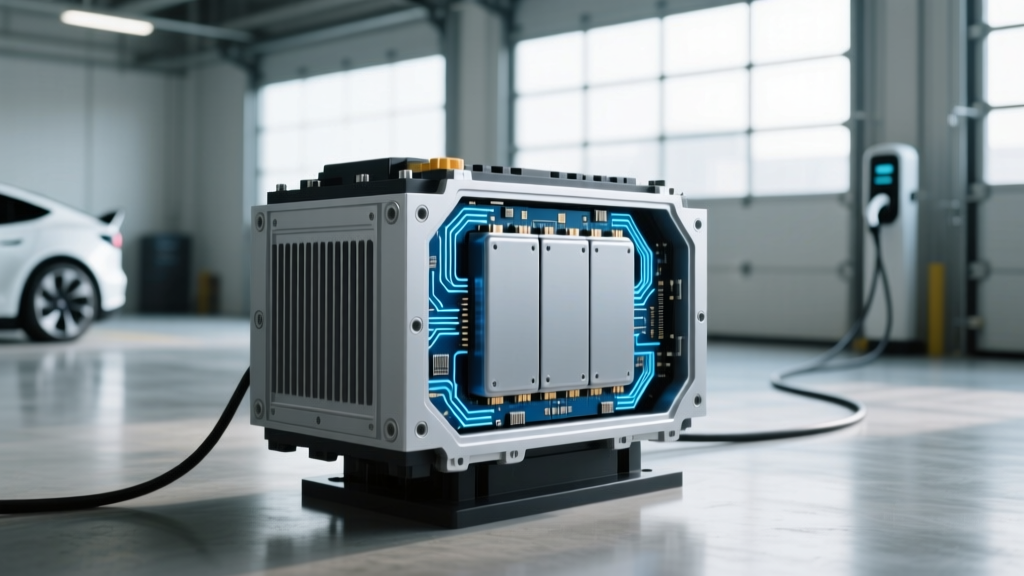
The single most expensive component in any battery-electric vehicle isn't the motor, the interior, or the infotainment stack — it's the high-voltage traction battery. Depending on the model, that pack represents 25–40% of the vehicle's total build cost and determines everything from EPA range to charging speed to long-term resale value. Yet for most buyers, electric vehicle battery systems remain a black box: a sealed slab of cells under the floor that either works or doesn't.
This guide dismantles that opacity. We'll walk through the two dominant lithium-ion chemistries shipping in 2026 models, quantify real-world degradation with fleet data, break down warranty coverage line by line, and give you a concrete care protocol to maximize pack longevity. Whether you're evaluating a Tesla Model 3 with an LFP pack or a Hyundai Ioniq 5 with NMC cells, the physics and economics below apply.
LFP vs NMC/NCA: The Chemistry Decision That Shapes Your Ownership
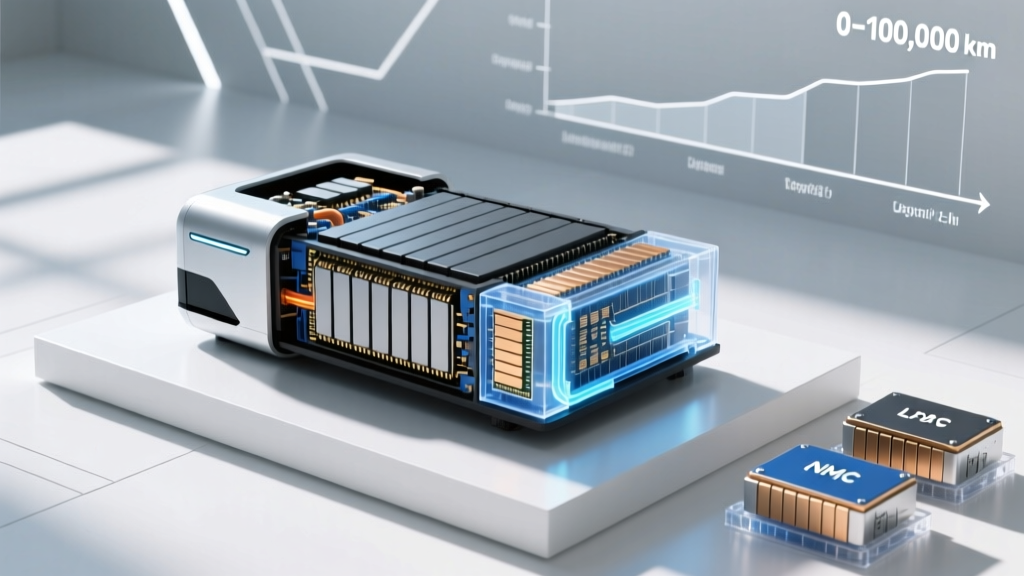
Every EV sold in the U.S. in 2026 uses one of two cathode chemistries in its traction battery: lithium iron phosphate (LFP) or nickel manganese cobalt / nickel cobalt aluminum (NMC/NCA). The choice isn't cosmetic — it dictates energy density, cycle life, cold-weather behavior, charging habits, and ultimately cost.
LFP cells use iron and phosphate in the cathode, eliminating nickel and cobalt entirely. That makes them cheaper to produce, more thermally stable (lower fire risk under abuse), and capable of far more charge cycles before meaningful degradation. The trade-off is lower energy density — roughly 15–25% less watt-hours per kilogram than NMC — which means a heavier or physically larger pack for the same range. LFP also suffers more voltage sag in freezing temperatures, reducing usable range and charge acceptance in winter.
NMC and NCA cells pack more energy into less mass, making them the default for long-range and performance models where minimizing weight matters. They deliver stronger cold-weather performance and faster charge acceptance at low state of charge. However, they degrade faster when routinely charged to 100% or exposed to sustained high temperatures, and the nickel/cobalt supply chain carries higher material costs and ethical sourcing concerns.
| Attribute | LFP (e.g., Tesla Model 3 RWD, standard-range BYD) | NMC/NCA (e.g., Hyundai Ioniq 5, Ford F-150 Lightning Extended) |
|---|---|---|
| Energy density (cell-level) | ~160–180 Wh/kg | ~220–260 Wh/kg |
| Typical cycle life to 80% SoH | 3,000–5,000+ cycles | 1,000–2,000 cycles |
| Cold-weather range loss (~20°F) | ~30–40% reduction | ~20–30% reduction |
| Recommended daily charge limit | 100% (weekly calibration encouraged) | 80% for daily; 100% for trips only |
| Thermal stability | Excellent — higher onset temp for thermal runaway | Good — requires active thermal management |
| Cost per kWh (pack-level, 2026 est.) | ~$100–$120 | ~$130–$155 |
| Cobalt/nickel content | None | Significant — subject to §30D critical-mineral sourcing rules |
Which is better? Neither — the right choice depends on your usage. If you charge at home nightly, drive under 250 miles daily, and live in a temperate or warm climate, LFP's longevity and 100%-charge tolerance make it the pragmatic pick. If you need maximum range per charge, frequently road-trip in cold weather, or tow, NMC's energy density and cold performance justify the tighter charging discipline.
How Long Do EV Batteries Actually Last? Degradation Data by the Numbers
The fear that an EV battery will "die" at 100,000 miles the way a phone battery degrades after two years is not supported by fleet data. Modern liquid-cooled packs lose capacity gradually, and the vast majority outlast the vehicle's structural and mechanical life.
What degradation actually looks like: Lithium-ion cells lose capacity through two mechanisms — calendar aging (chemical reactions that occur regardless of use, accelerated by heat and high state of charge) and cycle aging (wear from charge/discharge cycles, accelerated by deep discharges, high C-rates, and temperature extremes). In practice, you see a steeper drop in the first year or two (2–4%) as the solid electrolyte interphase (SEI) layer forms, then a long, slow linear decline.
Typical degradation trajectory (NMC, liquid-cooled, moderate climate):
- Year 1 / 15,000 mi: ~2–4% loss (initial SEI formation)
- Year 3 / 45,000 mi: ~5–8% total loss
- Year 5 / 75,000 mi: ~8–12% total loss
- Year 8 / 120,000 mi: ~10–15% total loss
- Year 10 / 150,000 mi: ~12–18% total loss (varies widely by care and climate)
Data synthesized from fleet reports by Recurrent Auto, Geotab, and manufacturer warranty claim rates. Individual results vary based on chemistry, climate, and charging habits.
For a concrete example: a 2024 Hyundai Ioniq 5 Long Range with a 77.4 kWh usable NMC pack and an EPA range of 305 miles would, under typical ownership, retain roughly 270–280 miles of range at year 5 and 260–275 miles at year 8. That's livable, not catastrophic.
LFP packs tell a different long-term story. Tesla's standard-range Model 3 (LFP, ~60 kWh usable) shows fleet degradation of roughly 5–8% after 100,000 miles in Recurrent's dataset — meaning a 272-mile EPA car might still deliver 250+ miles at that mileage. The chemistry's cycle-life advantage compounds over time.
According to fueleconomy.gov, the U.S. Department of Energy notes that most EV batteries are designed to last the life of the vehicle, with federally mandated minimum warranty coverage of 8 years or 100,000 miles (10 years/150,000 miles in California and states that follow CARB standards).
What the Battery Warranty Actually Covers — and What It Doesn't
Federal law (under CARB-influenced EPA standards) mandates that EV manufacturers warrant the high-voltage battery for a minimum of 8 years / 100,000 miles in most states, and 10 years / 150,000 miles in California and the roughly 17 states that have adopted California's emissions standards. But the details matter enormously.
| Vehicle | Chemistry | Warranty Term | Capacity Threshold | Notes |
|---|---|---|---|---|
| Tesla Model 3 RWD | LFP | 8 yr / 100,000 mi | 70% retention | Covers defects + degradation below threshold |
| Tesla Model 3 Long Range | NMC | 8 yr / 120,000 mi | 70% retention | Higher mileage cap than RWD |
| Hyundai Ioniq 5 | NMC | 10 yr / 100,000 mi | 70% retention | Hyundai's standard 10-yr powertrain applies |
| Ford F-150 Lightning | NMC | 8 yr / 100,000 mi | 70% retention | Covers battery + high-voltage components |
| Chevrolet Equinox EV | NMC (Ultium) | 8 yr / 100,000 mi | 60% retention (degradation); 70% (defects) | Verify threshold in purchase agreement — GM has used 60% in past Ultium terms |
| BMW iX | NMC | 8 yr / 100,000 mi | 70% retention | BMW offers optional extended battery certificate in some markets |
Key nuances buyers miss:
- The threshold is a floor, not a target. A 70% threshold means the warranty only triggers if your pack falls below 70% of original capacity. A pack at 72% SoH at year 7 is functioning "within spec," even if you've lost 28% of your range.
- "Defects" and "degradation" may have different thresholds. Some manufacturers (notably GM on certain Ultium packs) set a lower bar for capacity-loss claims than for manufacturing-defect claims. Read the warranty booklet, not the brochure.
- Transferability varies. Most OEM battery warranties transfer to second owners automatically, but some extended-protection certificates do not. This affects resale value.
- Opening the pack voids coverage. Third-party module-level repairs may save money now but will almost certainly void the OEM warranty on the remaining pack.
Replacement Cost: What It Actually Takes to Swap a Pack in 2026
This is the question that dominates EV forums, and the answer requires context. Most EV batteries never need a full replacement under normal ownership. Out-of-warranty pack swaps are rare — typically triggered by manufacturing defects that manifest early (covered by warranty), collision damage (covered by insurance), or extreme high-mileage use well past the 150,000-mile mark.
That said, if you do face an out-of-warranty replacement — say, on a 12-year-old EV with 180,000 miles — here's what the damage looks like:
| Vehicle | Pack Size (usable) | Estimated Parts Cost | Labor (est.) | Total Range |
|---|---|---|---|---|
| Tesla Model 3 Standard Range | ~60 kWh (LFP) | $7,000–$10,000 | $1,500–$2,500 | $8,500–$12,500 |
| Tesla Model Y Long Range | ~75 kWh (NMC) | $10,000–$14,000 | $1,500–$2,500 | $11,500–$16,500 |
| Hyundai Ioniq 5 Long Range | 77.4 kWh (NMC) | $11,000–$15,000 | $2,000–$3,000 | $13,000–$18,000 |
| Ford F-150 Lightning Extended | ~131 kWh (NMC) | $18,000–$25,000 | $3,000–$4,500 | $21,000–$29,500 |
| Chevrolet Bolt EV/EUV (legacy) | ~65 kWh (NMC) | $9,000–$13,000 | $2,000–$3,000 | $11,000–$16,000 |
Two important caveats. First, pack prices have fallen roughly 80% since 2013 and continue to decline — a replacement in 2032 will almost certainly cost less in real dollars than one today. Second, module-level repair is increasingly viable. Many packs are built from 10–20 individual modules, and a single failed module can sometimes be replaced for $1,500–$4,000 rather than swapping the entire pack. This requires a qualified EV technician and may void remaining OEM warranty.
Factors That Accelerate (or Slow) Battery Degradation
Battery longevity isn't random — it's a function of how you treat the cells. The following factors have the largest measurable impact on long-term State of Health:
Habits That Preserve Battery Health
- Charge to 80% daily (NMC/NCA). Sustained high state of charge stresses NMC cathodes. Set your charge limit to 80% and only bump to 100% when departing on a road trip. LFP owners can ignore this — charge to 100% freely.
- Precondition before DC fast charging. Cold cells accept charge slowly and suffer lithium plating at high C-rates. Use your car's built-in navigation preconditioning (routes through a Supercharger/DC station automatically warm the pack) to bring cells to ~30–35°C before high-power charging.
- Minimize DC fast charging frequency. Occasional road-trip fast charging is fine. Daily reliance on 150+ kW DC charging accelerates degradation by 1–3% over 100,000 miles compared to Level 2 home charging, per Geotab fleet data.
- Avoid prolonged storage at extremes. Don't leave the car sitting at 100% SoC in a hot garage for weeks, and don't let it sit below 10% SoC in freezing weather. For long-term storage, target 50–60% SoC in a shaded or climate-controlled space.
- Use regen braking moderately in extreme cold. Aggressive regen pushes high current into cold cells. Most EVs automatically limit regen when the pack is cold, but allowing the car to warm up before hard driving reduces stress.
Habits That Accelerate Degradation
- Routinely charging NMC to 100% and letting it sit for hours before driving
- Deep-discharging below 10% regularly (the lower buffer exists for a reason, but don't lean on it)
- Frequent DC fast charging in hot climates without preconditioning
- Track days or sustained high-speed towing in high ambient heat (sustained >120°F cell temps)
- Ignoring coolant system maintenance — battery thermal management fluid should be checked per the service schedule
Monitoring State of Health: How to Check Your Battery's Actual Condition
State of Health (SoH) is the percentage of original usable capacity your pack currently holds. A new pack is 100% SoH; a pack that held 77.4 kWh when new and now holds 69.7 kWh is at ~90% SoH. Monitoring this metric is the single best way to track long-term battery condition and catch anomalies before the warranty window closes.
Where to check SoH:
- In-car displays: Some manufacturers (BMW, Mercedes-Benz, Hyundai/Kia on updated 2025+ software) show SoH or a health percentage directly in the vehicle settings menu. Tesla does not natively display SoH but shows projected range at 100% charge, which you can compare to the original EPA figure.
- OBD-II diagnostic apps: Tools like OBDeleven, Car Scanner, or manufacturer-specific apps can read the BMS (Battery Management System) directly. The BMS tracks total energy in/out, internal resistance, and cell voltage variance — from which SoH is calculated.
- Third-party services: Companies like Recurrent Auto and AVILOO offer battery health reports based on telematics data. Some dealerships can pull a BMS report during service visits — request this at your annual checkup.
- DIY calculation: Charge to 100% (or your known max), drive to near-empty under moderate conditions, and measure kWh consumed from your charger's meter or app. Compare to the original usable capacity. This is imprecise but directionally useful.
What to watch for: Cell voltage variance (the spread between the highest and lowest cell groups in the pack) is often a better early-warning signal than overall SoH. A variance exceeding 200–300 mV at rest may indicate a weak module that could trigger a warranty claim. If you notice range dropping faster than the gradual degradation curve above, schedule a BMS diagnostic.
Emerging Battery Technology: What's Real and What's Still a Roadmap
The battery landscape is shifting, but it's critical to separate shipping products from lab announcements. Here's where the most-discussed next-generation technologies stand as of early 2026:
Silicon-dominant anodes: Companies like Sila Nanotechnologies and Group14 are supplying silicon-composite anode materials to production cells now. These replace some or all of the graphite in the anode, boosting energy density by 10–20% at the cell level. You'll find early silicon-anode cells in select 2025–2026 models from Mercedes-Benz (EQG) and in consumer electronics. Expect broader automotive adoption by 2027–2028.
Semi-solid-state cells: Manufacturers like NIO (150 kWh semi-solid pack, available in China) and Toyota (announced for 2027–2028 production) are bridging the gap between conventional liquid-electrolyte lithium-ion and true solid-state. These cells use a partially solid electrolyte to improve safety and energy density. Toyota has demonstrated prototypes claiming 750+ km (~465 miles) of range, but no mass-market vehicle with solid-state or semi-solid cells is currently on sale in the U.S. Treat any 2026 model-year claim of "solid-state" with extreme skepticism — these are announced, not shipping.
Sodium-ion batteries: CATL and BYD are producing sodium-ion cells for entry-level EVs in China, offering lower cost and better cold performance than LFP, at the expense of even lower energy density. U.S. availability is unlikely before 2028–2029 and will likely appear in budget-oriented models or stationary storage first.
What this means for today's buyer: Current LFP and NMC packs are mature, well-understood, and backed by extensive warranty coverage. Waiting for solid-state is a multi-year gamble with no guaranteed timeline or pricing. If an EV meets your needs today, the battery technology in it is ready for real-world ownership.
Frequently Asked Questions
How long do EV batteries last in years and miles?
Most modern liquid-cooled EV batteries retain 70–85% of their original capacity after 10 years or 150,000 miles, depending on chemistry, climate, and charging habits. LFP packs tend to outlast NMC packs at equivalent mileage. Catastrophic failure (sudden loss of function) is rare — degradation is gradual and linear after the first year. Many packs will function adequately past 200,000 miles, though with reduced range.
How much does an EV battery cost to replace out of warranty?
Full pack replacement costs range from roughly $8,500 for a compact LFP pack (Tesla Model 3 RWD) to $25,000+ for a large NMC pack (F-150 Lightning Extended Range), including labor. However, most batteries never require full replacement under normal ownership — fleet data shows the vast majority outlast the vehicle's useful life. Module-level repair, where available, can reduce costs to $1,500–$4,000 for a single failed module.
What does the EV battery warranty actually cover?
Federally mandated minimum coverage is 8 years / 100,000 miles (10 years / 150,000 miles in CARB states). Coverage typically includes manufacturing defects and capacity loss below a stated threshold — usually 70% of original capacity, though some manufacturers (notably GM on certain Ultium packs) have used a 60% threshold for degradation claims. The warranty covers the battery pack and often high-voltage components like the onboard charger and DC-DC converter. Read your specific warranty booklet for exact terms.
How do I check and maximize my EV battery's health?
Monitor State of Health through your car's BMS (via in-car display, OBD-II app, or dealer diagnostic). Maximize longevity by charging NMC to 80% daily (100% for LFP), preconditioning before DC fast charging, minimizing DCFC frequency, avoiding prolonged storage at 100% or below 10% SoC, and keeping up with thermal management coolant service. Realistically, following these habits can preserve an extra 3–5% of capacity over 100,000 miles compared to worst-case habits.
LFP vs NMC — which battery chemistry is better for me?
Choose LFP if you charge at home, drive under 250 miles daily, live in a mild or warm climate, and want maximum cycle life with the convenience of 100% charging. Choose NMC/NCA if you need maximum range per charge, frequently drive in cold weather, tow heavy loads, or take regular road trips where energy density and cold-weather charge acceptance matter. Neither is universally superior — the right chemistry matches your driving pattern.
Does fast charging damage my EV battery?
Occasional DC fast charging (road trips, a few times per month) causes negligible additional wear on modern liquid-cooled packs. Daily reliance on 150+ kW DC charging, especially without preconditioning and in hot climates, can accelerate degradation by 1–3% over 100,000 miles compared to exclusive Level 2 home charging. The bigger risk is charging at high power when cells are cold (below ~10°C) without preconditioning, which can cause lithium plating — a permanent form of capacity loss. Always use your car's navigation-based preconditioning when routing to a DC fast charger.
Will my EV battery need to be replaced before I sell the car?
Statistically, no. Data from Geotab and Recurrent Auto shows that the average EV battery loses roughly 1.8–2.3% of capacity per year under typical use. At that rate, a 10-year-old EV would retain roughly 77–82% of its original range — well within warranty thresholds and still practical for daily driving. Full pack replacement before the vehicle's end of life is the exception, not the rule. The more common ownership concern is gradual range reduction, not sudden failure.
Sources: U.S. Department of Energy / fueleconomy.gov; Recurrent Auto fleet battery data (2025 report); Geotab EV Battery Degradation Study; manufacturer warranty documentation (Tesla, Hyundai, Ford, GM); IRS §30D clean vehicle credit guidance (critical mineral and battery component sourcing rules affecting NMC vs LFP eligibility).