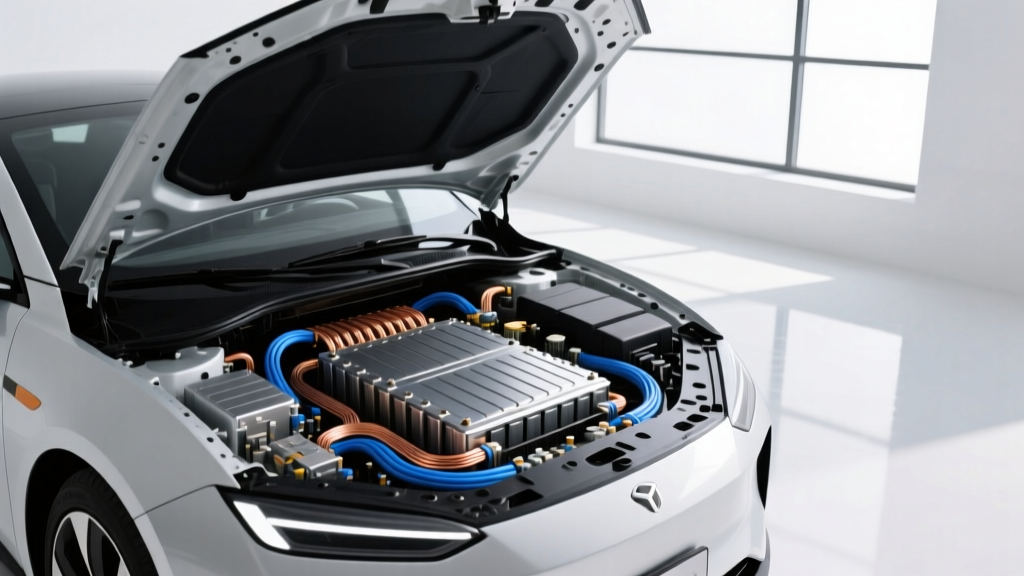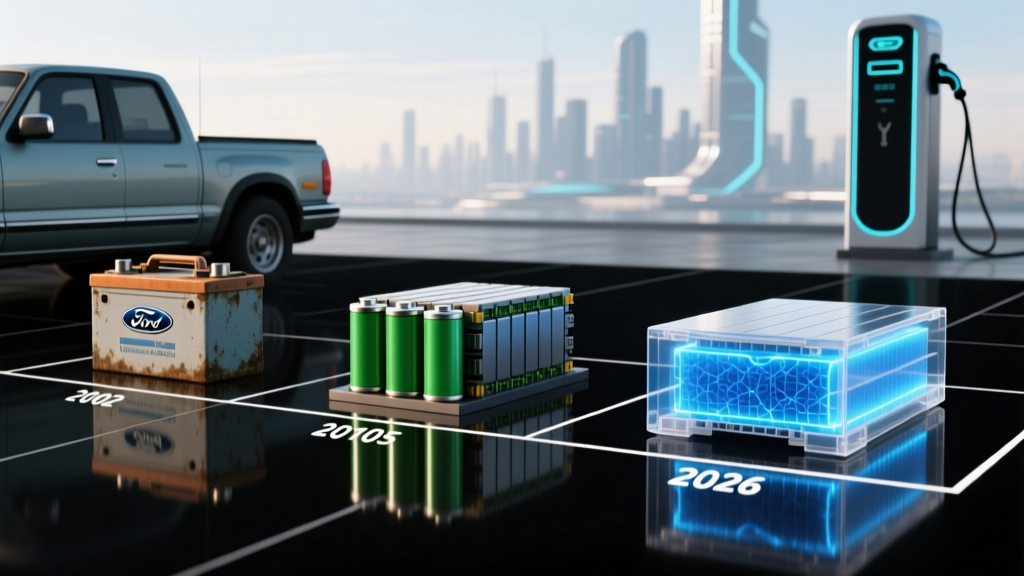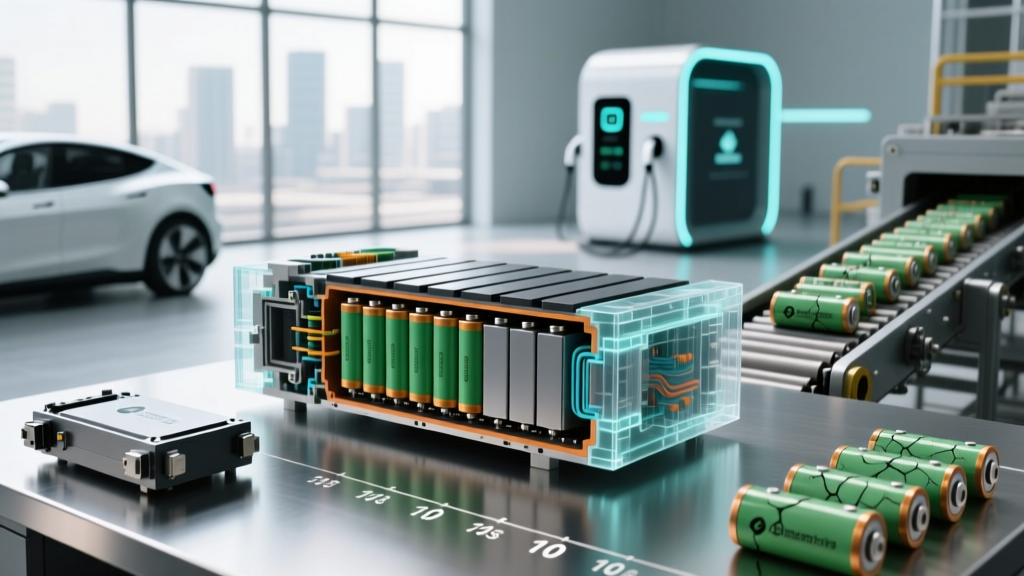
Whether you're evaluating a new Tesla Model 3, a Ford F-150 Lightning, or comparing consumer EVs to a commercial electric ship battery system, the core engineering challenge is identical: store maximum energy in minimum space, deliver it reliably for a decade or more, and keep degradation within acceptable limits. This guide breaks down exactly how modern EV traction batteries work, what the data says about their longevity, and what ownership actually costs when things go wrong.
LFP vs NMC: The Chemistry Decision That Defines Your EV
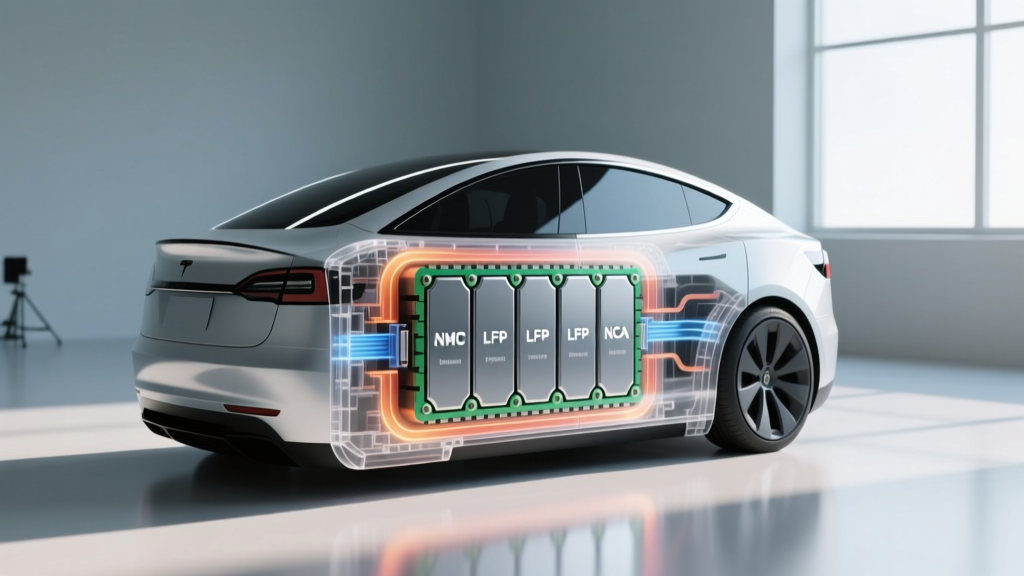
Every EV sold in 2026 uses one of two dominant lithium-ion cathode chemistries. Your choice between them affects range, charging habits, cold-weather performance, and long-term cost. Here's how they compare head-to-head:
| Attribute | LFP (Lithium Iron Phosphate) | NMC/NCA (Nickel Manganese Cobalt / Nickel Cobalt Aluminum) |
|---|---|---|
| Energy Density | Lower (~160-180 Wh/kg cell-level) | Higher (~220-260 Wh/kg cell-level) |
| Cycle Life | 3,000-5,000+ cycles to 80% SoH | 1,500-2,500 cycles to 80% SoH |
| Cold Performance | Weaker — notable range loss below 32°F | Better low-temp discharge capability |
| Thermal Stability | Superior — higher onset temp for thermal runaway | Good but requires more active thermal management |
| Cost (per kWh) | Lower — no cobalt or nickel | Higher — commodity-sensitive metals |
| Recommended SoC Ceiling | 100% daily charging is fine | 80% daily; 100% only for trips |
| Common 2026 Applications | Tesla Model 3/Y RWD, standard-range BYD, Rivian standard | Long-range models, F-150 Lightning Extended, Hyundai Ioniq 5 LR |
The trade-off is straightforward: LFP wins on longevity and cost but sacrifices energy density and cold-weather range. NMC/NCA wins on range per kWh and cold performance but degrades faster if routinely charged to 100%. This is the same fundamental calculus engineers face when scaling battery architecture from a 75 kWh sedan pack to a multi-megawatt-hour electric ship battery system — chemistry dictates the mission profile.
How Long Do EV Batteries Actually Last?
The short answer: almost certainly longer than you'll own the car. But the data tells a more nuanced story.
Real-World Degradation Data Points
Battery degradation is not linear. Most EVs experience a steeper drop in the first 20,000-30,000 miles (typically 2-5% loss), followed by a much slower, nearly linear decline. Here's what fleet and owner data shows:
- Tesla Model 3/Y (NMC, 2019-2023): Average ~8-12% capacity loss at 100,000 miles based on aggregated owner telemetry (source: Tesla Impact Report and third-party fleet analysis)
- Chevrolet Bolt EV/EUV (NMC, 2017-2023): ~6-10% loss at 80,000 miles; early 2017 models affected by the LG cell recall and replacement program
- Hyundai Ioniq 5 (NMC, 2022-2025): Early data suggests ~4-6% loss at 50,000 miles under normal use
- Tesla Model 3 RWD (LFP, 2022-2025): ~3-5% loss at 60,000 miles; LFP packs consistently show slower degradation curves
- Nissan Leaf (passively cooled, various years): Higher degradation rates — 15-25% at 80,000 miles in hot climates due to lack of active thermal management
For context, a modern liquid-cooled EV battery losing 10% capacity over 100,000 miles means a 300-mile EPA-rated vehicle still delivers roughly 270 miles of original range. Most owners never reach the point where degradation meaningfully impacts daily usability.
When Does a Battery Need Replacement?
Full traction battery replacement is rare before 150,000-200,000 miles on liquid-cooled packs. It becomes a consideration when:
- Capacity drops below 70% of original (often the warranty threshold)
- Individual cell or module failure causes imbalance that the BMS cannot correct
- Physical damage from collision or flooding compromises the pack enclosure
EV Battery Warranty Terms: What's Actually Covered
Federal law in the United States mandates a minimum EV battery warranty of 8 years / 100,000 miles (in California Air Resources Board states, it's 10 years / 150,000 miles). But manufacturers exceed these minimums, and the details matter.
| Manufacturer | Warranty Term | Capacity Retention Threshold | Notes |
|---|---|---|---|
| Tesla (Model 3/Y LWD) | 8 yr / 100,000 mi | 70% | LFP pack; covers defects and excessive degradation |
| Tesla (Model 3/Y LR, S, X) | 8 yr / 120,000 mi (S/X: 150,000 mi) | 70% | NMC/NCA pack |
| Hyundai / Kia | 10 yr / 100,000 mi | 70% | Among the longest terms in the industry |
| Ford (F-150 Lightning, Mach-E) | 8 yr / 100,000 mi | 70% | Covers battery and electric drivetrain components |
| GM (Ultium-platform vehicles) | 8 yr / 100,000 mi | 70% (some models 60%) | Verify specific model terms — Silverado EV warranty differs from Equinox EV |
| Rivian | 8 yr / 175,000 mi (R1T/R1S) | 70% | Higher mileage cap than most competitors |
| BMW (i4, iX, i7) | 8 yr / 100,000 mi | 70% | Includes high-voltage battery and related components |
Key caveat: "70% capacity retention" means the warranty triggers only if your battery falls below 70% of its original usable capacity within the term. A battery at 72% is not covered, even if you've lost noticeable range. Always read the specific warranty booklet for your model year — terms shift between model years and trims.
EV Battery Replacement Cost: What the Numbers Say
This is the single biggest fear for prospective EV buyers. Let's address it with actual figures, not speculation.
| Vehicle / Pack Size | Battery Capacity | Estimated Replacement Cost | Typical Replacement Timeline |
|---|---|---|---|
| Tesla Model 3 RWD (LFP) | ~60 kWh | $12,000 - $16,000 | Rarely needed before 200,000+ mi |
| Tesla Model Y Long Range | ~75 kWh | $15,000 - $20,000 | Rarely needed before 200,000+ mi |
| Hyundai Ioniq 5 Long Range | 77.4 kWh | $14,000 - $19,000 | Rarely needed before 150,000+ mi |
| Ford F-150 Lightning Ext. Range | ~131 kWh | $25,000 - $35,000 | Rarely needed before 150,000+ mi |
| Chevrolet Silverado EV | ~200 kWh (max) | $35,000 - $45,000 | Too new for real-world data |
| Nissan Leaf (40 kWh pack) | 40 kWh | $6,500 - $9,000 (reman) | May need sooner due to passive cooling |
Several important realities about these numbers:
- Most EVs never need a full battery replacement. Out-of-warranty replacements are overwhelmingly due to collision damage, not end-of-life degradation.
- Remanufactured and refurbished packs are increasingly available at 40-60% of new-pack cost, especially for high-volume models like the Model 3 and Bolt.
- Module-level repair is possible on some architectures (BMW, older Nissan Leaf) — replacing only the degraded modules rather than the entire pack for $2,000-$5,000.
- Battery costs continue to fall. Pack-level pricing has dropped from ~$1,200/kWh in 2010 to roughly $110-$140/kWh in 2025-2026 (source: BloombergNEF). A replacement in 2035 will almost certainly cost less than today.
What Kills an EV Battery: The 5 Degradation Factors You Control
Battery chemistry sets the ceiling, but your habits determine where on the degradation curve your pack actually lands. Here are the factors, ranked by impact:
1. Extreme State of Charge (SoC) Habits
Routinely storing an NMC/NCA battery at 100% SoC accelerates electrolyte decomposition and cathode structural stress. For NMC packs, daily charging to 80% and only using 100% for road trips measurably extends cycle life. LFP packs are more tolerant of 100% storage — which is why Tesla recommends periodic 100% charges for LFP Model 3 RWD vehicles (it also helps the BMS recalibrate).
2. Frequent DC Fast Charging
Charging at 150-350 kW generates significant internal heat. While modern thermal management systems mitigate this, data from fleet operators shows vehicles that DC fast-charge daily degrade 1-3% more over 100,000 miles than those that primarily use Level 2 home charging. This doesn't mean avoid fast charging — just don't rely on it exclusively if you have home charging access.
3. Extreme Temperature Exposure
Batteries degrade faster when regularly exposed to ambient temperatures above 95°F or below 10°F — especially while sitting at high SoC. Garage parking in hot climates meaningfully extends pack life. Cold weather itself doesn't permanently damage batteries, but charging a cold battery without preconditioning can cause lithium plating on the anode.
4. Deep Discharge Cycles
Regularly driving from 100% down to 5% or lower puts more stress on cells than shallow cycles (e.g., 80% to 30%). You don't need to baby your EV, but if your commute only uses 20% of the battery, there's no reason to charge to 100% every night.
5. Prolonged Storage at Low or High SoC
Leaving an EV unplugged at 5% SoC for weeks can push cells below their minimum voltage, potentially causing irreversible damage. Conversely, storing at 100% for extended periods accelerates calendar aging. For long-term storage (vacations, deployment), aim for 50% SoC and plug into a Level 1 or Level 2 charger with a scheduled departure or SoC limit set.
How to Check and Monitor Your Battery's State of Health
State of Health (SoH) is the percentage of your battery's current maximum capacity relative to its original capacity. A new EV starts at 100% SoH; at 70% SoH, the battery holds only 70% of its original kWh.
Methods for Checking SoH
- In-vehicle display: Some EVs (notably Tesla, BMW iX, Rivian) display estimated battery health or degradation percentage in the settings menu. Tesla's service mode can show a detailed SoH reading.
- Manufacturer app: The FordPass, Hyundai Bluelink, and Kia Connect apps provide battery health status, though often as a "good/fair/poor" indicator rather than a precise percentage.
- OBD-II diagnostic tools: Devices like the OBDLink SX paired with apps such as EVNotify or Leaf Spy (for Nissan Leaf) can read the battery management system's SoH estimate directly. This is the most precise consumer-accessible method.
- Dealer diagnostic: Any authorized service center can run a full battery health report. Request this during routine service visits, especially as you approach the warranty mileage limit.
- Manual calculation: Charge to 100%, note the displayed range, and compare to the original EPA-rated range (adjusted for the known relationship between displayed and EPA range for your model). Less precise but requires no tools.
SoH Monitoring Best Practices
Check SoH every 6-12 months or every 15,000 miles. Document readings to establish a trend line. If degradation suddenly accelerates (e.g., dropping 5% in a single quarter after years of gradual 1-2% annual loss), schedule a diagnostic — it may indicate a cell imbalance or thermal management issue that's warrantable.
Emerging Battery Technology: What's Next and When
The battery landscape is evolving rapidly, but it's critical to separate what's shipping from what's still in the lab.
Solid-State Batteries
Solid-state cells replace the liquid electrolyte with a solid conductor, promising higher energy density (potentially 400+ Wh/kg), faster charging, and improved safety. Status as of 2026: Toyota has announced limited solid-state production for select models, and QuantumScape is delivering prototype cells to Volkswagen for testing. However, mass-market availability at scale remains projected for 2028-2032. Cost per kWh is currently many multiples of conventional lithium-ion.
Silicon-Dominant Anodes
Replacing graphite anodes with silicon can increase energy density by 20-40%. Companies like Sila Nanotechnologies and Group14 are shipping early silicon-anode cells. Expect to see these in premium EVs by 2027-2028, with broader adoption following as manufacturing scales.
Sodium-Ion Batteries
CATL and BYD are producing sodium-ion cells for lower-cost, shorter-range applications. These offer lower energy density than LFP but eliminate lithium entirely, reducing cost and supply-chain risk. Likely destined for budget EVs, urban runabouts, and stationary storage before appearing in mainstream US-market vehicles.
None of these technologies are available in production EVs sold in the US today. If a salesperson tells you otherwise, ask for the spec sheet.
Frequently Asked Questions
How long do EV batteries last in years and miles?
Modern liquid-cooled EV batteries (LFP or NMC) routinely last 150,000-200,000+ miles before reaching 70-80% of original capacity. In years, that's typically 12-20 years of average driving (12,000-15,000 miles/year). Passively cooled batteries (like the pre-2023 Nissan Leaf) may degrade faster, especially in hot climates. Most EVs are scrapped for reasons unrelated to the battery before the pack reaches end-of-life.
How much does an EV battery cost to replace?
Full replacement costs range from roughly $6,500 (small, older packs like the 40 kWh Leaf) to $35,000+ (large packs like the F-150 Lightning Extended Range or Silverado EV). For mainstream EVs (Model 3, Ioniq 5, Mach-E), expect $12,000-$20,000. Remanufactured packs and module-level repairs can reduce this by 40-60%. Battery pricing continues to decline year over year, so future replacements will likely cost less.
What does the EV battery warranty actually cover?
Federal minimum is 8 years / 100,000 miles (10/150,000 in CARB states). Coverage includes manufacturing defects and excessive capacity loss — typically defined as dropping below 70% of original capacity within the term. The warranty does not cover damage from collisions, flooding, improper modifications, or use outside manufacturer specifications. Always review your specific model-year warranty booklet, as terms vary by trim and manufacturer.
How do I maximize my EV battery's health and lifespan?
For NMC/NCA batteries: set daily charge limit to 80%, avoid leaving the car at 100% SoC for extended periods, precondition before fast charging, use Level 2 home charging as your primary method, and garage-park in extreme heat when possible. For LFP batteries: follow manufacturer guidance (Tesla recommends periodic 100% charges for BMS calibration), and the same thermal and fast-charging best practices apply. Neither chemistry requires you to obsess — moderate habits are sufficient.
LFP vs NMC — which battery chemistry is better?
Neither is universally better; it depends on your use case. Choose LFP if you prioritize maximum cycle life, lower cost, and plan to charge to 100% regularly (e.g., daily commuting with home charging). Choose NMC/NCA if you need maximum range per charge, frequently drive in cold climates, or take regular road trips where energy density matters. Both chemistries will outlast most ownership periods with reasonable care. The same chemistry trade-offs apply at every scale — from a compact EV to an industrial electric ship battery system, the mission profile dictates the chemistry choice.