Who Actually Makes Your EV Battery?
When you buy a Tesla Model Y, Ford F-150 Lightning, or Hyundai Ioniq 5, you're not just buying the automaker's engineering — you're buying a battery pack from a specialized EV battery supplier. The cell chemistry, manufacturing quality, and thermal management design from these suppliers directly determine your real-world range, charging speed, long-term degradation, and eventual replacement cost.
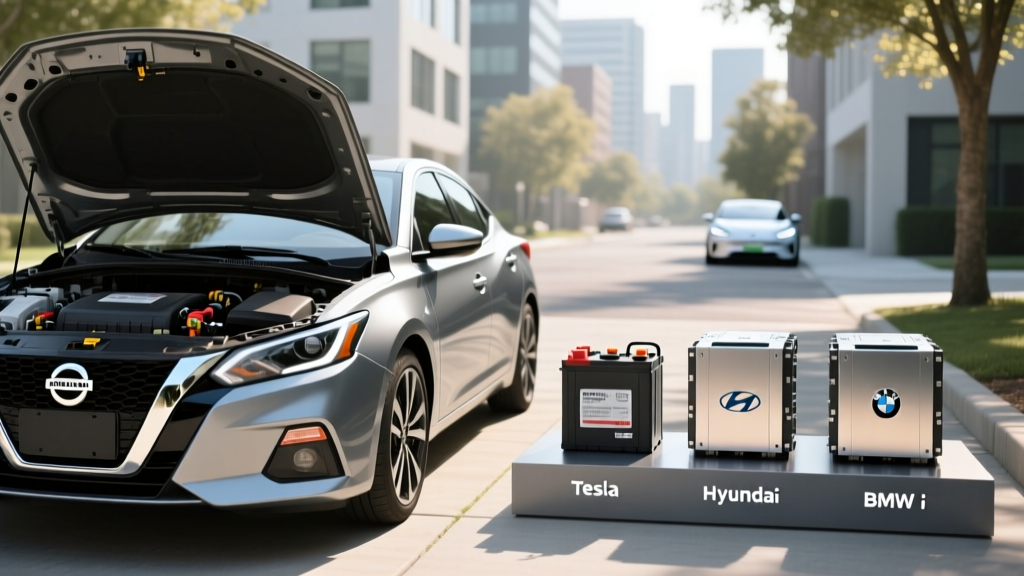
As of 2026, the global EV battery supplier market is dominated by a handful of players: CATL (China), BYD (China), LG Energy Solution (South Korea), Panasonic (Japan), SK On (South Korea), and Samsung SDI (South Korea). Each supplies different chemistries to different automakers, and understanding which supplier and chemistry your vehicle uses is critical for predicting longevity and performance.
Battery Chemistry: LFP vs NMC vs NCA
The two dominant lithium-ion chemistries in 2026 EVs are LFP (lithium iron phosphate) and NMC/NCA (nickel manganese cobalt / nickel cobalt aluminum). Your EV battery supplier's chemistry choice affects energy density, cycle life, cold-weather performance, and cost — and the trade-offs are significant.
| Attribute | LFP (LiFePO4) | NMC/NCA |
|---|---|---|
| Energy Density | ~160-180 Wh/kg (lower) | ~220-260 Wh/kg (higher) |
| Cycle Life | 3,000-5,000+ cycles | 1,000-2,000 cycles |
| Cold Performance | Poor below 32°F (slower charging, range loss) | Better in cold (less range penalty) |
| Cost per kWh | ~$80-100/kWh (cell level) | ~$110-140/kWh (cell level) |
| Thermal Stability | Excellent (less thermal runaway risk) | Good (requires more robust BMS) |
| Typical Suppliers | CATL, BYD | LG, Panasonic, SK On, Samsung SDI |
| Example Vehicles (2026) | Tesla Model 3 RWD, Model Y RWD, Ford Mustang Mach-E Select | Tesla Model Y Long Range, Hyundai Ioniq 5, Rivian R1T, Ford F-150 Lightning Extended |
Which is better? LFP wins on longevity and cost — if you can tolerate the cold-weather penalty and slightly lower range per kWh. NMC/NCA wins on energy density, making it the choice for long-range and performance trims. Tesla's shift to LFP for standard-range models (sourced from CATL and BYD) reflects this cost-durability trade-off. If you live in a mild climate and charge primarily at home, LFP is the pragmatic choice. If you need maximum range or live in Minnesota winters, NMC/NCA is worth the premium.
How Long Do EV Batteries Last? Real Degradation Data
The question "how long do EV batteries last" has a data-backed answer: most modern EV batteries outlast the vehicle itself. But degradation is real, measurable, and varies by chemistry and usage.
Typical Degradation Curves (2026 fleet data):
- Tesla Model 3/Y (NMC, Panasonic/LG): ~5-7% capacity loss at 100,000 miles; ~8-12% at 200,000 miles (source: Tesla Impact Report, Recurrent Auto fleet data)
- Tesla Model 3 RWD (LFP, CATL/BYD): ~3-5% loss at 100,000 miles; projected ~6-8% at 200,000 miles
- Hyundai Ioniq 5 (NMC, SK On): ~4-6% loss at 100,000 miles (owner-reported fleet averages)
- Nissan Leaf (NMC, AESC/Envision): Older air-cooled packs showed 10-15% loss at 80,000 miles; 2023+ liquid-cooled packs improved to ~6-8% at 100,000 miles
- Ford F-150 Lightning (NMC, SK On): ~5-7% loss at 100,000 miles (fleet data, 2024-2026 models)
The degradation curve is non-linear: expect a steeper drop in the first 20,000-30,000 miles (1-3%), then a slow, linear decline. A 2026 Model Y Long Range with an EPA-rated 330 miles and 82 kWh usable battery will likely retain ~310 miles of range at 100,000 miles — still functional for daily driving and road trips.
Battery Warranty Terms: What's Actually Covered?
Federal law (EPA emissions warranty) doesn't cover EV batteries, but every major automaker provides a dedicated high-voltage battery warranty. The industry standard is 8 years / 100,000 miles, with a capacity retention threshold of 70% (some manufacturers use 65% or define it differently). California and states adopting CARB rules require 10 years / 150,000 miles.
| Manufacturer | Warranty Term | Capacity Threshold | Supplier(s) |
|---|---|---|---|
| Tesla (Model 3/Y RWD, LFP) | 8 yr / 120,000 mi | 70% retention | CATL, BYD |
| Tesla (Model 3/Y LR, NMC) | 8 yr / 120,000 mi | 70% retention | Panasonic, LG |
| Hyundai/Kia (Ioniq 5/6, EV6) | 10 yr / 100,000 mi | 70% retention | SK On, Samsung SDI |
| Ford (F-150 Lightning, Mach-E) | 8 yr / 100,000 mi | 70% retention | SK On |
| Rivian (R1T, R1S) | 8 yr / 175,000 mi | 70% retention | Samsung SDI |
| GM (Ultium platform) | 8 yr / 100,000 mi | 60-70% (varies) | LG (Ultium Cells JV) |
What triggers a warranty claim? If your battery's State of Health (SoH) drops below the threshold (e.g., 70% of original capacity) within the warranty period, the manufacturer will repair or replace the pack — typically with a refurbished unit, not new. Most claims involve individual module replacement, not full-pack swaps. Full replacements are rare and usually occur only after catastrophic failure or severe degradation anomalies.
EV Battery Replacement Cost: When and How Much?
Most EV batteries will never need replacement during typical ownership. But if yours fails outside warranty — or you're buying a high-mileage used EV — here's what to expect.
| Vehicle | Battery Size (kWh) | Chemistry | Replacement Cost (parts + labor) |
|---|---|---|---|
| Tesla Model 3 RWD | 60 kWh | LFP | $8,000-$12,000 |
| Tesla Model Y Long Range | 82 kWh | NMC | $12,000-$16,000 |
| Hyundai Ioniq 5 | 77.4 kWh | NMC | $10,000-$14,000 |
| Ford F-150 Lightning Extended | 131 kWh | NMC | $18,000-$25,000 |
| Rivian R1T (Large Pack) | 128 kWh | NMC | $16,000-$22,000 |
| Chevrolet Bolt EV/EUV | 65 kWh | NMC | $9,000-$13,000 |
These costs are typically incurred only after 200,000+ miles or 15+ years — well beyond average ownership duration. For context, the average American drives ~14,000 miles/year, meaning a 200,000-mile battery lasts ~14 years. Most EVs are traded or sold before reaching this threshold. The fear of a $20,000 battery replacement is largely overblown for new-EV buyers; it's a more relevant concern for high-mileage used-EV shoppers.
Factors That Accelerate Battery Degradation
Your EV battery supplier builds the cells, but your habits determine how long they last. These factors have the most impact:
- Frequent DC fast charging above 150 kW: Occasional use is fine; daily 350 kW sessions accelerate degradation by ~1-2% over 100k miles due to heat stress. Preconditioning (warming the battery before charging) mitigates this.
- Sustained 100% State of Charge: For NMC/NCA, storing at 100% SoC for days accelerates calendar aging. LFP tolerates 100% better — Tesla recommends periodic 100% charges for LFP to recalibrate the BMS.
- Extreme heat exposure: Parking in 100°F+ ambient for weeks without thermal management active can cause 1-2% additional annual loss. Garage parking helps.
- Deep discharges (below 10% SoC): Repeatedly draining to near-zero stresses cells. Keep above 10% when possible.
- Cold-weather fast charging without preconditioning: Charging a frozen battery at high kW causes lithium plating, a permanent degradation mechanism. Always precondition in sub-32°F conditions.
How to Check Your Battery's State of Health (SoH)
Most EVs don't display SoH directly in the dash, but you can estimate it:
- Tesla: Use third-party apps like Tessie or Stats for Tesla, which pull SoH estimates from the vehicle's API. Tesla service centers can also run a battery health report.
- Hyundai/Kia: The infotainment system (in 2024+ models) shows battery health under EV diagnostics. Dealerships can pull detailed SoH via the KDS diagnostic tool.
- Ford: FordPass app shows estimated range vs. original; dealerships can run an OBD-II battery health scan.
- Universal method: Compare your current full-charge range (at 100% SoC) to the original EPA rating. If your 330-mile Model Y now shows 300 miles at 100%, that's ~91% SoH (accounting for temperature and driving-style variance).
For used-EV buyers, request a battery health report from the seller or a pre-purchase inspection at a dealership. A 2022 Model 3 with 60,000 miles should show ~94-96% SoH; anything below 90% warrants investigation.
Emerging Battery Tech: Solid-State and Silicon Anodes
The next generation of EV battery technology is in development, but realistic timelines matter:
- Solid-state batteries: Toyota, Samsung SDI, and QuantumScape are targeting 2027-2028 production, but these will debut in limited, premium models (likely Toyota/Lexus). Expect ~400 Wh/kg energy density (vs. ~250 for current NMC), faster charging, and improved safety. Mass-market availability is unlikely before 2030.
- Silicon anode batteries: Sila Nanotechnologies and Group14 are supplying silicon-dominant anodes to Mercedes (2025+ G-Class EV) and others. These boost energy density by ~20% vs. graphite anodes. Expect broader adoption by 2027-2028.
- Sodium-ion batteries: CATL is producing sodium-ion cells for low-cost, short-range EVs in China (2025+). These are cheaper than LFP but have lower energy density (~140 Wh/kg). US-market adoption is uncertain and likely limited to fleet/urban vehicles.
These technologies are forward-looking and not yet available in 2026 production vehicles. For current buyers, LFP and NMC remain the proven, reliable choices.
FAQ: EV Battery Longevity and Ownership
How long do EV batteries last in years and miles?
Most 2026 EV batteries are designed to last 200,000-300,000 miles (15-20 years) before dropping below 70% capacity. Real-world fleet data from Tesla, Hyundai, and Ford shows 5-8% degradation at 100,000 miles for liquid-cooled packs. LFP chemistries (CATL, BYD) are projected to exceed 300,000 miles with minimal loss.
How much does an EV battery cost to replace?
Full replacement costs range from $8,000 (smaller LFP packs like Tesla Model 3 RWD) to $25,000 (large NMC packs like F-150 Lightning Extended Range). However, most batteries outlast the vehicle, and individual module repairs (not full swaps) are more common, costing $2,000-$5,000. Warranty coverage (8-10 years) protects against early failures.
What does the EV battery warranty cover?
Standard warranties cover capacity loss below 70% (some 65%) within 8 years / 100,000 miles (10/150k in CARB states). This includes defects, premature degradation, and module failures. Warranties do not cover damage from accidents, flooding, or improper modifications. Warranty replacements are typically refurbished packs, not new.
How do I maximize my EV battery's lifespan?
For NMC/NCA: charge to 80-90% daily, avoid sustained 100% storage, precondition before fast charging in cold weather, and limit 350 kW DCFC to road trips. For LFP: periodic 100% charges are recommended for BMS calibration. Garage parking in extreme heat, avoiding deep discharges below 10%, and using Level 2 home charging (7-11 kW) over daily DCFC all extend life.
LFP vs NMC — which chemistry should I choose?
Choose LFP if you prioritize longevity (3,000+ cycles), lower cost, and live in a mild climate. Choose NMC/NCA if you need maximum range per kWh, better cold-weather performance, or are buying a long-range/performance trim. LFP is ideal for daily commuters with home charging; NMC is better for road-trippers and cold-climate drivers.
For authoritative data on EV efficiency and range, consult fueleconomy.gov. For federal tax credit eligibility (which can offset battery-related costs), review IRS §30D rules, noting that eligibility depends on MSRP caps, buyer income, and battery component sourcing — rules that vary by model year and supplier.