What Battery State of Health Actually Measures
Every EV owner eventually asks the same question: how much capacity has my battery lost? The answer lives in a metric called battery state of health (SoH) — a percentage comparing your pack's current maximum energy capacity to its original factory rating. A brand-new EV starts at 100% SoH. When that number drops to 70-80%, you'll notice reduced range and, in some cases, slower charging speeds.
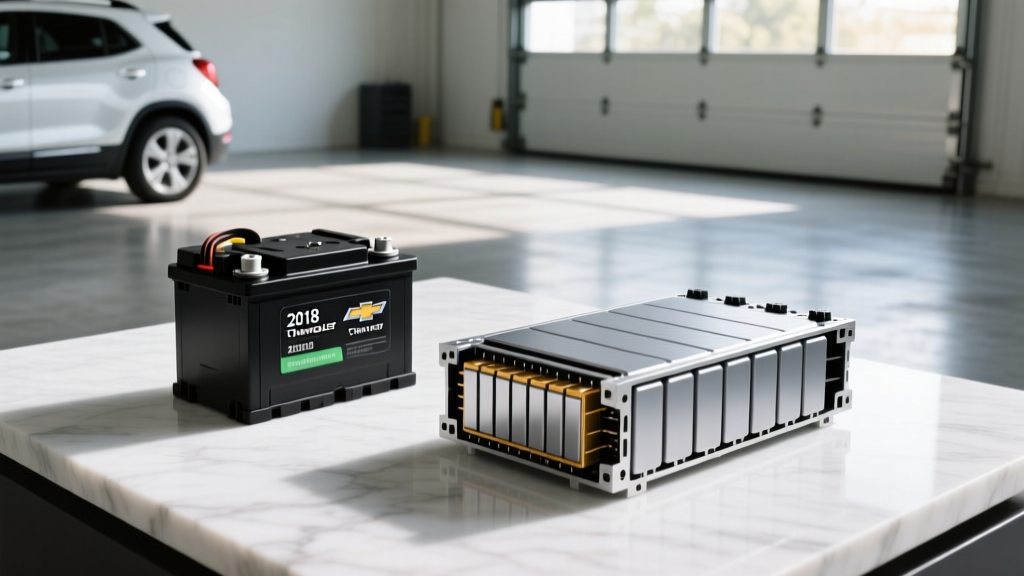
Unlike the 12V auxiliary battery that powers your EV's electronics and accessories, the high-voltage traction battery (typically 400V or 800V architecture) is the expensive, heavy, chemically complex pack that actually propels the vehicle. Understanding how that pack degrades, what accelerates wear, and how to monitor it is the difference between confident long-term ownership and expensive surprises.
This guide breaks down the chemistry, the real-world data, the warranty protections, and the daily habits that determine whether your EV battery lasts 100,000 miles or 300,000 miles.
LFP vs NMC/NCA: Chemistry Determines Your Degradation Curve
The single biggest predictor of long-term battery state of health is cell chemistry. In 2026, virtually every mainstream EV uses one of two lithium-ion variants:
| Attribute | LFP (Lithium Iron Phosphate) | NMC/NCA (Nickel Manganese Cobalt / Nickel Cobalt Aluminum) |
|---|---|---|
| Energy Density | Lower (~160 Wh/kg cell-level) | Higher (~250 Wh/kg cell-level) |
| Typical Cycle Life | 3,000-5,000+ full cycles | 1,000-2,000 full cycles |
| Calendar Aging | Slower; tolerates 100% SoC storage better | Faster at high SoC; prefers 80% daily limit |
| Cold-Weather Performance | Weaker below 32°F; greater range loss | Better low-temp discharge and regen acceptance |
| Cost | Lower — no cobalt or nickel | Higher — commodity-sensitive metals |
| SoC Estimation | Flat voltage curve makes % gauge less precise | Steeper voltage curve = more accurate dashboard readout |
| Common In (2026 Models) | Tesla Model 3/Y RWD, Ford Mustang Mach-E Select, Rivian Standard | Hyundai Ioniq 5/6, Chevy Equinox EV, BMW iX, most long-range trims |
The trade-off is straightforward: LFP packs sacrifice some range per kilogram but gain dramatically longer cycle life and more forgiving daily-use habits. NMC/NCA packs deliver more range in a lighter package but demand more careful charging discipline to maximize longevity.
If you're buying an EV you plan to keep past 150,000 miles and you have reliable home charging, LFP is increasingly the pragmatic choice. If you need maximum range in a single charge or live in a consistently cold climate, NMC/NCA still has the edge — provided you follow the care guidelines below.
Real-World Degradation Data: What Owners Actually See
Lab-tested cycle life is useful, but real-world battery state of health depends on a matrix of charging habits, climate, and mileage. Here's what aggregated fleet data and long-term owner reports show as of 2026:
Typical Capacity Retention Over Time (Fleet Averages):
- Year 1 / 15,000 miles: 95-98% SoH (initial "formation" loss is normal)
- Year 3 / 45,000 miles: 90-95% SoH
- Year 5 / 75,000 miles: 86-92% SoH
- Year 8 / 120,000 miles: 80-88% SoH (NMC); 88-94% SoH (LFP)
- Year 10 / 150,000 miles: 75-84% SoH (NMC); 85-92% SoH (LFP)
These numbers come with important caveats. Tesla's 2025 Impact Report cited fleet data showing Model 3/Y packs retaining roughly 85% capacity at 200,000 miles — but that average includes many LFP-equipped RWD vehicles. Geotab's multi-brand study of over 10,000 EVs found an average annual degradation of about 1.8% across all chemistries, with significant spread depending on climate and DC fast-charging frequency.
The key insight: degradation is non-linear. Most packs lose 2-5% in the first year (formation loss), then settle into a slow, steady decline of roughly 1-2% per year. A sudden drop in SoH after years of stability usually signals a defective module, not normal wear.
Battery Warranty Terms: Your Financial Safety Net
Federal law mandates that EV battery warranties cover at minimum 8 years or 100,000 miles (whichever comes first), with California Air Resources Board (CARB) states requiring 10 years or 150,000 miles. But the capacity-retention threshold — the SoH percentage at which the manufacturer must intervene — varies significantly:
| Manufacturer | Warranty Period | Capacity Threshold | What's Covered |
|---|---|---|---|
| Tesla (Model 3/Y) | 8 yr / 100,000 mi (120K for LR/AWD) | 70% SoH | Repair or replacement to ≥70% |
| Hyundai / Kia | 10 yr / 100,000 mi | 70% SoH | Repair or replacement |
| Ford | 8 yr / 100,000 mi | 70% SoH | Repair or replacement |
| GM (Chevy/Cadillac) | 8 yr / 100,000 mi | 60% SoH (some Ultium trims 70%) | Repair or replacement |
| Rivian | 8 yr / 120,000 mi (Max: 175K) | 70% SoH | Repair or replacement |
| BMW | 8 yr / 100,000 mi | 70% SoH | Module-level repair or full replacement |
A critical distinction: the warranty covers defects and abnormal degradation — not normal, gradual capacity loss above the threshold. If your battery drops to 72% SoH at year 7, you're covered. If it drops to 72% at year 9, you're likely paying out of pocket unless you're in a CARB state with the extended 10-year mandate.
Always check whether the warranty covers the full pack or allows module-level repair. Some manufacturers (BMW, Hyundai) will replace only the degraded modules rather than the entire pack, which is less disruptive but means your SoH post-repair may not return to 100%.
EV Battery Replacement Cost: The Numbers Behind the Fear
This is where misinformation runs rampant. Headlines cite $20,000 replacement costs without context. Here's the reality for out-of-warranty battery replacement in 2026:
| Vehicle / Pack Size | Battery Cost (Parts) | Labor | Total Estimate | When Typically Needed |
|---|---|---|---|---|
| Tesla Model 3 RWD (60 kWh LFP) | $8,000-$11,000 | $1,500-$2,500 | $9,500-$13,500 | Rarely before 200K+ mi |
| Hyundai Ioniq 5 (77.4 kWh NMC) | $12,000-$16,000 | $2,000-$3,000 | $14,000-$19,000 | Rarely before 150K-200K mi |
| Ford F-150 Lightning Ext. (131 kWh) | $18,000-$24,000 | $2,500-$4,000 | $20,500-$28,000 | Rarely before 150K mi |
| Chevy Equinox EV (85 kWh Ultium) | $11,000-$15,000 | $2,000-$3,000 | $13,000-$18,000 | Rarely before 150K-200K mi |
| Module-level repair (typical) | $2,000-$5,000 | $1,000-$2,000 | $3,000-$7,000 | As needed for isolated cell failure |
The context that matters: according to data from Geotab's fleet study, the vast majority of EV batteries outlast the vehicle itself. Fewer than 2% of EVs in their dataset required a full pack replacement outside of warranty claims. Most original owners sell or trade their EVs well before the battery reaches a critical degradation point. The fear of a $20,000 surprise bill is statistically overblown — but it's a real risk for high-mileage used-EV buyers who inherit a pack near the warranty threshold.
Prices are also trending downward. Battery pack costs fell below $130/kWh at the cell level in 2025 (per BloombergNEF), and continued LFP adoption plus manufacturing scale are pushing replacement costs lower each year.
Five Factors That Accelerate Battery Degradation
Your battery's state of health isn't just a function of age — it's a function of how you treat it. These five factors have the most measurable impact:
1. DC Fast-Charging Frequency
- Exclusive DC fast charging (150+ kW) can add 1-3% extra annual degradation vs. primarily Level 2 home charging.
- The heat generated at high charge rates stresses cell chemistry. Occasional road-trip fast charging is fine; daily reliance on it is not.
- Best practice: Use Level 2 (7-19 kW) for daily charging. Reserve DC fast charging for road trips.
2. State of Charge Habits
- NMC/NCA: Sustained storage at 100% SoC accelerates calendar aging. Set your daily charge limit to 80% and only charge to 100% when you need the full range for a trip.
- LFP: Manufacturers (including Tesla) recommend charging to 100% at least once per week because LFP's flat voltage curve needs a full charge for the BMS to recalibrate.
- Both chemistries: Avoid leaving the vehicle at 0% SoC for extended periods. If storing for weeks, set SoC to ~50%.
3. Extreme Temperatures
- Charging in sub-freezing temps without battery preconditioning can cause lithium plating — a permanent, irreversible form of degradation.
- Prolonged exposure to ambient heat above 95°F (especially at high SoC) accelerates electrolyte decomposition.
- Best practice: Always enable preconditioning before fast charging in cold weather. Park in shade or a garage during summer heat waves when possible.
4. Deep Discharge Cycles
- Regularly driving from 100% down to near 0% puts more mechanical stress on cells than shallow cycles (e.g., 70% to 30%).
- This matters more for NMC. LFP tolerates deep cycles significantly better.
5. High-Performance Driving and Towing
- Sustained high-current discharge (track use, heavy towing, repeated hard acceleration) generates internal heat that compounds degradation.
- Most modern thermal management systems handle this well, but it's a measurable factor for heavy-use owners.
How to Check and Monitor Your Battery State of Health
Most EVs don't display a simple "battery health percentage" on the dashboard the way your phone does. Here's how to actually monitor SoH in 2026:
Built-in vehicle tools:
- Tesla: The service menu (accessible via the software screen) shows battery health data. Third-party apps like Tessie or TeslaFi pull SoH estimates from the vehicle's API using charge/discharge logs.
- Hyundai/Kia: The infotainment EV diagnostics page shows a battery health indicator, though it's often simplified to "Good / Normal / Check." The OBD2 port provides more granular data.
- GM Ultium vehicles: The myChevrolet/myCadillac app includes a battery health check feature that estimates SoH based on recent charging behavior.
- BMW: The iDrive system includes a battery health report in the service menu, accessible through the ConnectedDrive app.
OBD2 diagnostic tools:
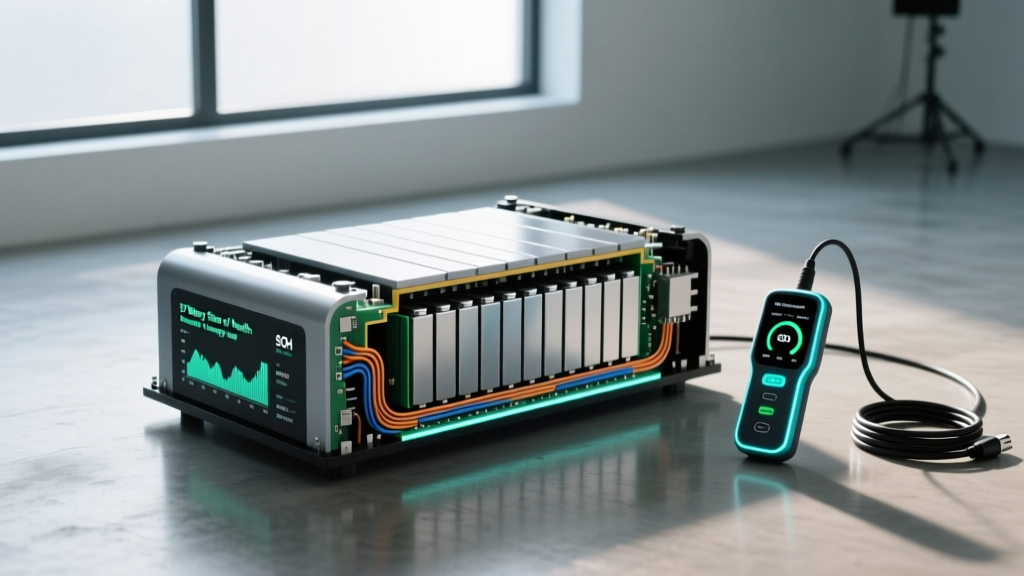
For more precise readings, an OBD2 dongle paired with apps like Car Scanner, ABRP (A Better Route Planner), or brand-specific tools can read the battery management system's internal SoH estimate. This is the method used by most independent EV inspectors and used-EV certification programs.
Manual calculation method:
Charge your EV to 100% (or a known SoC) and record the kWh delivered by your charger. Compare that to the pack's usable capacity. If your 77.4 kWh Ioniq 5 accepts only 68 kWh from 5% to 100%, your rough SoH is approximately 68 ÷ (77.4 × 0.95) = ~92.6%. This method isn't perfectly precise — charging losses and BMS buffer variations introduce a margin of error — but it's a reliable trend tracker over time.
Pre-purchase inspection: If you're buying a used EV, request a battery health report from the dealer or use a mobile EV inspection service. A Carfax or AutoCheck report won't tell you SoH — only an OBD2 scan or manufacturer diagnostic tool will.
Emerging Battery Technology: What's Next (And When)
The battery landscape is evolving, but timelines matter. Here's what's on the horizon — and what's still years away from your driveway:
Silicon-dominant anodes: Companies like Sila Nanotechnologies and Group14 are replacing graphite anodes with silicon composites, boosting energy density by 20-40%. Early deployments appeared in luxury and performance EVs in 2025-2026, but widespread adoption in mainstream models is expected around 2028-2030. These cells promise more range per kilogram but face cycle-life challenges that manufacturers are still resolving.
Solid-state batteries: The long-promised technology replaces the liquid electrolyte with a solid ceramic or polymer layer, offering potentially 2x energy density, faster charging, and improved safety. Toyota, Samsung SDI, and QuantumScape have all demonstrated prototype cells, but mass production at automotive scale remains the bottleneck. Realistic timeline for consumer vehicles: 2028-2032 for initial limited deployments, with mainstream availability likely post-2032.
Sodium-ion batteries: CATL and other Chinese manufacturers have begun deploying sodium-ion packs in lower-cost vehicles in China. These cells use abundant, cheap materials and perform well in cold weather, but offer significantly lower energy density than lithium-ion. US-market adoption is uncertain and likely limited to budget urban EVs or stationary storage applications.
What this means for today's buyers: current lithium-ion technology (both LFP and NMC) is mature, well-understood, and backed by robust warranty coverage. Waiting for solid-state is not a practical strategy if you need a vehicle now. The packs in 2026 model-year EVs are the best they've ever been, with degradation rates lower than vehicles sold just three years ago.
Frequently Asked Questions
How long do EV batteries actually last?
Most modern EV batteries are designed to last the life of the vehicle — typically 150,000 to 200,000+ miles before reaching 70-80% SoH. LFP-equipped vehicles routinely exceed 200,000 miles with minimal capacity loss. The federal warranty minimum is 8 years/100,000 miles, and many manufacturers exceed this. Full battery failure before 100,000 miles is rare and almost always covered under warranty.
How much does it cost to replace an EV battery?
Out-of-warranty full pack replacement ranges from roughly $9,500 for a Tesla Model 3 RWD (LFP) to $28,000 for a Ford F-150 Lightning Extended Range. Module-level repairs cost $3,000-$7,000. However, fewer than 2% of EVs require full pack replacement, and prices continue to decline as cell costs fall. Most EV batteries outlive the vehicle they're installed in.
What does the battery warranty actually cover?
EV battery warranties cover defects and abnormal degradation below a stated capacity threshold (typically 70% SoH for most brands, 60% for some GM trims) within the warranty period (8-10 years / 100,000-150,000 miles depending on brand and state). Normal gradual capacity loss above the threshold is not covered. CARB states (including California, New York, and others) mandate extended 10-year/150,000-mile coverage.
How do I check my battery state of health?
Methods vary by brand. Tesla owners can use the service menu or third-party apps like Tessie. Hyundai/Kia owners can check the infotainment diagnostics page or use an OBD2 tool. GM Ultium owners can use the myChevrolet app. For precise readings, an OBD2 dongle with apps like Car Scanner or ABRP pulls SoH data directly from the battery management system. You can also estimate SoH manually by comparing kWh accepted during a full charge to the pack's rated usable capacity.
Is LFP or NMC better for battery longevity?
For pure longevity and cycle life, LFP wins decisively — rated for 3,000-5,000+ full cycles vs. 1,000-2,000 for NMC. LFP also tolerates daily 100% charging better and degrades more slowly at high SoC. However, NMC offers higher energy density (more range per pound) and better cold-weather performance. Choose LFP if longevity and daily convenience are your priorities; choose NMC if you need maximum range or live in a cold climate.
Does fast charging damage my battery?
Occasional DC fast charging on road trips has a negligible effect on long-term SoH. However, exclusive reliance on DC fast charging (150+ kW) as your primary charging method can add 1-3% extra annual degradation due to sustained heat stress. Modern thermal management systems mitigate this significantly, but Level 2 home charging (7-19 kW) remains the gentlest option for daily use. Always precondition the battery before fast charging in cold weather to prevent lithium plating.
Should I be worried about buying a used EV with high mileage?
Not necessarily — if you do your homework. Request a battery health report via OBD2 scan before purchasing. A 100,000-mile EV with 88% SoH and remaining warranty coverage is often a better buy than a 30,000-mile EV that was frequently fast-charged and stored at 100% SoC. Check the Carfax for warranty service records, and verify whether the vehicle is in a CARB state (which extends warranty coverage to 10 years/150,000 miles).
For official warranty and emissions compliance details, consult the EPA's Green Vehicles resources and your manufacturer's warranty booklet. For federal tax credit implications on new and used EV purchases, review the current IRS §30D Clean Vehicle Credit guidelines.