When an electric vehicle powers on, a small but critical component clicks into place before a single electron flows from the high-voltage pack to the drive motors: the battery contactor — often colloquially called a battery solenoid. This heavy-duty relay is the gatekeeper between your traction battery and the rest of the vehicle's high-voltage system. If it fails, your EV won't drive. Yet most EV owners never think about it until something goes wrong.
This guide unpacks what the battery solenoid (contactor) actually does, how it fits into the broader battery management system, and then covers the questions every EV owner and buyer really cares about: how long the pack lasts, what degradation looks like in real data, what warranties actually cover, and what replacement costs in the rare event you need one.
What Is a Battery Solenoid (Contactor) in an EV?
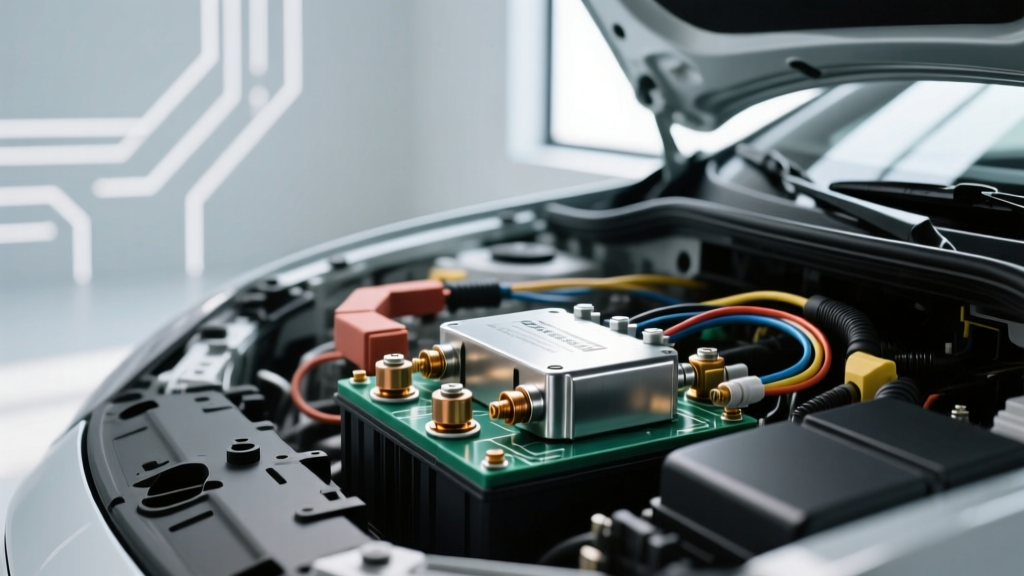
In automotive electrical systems, a solenoid is an electromechanical switch that uses a small current to control a much larger one. In conventional vehicles, you'll find a starter solenoid that bridges the 12V battery to the starter motor. In an EV, the equivalent component on the high-voltage side is more precisely called a contactor — though technicians, parts catalogs, and online forums frequently refer to it as a battery solenoid.
Modern EV battery packs typically contain two or more high-voltage contactors:
- Positive contactor — connects the positive terminal of the battery module array to the high-voltage bus.
- Negative contactor — connects the negative terminal, completing the circuit.
- Precharge contactor — a smaller relay paired with a precharge resistor that slowly energizes the inverter's DC-link capacitors before the main contactors close, preventing a damaging inrush current spike.
The Battery Management System (BMS) controls these contactors. If the BMS detects a fault — overcurrent, isolation loss, thermal runaway risk, or a collision signal from the vehicle's crash sensors — it opens the contactors in milliseconds, physically disconnecting the pack. This is why you sometimes hear a distinct click from beneath the floor when you start or shut down an EV.
Contactor failures are uncommon but not unheard of. Welded-shut contactors (where the internal contacts fuse together from arcing) are a known failure mode that can prevent the BMS from safely isolating the pack. Several manufacturer recalls over the years — including certain Hyundai Kona Electric and Chevrolet Bolt EV batches — have involved contactor or BMS-related issues rather than cell-level defects.
EV Battery Chemistry: LFP vs NMC vs NCA Trade-Offs
The contactor protects the pack, but the cells inside that pack determine your range, longevity, and charging behavior. As of 2026, two lithium-ion chemistries dominate the EV market: LFP (lithium iron phosphate) and NMC/NCA (nickel manganese cobalt / nickel cobalt aluminum). Understanding which chemistry your EV uses is essential for setting realistic expectations on degradation and daily charging habits.
| Attribute | LFP (LiFePO₄) | NMC / NCA |
|---|---|---|
| Energy Density | Lower (~160–180 Wh/kg cell-level) | Higher (~220–260 Wh/kg cell-level) |
| Cycle Life | 3,000–5,000+ cycles to 80% SoH | 1,000–2,000 cycles to 80% SoH |
| Cold-Weather Performance | Weaker; slower charge acceptance below 32°F (0°C) | Better low-temp conductivity and regen |
| Cost per kWh | Lower — no cobalt or nickel | Higher — tied to commodity nickel/cobalt pricing |
| Recommended Daily SoC | 100% daily is fine (no calendar stress penalty) | 80% daily; 100% only for trips |
| Typical Use (2026) | Tesla Model 3/Y RWD, Ford Mustang Mach-E Select, BYD models | Long-range/performance trims, most luxury EVs |
The trade-off is straightforward: LFP sacrifices energy density (meaning a heavier or physically larger pack for the same kWh) in exchange for dramatically longer cycle life and lower cost. NMC/NCA packs deliver more range per kilogram but degrade faster under high-SoC and high-temperature stress.
How Long Do EV Batteries Actually Last?
The short answer: almost certainly longer than most owners expect, and often longer than the vehicle's useful life. But "longer" needs numbers.
Typical degradation trajectory (NMC packs, liquid-cooled):
- Year 1 / 15,000 mi: ~2–4% capacity loss (initial "break-in" degradation)
- Year 3 / 45,000 mi: ~6–9% total loss
- Year 5 / 75,000 mi: ~8–12% total loss
- Year 8 / 120,000 mi: ~10–15% total loss
- Year 10+ / 150,000+ mi: ~12–20% total loss
LFP packs typically show a slower, more linear degradation curve. Tesla's 2025 Impact Report noted that Model 3/Y vehicles with LFP packs retained an average of 92% capacity at 100,000 miles, compared to roughly 88% for NMC-equipped long-range variants over the same distance.
Real-world fleet data from Recurrent Auto, which tracks over 15,000 EVs in daily use, shows that the vast majority of modern liquid-cooled packs retain above 85% of original capacity at 100,000 miles — well within warranty thresholds.
Worth noting: degradation is not linear. Most packs experience a steeper drop in the first 1–2 years (the so-called "knee" of initial SEI layer formation), then settle into a slow, nearly flat decline for many subsequent years. A second, steeper "knee" can appear at very high cycle counts (typically 2,000+ for NMC), but few consumer EVs reach that point before retirement.
Factors That Accelerate (or Preserve) Battery Health
Your battery's State of Health (SoH) isn't just a function of time and miles — how you use it matters enormously.
- Avoid sustained 100% SoC (NMC/NCA): Store and commute at 80% or below; reserve 100% for road trips. LFP owners can charge to 100% daily without concern.
- Minimize DC fast charging frequency: Occasional road-trip fast charging is fine. Daily 150+ kW DC sessions accelerate degradation — aim for Level 2 home charging as your routine.
- Precondition the battery before fast charging: Most EVs do this automatically when you navigate to a charger. A warm pack (ideally 70–95°F / 20–35°C) accepts charge faster and with less lithium plating risk.
- Avoid extreme SoC in extreme heat: A pack sitting at 100% SoC in 110°F Arizona summer is under maximum calendar-aging stress. If you must park in heat, set charge limit to 50–60%.
- Don't baby the pack too much: Modern BMS systems actively manage cell balancing, thermal limits, and charge buffers. The usable kWh is already less than the gross kWh — your car has built-in protection.
- Drive it: Regular cycling keeps cells balanced. Long-term storage at low SoC (below 20%) can cause copper dissolution in the anode current collector.
The single most impactful habit? Keeping an NMC pack between 20–80% SoC for daily use and relying on Level 2 home charging rather than daily DC fast charging. For LFP packs, the rules are simpler: charge to 100% regularly (the BMS needs full-charge events for accurate cell balancing) and don't worry much about the upper SoC limit.
Battery Warranties: What's Actually Covered?
Federal law mandates a minimum 8-year / 100,000-mile warranty on EV battery packs for emissions-related compliance, and every major automaker meets or exceeds this baseline. California and states adopting CARB standards push the requirement to 10 years / 150,000 miles for certain components.
| Manufacturer / Model | Warranty Term | Capacity Retention Threshold |
|---|---|---|
| Tesla Model 3/Y (LFP, RWD) | 8 yr / 100,000 mi | 70% |
| Tesla Model 3/Y (NMC, Long Range) | 8 yr / 120,000 mi | 70% |
| Hyundai Ioniq 5 / Ioniq 6 | 10 yr / 100,000 mi | 70% |
| Ford Mustang Mach-E | 8 yr / 100,000 mi | 70% |
| Chevrolet Equinox EV / Blazer EV | 8 yr / 100,000 mi | 60% (GM's stated threshold) |
| BMW i4 / iX | 8 yr / 100,000 mi | 70% |
| Rivian R1T / R1S | 8 yr / 175,000 mi | 70% |
Critical fine print: the warranty covers the pack dropping below the stated threshold, not any measurable degradation. A pack at 72% capacity at 95,000 miles — while noticeably degraded — is not a warranty claim for most brands. Also, warranties cover defects and abnormal degradation; they typically exclude damage from collisions, flooding, improper modifications, or using the vehicle as a stationary power source beyond manufacturer-approved V2H/V2L functionality.
If you suspect abnormal degradation, most dealerships can perform a BMS diagnostic read that reports SoH percentage. Some brands, like Tesla and Rivian, expose a version of this data through the vehicle's service menu or app.
EV Battery Replacement Cost: The Real Numbers
This is the question that generates the most anxiety — and the most misinformation. Here's what replacement actually costs when it's needed, which for most owners is never during their ownership.
| Vehicle | Pack Size (kWh, usable) | Estimated Replacement Cost |
|---|---|---|
| Tesla Model 3 RWD (LFP) | 57.5 kWh | $8,000 – $12,000 |
| Tesla Model Y Long Range (NMC) | 75 kWh | $12,000 – $16,000 |
| Hyundai Ioniq 5 (Long Range) | 77.4 kWh | $11,000 – $15,000 |
| Ford F-150 Lightning (Extended Range) | 131 kWh | $20,000 – $28,000 |
| Chevrolet Silverado EV | 200 kWh (max pack) | $30,000 – $40,000+ |
| Nissan Leaf (40 kWh pack, older) | 40 kWh | $6,500 – $9,000 |
These figures include the pack and labor at a dealership or authorized service center. Third-party EV repair shops and refurbished packs can reduce costs by 30–50%. It's also worth noting that module-level replacement is possible on some platforms — if only a subset of modules has degraded unevenly, a technician can swap individual modules rather than the entire pack, reducing cost substantially.
For context on how rarely this is needed: according to data analyzed by Consumer Reports, fewer than 5% of EVs on the road have required a full battery pack replacement outside of warranty, and many of those replacements involved early-generation packs (pre-2018) with passive air cooling rather than modern liquid-cooled systems.
Checking Your Battery's State of Health (SoH)
Unlike a gas car's compression test, you can't easily measure battery health with a $20 tool. But you have options:
- Dealership BMS diagnostic: Any authorized service center can pull a State of Health report showing remaining capacity as a percentage of original. Ask for this during routine service visits.
- Onboard telemetry (select brands): Tesla's service mode (accessible via a hidden menu in newer software versions) displays pack SoH. Hyundai/Kia's EV diagnostic screen shows similar data. Rivian's service team can remote-diagnose pack health via cellular telemetry.
- OBD-II dongles + apps: Devices like the OBDLink SX paired with apps such as LeafSpy (Nissan Leaf), Scan My Tesla, or ABRP's OBD integration can read cell-level voltage, pack temperature, and estimated SoH from the BMS CAN bus.
- Manual tracking: Charge to a known SoC (e.g., 100% for LFP, or a consistent 90% for NMC), then drive a measured route and note the energy consumed (kWh) from the trip computer. Compare to the pack's original usable capacity. Repeating this quarterly gives you a reliable trend line.
If your SoH drops below the warranty threshold before the time/mileage limit, document it with a timestamped dealer diagnostic report and file a warranty claim promptly.
Looking Ahead: Solid-State and Silicon-Anode Batteries
Next-generation battery technologies are frequently hyped, so here's a grounded timeline based on confirmed manufacturer announcements and production realities as of 2026:
- Silicon-dominant anode cells: Already in limited production. Tesla's 4680 cells use a silicon-composite anode, and companies like Sila Nanotechnologies supply silicon anode materials to Panasonic. Expect incremental energy-density gains (10–20% over graphite anodes) rolling into mainstream EVs through 2028.
- Semi-solid-state batteries: NIO's 150 kWh semi-solid pack (in limited deployment in China since 2024) demonstrates the concept — a hybrid electrolyte that improves safety and energy density but doesn't fully eliminate liquid components. U.S.-market availability remains limited and expensive.
- True solid-state batteries: Toyota has announced a 2027–2028 production target for solid-state EVs with ~470-mile range and 10-minute fast charging. Samsung SDI and QuantumScape are targeting similar timelines. However, manufacturing scale-up, cost parity, and cycle-life validation remain unproven at volume. Realistic mass-market availability: 2029–2032 at the earliest.
None of these technologies change the contactor/solenoid architecture — the high-voltage safety gatekeeping function remains regardless of cell chemistry. What will change is energy density, charge speed, and potentially the overall cost-per-kWh of replacement packs.
Frequently Asked Questions
Is the battery solenoid the same as the 12V battery?
No. The battery solenoid (contactor) is part of the high-voltage traction battery system — typically 400V or 800V — that powers the drive motors. The 12V auxiliary battery is a separate, conventional lead-acid or lithium 12V battery that runs the vehicle's computers, lights, infotainment, and — critically — provides the low-voltage signal that tells the BMS to close the high-voltage contactors. If your 12V battery dies, the contactors can't engage and the car won't start, even if the main traction pack is fully charged.
How long do EV batteries last in years and miles?
Modern liquid-cooled EV batteries (2020+ production) typically retain 80–90% of original capacity at 100,000 miles and 8–10 years of use. LFP chemistries generally outlast NMC in cycle life. Most packs will outlive the vehicle's economic lifespan. Full pack replacement before 150,000 miles is rare for current-generation EVs.
What does the battery warranty actually cover?
Battery warranties guarantee that the pack will retain a minimum percentage of original capacity (typically 70%) for a defined period (typically 8 years / 100,000 miles). If SoH drops below that threshold within the warranty window, the manufacturer will repair or replace the pack at no cost. Warranties do not cover physical damage, improper use, or normal gradual degradation above the threshold.
How much does it cost to replace an EV battery?
Replacement costs range from roughly $6,500 for a smaller pack (e.g., Nissan Leaf 40 kWh) to $30,000+ for the largest packs (e.g., Chevrolet Silverado EV 200 kWh). Most mainstream EVs (60–80 kWh packs) fall in the $10,000–$16,000 range including labor. However, fewer than 5% of modern EVs require out-of-warranty pack replacement, and module-level repairs can reduce costs significantly.
LFP vs NMC — which battery chemistry should I choose?
Choose LFP if you prioritize longevity, lower cost, and the convenience of daily 100% charging, and you can accept slightly less range for a given pack weight. Choose NMC/NCA if you need maximum range per charge, better cold-weather performance, or you're buying a performance-oriented trim. Both chemistries will comfortably outlast typical ownership periods with proper care.
Can I check my EV battery health myself?
Yes, with caveats. Some vehicles expose SoH data through hidden service menus or apps. An OBD-II adapter with EV-compatible software (LeafSpy, Scan My Tesla, etc.) can read BMS data on many models. For a definitive reading, request a BMS diagnostic report from your dealership — this is the documentation you'll need for any warranty claim.