If you're searching for information on how to find a battery for my car — specifically the high-voltage traction battery that powers an electric vehicle — you're likely either planning a long-term ownership strategy, evaluating a used EV purchase, or facing an out-of-warranty replacement scenario. The good news: most EV owners will never need to replace their traction battery. But understanding what's inside your pack, how it degrades, what the warranty actually covers, and what a replacement costs is essential for any current or prospective EV owner.
This guide covers everything from lithium iron phosphate (LFP) versus nickel manganese cobalt (NMC) chemistry trade-offs, to real-world degradation curves, to the practical steps you can take to maximize your battery's lifespan. We'll also look at emerging solid-state technology and when it might actually reach production vehicles.
LFP vs NMC/NCA: Which Battery Chemistry Is Right for Your EV?
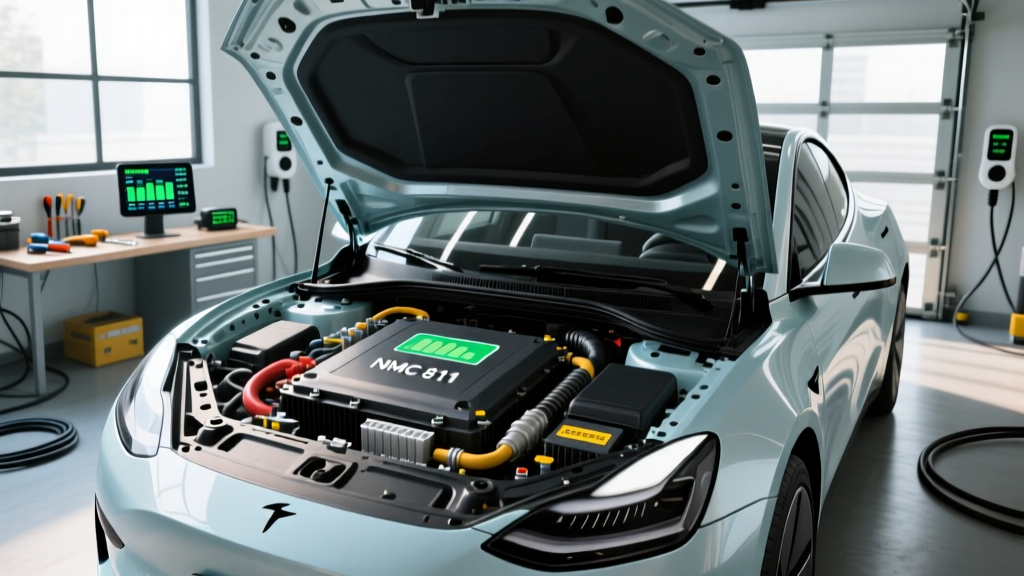
Not all EV batteries are created equal. The two dominant chemistries in the 2025-2026 EV market are LFP (lithium iron phosphate) and NMC (nickel manganese cobalt) / NCA (nickel cobalt aluminum). Each has distinct trade-offs that affect range, longevity, cold-weather performance, and price.
| Attribute | LFP (Lithium Iron Phosphate) | NMC / NCA |
|---|---|---|
| Energy Density | Lower (~160-180 Wh/kg cell-level) | Higher (~220-280 Wh/kg cell-level) |
| Typical Range Impact | Slightly shorter range for same pack weight | Longer range per kg of battery |
| Cycle Life | 3,000-5,000+ full cycles | 1,000-2,000 full cycles |
| Cold-Weather Performance | More range loss below freezing (~30-40%) | Better cold performance (~20-30% loss) |
| Charging to 100% Regularly | Recommended — no degradation penalty | Not recommended — accelerates wear above 80% |
| Cost per kWh | Lower (~$80-100/kWh pack-level) | Higher (~$110-140/kWh pack-level) |
| Thermal Stability | Excellent — less prone to thermal runaway | Good but requires more active cooling |
| Common In (2025-2026) | Tesla Model 3/Y RWD, BYD models, Ford Mustang Mach-E Select | Hyundai Ioniq 5/6, Kia EV6/EV9, Tesla Long Range, Rivian, GM Ultium |
Which is better? It depends on your use case. If you prioritize maximum cycle life, lower cost, and plan to charge to 100% daily (e.g., for a commute-heavy routine), LFP is the pragmatic choice. If you need maximum range per charge and regularly drive in cold climates, NMC/NCA packs deliver higher energy density and better winter efficiency. Neither is universally superior — the chemistry choice should match your driving pattern.
How Long Do EV Batteries Actually Last?
The question "how long do EV batteries last?" comes up constantly, and the answer is more reassuring than most buyers expect. Based on aggregated fleet data and long-term owner reports, most modern EV traction batteries retain 85-95% of their original capacity after 100,000 miles, and many packs are designed to outlast the vehicle itself.
Typical EV Battery Degradation Curve (NMC, liquid-cooled packs):
- Year 1 / 15,000 mi: ~2-4% capacity loss (initial formation loss)
- Year 3 / 45,000 mi: ~5-7% total loss
- Year 5 / 75,000 mi: ~7-10% total loss
- Year 8 / 120,000 mi: ~10-15% total loss
- Year 10+ / 150,000+ mi: ~12-20% total loss (varies heavily by usage)
Sources: Recurrent Auto fleet data (2024-2025), Tesla Impact Reports, Geotab long-term EV battery study. LFP packs typically show even slower degradation curves.
Key takeaway: a 2025 Hyundai Ioniq 5 with an EPA-rated 303-mile range and a 77.4 kWh usable NMC battery might realistically deliver ~265-280 miles at 100,000 miles of age. That's a noticeable but manageable reduction, not a cliff. The degradation curve flattens significantly after the initial 2-3 years — it's not a linear decline.
According to data from fueleconomy.gov and manufacturer filings, battery failure rates in the first 8 years are well below 1% for most major manufacturers. Catastrophic pack failure (sudden, total loss) is extremely rare in liquid-cooled systems.
What Does the EV Battery Warranty Actually Cover?
Federal law in the United States mandates that EV batteries carry a minimum warranty of 8 years or 100,000 miles (whichever comes first). In California Air Resources Board (CARB) states, that extends to 10 years or 150,000 miles. Most manufacturers meet or exceed these minimums.
| Manufacturer | Warranty Term | Capacity Retention Threshold | Notes |
|---|---|---|---|
| Tesla (Model 3/Y RWD - LFP) | 8 yr / 100,000 mi | 70% minimum | LFP pack; CARB states get 8yr/120k |
| Tesla (Long Range/Performance) | 8 yr / 120,000 mi | 70% minimum | NMC/NCA pack |
| Hyundai / Kia (E-GMP) | 10 yr / 100,000 mi | 70% minimum | Among the longest terms |
| GM (Ultium-based) | 8 yr / 100,000 mi | 70% minimum (60% for some commercial) | Module-level replacement possible |
| Ford (Mach-E, F-150 Lightning) | 8 yr / 100,000 mi | 70% minimum | LFP option on select trims |
| Rivian (R1T/R1S) | 8 yr / 175,000 mi | 70% minimum | Higher mileage threshold |
| BMW (iX, i4, i7) | 8 yr / 100,000 mi | 70% minimum | Cell module service available |
What the warranty covers: If your battery's State of Health (SoH) drops below the stated threshold (typically 70% of original capacity) within the warranty period, the manufacturer will repair or replace the pack at no cost. Some manufacturers, like GM and BMW, can replace individual modules rather than the entire pack, reducing waste and downtime.
What it doesn't cover: Damage from accidents, flooding, improper modifications, or use outside manufacturer specifications (e.g., repeated exposure to extreme conditions against guidance). Normal degradation above the threshold is also not covered — a battery at 72% SoH at year 7 is functioning within warranty terms, even though range is noticeably reduced.
How Much Does It Cost to Replace an EV Battery?
This is the question that generates the most anxiety, and it deserves a data-grounded answer rather than fear-driven headlines. Yes, EV battery replacement is expensive — but the context matters enormously.
| Vehicle | Battery Size (usable kWh) | Chemistry | Estimated Replacement Cost | When Typically Needed |
|---|---|---|---|---|
| Tesla Model 3 RWD | 57.5 kWh | LFP | $7,000 - $10,000 | Rarely before 200,000+ mi |
| Tesla Model Y Long Range | 75 kWh | NMC | $10,000 - $14,000 | Rarely before 180,000+ mi |
| Hyundai Ioniq 5 | 77.4 kWh | NMC | $9,000 - $13,000 | Rarely before 175,000+ mi |
| Ford F-150 Lightning Ext. Range | 131 kWh | NMC | $18,000 - $25,000+ | Rarely before 150,000+ mi |
| Chevrolet Equinox EV | 85 kWh | NMC (Ultium) | $10,000 - $15,000 | Rarely before 175,000+ mi |
| Rivian R1T (Large Pack) | 128.9 kWh | NMC | $18,000 - $24,000 | Rarely before 175,000+ mi |
| Nissan Leaf (40 kWh) | 40 kWh | NMC (passive air-cooled) | $6,500 - $9,000 | May need replacement at 100,000-130,000 mi |
Critical context: The Nissan Leaf is a cautionary example — its passively air-cooled battery degrades faster than liquid-cooled packs, and some owners have needed replacements within 8-10 years. In contrast, liquid-cooled packs from Tesla, Hyundai/Kia, GM, and Ford are showing degradation rates that suggest most will retain 70%+ capacity well past 150,000 miles.
Most EV owners sell or trade their vehicles before a battery replacement is ever needed. For those who keep their EVs 10+ years, the replacement cost is a real consideration — but it should be weighed against a decade of fuel and maintenance savings. A 2025 EV owner saving ~$1,500-$2,000/year on fuel versus a comparable ICE vehicle will have recouped the replacement cost multiple times over before it's needed.
According to the IRS §30D guidelines, a new battery replacement may qualify for certain tax considerations if it's part of a vehicle that meets clean vehicle credit requirements, though this is a nuanced area best discussed with a tax professional.
What Factors Affect EV Battery Life — and How to Maximize It
Battery degradation isn't just a function of time and miles. Your charging habits, climate, and driving style all influence how quickly your pack loses capacity. Here's a practical checklist for maximizing battery longevity:
- Avoid frequent DC fast charging above 150 kW when possible. Occasional road-trip fast charging is fine, but daily use of 250-350 kW chargers accelerates degradation. Level 2 home charging (7-11 kW) is the gentlest method.
- Keep State of Charge between 20-80% for NMC/NCA packs. Daily charging to 100% stresses NMC chemistry. Set your charge limit to 80% for daily use and only charge to 100% before long trips. (LFP packs are the exception — manufacturers recommend periodic 100% charges for calibration.)
- Precondition your battery before fast charging. Most EVs do this automatically when you navigate to a charger, but in cold weather, allowing the pack to warm up before accepting a high-power charge reduces stress.
- Minimize prolonged storage at extreme SoC levels. Don't leave your EV sitting at 100% or below 10% for weeks. If storing for an extended period, aim for ~50% SoC.
- Park in shade or a garage during extreme heat. Sustained battery temperatures above 104°F (40°C) accelerate degradation. Liquid-cooled packs manage this better, but ambient heat still matters.
- Use regenerative braking moderately in extreme cold. High regen forces can stress a cold battery. Many EVs automatically reduce regen when the pack is cold — let the system manage this.
- Keep your EV's software updated. Manufacturers regularly refine battery management system (BMS) algorithms to optimize thermal management and charging profiles.
How to Check Your EV Battery's State of Health (SoH)
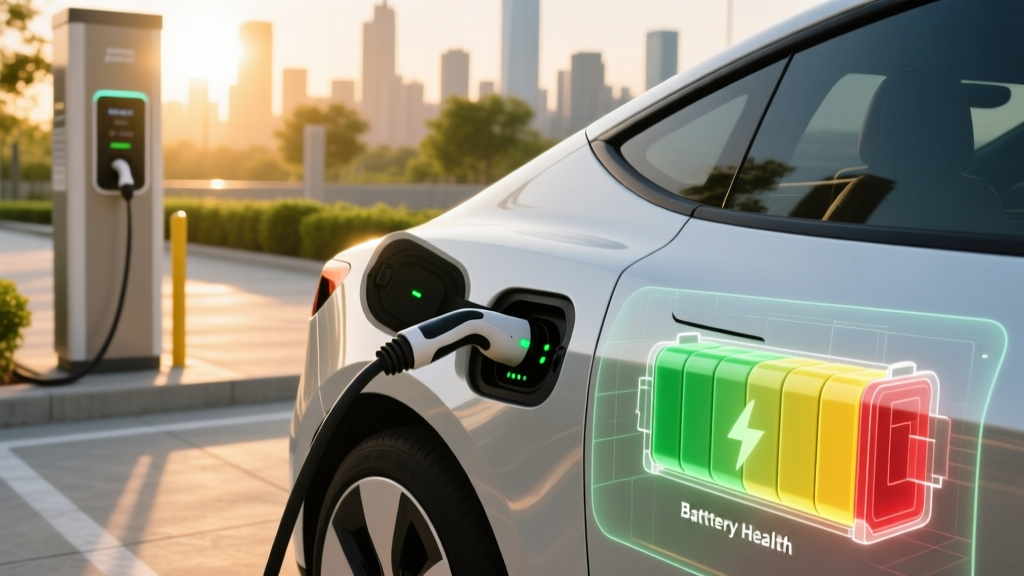
State of Health (SoH) is the metric that tells you how much of your battery's original capacity remains. A new battery is at 100% SoH; one that has degraded to hold only 85% of its original energy is at 85% SoH.
How to check SoH by brand:
- Tesla: The vehicle doesn't display SoH directly in the UI, but you can estimate it by charging to 100% and comparing the displayed range to the original EPA rating. Third-party apps like Tessie or the TeslaFi log can provide more granular SoH estimates based on energy throughput.
- Hyundai/Kia: Some models display battery health percentage in the EV settings menu. The Hyundai Bluelink / Kia Connect app may also show SoH data.
- GM (Ultium): The myChevrolet/myCadillac app and in-vehicle diagnostics can provide battery condition reports.
- Ford: The FordPass app includes a battery health indicator. Dealership service departments can run a full diagnostic.
- Any EV at a dealership: Service departments have diagnostic tools that read the BMS directly and can provide an official SoH report. Request this when buying a used EV.
- OBD-II scanners and third-party tools: Devices like the OBDeleven or apps that interface with the vehicle's CAN bus can often read battery health data, though accuracy varies.
For used-EV buyers, a pre-purchase battery health check is as important as a compression test was for gas cars. If the SoH is below 80% and the vehicle is still under warranty, you may have grounds for a warranty claim. If it's out of warranty, factor the reduced range into your purchase negotiation.
Emerging Battery Tech: Solid-State, Silicon Anodes, and What's Realistic
The battery technology landscape is evolving rapidly, but it's important to separate laboratory milestones from production-ready reality.
Solid-state batteries replace the liquid electrolyte with a solid material, promising higher energy density (~350-500 Wh/kg cell-level), faster charging, and improved safety. Toyota has announced plans for a solid-state-equipped EV with a targeted 750+ km (WLTP) range by 2027-2028. Samsung SDI and QuantumScape are also advancing solid-state prototypes. However, manufacturing scale-up, cost reduction, and cycle-life validation remain significant hurdles. Realistic mass-market availability: 2028-2032.
Silicon-dominant anodes (replacing graphite) can increase energy density by 20-40%. Companies like Sila Nanotechnologies and Group14 are supplying silicon anode materials to battery manufacturers. Expect incremental adoption in premium EVs starting 2026-2028, with broader availability by 2030.
Sodium-ion batteries use abundant sodium instead of lithium, offering lower cost and excellent cold-weather performance at the expense of energy density. CATL and BYD are producing sodium-ion cells for smaller, lower-range EVs in China. US-market availability in passenger vehicles is not expected before 2027-2029.
None of these technologies are available in production vehicles sold in the US as of early 2026. If you're buying today, LFP and NMC remain your proven, well-understood options — and both are excellent.
How to Find a Replacement Battery for Your Specific EV
If you've determined that your EV's battery needs replacement (confirmed by a dealership diagnostic or SoH reading below the warranty threshold), here's the practical path forward:
- Check warranty status first. Pull your vehicle's in-service date and current mileage. If you're within 8 years/100,000 miles (or 10/150,000 in CARB states), contact the manufacturer's service department for a warranty evaluation.
- Dealership replacement. OEM replacement through an authorized dealer ensures compatibility and typically includes a new warranty on the replacement pack (often 1-3 years). This is the most expensive but most reliable route.
- Independent EV specialists. A growing network of independent shops (e.g., Electrified Garage, EV-specific service centers) can source refurbished or new packs at lower labor rates. Ensure they use OEM or certified-remanufactured modules.
- Refurbished/remanufactured packs. Some companies offer packs built from tested, graded cells recovered from salvaged EVs. These can cost 30-50% less than new OEM packs. Verify the warranty and cell grading standards before purchasing.
- Module-level replacement. If only specific cell modules have degraded or failed, some manufacturers (GM, BMW, Tesla) support replacing individual modules rather than the full pack. This can reduce cost to $1,500-$4,000 per module.
When searching for a replacement, always match the exact battery part number for your model year and trim. Battery specs can change between model years even within the same vehicle line — a 2023 Ioniq 5 pack is not necessarily identical to a 2025 Ioniq 5 pack.
How long do EV batteries last in years and miles?
Most modern liquid-cooled EV batteries retain 85-95% of their original capacity at 100,000 miles and 70-85% at 150,000-200,000 miles. In years, that translates to reliable service for 12-20 years under normal use. LFP packs often exceed these figures. Passively cooled packs (like older Nissan Leaf models) degrade faster and may need attention sooner.
How much does an EV battery cost to replace?
Replacement costs range from roughly $7,000 for smaller packs (Tesla Model 3 RWD LFP) to $25,000+ for large packs (Ford F-150 Lightning Extended Range, Rivian R1T Large Pack). The typical mid-size SUV or sedan with a 75-85 kWh pack falls in the $9,000-$15,000 range for parts and labor. Module-level repairs can cost significantly less.
What does the EV battery warranty cover?
Federal minimum is 8 years/100,000 miles (10/150,000 in CARB states). Coverage triggers when capacity drops below a stated threshold — typically 70% of original capacity. The warranty covers defects and abnormal degradation, not damage from accidents, modifications, or environmental events. Some manufacturers extend coverage or offer higher mileage thresholds (Rivian: 8yr/175,000 mi).
How do I check and maximize my EV battery health?
Check SoH through your vehicle's app, in-vehicle diagnostics, or a dealership service scan. Maximize longevity by favoring Level 2 home charging over frequent DC fast charging, keeping NMC packs between 20-80% SoC for daily use (LFP packs can be charged to 100%), preconditioning before fast charges, avoiding prolonged storage at extreme SoC levels, and parking in moderate temperatures when possible.
LFP vs NMC — which is better for my EV?
LFP excels in cycle life (3,000-5,000+ cycles), cost, and thermal safety, and can be charged to 100% daily without degradation concerns. NMC delivers higher energy density (more range per kg) and better cold-weather performance. Choose LFP if you prioritize longevity, lower cost, and daily full charges. Choose NMC if you need maximum range and drive frequently in cold climates. Both are proven, reliable chemistries.
Can I upgrade my EV to a larger or newer battery?
In most cases, no. EV battery packs are engineered for specific vehicle platforms, and swapping to a different capacity or chemistry is generally not supported by manufacturers. Some older vehicles (like the Nissan Leaf) have aftermarket upgrade paths, but these are exceptions. For most EVs, you're committed to the original pack specification.