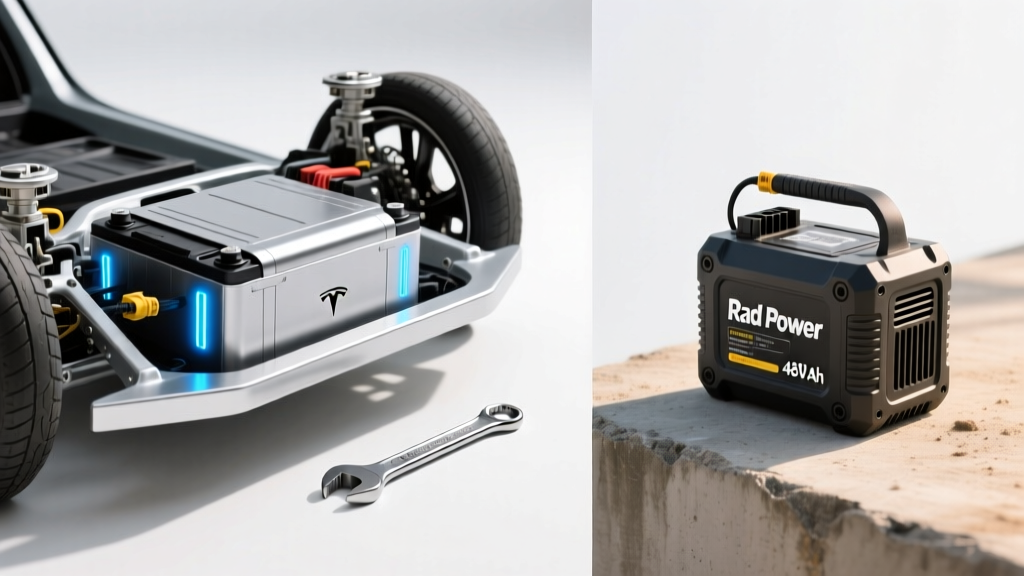
If you've searched for a Rad Power Bike battery replacement, you've likely seen prices around $549–$799 for a 48V, 14 Ah (672 Wh) lithium-ion pack. That's a real expense for an e-bike owner — but it also raises a much bigger question for anyone considering an electric vehicle: what happens when an EV's traction battery needs replacing?
The short answer is that EV battery replacement is dramatically more expensive than swapping an e-bike battery, but it's also dramatically less likely to be needed during typical ownership. This guide breaks down the chemistry, degradation data, warranty protections, and real replacement costs for EV traction batteries in 2026 — with e-bike battery pricing as a reference point.
LFP vs NMC/NCA: The Chemistry Trade-Off That Determines Battery Life
Every EV battery uses one of two dominant lithium-ion chemistries: LFP (lithium iron phosphate) or NMC/NCA (nickel manganese cobalt / nickel cobalt aluminum). The chemistry choice affects energy density, cycle life, cold-weather performance, and ultimately how long the pack lasts before degradation becomes noticeable.
| Attribute | LFP (Lithium Iron Phosphate) | NMC / NCA (Nickel-based) |
|---|---|---|
| Energy Density | Lower (~160 Wh/kg cell-level) | Higher (~220–260 Wh/kg cell-level) |
| Cycle Life | 3,000–5,000+ cycles to 80% SoH | 1,000–2,000 cycles to 80% SoH |
| Cold Performance | Weaker below 32°F; slower charging | Better low-temp discharge and charge acceptance |
| Cost (per kWh) | Lower — no cobalt or nickel | Higher — commodity-sensitive metals |
| Thermal Stability | Excellent — less prone to thermal runaway | Good, but requires more active management |
| Typical Use in 2026 | Tesla Model 3/Y RWD, Ford Mustang Mach-E Select, many Chinese-market EVs | Long-range AWD trims, Hyundai Ioniq 5/6, Rivian, GM Ultium platforms |
Which is better? It depends on your use case. If you prioritize longevity and can charge at home nightly (LFP packs tolerate 100% daily SoC better), LFP is the durability winner. If you need maximum range in a lighter package and regularly drive in cold climates, NMC/NCA delivers better real-world winter performance. Most e-bike batteries, including Rad Power's replacements, use NMC cells for weight savings — which is why their cycle life tends to be shorter than an LFP-equipped EV.
How Long Do EV Batteries Actually Last? Degradation Data
The fear that EV batteries "wear out like phone batteries" is the single biggest misconception in electrified ownership. Real-world fleet data tells a different story.
Observed Degradation Benchmarks (fleet averages):
- Tesla Model 3/Y (NMC & LFP): ~5–8% capacity loss at 100,000 miles; ~10–12% at 200,000 miles. Tesla's 2025 Impact Report cites an average of 85% retained capacity at 200,000 miles across the fleet.
- Hyundai/Kia E-GMP platform (Ioniq 5, EV6): ~6–9% loss at 100,000 miles based on owner-reported data from EV forums and fueleconomy.gov tracking.
- Chevrolet Bolt EV/EUV (NMC): ~8–10% at 80,000 miles; many packs reach 150,000+ miles before hitting 70% SoH — the typical warranty threshold.
- Nissan Leaf (passive-air-cooled, older NMC): Higher degradation — 15–25% loss by 80,000 miles in hot climates. This is the outlier that fueled early battery-fear narratives.
- Rad Power Bike battery (e-bike reference): Rated for ~800 full charge cycles to 80% capacity. At daily use, that's roughly 2–3 years of heavy riding before noticeable range loss.
For context, the average US driver covers ~13,500 miles per year (FHWA data). At that rate, a modern liquid-cooled EV battery should retain 85–90% of its original capacity after 10 years and 135,000 miles. Most packs will outlast the vehicle's body and interior.
Battery Warranty Terms: What's Actually Covered
Federal law mandates a minimum 8-year / 100,000-mile warranty on EV battery packs for emissions-related compliance, and nearly every manufacturer matches or exceeds this. Here's how major brands structure coverage in 2026:
| Manufacturer | Warranty Period | Capacity Retention Threshold | Notes |
|---|---|---|---|
| Tesla (Model 3/Y RWD — LFP) | 8 yr / 120,000 mi | 70% | LFP packs may degrade faster initially then plateau |
| Tesla (Long Range/Performance — NMC) | 8 yr / 120,000 mi | 70% | |
| Hyundai / Kia (E-GMP) | 10 yr / 100,000 mi | 70% | Among the longest coverage in the industry |
| GM (Ultium — Equinox EV, Blazer EV) | 8 yr / 100,000 mi | 70% | Modular pack allows partial replacement |
| Ford (Mach-E, F-150 Lightning) | 8 yr / 100,000 mi | 70% | |
| Rivian (R1T, R1S) | 8 yr / 175,000 mi | 70% | Highest mileage threshold |
| Rad Power Bike (e-bike) | 1 year limited | N/A — defect-based | No capacity retention guarantee |
Key detail: The 70% threshold means the manufacturer replaces or repairs the battery only if it falls below 70% of original capacity within the warranty window. A pack at 72% SoH is still "in spec," even though you'll notice ~28% less range than new. In practice, very few liquid-cooled packs breach this threshold within the warranty period.
EV Battery Replacement Cost: What You'll Actually Pay
When a battery does need replacement — typically at 150,000–250,000+ miles for modern packs, or after a physical damage event — the cost is significant. Here's the current landscape:
| Vehicle / Battery Size | Chemistry | Replacement Cost (Parts + Labor) | Typical Replacement Trigger |
|---|---|---|---|
| Tesla Model 3 RWD (~60 kWh) | LFP | $12,000–$16,000 | 200,000+ mi or collision damage |
| Tesla Model Y LR (~75 kWh) | NMC | $14,000–$20,000 | 200,000+ mi |
| Hyundai Ioniq 5 (~77.4 kWh) | NMC | $15,000–$22,000 | 180,000+ mi; modular repair may reduce cost |
| Ford F-150 Lightning Ext. Range (~131 kWh) | NMC | $25,000–$35,000 | 200,000+ mi; largest consumer pack on market |
| Chevrolet Bolt EV (~65 kWh) | NMC | $14,000–$18,000 | Recall-replaced packs now under updated warranty |
| Nissan Leaf (40–62 kWh) | NMC (passive cooling) | $8,000–$12,000 (refurbished) | 100,000+ mi in hot climates |
| Rad Power Bike (672 Wh / 0.672 kWh) | NMC | $549–$799 | 800–1,200 charge cycles (~2–4 years) |
The per-kWh cost for EV traction batteries has fallen from ~$1,100/kWh in 2010 to roughly $125–$140/kWh at the cell level in 2026 (BloombergNEF tracking), but pack-level replacement includes labor, BMS reprogramming, coolant flush, and dealer markup — pushing installed cost to $200–$350/kWh depending on the vehicle.
The critical context: Most EV batteries never need replacement during original ownership. A 2025 study by Recurrent Auto found that only ~1.5% of EVs required battery replacement within the first 10 years, and the vast majority of those were covered under warranty. A Rad Power Bike battery, by contrast, will almost certainly need replacement within 3–5 years of regular use — the cost is lower, but the frequency is higher.
Factors That Accelerate (or Preserve) Battery Health
Battery degradation isn't purely a function of time — how you charge, discharge, and store the vehicle matters enormously. Here's what moves the needle:
Maximize Battery Longevity:
- Limit DC fast charging frequency. Occasional road-trip fast charging is fine, but daily 150+ kW sessions accelerate degradation by ~1–2% per year vs. Level 2 home charging. The heat generated at high C-rates stresses cell chemistry.
- Avoid extreme State of Charge (SoC) storage. For NMC packs, storing at 100% SoC for days (especially in heat) accelerates calendar aging. Aim for 80% daily, 100% only before long trips. LFP packs are an exception — Tesla and Ford recommend periodic 100% charges for BMS calibration.
- Use preconditioning. Preconditioning warms the battery before fast charging or hard driving in cold weather, reducing lithium plating risk and improving charge acceptance. Most EVs do this automatically when you navigate to a charger.
- Park in shade or a garage in hot climates. Sustained battery temperatures above 95°F accelerate calendar degradation. Liquid cooling mitigates this, but it doesn't eliminate it.
- Don't let the pack sit at 0% SoC. Deep discharge can trip the BMS into a protective sleep mode that requires dealer intervention. Keep it above 10% if storing.
- Moderate regen settings in extreme cold. Aggressive regen on a freezing-cold battery can cause lithium plating on the anode. Most EVs limit regen automatically, but it's worth understanding why.
How to Check Your Battery's State of Health (SoH)
State of Health (SoH) is the percentage of original capacity your battery can still hold. A new pack is 100% SoH; a degraded pack at 85% SoH holds 85% of its original kWh. Here's how to monitor it:
- In-vehicle displays: Tesla shows battery health via the service menu (available since 2024 software updates). Hyundai/Kia displays SoH through the diagnostic screen. GM's Ultium vehicles show estimated range vs. original, which you can convert to an SoH proxy.
- OBD-II dongles + apps: Tools like OBDeleven (VW/Hyundai/Kia) or Scan My Tesla pull BMS data directly, including pack voltage, cell imbalance, and SoH percentage. This is the most accurate consumer-accessible method.
- Third-party services: Companies like Recurrent Auto provide battery health reports by analyzing your telematics data over time — useful for resale documentation.
- Manual calculation: Charge to 100%, note the displayed range, and compare to the original EPA sticker. A Model 3 that originally showed 358 miles at 100% and now shows 315 miles is at roughly 88% SoH (accounting for temperature and BMS calibration variance).
For e-bike owners: Rad Power Bikes does not provide a built-in SoH readout. You can estimate it by fully charging and measuring actual range vs. the original rated range, or by using a multimeter to check resting voltage against the manufacturer's spec sheet.
Emerging Battery Tech: Solid-State and Silicon Anodes
Next-generation battery technologies promise step-change improvements, but realistic timelines matter more than press-release promises:
- Solid-state batteries: Replace the liquid electrolyte with a solid ceramic or polymer, enabling lithium-metal anodes for 30–50% higher energy density and faster charging. Toyota has announced a 2027–2028 production timeline for limited vehicles; QuantumScape is in validation with VW but has not reached commercial scale. Not available in any consumer vehicle as of 2026.
- Silicon-anode cells: Companies like Sila Nanotechnologies and Group14 are shipping silicon-dominant anodes that boost energy density ~20% over graphite. These are entering production in 2026–2027 for select EVs (Mercedes-Benz G-Class EV is an early adopter). Incremental but real.
- Sodium-ion batteries: CATL and BYD are producing sodium-ion cells for lower-cost, lower-range EVs in China. Energy density is ~30% below LFP, but cost and cold performance are advantages. US-market availability remains uncertain.
None of these technologies will help your current EV or e-bike. But they signal that replacement costs for future vehicles will likely decrease as energy density improves and manufacturing scales.
Frequently Asked Questions
How long do EV batteries last in years and miles?
Modern liquid-cooled EV batteries (LFP or NMC) typically retain 85–90% capacity at 10 years / 135,000 miles and 75–85% at 15 years / 200,000 miles. They rarely fail catastrophically — degradation is gradual. Most packs outlast the vehicle's useful economic life.
How much does an EV battery cost to replace in 2026?
Between $12,000 and $35,000 depending on pack size and vehicle. A 60 kWh Tesla Model 3 LFP pack runs ~$12,000–$16,000 installed; a 131 kWh F-150 Lightning pack can exceed $30,000. For comparison, a Rad Power Bike battery replacement costs $549–$799 but needs replacing far more frequently.
What does the EV battery warranty cover?
Typically 8 years / 100,000 miles (10/100k for Hyundai/Kia) against capacity loss below 70% of original. Manufacturing defects and premature degradation are covered. Physical damage, flooding, and unauthorized modifications are excluded. Check IRS §30D guidelines for how battery sourcing affects federal tax credit eligibility.
How do I check or maximize my EV battery health?
Use your vehicle's built-in health display, an OBD-II scanner with EV-compatible software, or a service like Recurrent Auto for ongoing monitoring. Maximize longevity by favoring Level 2 home charging over daily DC fast charging, keeping NMC packs between 20–80% SoC for daily use, preconditioning in cold weather, and avoiding prolonged storage at extreme SoC levels.
LFP vs NMC — which battery chemistry is better for longevity?
LFP wins on pure cycle life (3,000–5,000 cycles vs. 1,000–2,000 for NMC) and cost. NMC wins on energy density and cold-weather performance. If you own a home charger and drive in moderate climates, LFP is the longevity champion. If you need maximum range and regularly face sub-freezing temperatures, NMC is the practical choice.