The Real Cost of EV Battery Replacement in 2026
If you're researching electric vehicles, you've probably typed some version of "how much is a battery for a..." into a search engine. It's one of the most common concerns among prospective EV buyers and long-term owners alike. The short answer: a full high-voltage traction battery replacement in 2026 typically costs between $5,000 and $22,000 depending on the vehicle, battery size, and chemistry — but the context around that number matters far more than the sticker price alone.
Here's the reality that often gets lost in the headlines: most EV batteries outlast the vehicles they're installed in. Data aggregated from millions of miles of real-world driving shows that the average EV battery retains roughly 85–90% of its original capacity after 100,000 miles. Catastrophic failure requiring a full replacement is rare, and module-level repairs have become increasingly common and affordable. Before we get to the cost breakdown, you need to understand what's inside the pack, how it degrades, and what protections you already have.
LFP vs NMC vs NCA: What's Inside Your EV Battery
Not all EV batteries are built the same. The cathode chemistry determines energy density, longevity, cold-weather performance, and ultimately replacement cost. In 2026, the two dominant chemistries in the US market are LFP (lithium iron phosphate) and NMC/NCA (nickel manganese cobalt / nickel cobalt aluminum). Here's how they stack up:
| Attribute | LFP (Lithium Iron Phosphate) | NMC / NCA (Nickel-based) |
|---|---|---|
| Energy Density | Lower (~160 Wh/kg cell-level) — heavier pack for same kWh | Higher (~250–300 Wh/kg) — lighter, more range per kg |
| Cycle Life | 3,000–6,000+ cycles to 80% SoH | 1,000–2,500 cycles to 80% SoH |
| Cold-Weather Performance | Weaker — more range loss below freezing, slower cold charging | Better low-temp conductivity, less winter range penalty |
| Charging Ceiling | Can charge to 100% daily without accelerated degradation | Best kept 20–80% daily; 100% only for trips |
| Cost (Replacement) | Lower — no cobalt/nickel, simpler supply chain | Higher — commodity-linked cathode materials |
| Common In (2026 Models) | Tesla Model 3/Y RWD, Ford Mustang Mach-E Select, base Bolt EV | Tesla Long Range, Hyundai Ioniq 5/6, Rivian, BMW iX, most luxury EVs |
| Thermal Stability | Excellent — very low thermal runaway risk | Good but requires more active thermal management |
Which is better? It depends on your use case. If you want maximum range per charge, drive in cold climates, or need fast DC charging performance, NMC/NCA delivers. If you prioritize long-term durability, plan to keep the vehicle 10+ years, charge at home daily, and want lower eventual replacement cost, LFP is the stronger choice. Tesla's standard-range models switching to LFP has been a major driver of the chemistry's adoption in the US market.
How Long Do EV Batteries Actually Last?
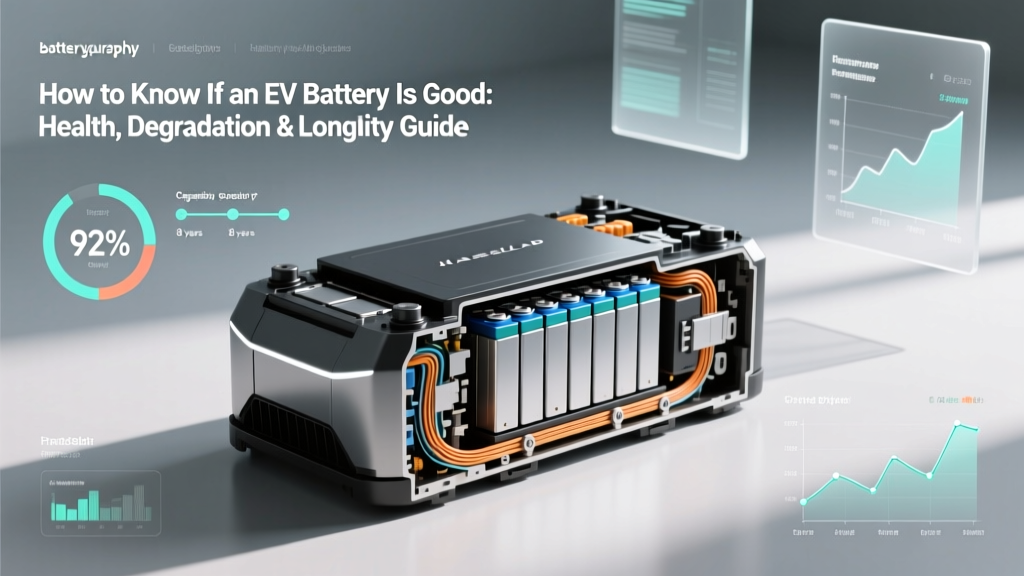
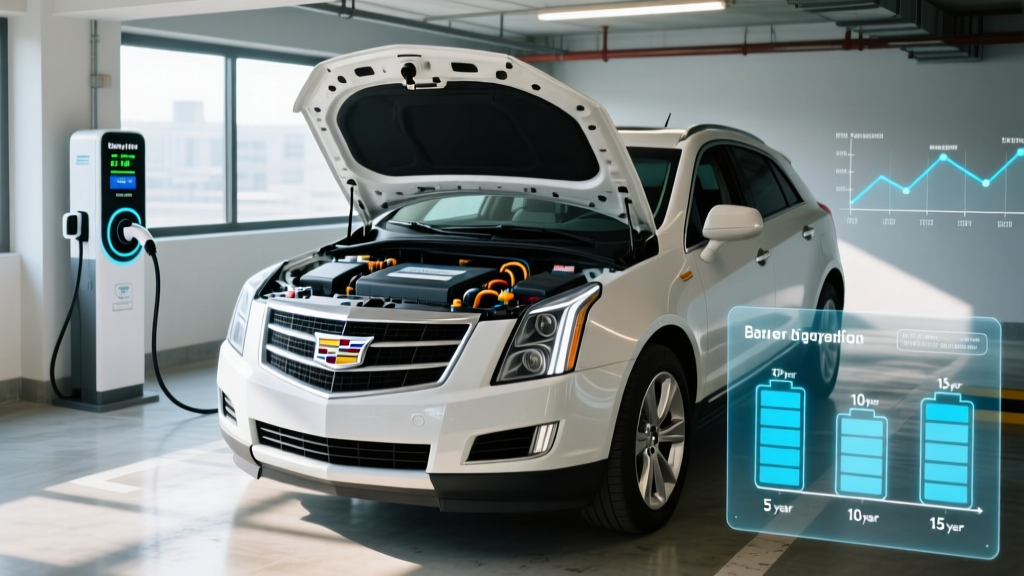
EV battery lifespan is measured in two dimensions: calendar age and charge cycles. Modern liquid-cooled battery packs are engineered to retain 70–80% of original capacity for 150,000–200,000+ miles under normal use. Here's what the data shows:
- Year 1 / 15,000 mi: ~2–5% capacity loss (initial settling — normal for all lithium-ion)
- Year 3 / 45,000 mi: ~5–8% total loss — degradation curve flattens significantly
- Year 5 / 75,000 mi: ~8–12% total loss — most packs still above 88% SoH
- Year 8 / 120,000 mi: ~10–15% total loss — within warranty threshold for most manufacturers
- Year 10 / 150,000 mi: ~12–18% total loss — battery still functional, reduced range
- Year 12+ / 200,000 mi: ~15–22% total loss — approaching end of automotive service life
Sources: Geotab fleet battery health study, Recurrent Auto battery data reports, manufacturer warranty filings.
The degradation curve is not linear. Most capacity loss occurs in the first 1–2 years as the solid electrolyte interphase (SEI) layer forms and stabilizes. After that, degradation slows to roughly 1–2% per year under normal conditions. This is why a 5-year-old EV with 60,000 miles often shows remarkably similar State of Health (SoH) to one with 40,000 miles — calendar aging matters as much as mileage.
So how long do EV batteries last? In practical terms, 15–20 years or 200,000+ miles before the pack drops below 70% of original capacity. At that point, the vehicle may still be perfectly drivable — you simply have reduced range. A 300-mile EPA-rated EV at 70% SoH still delivers ~210 miles, which covers most daily driving needs.
How Much Does an EV Battery Cost to Replace?
Replacement cost depends on battery size (kWh), chemistry, vehicle platform, and whether you need a full pack or just failed modules. Here's a breakdown of current 2026 pricing from OEM and independent replacement channels:
| Vehicle | Battery (kWh / Chemistry) | Full Pack Replacement | Module Repair (if avail.) |
|---|---|---|---|
| Chevrolet Bolt EV/EUV | 65 kWh / NMC | $6,500–$9,000 | $1,500–$3,500 per module section |
| Tesla Model 3 RWD | 60 kWh / LFP | $7,000–$10,000 | Limited module service; pack swap common |
| Tesla Model 3/Y Long Range | 75–82 kWh / NMC | $10,000–$14,000 | Refurbished packs available ~$8,000 |
| Hyundai Ioniq 5 | 77.4 kWh / NMC | $11,000–$15,000 | Module-level service available |
| Ford F-150 Lightning (Std Range) | 98 kWh / NMC | $14,000–$18,000 | Under evaluation |
| Ford F-150 Lightning (Ext Range) | 131 kWh / NMC | $18,000–$22,000+ | Under evaluation |
| Rivian R1T / R1S (Large Pack) | 128 kWh / NMC | $17,000–$21,000 | Module architecture supports partial repair |
| BMW iX xDrive50 | 111.5 kWh / NMC | $18,000–$22,000 | Module replacement available at dealers |
When is replacement typically needed? Full pack replacement is uncommon before 150,000+ miles. Most out-of-warranty battery service involves module-level repair — replacing one or more failed cell modules rather than the entire pack. This can cost $1,500–$5,000 depending on how many modules need service and labor accessibility. Vehicles with modular pack architectures (Hyundai E-GMP, BMW, some GM Ultium platforms) are specifically designed for this type of targeted repair, which significantly reduces worst-case costs.
A growing refurbished/remanufactured battery market has emerged, offering packs at 40–60% of new OEM pricing. These are typically pulled from low-mileage salvage vehicles or rebuilt with graded cells. While viable, ensure any refurbished pack includes a minimum 2-year warranty and is installed by a certified EV technician.
What Does the EV Battery Warranty Actually Cover?
Federal law mandates that EV battery warranties cover a minimum of 8 years / 100,000 miles (in California Air Resources Board states, it's 10 years / 150,000 miles). Most manufacturers exceed these minimums. Here's how major brands structure their coverage:
| Manufacturer | Duration | Capacity Threshold | What Triggers a Claim |
|---|---|---|---|
| Tesla | 8 yr / 100,000 mi (SR) or 120,000 mi (LR/Performance) | 70% retention | Battery falls below 70% of original capacity within term |
| Hyundai / Kia | 10 yr / 100,000 mi | 70% retention | Capacity below 70% or defect/failure |
| General Motors (Ultium) | 8 yr / 100,000 mi | 70% retention | Below 70% SoH or manufacturing defect |
| Ford | 8 yr / 100,000 mi | 70% retention | Capacity below 70% or component failure |
| BMW | 8 yr / 100,000 mi | 70% retention | Below 70% capacity or HV system defect |
| Rivian | 8 yr / 175,000 mi (R1T) or 120,000 mi (R1S) | 70% retention | Below 70% SoH or failure |
Critical warranty details most buyers miss:
- The 70% threshold is the trigger, not the guarantee. Your battery doesn't need to fail catastrophically — it just needs to degrade below 70% of original usable capacity to qualify for warranty service.
- Warranty covers defects AND degradation. If a cell module fails at 50,000 miles, that's covered regardless of overall pack capacity.
- Warranty replacement may use a refurbished pack — OEMs are not required to install a brand-new battery. The replacement will meet or exceed the 70% threshold.
- Misuse exclusions apply. Using the vehicle as a stationary power source (outside approved V2H/V2G programs), repeated 100% DC fast charging in extreme heat without preconditioning, or aftermarket modifications to the HV system can void coverage.
- Warranty is transferable to subsequent owners in most cases, which supports EV resale values.
Factors That Accelerate Battery Degradation (and How to Avoid Them)
While modern battery management systems (BMS) do an excellent job protecting the pack, your charging and driving habits meaningfully impact long-term State of Health. Here's what the data shows:
- ✅ Keep daily charge between 20–80% (NMC/NCA) — storing at high SoC accelerates electrolyte decomposition. LFP owners can charge to 100% daily without concern.
- ✅ Use Level 2 home charging as your primary method — slower charging generates less heat, reducing cell stress. A 7–11 kW Level 2 charger is ideal for daily use.
- ✅ Limit DC fast charging frequency — occasional road-trip fast charging is fine, but daily 150+ kW sessions accelerate degradation by ~1–3% over 100,000 miles vs. primarily L2 charging.
- ✅ Precondition the battery before fast charging — most EVs do this automatically when you navigate to a charger. Cold batteries charged at high power suffer lithium plating, a permanent capacity loss mechanism.
- ✅ Avoid prolonged storage at 100% or 0% SoC — if leaving the vehicle for weeks, store at ~50% SoC.
- ✅ Park in shade or a garage in extreme heat — sustained battery temps above 95°F (35°C) accelerate calendar aging. Active thermal management helps but isn't infinite.
- ✅ Don't obsess over avoiding 100% — charging to full before a road trip is fine. The damage comes from sitting at 100% for days, not from reaching it occasionally.
- ❌ Avoid aftermarket "battery optimization" devices or software — these can interfere with the OEM BMS and void your warranty.
The fast-charging question deserves nuance. A 2024 study by Recurrent Auto analyzing over 12,500 Tesla vehicles found that cars that fast-charged more than 90% of the time showed only ~2–3% additional degradation at 100,000 miles compared to those that primarily used Level 2. This is because modern BMS and thermal management have become very effective at managing charge-session heat. The bigger degradation risk is high ambient temperature combined with high SoC — a car sitting at 100% in a Phoenix summer is under more stress than one that fast-charges daily in Seattle.
How to Check Your EV Battery's State of Health
Monitoring your battery's State of Health (SoH) helps you track degradation over time, plan for potential warranty claims, and assess value when buying or selling a used EV. Here are the primary methods:
1. In-Vehicle Displays
Some manufacturers provide SoH or degradation data directly in the vehicle's infotainment system. Hyundai/Kia's EV models show battery health diagnostics in the service menu. Tesla displays rated range, which you can compare to the original EPA figure to estimate degradation (though software updates can shift rated range independently of actual cell health).
2. OBD-II Diagnostic Tools
Third-party apps like Scan My Tesla, ABRP (A Better Route Planner) OBD integration, and Leaf Spy (for Nissan Leaf) can read the battery management system directly via an OBD-II dongle. These tools report actual kWh capacity, cell voltage variance, and calculated SoH percentage. This is the most accurate consumer-accessible method.
3. Dealer Diagnostic Reports
Any authorized dealer can pull a full HV battery health report during service visits. Request this if you're approaching a warranty mileage threshold and want documentation. Some dealers provide this free; others charge a diagnostic fee ($100–$200).
4. Third-Party Battery Health Certificates
Companies like Recurrent and AVR (Altelium Vehicle Reports) offer battery health certifications that are increasingly used in the used-EV market. These reports verify SoH, charging history patterns, and projected remaining life — valuable for both buyers and sellers.
What to watch for: Cell voltage imbalance (one module significantly lower than others) is often a more actionable signal than overall SoH. A single degraded module can be replaced for $1,000–$3,000, restoring pack balance and extending overall life.
Emerging Battery Technology: What's Coming Next
Several next-generation battery technologies are in development that promise to reshape replacement economics and longevity. It's important to understand their realistic timelines:
Solid-State Batteries: These replace the liquid electrolyte with a solid material, offering higher energy density (potentially 400+ Wh/kg), faster charging, and dramatically improved cycle life. Toyota, Samsung SDI, and QuantumScape are leading development. Toyota has announced solid-state EV production targeted for 2027–2028, initially in limited, premium vehicles. Mass-market availability is not expected before 2030–2032. These are not available in any production vehicle as of 2026.
Silicon Anode Batteries: Companies like Sila Nanotechnologies and Group14 are replacing graphite anodes with silicon-dominant materials, increasing energy density by 20–40%. Early production applications are appearing in premium EVs (Mercedes-Benz's G-Class EV uses Sila cells). Expect broader adoption in 2027–2029 model-year vehicles.
Sodium-Ion Batteries: Using abundant sodium instead of lithium, these offer lower cost and excellent cycle life at the expense of energy density. CATL has begun production in China for lower-range city EVs. US-market adoption for passenger vehicles is likely 2028+ and may initially target fleet/commercial applications where weight is less critical.
LFP improvements: LMFP (lithium manganese iron phosphate) adds manganese to boost energy density by ~15–20% while retaining LFP's longevity and safety advantages. CATL and BYD are scaling LMFP production, with US-market vehicles expected by 2027.
The practical takeaway: today's NMC and LFP batteries are mature, well-understood technologies with proven longevity. Waiting for next-gen chemistry is not a compelling reason to delay an EV purchase — current packs are already lasting 15+ years in normal use.
Frequently Asked Questions
How much is a battery for a Tesla Model 3?
A full battery replacement for a Tesla Model 3 ranges from approximately $7,000–$10,000 for the LFP Standard Range pack to $10,000–$14,000 for the Long Range NMC pack. Refurbished packs are available through Tesla's service network and third-party providers for 30–50% less. Under warranty (8 years / 100,000–120,000 miles depending on trim), replacement is covered if capacity drops below 70%.
Do EV batteries need to be replaced regularly like gas car components?
No. Unlike oil changes, spark plugs, or timing belts, EV batteries are not a scheduled maintenance item. They degrade gradually over 15–20+ years. Most EVs will be retired for other reasons (body damage, interior wear, technology obsolescence) before the battery requires replacement. The US Department of Energy notes that EV battery packs are designed to last the lifetime of the vehicle.
Can I replace just one battery module instead of the whole pack?
Yes, on many vehicles. Platforms with modular battery architectures — including Hyundai E-GMP (Ioniq 5/6), BMW's Gen5 eDrive, and GM's Ultium — support individual module replacement. Cost per module typically ranges from $1,000–$3,500 plus labor. Tesla's structural battery packs are less modular and more often require full-pack service. Always have a qualified EV technician diagnose whether a single module or the full pack is the issue.
Does fast charging damage my EV battery?
The impact is smaller than commonly feared. Modern thermal management systems keep cells within safe temperature windows during DC fast charging. Data from Recurrent Auto shows that frequent fast charging adds approximately 1–3% additional degradation over 100,000 miles compared to Level 2-only charging. The bigger risk is fast charging a cold battery without preconditioning — always let the vehicle warm the pack before high-power sessions.
What happens to an EV battery after it's replaced?
Retired EV batteries rarely go to landfill. They enter one of two streams: second-life applications (stationary energy storage for homes, commercial buildings, or grid balancing) where they operate at 70–50% capacity for another 5–10 years, or recycling where companies like Redwood Materials, Li-Cycle, and Cirba Solutions recover 90–95% of critical minerals (lithium, cobalt, nickel, manganese) for use in new battery production. This circular supply chain is reducing long-term replacement costs.
Is it worth buying a used EV given battery degradation concerns?
In most cases, yes — if you verify the battery's State of Health before purchase. A used EV at 60,000 miles with 92% SoH and remaining warranty coverage is often a better value proposition than a new vehicle. Request a battery health report, check the remaining warranty period, and compare the current real-world range to the original EPA figure. Factor in that the steepest part of the degradation curve (the initial 3–5% drop) has already occurred.
How does extreme cold affect long-term battery health?
Cold weather reduces range temporarily (typically 15–30% loss at 20°F / -7°C due to increased internal resistance and cabin heating demands), but this is reversible — it's not permanent degradation. The actual longevity risk comes from charging at high power when the battery is cold, which can cause lithium plating. Always use preconditioning (automatic when navigating to a charger in most EVs) and rely on Level 2 charging in winter when possible.
This guide reflects pricing, warranty terms, and technology status as of early 2026. Battery replacement costs vary by region, service provider, and parts availability. Always consult your vehicle's specific warranty documentation and a qualified EV service center for estimates applicable to your vehicle. Tax credit eligibility for battery replacement is not covered under IRS §30D but may qualify under certain state incentive programs — consult a tax professional.