Why "Removing the Battery" Means Something Entirely Different in an EV
If you've ever popped the hood of a gas car and unbolted a 12-volt lead-acid battery in ten minutes with a 10mm socket, you might assume an electric vehicle works the same way. It doesn't. When EV owners and shoppers ask how to remove the battery from a car, they're usually facing one of two very different scenarios — and confusing them can cost thousands of dollars or cause serious injury.
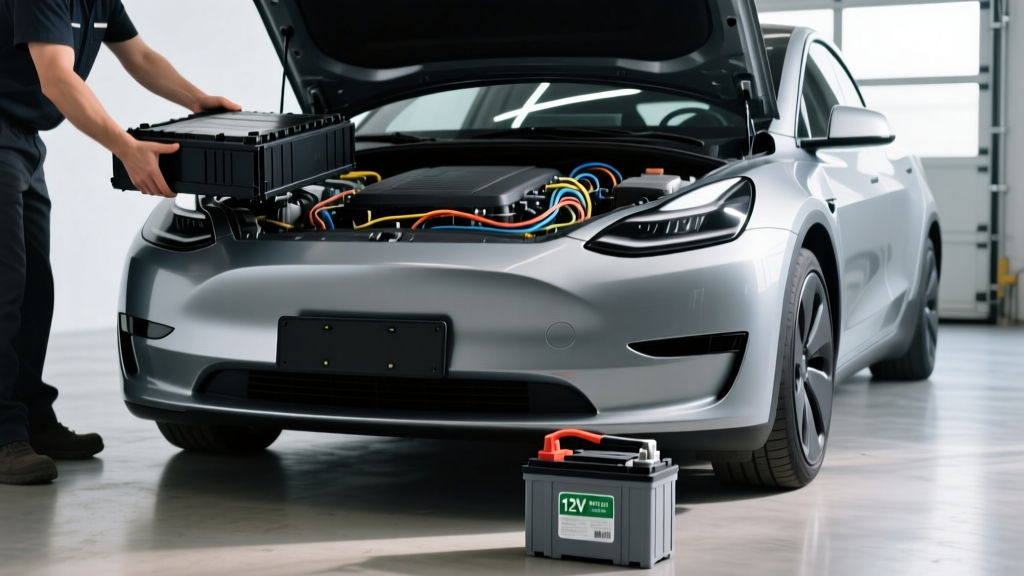
Every modern EV actually carries two batteries: a small 12V auxiliary battery (similar to a gas car's) that runs lights, infotainment, and door locks, and a massive high-voltage traction battery (40–120+ kWh) that powers the motors and determines the vehicle's range. The 12V battery is user-serviceable. The traction battery is not a DIY project — it's a 600–1,200 lb structural component integrated into the chassis, connected to 400V or 800V systems, and its removal requires a certified high-voltage technician, a lift, and insulated tooling.
This guide covers what you actually need to know about EV traction batteries: when removal becomes necessary, what it costs, how long they really last, and how to maximize the one you have.
How Long Do EV Batteries Actually Last?
The short answer: far longer than most buyers assume. The prevailing fear — that an EV battery will fail at 80,000 miles like a laptop battery — is not supported by fleet data.
According to long-term tracking by Recurrent Auto, the average EV battery retains approximately 90–95% of its original capacity after 5 years and 85–92% after 10 years / 150,000 miles. Tesla's 2025 Impact Report states its Model 3/Y fleet retains roughly 85% capacity at 200,000 miles. Early Nissan Leaf models (2011–2017) with passive air-cooled batteries showed more aggressive degradation — some dropping to 70–75% capacity by year 8 — but modern liquid-cooled packs from Hyundai, GM, Ford, BMW, and Tesla have largely solved this.
Most EV batteries will outlast the vehicle's economic life. Full battery replacement before 150,000 miles is uncommon unless there's a manufacturing defect (covered under warranty) or physical damage from a collision.
LFP vs NMC Battery Chemistry: What's Inside Your Pack
Not all EV batteries are the same. The two dominant lithium-ion chemistries in 2026 model-year EVs are LFP (lithium iron phosphate) and NMC/NCA (nickel manganese cobalt / nickel cobalt aluminum). Which chemistry is under your floor affects range, longevity, charging habits, and even whether you should charge to 100%.
| Attribute | LFP (Lithium Iron Phosphate) | NMC / NCA (Nickel-Based) |
|---|---|---|
| Energy Density | Lower (~160 Wh/kg cell-level) | Higher (~250–300 Wh/kg cell-level) |
| Typical Use | Standard-range / base trims (Tesla Model 3 RWD, Ford Mustang Mach-E Select LFP) | Long-range / performance trims (Model 3 LR, Ioniq 5, EV6, F-150 Lightning Ext.) |
| Cycle Life | 3,000–5,000+ cycles | 1,000–2,000 cycles |
| Charge-to-100% Recommendation | Yes — manufacturers recommend periodic 100% charges for BMS calibration | No — daily limit 80%; 100% only for trips |
| Cold-Weather Performance | Weaker — 25–35% range loss below 20°F | Better — 15–25% range loss below 20°F |
| Cost per kWh | Lower (~$90–110/kWh pack-level) | Higher (~$120–150/kWh pack-level) |
| Thermal Stability | Excellent — lower runaway risk | Good — requires more active thermal management |
Which is better? It depends on your use case. LFP is the longevity champion — ideal for daily commuters who charge at home and want a pack that will outlast the car. NMC is the range and performance pick — better for road-trippers, cold-climate drivers, and buyers who need maximum miles per charge. Neither is universally superior; they're engineering trade-offs.
Battery Degradation: What the Data Actually Shows
Degradation isn't linear. Most EV batteries experience a steeper drop in the first 1–2 years (roughly 2–5%), then settle into a slow, nearly flat decline for the remainder of their life. Here's a data-informed approximation for modern liquid-cooled packs:
Typical Degradation Curve (NMC, liquid-cooled, moderate climate):
- Year 1 / 15,000 mi: 96–98% capacity retained
- Year 3 / 45,000 mi: 93–95% retained
- Year 5 / 75,000 mi: 90–93% retained
- Year 8 / 120,000 mi: 87–91% retained
- Year 10 / 150,000 mi: 85–90% retained
LFP packs typically show even slower fade, with some fleet data suggesting 92–95% retention at year 8. Source: Recurrent Auto fleet analysis, Tesla Impact Report.
Factors that accelerate degradation:
- Frequent DC fast charging above 150 kW — occasional use is fine, but daily 350 kW sessions add thermal stress. Sustained charging at peak rates generates more heat than the thermal management system can always dissipate.
- Sustained high State of Charge (SoC) — leaving an NMC pack at 100% for days or weeks accelerates electrolyte breakdown. LFP is more tolerant of 100% SoC.
- Extreme heat exposure — prolonged parking in 110°F+ environments without active thermal management. Garage parking helps.
- Deep discharge to 0% — regularly running the pack to true zero stresses cells. The vehicle's buffer (typically 3–8 kWh hidden below the "0%" display) protects against the worst damage, but avoid habitual deep cycling.
- Cold charging without preconditioning — plugging into a DC fast charger with a sub-32°F battery without preconditioning can cause lithium plating on the anode, a permanent form of degradation.
What Does the EV Battery Warranty Actually Cover?
Federal law mandates a minimum battery warranty of 8 years / 100,000 miles for EVs sold in the US. California and states adopting CARB standards require 10 years / 150,000 miles. Most manufacturers exceed the federal minimum voluntarily.
| Manufacturer | Battery Warranty | Capacity Retention Threshold |
|---|---|---|
| Tesla (Model 3/Y) | 8 yr / 120,000 mi (LR/AWD); 8 yr / 100,000 mi (RWD) | 70% |
| Hyundai / Kia (Ioniq 5, EV6) | 10 yr / 100,000 mi | 70% |
| Ford (Mach-E, F-150 Lightning) | 8 yr / 100,000 mi | 70% |
| GM (Ultium — Equinox EV, Blazer EV, Silverado EV) | 8 yr / 100,000 mi | 70% |
| BMW (i4, iX, i5) | 8 yr / 100,000 mi | 70% |
| Rivian (R1T, R1S) | 8 yr / 175,000 mi | 70% |
What triggers a warranty claim: If your battery's usable capacity drops below the threshold (typically 70% of original) within the warranty period, the manufacturer will repair or replace it at no cost. In practice, this means a 75 kWh pack that can no longer hold 52.5 kWh usable qualifies. Very few modern EVs hit this threshold under normal use.
What voids the warranty: Physical damage (collision, flood), unauthorized modifications to the high-voltage system, or use of non-approved charging equipment that causes damage. Simply fast-charging frequently or exceeding mileage limits does not void coverage.
For precise warranty language and current-year requirements, always check the manufacturer's official warranty booklet or the EPA's fueleconomy.gov vehicle detail pages.
How Much Does an EV Battery Replacement Cost?
If your battery fails outside warranty — or you're buying a used EV with a degraded pack — replacement costs are significant but have been declining as cell prices fall and more third-party rebuilders enter the market.
| Vehicle | Battery Size | Estimated Replacement Cost (2026) |
|---|---|---|
| Tesla Model 3 RWD (LFP) | ~60 kWh | $7,000 – $10,000 |
| Tesla Model Y Long Range | ~75 kWh | $10,000 – $14,000 |
| Hyundai Ioniq 5 | 77.4 kWh | $9,000 – $13,000 |
| Ford F-150 Lightning Ext. Range | ~131 kWh | $18,000 – $25,000 |
| Chevrolet Bolt EV (older gen) | ~65 kWh | $6,000 – $9,000 (declining) |
| Rivian R1T (Large Pack) | ~128 kWh | $16,000 – $22,000 |
These figures include the battery pack and labor but can vary by region, dealer vs. independent shop, and whether you opt for a new OEM pack, a remanufactured unit, or a module-level repair (replacing only the degraded cell modules rather than the entire pack — increasingly common and 40–60% cheaper).
When is replacement typically needed? For most owners, never during their ownership. Out-of-warranty replacement is most relevant for second- or third-owners of high-mileage EVs (180,000+ miles), vehicles with accident-damaged packs, or early-generation models with known chemistry issues.
How to Check and Maximize Your Battery's Health
You don't need to remove the battery to assess its condition. Here's how to monitor State of Health (SoH) and extend pack life:
Monitoring Your Battery's State of Health
- In-dash SoH display: Tesla shows battery health percentage in the service menu (Settings → Software → Battery Health). Hyundai/Kia displays a similar metric via the EV-specific trip computer. Check it quarterly.
- OBD-II apps: Tools like Car Scanner, LeafSpy (Nissan Leaf), or Scan My Tesla pull real-time SoH, cell voltage delta, and degradation data from the BMS (Battery Management System) via the OBD-II port.
- Range comparison: Track your full-charge displayed range over time. If your 310-mile EPA-rated EV consistently shows 265 miles at 100% after 3 years, that's roughly 85% SoH — normal and healthy.
- Dealer diagnostic: During service visits, ask for a battery health report. Most dealers can pull detailed cell-balance and capacity data.
Best Practices for Longevity
- NMC owners: Set daily charge limit to 80%. Charge to 100% only when departing for a trip, and drive soon after reaching full.
- LFP owners: Charge to 100% at least once per week — this calibrates the BMS and prevents SoC estimation drift.
- Minimize DC fast charging to 1–2 sessions per week when possible. Level 2 home charging (7–11 kW) is gentler on cells.
- Precondition before fast charging — use the vehicle's navigation to route to a charger (triggers automatic battery warm-up) or manually precondition via the app in cold weather.
- Avoid prolonged storage at extremes: If parking for weeks, leave SoC at 40–60%. Never store at 100% or below 10%.
- Garage park in extreme heat when possible — sustained 100°F+ ambient temps accelerate calendar degradation.
Can You Remove an EV Battery Yourself?
No — not safely, and not legally in many jurisdictions. Here's why the traction battery is strictly professional-service territory:
- Weight: EV battery packs weigh 600–1,200+ lbs (the F-150 Lightning Extended Range pack is approximately 1,200 lbs). Removal requires a hydraulic lift and a battery table.
- Voltage: 400V systems (most EVs) and 800V systems (Hyundai Ioniq 5, Kia EV6, Porsche Taycan, Lucid Air) can cause lethal arc flash and electrocution. Technicians require insulated gloves rated for the system voltage and specific high-voltage safety training.
- Structural integration: In most modern EVs (Tesla's structural pack, GM Ultium, Hyundai E-GMP), the battery is a stressed chassis member. Removing it without proper procedure can compromise the vehicle's structural rigidity.
- Coolant systems: The battery is connected to a liquid thermal management loop. Removal requires proper coolant evacuation, and reinstallation requires vacuum-filling and bleeding — air pockets can cause hot spots and cell damage.
- Software pairing: Many BMS units are paired to the vehicle's ECU. A replacement pack often requires dealer-level software reprogramming to function correctly.
If you're asking how to remove the battery from a car because you're considering a home battery swap, a conversion project, or a salvage-title repair — consult a certified EV technician or a shop with documented high-voltage credentials. Organizations like ASE offer an L3 Light Duty Hybrid/Electric Vehicle Specialist certification that qualified shops will display.
The 12V auxiliary battery, however, is a different story. Most EVs use a standard 12V lead-acill or lithium 12V unit located in the frunk or rear cargo area. This can be replaced by the owner with basic hand tools — consult your owner's manual for location and group size. A dead 12V battery is the #1 reason an EV won't "turn on," even when the traction battery is fully charged.
What's Next: Solid-State and Silicon-Anode Batteries
Looking ahead, two technologies promise to reshape EV batteries — but neither is available in production vehicles as of 2026:
- Solid-state batteries: Replace the liquid electrolyte with a solid ceramic or polymer layer, enabling higher energy density (potentially 400+ Wh/kg), faster charging, and reduced fire risk. Toyota has announced a solid-state EV targeting 2027–2028 production with ~750 km (466 mi) range, but this remains preliminary and has not been independently verified at scale. Samsung SDI and QuantumScape are also in advanced testing. Realistic mass-market availability: 2028–2030.
- Silicon-anode batteries: Replace graphite anodes with silicon-dominant composites, boosting energy density 20–40%. Companies like Sila Nanotechnologies and Group14 are supplying early production cells. The 2026 Mercedes-Benz G-Class 580e uses a silicon-anode battery from Sila. Expect broader adoption across premium EVs by 2027–2028.
Neither technology changes the advice in this guide. Current-gen LFP and NMC packs, properly cared for, will serve most owners for the full life of the vehicle.
Frequently Asked Questions
How long do EV batteries last in years and miles?
Modern liquid-cooled EV batteries typically last 15–20 years and 200,000+ miles before dropping to 70–80% of original capacity. Fleet data from Recurrent Auto and Tesla show most packs retain 85–92% capacity at 150,000 miles. Full failure before 150,000 miles is rare and usually covered by warranty.
How much does an EV battery cost to replace in 2026?
Replacement costs range from approximately $6,000 for a smaller pack (Chevrolet Bolt EV, ~65 kWh) to $25,000 for a large pack (F-150 Lightning Extended Range, ~131 kWh). The average mid-size EV (Tesla Model Y, Ioniq 5) falls in the $9,000–$14,000 range including labor. Module-level repairs are increasingly available at 40–60% lower cost.
What does the EV battery warranty cover?
Federal law requires at least 8 years / 100,000 miles of battery coverage. CARB states require 10 years / 150,000 miles. The warranty guarantees the battery will retain at least 70% of its original usable capacity. If it drops below this threshold within the warranty period, the manufacturer repairs or replaces it at no cost. Physical damage and unauthorized modifications are excluded.
How do I check my EV battery health without removing it?
Use the in-dash battery health display (Tesla, Hyundai/Kia), an OBD-II diagnostic app like Car Scanner or Scan My Tesla, or request a dealer battery health report. Track your displayed full-charge range over time as a simple proxy — gradual decline is normal; sudden drops warrant a service visit.
LFP vs NMC — which battery chemistry is better?
LFP offers longer cycle life (3,000–5,000+ cycles), lower cost, and safer chemistry but has lower energy density and worse cold-weather range. NMC delivers more range per kWh and better cold performance but has shorter cycle life and requires more careful SoC management. Choose LFP for daily commuting and maximum longevity; choose NMC for road trips, cold climates, and maximum range.
Is it safe to remove an EV traction battery at home?
No. High-voltage traction batteries (400V–800V) pose lethal electrocution risk and weigh 600–1,200+ lbs. Removal requires a certified high-voltage technician, a vehicle lift, insulated tooling, and proper coolant handling. The 12V auxiliary battery, by contrast, is safe for owner replacement — consult your owner's manual.
Sources: fueleconomy.gov (EPA range and efficiency data), Recurrent Auto (fleet degradation data), manufacturer warranty documentation (Tesla, Hyundai, Ford, GM, Rivian).