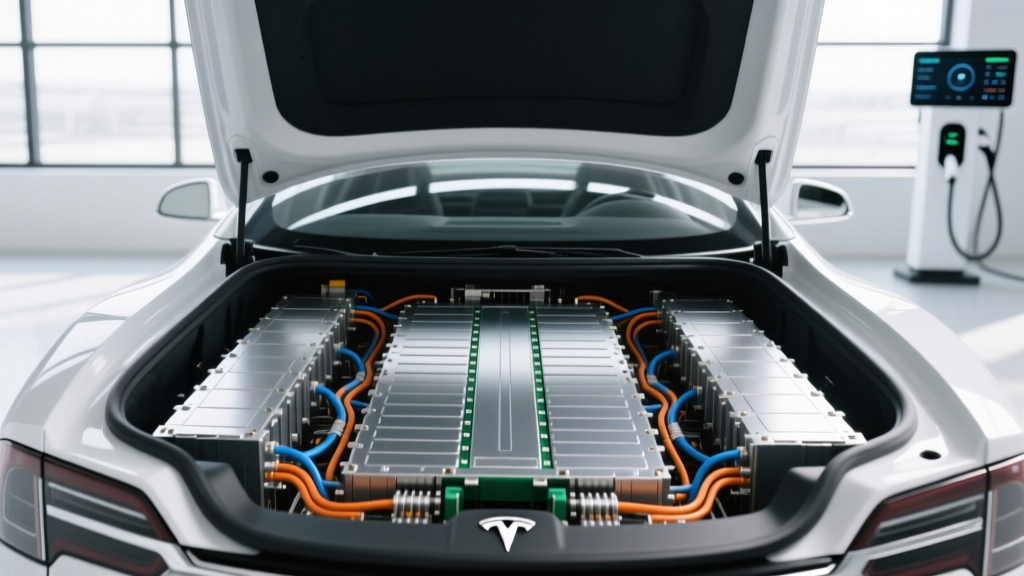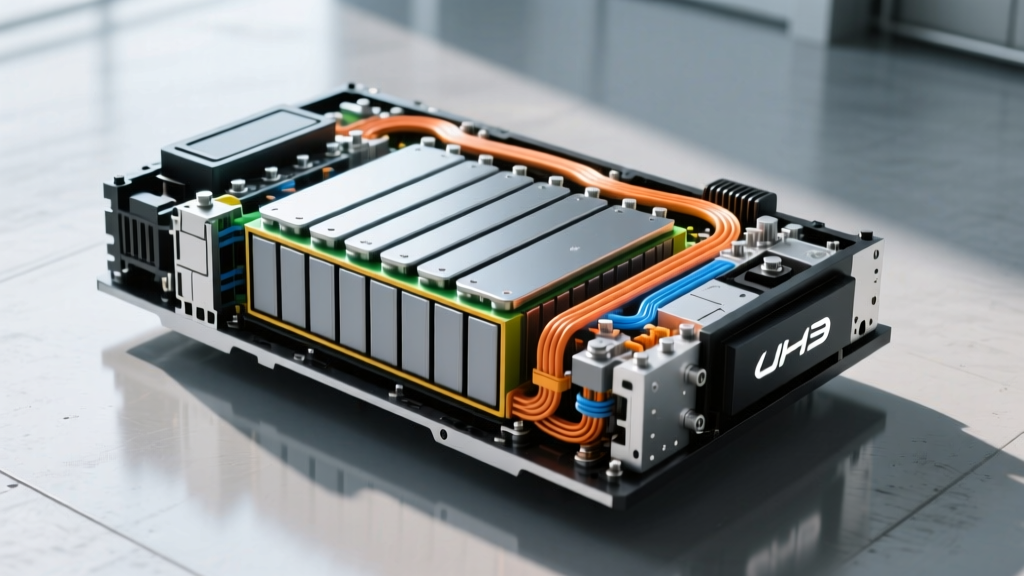
If you've typed "how to take a battery out of a car" into a search bar, you're likely facing one of two situations: you need to replace the high-voltage traction battery in an electric vehicle, or you're researching what EV battery ownership actually looks like over a decade or more. Either way, the process is nothing like swapping a 12V lead-acid battery in a gas car. An EV traction battery pack weighs 600–1,200 pounds, operates at 400–800 volts, and requires specialized high-voltage training, insulated tools, and manufacturer-specific diagnostic equipment to remove safely.
This guide walks through the realities of EV battery removal and replacement, degradation data pulled from real-world fleet studies, warranty coverage you can actually count on, and the chemistry trade-offs (LFP vs. NMC/NCA) that determine how your battery ages. We'll also cover how to monitor State of Health (SoH), what habits preserve your pack, and where emerging solid-state technology realistically stands in 2026.
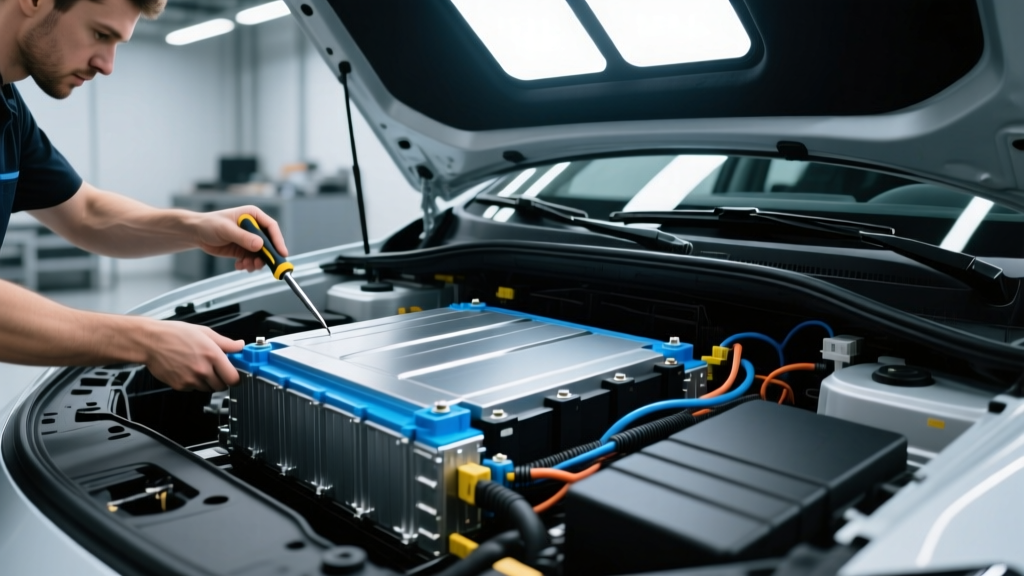
Why Removing an EV Battery Is Not a DIY Job
In a conventional vehicle, pulling the 12V battery takes a 10mm socket and about ten minutes. An EV traction battery is a fundamentally different proposition. The high-voltage pack sits in a structural enclosure bolted to the vehicle floor (in most skateboard-platform EVs like the Tesla Model Y, Hyundai Ioniq 5, or Ford Mustang Mach-E) or integrated into the chassis. Removal involves:
- Depowering the high-voltage system — disconnecting the service plug, waiting for capacitors to discharge (typically 10–15 minutes per OEM procedure), and verifying zero voltage with a CAT III/IV multimeter.
- Coolant evacuation — most liquid-cooled packs have glycol-based thermal management loops that must be drained and captured before disconnection.
- Structural unbolt and lowering — 20–40+ bolts securing the pack to the subframe, requiring a hydraulic lift table rated for 1,500+ lbs.
- Software handshake — many OEMs (BMW, Tesla, VW Group) require a dealer-level diagnostic tool to re-pair a replacement BMS (Battery Management System) to the vehicle's powertrain controller.
The short answer: unless you hold ASE L3 (Light Duty Hybrid/Electric Vehicle) certification or equivalent high-voltage training and have access to a lift and OEM service documentation, battery removal is a job for a qualified EV service center. Attempting it without proper PPE (Class 0 insulated gloves rated to 1,000V) risks lethal electrocution.
How Long Do EV Batteries Actually Last?
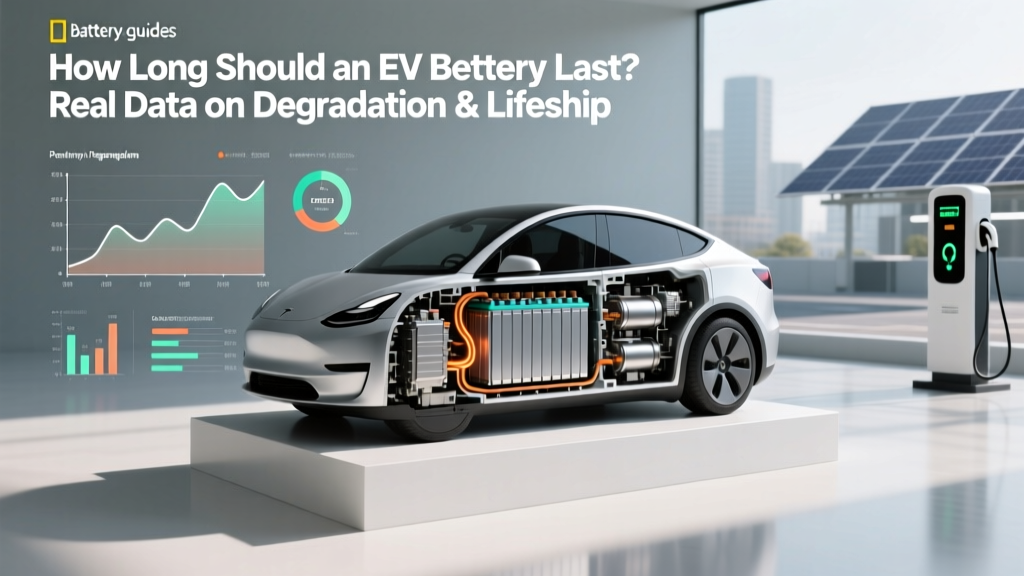
The most persistent myth in EV ownership is that batteries need replacing every few years like a phone. Real-world data tells a different story. According to fleet data aggregated by Recurrent Auto (which tracks over 15,000 EVs in real-world use), the average EV battery retains approximately 90–95% of its original capacity after 5 years and 100,000 miles. Degradation curves are non-linear: the steepest loss occurs in the first 1–2 years (roughly 2–5%), then plateaus into a slow, linear decline.
- Year 1 / 15,000 mi: ~2–4% capacity loss (initial formation loss)
- Year 3 / 45,000 mi: ~5–8% total loss
- Year 5 / 75,000 mi: ~7–12% total loss
- Year 8 / 120,000 mi: ~10–18% total loss
- Year 10 / 150,000 mi: ~12–22% total loss (varies heavily by chemistry and climate)
Sources: Recurrent Auto fleet data, Geotab fleet study of 6,300+ EVs.
What does this mean in practical terms? A 2026 Tesla Model 3 Long Range with an EPA-estimated 363 miles of range and an 82 kWh (usable) NMC pack might realistically deliver ~320–330 miles at 50,000 miles and ~290–310 miles at 150,000 miles. The car remains perfectly functional — you just lose range progressively. Most EV batteries will outlast the vehicle's economic life. Total failure (a pack that no longer holds charge or throws isolation faults) is rare and typically covered under warranty.
LFP vs. NMC/NCA: Which Battery Chemistry Lasts Longer?
Battery chemistry is the single largest variable in how your pack ages. As of 2026, two chemistries dominate the US EV market:
| Attribute | LFP (Lithium Iron Phosphate) | NMC/NCA (Nickel Manganese Cobalt / Nickel Cobalt Aluminum) |
|---|---|---|
| Energy Density | Lower (~160 Wh/kg cell-level) — heavier pack for same kWh | Higher (~250–300 Wh/kg) — lighter, more range per pack |
| Cycle Life | 3,000–5,000+ full cycles to 80% SoH | 1,000–2,000 full cycles to 80% SoH |
| Calendar Life | Excellent — less degradation at high SoC | Good — degrades faster if stored at 100% SoC |
| Cold Performance | Weaker — more range loss below freezing (~35–40% loss at 20°F) | Better — ~25–30% range loss at 20°F |
| Fast-Charging Tolerance | More tolerant of frequent DC fast charging | Moderate — benefits from limiting DCFC to road trips |
| Cost (per kWh) | ~$85–100/kWh (pack-level, 2026) | ~$110–140/kWh (pack-level, 2026) |
| SoC Recommendation | Can charge to 100% daily (OEMs recommend it for BMS calibration) | 80% daily; 100% only before long trips |
| Common In (2026 Models) | Tesla Model 3/Y RWD, Ford Mustang Mach-E Select (base), BYD (non-US) | Tesla LR/Performance, Hyundai Ioniq 5/6, Kia EV6/EV9, Rivian, BMW iX |
Which is better? It depends on your use case. If you drive in mild climates, charge at home nightly, and want maximum battery longevity (think 200,000+ miles with minimal degradation), LFP is the durability winner. If you need maximum range per charge, drive in cold winters, or tow frequently, NMC/NCA delivers higher energy density and better low-temperature performance. Neither is universally superior — the right choice maps to your driving pattern.
What Does the EV Battery Warranty Actually Cover?
Federal law (EPA emissions warranty requirements) mandates that EV battery packs carry a minimum warranty of 8 years / 100,000 miles (whichever comes first). In California Air Resources Board (CARB) states — which include CA, CO, CT, MA, MD, ME, MN, NJ, NY, OR, RI, VA, VT, WA — the requirement extends to 10 years / 150,000 miles for vehicles certified to CARB standards.
| Manufacturer | Warranty Period | Capacity Retention Threshold | Notes |
|---|---|---|---|
| Tesla | 8 yr / 100,000–120,000 mi (varies by model) | 70% minimum retention | Model S/X: 8yr/150k mi |
| Hyundai / Kia | 10 yr / 100,000 mi | 70% minimum retention | Among the longest coverage |
| Ford | 8 yr / 100,000 mi | 70% minimum retention | Mach-E, F-150 Lightning |
| GM (Chevrolet, Cadillac) | 8 yr / 100,000 mi | 70% minimum retention | Ultium platform |
| BMW | 8 yr / 100,000 mi | 70% minimum retention | i4, i5, i7, iX |
| Rivian | 8 yr / 175,000 mi | 70% minimum retention | Highest mileage threshold |
The critical detail: the warranty triggers when capacity drops below the stated threshold (usually 70% of original). A pack at 72% SoH at 95,000 miles is not a warranty claim — even though you've lost 28% of your range. In practice, most packs hold well above 80% at the warranty boundary, making successful warranty claims relatively uncommon. If you do qualify, the OEM typically replaces or remanufactures the pack at no cost — you don't get a brand-new battery, but rather one restored to at least the threshold capacity.
How Much Does It Cost to Replace an EV Battery?
Replacement cost is the number-one anxiety among prospective EV buyers. Here's what the numbers actually look like in 2026, based on OEM parts pricing and independent EV shop estimates:
| Vehicle (Example) | Pack Size | Parts Cost | Labor (est.) | Total Range |
|---|---|---|---|---|
| Tesla Model 3 RWD (LFP) | ~60 kWh | $8,000–$12,000 | $1,500–$3,000 | $9,500–$15,000 |
| Tesla Model Y Long Range | ~82 kWh | $12,000–$16,000 | $2,000–$3,500 | $14,000–$19,500 |
| Hyundai Ioniq 5 (Long Range) | 77.4 kWh | $11,000–$15,000 | $2,000–$3,000 | $13,000–$18,000 |
| Ford F-150 Lightning (Extended) | 131 kWh | $18,000–$28,000 | $3,000–$5,000 | $21,000–$33,000 |
| Chevrolet Bolt EV/EUV | 65 kWh | $9,000–$14,000 | $1,500–$2,500 | $10,500–$16,500 |
| BMW iX xDrive50 | ~105 kWh usable | $20,000–$30,000 | $3,000–$5,000 | $23,000–$35,000 |
Context matters enormously here. These are out-of-warranty, full-pack replacement figures. In reality:
- Most EVs never need a full pack replacement. Data from Geotab's fleet study shows that at 200,000 miles, the average EV battery still retains ~75–85% of its original capacity — well within usable range.
- Module-level repair is increasingly common. Many packs consist of 12–24 individual modules. A single degraded or faulty module can be replaced for $1,500–$4,000 rather than swapping the entire pack. Independent EV shops (like Electrified Garage in the Northeast or Gruber Motor Company in the Southwest) specialize in this.
- When replacement IS needed, it's typically at 150,000–250,000+ miles, often on vehicles that are already 10–15 years old. At that point, the replacement cost must be weighed against the vehicle's residual value — the same calculus as a transmission replacement on a gas car.
What Affects EV Battery Life — and What You Can Control
Battery degradation comes from two sources: cycle degradation (wear from charging and discharging) and calendar degradation (chemical aging that happens regardless of use). Here are the factors, ranked roughly by impact:
- ☑️ Limit daily charge to 80% (NMC/NCA) or 100% (LFP). Storing an NMC pack at 100% SoC for extended periods accelerates calendar degradation. LFP packs are more tolerant and OEMs like Tesla recommend periodic 100% charges for BMS cell-balancing.
- ☑️ Minimize DC fast charging when possible. Occasional DCFC on road trips is fine. Daily reliance on 150–350 kW DC fast charging generates sustained heat and lithium plating risk. Home Level 2 (7–11.5 kW) is the gentlest charging method.
- ☑️ Precondition before fast charging. Most modern EVs automatically precondition the battery when a Supercharger or DCFC station is set as the navigation destination. This brings the pack to optimal temperature (~95–105°F), reducing stress and improving charge speed. If your EV doesn't auto-precondition, manually activate it 15–20 minutes before arrival.
- ☑️ Avoid extreme SoC in extreme temperatures. Don't leave an NMC pack at 100% SoC in 110°F Phoenix heat, and don't leave it at 5% SoC in a Minnesota January. Aim for 50–70% if storing for weeks.
- ☑️ Use regenerative braking normally. Regen does not meaningfully accelerate degradation — the current levels are well within the battery's C-rate tolerance.
- ☑️ Keep up with coolant service. The thermal management system's glycol should be flushed per the OEM schedule (typically every 4–5 years). Degraded coolant reduces cooling efficiency and increases pack temperature.
How to Check Your Battery's State of Health (SoH)
State of Health (SoH) is the percentage of original capacity your pack currently holds. A new pack is 100% SoH; a pack that held 80 kWh when new and now holds 72 kWh is at 90% SoH. Here's how to check it:
1. In-Vehicle Displays: Some EVs show SoH or degradation data natively. Tesla owners can access "Battery Health" in the Service menu (added via OTA in 2023–2024). The Nissan Leaf has long displayed capacity bars on the dash. Hyundai/Kia provide SoH data through the dealer diagnostic tool but not always in the consumer app.
2. Third-Party Apps and OBD-II Readers: Tools like LeafSpy (Nissan Leaf), Teslalogger/Tessie (Tesla), and generic OBD-II EV readers (compatible with apps like ABRP or Car Scanner) can pull BMS-reported SoH, cell voltage deltas, and pack temperature. These read directly from the CAN bus and are more granular than what most OEM apps surface.
3. Dealer Diagnostic Check: Any authorized service center can run a full battery health report. This is particularly useful pre-purchase on a used EV — ask for a printout showing SoH percentage, individual module voltage spread, and any logged isolation faults.
4. Range-Based Estimation: A rough but practical method: fully charge the vehicle to 100% (on an LFP pack or an NMC pack occasionally for calibration), note the displayed range, and compare it to the original EPA figure adjusted for your typical efficiency. If your Ioniq 5 originally showed 303 miles at 100% and now shows 272 miles, you're at approximately 90% SoH — consistent with expected degradation at ~50,000 miles.
When Is Battery Replacement Actually Necessary?
Gradual capacity loss alone rarely necessitates replacement. A pack at 75% SoH still provides 200+ miles of range in most modern EVs — adequate for daily driving. Replacement becomes relevant in these scenarios:
- Cell or module failure causing isolation faults. If the BMS detects an internal short, insulation breakdown, or cell imbalance beyond correction, it will throw a "Service High Voltage System" warning and may limit power or prevent charging. This is a safety-critical fault requiring immediate service.
- Physical damage. Bottom impacts (road debris, deep potholes, flooding) that compromise the pack enclosure can breach the waterproof seal and damage cells. Many of these are covered by comprehensive insurance.
- Capacity below warranty threshold. If SoH drops below 70% within the warranty period, the OEM will replace or refurbish the pack.
- Severe degradation on an older vehicle you plan to keep long-term. At 200,000+ miles with 65–70% SoH, a replacement might make economic sense if the rest of the vehicle is in good condition — similar to a motor or transmission rebuild on a cherished gas car.
What's Next: Solid-State and Silicon-Anode Batteries
Next-generation battery technology is advancing, but timelines matter. Here's where things stand in 2026 — and what's realistic versus marketing hype:
Silicon-Anode Batteries: Companies like Sila Nanotechnologies and Group14 are producing silicon-dominant anode materials that boost energy density by 20–40% over conventional graphite anodes. These are entering production in limited applications (Mercedes G-Class EV, announced partnerships with Panasonic). Expect broader availability in premium EVs by 2027–2028, with mainstream adoption by 2029–2030. Silicon anodes improve energy density and charge speed but face cycle-life challenges that are being progressively solved.
Solid-State Batteries: Toyota, Samsung SDI, and QuantumScape continue to announce milestones. Toyota has confirmed a solid-state pack targeting 750+ km (WLTP) range and 10-minute 10–80% charging for a 2027–2028 production vehicle. Samsung SDI targets 2027 for initial production. QuantumScape's cells are in validation with VW Group. However, solid-state packs face manufacturing yield challenges and will debut at significant cost premiums — likely limited to luxury and performance vehicles through 2030. Mass-market solid-state EVs at price parity with current NMC packs are a 2030+ proposition at the earliest.
Sodium-Ion Batteries: CATL and BYD are deploying sodium-ion packs in Chinese-market vehicles. These offer lower energy density than LFP but eliminate lithium, cobalt, and nickel entirely. US availability is uncertain due to trade restrictions and limited domestic production capacity as of 2026.
None of these technologies are currently available in US-market EVs. If you're buying today, LFP and NMC/NCA are mature, well-understood chemistries with proven track records spanning hundreds of thousands of real-world vehicles.
Frequently Asked Questions
How long do EV batteries last in years and miles?
Based on fleet data from Recurrent Auto and Geotab, most EV batteries retain 75–85% of original capacity at 200,000 miles and 10–15 years. Complete failure requiring replacement before 150,000 miles is uncommon. The battery will almost certainly outlast the vehicle's economic value.
How much does an EV battery cost to replace out of warranty?
Full pack replacement ranges from approximately $10,000 for a smaller pack (60 kWh, like a Tesla Model 3 RWD) to $25,000–$35,000 for large packs (100–131 kWh, like an F-150 Lightning Extended Range or BMW iX). Module-level repairs, when possible, cost $1,500–$4,000. Most owners never pay this — the pack outlives the car or is covered under the 8-year/100,000-mile warranty.
What does the battery warranty cover?
All new EVs sold in the US carry a minimum 8-year/100,000-mile battery warranty (10yr/150,000mi in CARB states). The warranty covers capacity loss below a stated threshold (typically 70% of original) and defects in materials or workmanship. It does not cover damage from accidents, flooding, or aftermarket modifications. Normal gradual degradation above the threshold is not a claim.
How do I check my EV battery's State of Health?
Check SoH through your vehicle's built-in battery health display (if equipped), third-party OBD-II apps like LeafSpy or Tessie, a dealer diagnostic report, or by comparing your 100% charge displayed range to the original EPA figure. For a used EV purchase, always request a dealer battery health printout.
LFP or NMC — which battery chemistry should I choose?
Choose LFP if you prioritize longevity, charge at home nightly, live in a mild climate, and don't need maximum range. Choose NMC/NCA if you need the longest range per charge, drive in cold winters, tow, or frequently road-trip. LFP tolerates 100% daily charging; NMC should be limited to 80% daily for optimal lifespan. Both chemistries are proven and reliable.
Can I remove an EV battery myself?
No — not safely or legally in most cases. High-voltage traction batteries operate at 400–800V and require ASE L3 certification, insulated tools, a vehicle lift, hydraulic lowering equipment, and OEM diagnostic software for BMS re-pairing. Improper handling risks fatal electrocution. Always use a qualified EV service center. The 12V auxiliary battery, however, is user-replaceable like any conventional car battery.