Most EV owners will never need to replace their high-voltage traction battery. Modern packs routinely outlast 200,000 miles with manageable degradation. But when batteries do reach end-of-life — whether from age, defect, or collision — a rapidly maturing electric vehicle battery recycling market ensures those cells don't end up in landfills. Understanding that ecosystem, alongside the real data on battery longevity, replacement costs, and warranty coverage, is essential for any current or prospective EV owner.
This guide covers the full battery lifecycle: chemistry trade-offs, degradation curves, warranty protections, replacement economics, and the recycling infrastructure that gives spent cells a second life.
How Long Do EV Batteries Actually Last?
The short answer: longer than most buyers expect. Lithium-ion traction batteries in modern EVs are engineered for 1,500 to 3,000 full charge cycles before reaching 70-80% of original capacity. For a vehicle with 300 miles of EPA range, that translates to 450,000 to 900,000 cumulative miles before hitting the degradation threshold that triggers warranty coverage.
Real-world fleet data supports this. A 2024 Recurrent study of over 15,000 EVs found that most models retained 90% or more of original range after five years and 100,000 miles. Tesla's 2023 Impact Report showed its fleet averaging roughly 12% degradation at 200,000 miles. Chevrolet Bolt owners have reported similar trajectories, with gradual capacity loss plateauing after the initial break-in period.
Typical Degradation Curve (NMC Chemistry):
- Year 1 / 15,000 mi: ~3-5% loss (initial break-in)
- Year 3 / 45,000 mi: ~6-8% loss
- Year 5 / 75,000 mi: ~8-10% loss
- Year 8 / 120,000 mi: ~10-14% loss
- Year 10 / 150,000 mi: ~12-17% loss
LFP chemistry typically degrades more slowly, often retaining 90%+ capacity at 200,000 miles. Degradation is non-linear — steep in the first year, then flattening significantly.
The critical insight: battery "end of life" in automotive terms doesn't mean the cell is dead. A pack at 70% State of Health (SoH) still stores substantial energy — it simply offers reduced range. Many fleet vehicles operate comfortably below this threshold. The recycling market activates primarily when cells are no longer viable for any mobile application or when warranty claims generate returned packs.
LFP vs NMC/NCA: Chemistry Trade-Offs That Affect Lifespan
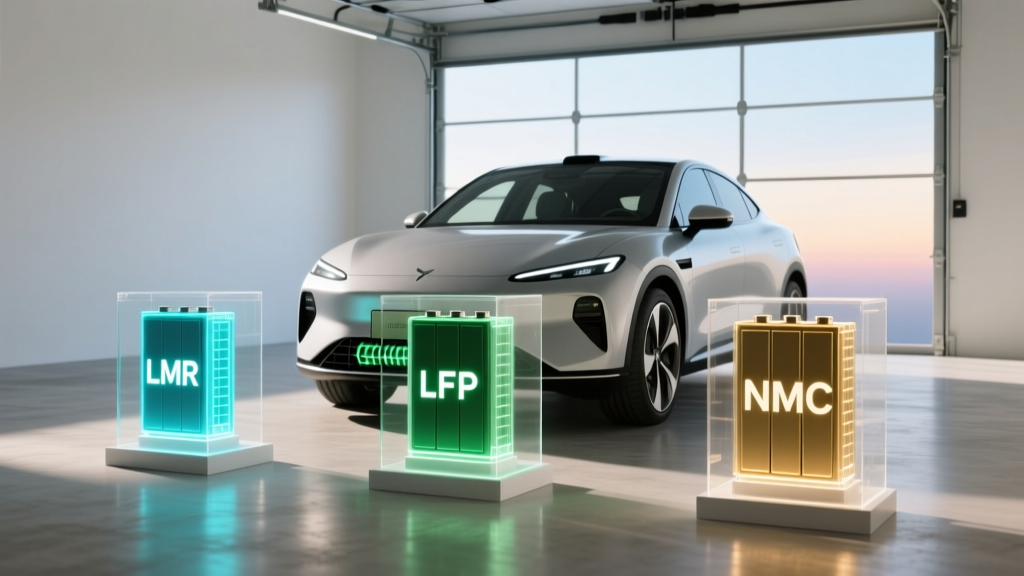
The two dominant lithium-ion chemistries in 2026 EVs carry fundamentally different longevity profiles, cost structures, and recycling economics.
| Attribute | LFP (Lithium Iron Phosphate) | NMC/NCA (Nickel Manganese Cobalt / Nickel Cobalt Aluminum) |
|---|---|---|
| Energy Density | Lower (~160 Wh/kg cell-level) | Higher (~250-300 Wh/kg cell-level) |
| Cycle Life | 3,000-5,000+ cycles | 1,500-2,500 cycles |
| Cold-Weather Performance | Weaker; more range loss below freezing | Better low-temp discharge capability |
| Cost per kWh | Lower ($80-$100/kWh pack-level) | Higher ($110-$140/kWh pack-level) |
| Typical Use | Standard Range trims (Tesla Model 3 RWD, BYD, base Ford Mustang Mach-E) | Long Range / Performance trims, larger SUVs and trucks |
| Recycling Value | Lower — no cobalt or nickel to recover | Higher — cobalt, nickel, and manganese have commodity value |
| SoC Recommendation | Can charge to 100% regularly | Best kept at 80% daily; 100% for trips only |
LFP's longer cycle life makes it inherently more durable, and its tolerance for 100% daily charging simplifies ownership. However, NMC's higher energy density is essential for vehicles targeting 350+ mile range or heavy payloads — a Ford F-150 Lightning Extended Range or Rivian R1T Max Pack couldn't achieve their range targets with LFP at current cell-level densities.
From a recycling perspective, NMC packs command higher recovery value because cobalt and nickel are expensive commodities. LFP recycling is economically viable primarily through lithium recovery and is increasingly supported by direct-recycling processes that preserve cathode structure rather than smelting.
What the Battery Warranty Actually Covers
Federal law mandates a minimum 8-year / 100,000-mile warranty on EV battery packs for emissions-related compliance, and nearly every manufacturer meets or exceeds this baseline. California Air Resources Board (CARB) states require 10 years / 150,000 miles.
| Manufacturer | Warranty Period | Capacity Retention Threshold |
|---|---|---|
| Tesla (Model 3/Y LFP) | 8 yr / 120,000 mi | 70% |
| Tesla (Model 3/Y LR, Model S/X) | 8 yr / 120,000-150,000 mi | 70% |
| Hyundai / Kia | 10 yr / 100,000 mi | 70% |
| Ford (Mustang Mach-E, F-150 Lightning) | 8 yr / 100,000 mi | 70% |
| GM (Ultium-based) | 8 yr / 100,000 mi | 70% (some models 60%) |
| Rivian | 8 yr / 175,000 mi | 70% |
| BMW | 8 yr / 100,000 mi | 70% |
The warranty covers defects and excessive capacity loss — meaning if your pack falls below the stated threshold within the coverage window, the manufacturer replaces or repairs it at no cost. It does not cover damage from collisions, flooding, improper charging equipment, or modifications. Gradual degradation within the threshold (say, 12% loss over 8 years) is considered normal wear.
Warranty claims remain rare. Tesla reported a battery replacement rate under 1% across its fleet through 2023, and most replacements stem from manufacturing defects identified early rather than end-of-life wear.
EV Battery Replacement Costs: What the Numbers Show
Out-of-warranty battery replacement is expensive, but it's also increasingly uncommon. Prices vary dramatically by pack size, chemistry, and vehicle architecture.
| Vehicle | Battery Size (kWh) | Chemistry | Estimated Replacement Cost |
|---|---|---|---|
| Tesla Model 3 RWD | ~60 kWh | LFP | $7,000 - $10,000 |
| Tesla Model Y Long Range | ~75 kWh | NMC | $10,000 - $14,000 |
| Hyundai Ioniq 5 (Long Range) | 77.4 kWh | NMC | $11,000 - $15,000 |
| Ford F-150 Lightning Ext. Range | 131 kWh | NMC | $18,000 - $25,000 |
| Chevrolet Equinox EV | ~85 kWh | NMC (Ultium) | $12,000 - $16,000 |
| Rivian R1T (Max Pack) | ~149 kWh | NMC | $20,000 - $28,000 |
These figures include the battery pack and labor but can fluctuate based on raw material costs and whether the replacement uses a new, remanufactured, or refurbished unit. As the electric vehicle battery recycling market matures, remanufactured packs — assembled from tested, graded cells recovered from returned packs — are becoming a cost-effective alternative, often priced 30-50% below new units.
Context matters here: the vast majority of EVs are scrapped or sold long before their battery reaches replacement age. A 2025 Insurance Information Institute analysis found that EV battery claims represent a small fraction of total EV insurance losses, with collision and comprehensive claims dominating.
How the Electric Vehicle Battery Recycling Market Works in 2026
The global EV battery recycling market has scaled rapidly. BloombergNEF projected the market to exceed $25 billion annually by the late 2020s, driven by the first major wave of EVs reaching end-of-life and tightening regulations on battery sourcing and disposal.
Three primary recycling pathways exist:
- Pyrometallurgical (smelting): Cells are heated to extract cobalt, nickel, and copper. Simple but energy-intensive; recovers ~50-60% of materials and loses lithium and aluminum to slag.
- Hydrometallurgical (chemical leaching): Cells are dissolved in acid solutions, and individual metals are precipitated out. Higher recovery rates (90%+ for key metals) and lower energy use. Companies like Li-Cycle and Redwood Materials use variations of this process.
- Direct recycling: The cathode material is recovered intact without breaking it into constituent elements, preserving its crystal structure. This is the most promising for LFP chemistry, where the cathode material's value lies in its structure rather than its raw elements. DOE-funded research at Argonne National Laboratory has advanced this method significantly.
Redwood Materials, founded by Tesla co-founder JB Straubel, operates one of the largest recycling facilities in North America, processing spent packs from multiple automakers and returning anode copper and cathode precursor materials to the supply chain. Li-Cycle's "Spoke & Hub" model shreds batteries at regional facilities before shipping the intermediate "black mass" to centralized refining plants.
The EU Battery Regulation, fully effective by 2027, mandates minimum recycled-content percentages in new batteries sold in Europe (16% cobalt, 6% lithium, 6% nickel by 2031), which is accelerating investment in recycling capacity globally. The U.S. has no identical mandate, but DOE's Battery Recycling R&D programs and IRA-era supply-chain incentives are driving domestic capacity buildout.
Maximizing Battery Health: What Owners Can Control
Battery degradation is inevitable, but its rate is highly variable based on usage patterns. Here's what the data shows:
Do:
- Keep daily State of Charge between 20-80% for NMC/NCA batteries (LFP can charge to 100% regularly)
- Use Level 2 home charging as your primary method — slow, steady charging generates less heat
- Precondition the battery before DC fast charging (most EVs do this automatically when you navigate to a charger)
- Park in shade or garages during extreme heat; plug in during extreme cold so the thermal management system can operate on grid power
- Update vehicle firmware — manufacturers regularly refine battery management algorithms
Avoid:
- Daily DC fast charging unless necessary — frequent 150+ kW sessions accelerate degradation
- Leaving the vehicle at 100% SoC for extended periods (days/weeks), especially in heat
- Letting the battery sit at 0% SoC — store at ~50% if the vehicle won't be driven for weeks
- Aftermarket modifications to charging systems or battery management
How to Check Your Battery's State of Health (SoH)
State of Health represents remaining capacity as a percentage of the pack's original, nameplate capacity. A new battery is 100% SoH; a degraded pack might sit at 88%.
In-vehicle tools: Most modern EVs display battery health in the settings or energy menu. Tesla owners can access detailed SoH data through the service menu or third-party apps like Tessie. Hyundai/Kia vehicles report SoH in the EV-specific settings. Ford's SYNC system includes a battery health indicator on newer models.
OBD-II diagnostics: Devices like the OBDLink SX paired with apps such as EV Health or ABRP can pull detailed battery telemetry — pack voltage, cell imbalance, estimated capacity in kWh, and calculated SoH. This is the most accurate method outside a dealer service bay.
Dealer/service center: A full diagnostic scan at a manufacturer service center provides the most authoritative SoH reading, including individual module balance data. This is recommended before purchasing a used EV or if you suspect abnormal degradation.
Third-party services: Companies like Recurrent (now part of Cox Automotive) offer battery health reports based on telematics data, useful for used-EV transactions.
Emerging Battery Technologies: What's on the Horizon
Several next-generation technologies are in development, but none are commercially available in production EVs as of 2026:
Solid-state batteries: These replace the liquid electrolyte with a solid material, promising higher energy density (potentially 400+ Wh/kg), faster charging, and improved safety. Toyota has announced limited production for 2027-2028, but initial deployment will be in low volumes and likely restricted to the Japanese market. Samsung SDI, QuantumScape, and Solid Power are also advancing prototypes, but mass-market availability remains 2029+ at the earliest.
Silicon-dominant anodes: Replacing graphite anodes with silicon can increase energy density by 20-40%. Sila Nanotechnologies and Group14 Technologies are supplying early production cells, but silicon anodes still face cycle-life challenges at scale. Expect limited deployment in premium models by 2027-2028.
Sodium-ion batteries: CATL and BYD have begun producing sodium-ion cells for lower-cost, shorter-range applications. These avoid lithium, cobalt, and nickel entirely, reducing supply-chain risk and cost, but offer lower energy density (~120-150 Wh/kg). Likely to appear in budget city cars and stationary storage before passenger EVs in the U.S. market.
None of these technologies should factor into a 2026 purchase decision. Current lithium-ion chemistries — both LFP and NMC — are mature, well-understood, and supported by a growing recycling infrastructure.
Frequently Asked Questions
Will I need to replace my EV battery during ownership?
Statistically, no. The majority of EV batteries outlast the vehicle itself. Fleet data from Tesla, Hyundai, and others shows 85-90%+ capacity retention at 150,000 miles. Out-of-warranty replacements are rare and typically result from collision damage or early manufacturing defects, not gradual wear.
Does frequent DC fast charging hurt my battery?
Yes, but the effect is manageable. Studies show that exclusive DC fast charging (150+ kW) can increase annual degradation by 1-3 percentage points compared to Level 2 charging. For most drivers who fast-charge on road trips and use Level 2 at home, the impact is minimal. The bigger risk is heat — fast charging in hot weather without preconditioning causes the most stress.
What happens to my old battery if it's replaced?
Under warranty, the manufacturer takes possession and routes it to recycling or second-life applications. Out of warranty, most service centers partner with recyclers. Second-life applications — using degraded EV packs for stationary energy storage — are growing, as packs at 70% SoH still have years of useful capacity for less demanding applications.
Is LFP or NMC better for long-term ownership?
For longevity and simplicity, LFP wins: longer cycle life, tolerance for 100% charging, and lower cost. For maximum range and cold-weather performance, NMC is superior. If your daily driving is under 200 miles and you live in a moderate climate, LFP is the pragmatic choice. If you regularly drive 300+ miles or face harsh winters, NMC's energy density and cold-weather output matter more.
Can I check battery health before buying a used EV?
Yes, and you should. Request a dealer diagnostic report, use an OBD-II scanner with EV-compatible software, or use a third-party service like Recurrent. Look for SoH above 85% on vehicles under 80,000 miles, and verify that no individual cell modules show abnormal voltage deviation.
Does the federal EV tax credit affect battery sourcing?
Yes. Under IRS §30D rules, the $7,500 new clean vehicle credit requires that a percentage of battery critical minerals be sourced from the U.S. or free-trade-agreement partners, and battery components must be manufactured or assembled in North America. These thresholds tighten annually. Check current-year requirements on IRS.gov before purchasing, as eligibility depends on the specific vehicle's supply chain, your income, and the vehicle's MSRP.
The electric vehicle battery recycling market is no longer theoretical — it's an operational, scaled industry that underpins the long-term sustainability of EV ownership. Combined with robust warranties, proven chemistry, and declining replacement costs, the battery longevity question has shifted from "will it last?" to "how do I make it last even longer?" The data consistently shows that with basic care, your EV's battery will serve you well for the life of the vehicle.