For most EV buyers, the high-voltage traction battery is the single biggest source of long-term anxiety. How many miles until it degrades? What does a replacement actually cost? And when the pack finally reaches end-of-life, what happens to it? The answer to that last question increasingly involves an EV battery recycler — a specialized facility that recovers lithium, cobalt, nickel, and other critical minerals from retired packs so they can re-enter the supply chain.
But before recycling enters the picture, most EV batteries spend a decade or more in active service, often outlasting the vehicles they power. This guide breaks down exactly how long modern packs last, what warranties cover, how much replacements cost across popular models, and how chemistry choices (LFP vs NMC) shape the entire lifecycle — including what recyclers can recover at the end.
How Long Do EV Batteries Actually Last?
Based on aggregated fleet data and manufacturer disclosures through 2025–2026, the average liquid-cooled EV traction battery retains roughly 90–95% of its original capacity after 5 years / 75,000 miles, and approximately 80–88% after 10 years / 150,000 miles. Catastrophic failure (a pack that suddenly stops working) remains rare — well under 1% of vehicles according to Recurrent's analysis of over 15,000 EVs.
Real-world longevity depends heavily on three variables: battery chemistry, thermal management design, and owner charging habits. A Tesla Model 3 with an NMC pack driven in Arizona heat and DC fast-charged daily will degrade faster than a Chevrolet Bolt with the same chemistry garage-parked in Seattle and charged to 80% on Level 2. The gap can be 10–15 percentage points of capacity retention over a decade.
Typical Degradation Curve (Liquid-Cooled NMC Pack, Moderate Climate):
- Year 1 / 15k mi: ~95–97% SoH (initial formation loss)
- Year 3 / 45k mi: ~92–94% SoH
- Year 5 / 75k mi: ~89–92% SoH
- Year 8 / 120k mi: ~84–88% SoH
- Year 10 / 150k mi: ~80–85% SoH
- Year 15 / 200k+ mi: ~72–80% SoH (approaching recycler threshold)
Sources: Recurrent Auto fleet data, Geotab battery health study, manufacturer warranty disclosures.
The degradation curve is not linear. Most packs experience a steeper drop in the first 12–18 months (electrolyte formation and solid-electrolyte interphase growth), then flatten into a slow, predictable decline. This is why a 3-year-old EV with 93% State of Health (SoH) is not a cause for concern — it's tracking exactly as expected.
LFP vs NMC/NCA: Chemistry Determines Lifespan and Recyclability
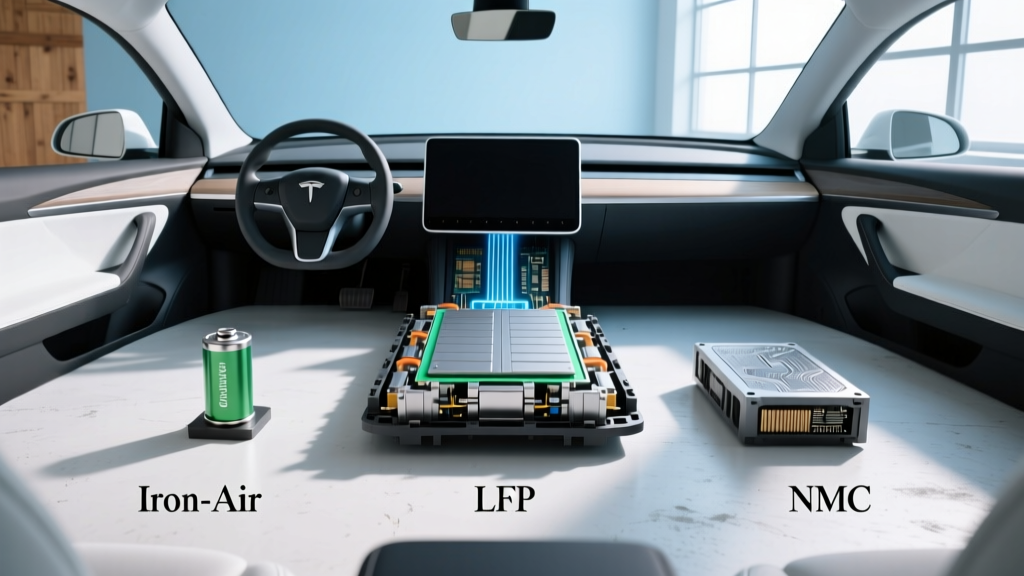
The two dominant lithium-ion chemistries in 2026 EVs — LFP (lithium iron phosphate) and NMC/NCA (nickel manganese cobalt / nickel cobalt aluminum) — have fundamentally different aging profiles and recycling economics.
| Attribute | LFP (LiFePO₄) | NMC / NCA |
|---|---|---|
| Energy Density | ~160–180 Wh/kg (lower) | ~230–270 Wh/kg (higher) |
| Cycle Life | 3,000–5,000+ cycles | 1,000–2,500 cycles |
| Typical Capacity Retention @ 10yr | ~88–93% | ~80–88% |
| Cold-Weather Range Loss | Greater (~30–40% at 20°F) | Moderate (~20–30% at 20°F) |
| Cost per kWh (pack level) | ~$90–$110 | ~$120–$145 |
| Cobalt Content | None | Yes (NMC: 5–10%; NCA: ~5%) |
| Recycler Value | Lower (iron, lithium, phosphate) | Higher (nickel, cobalt, lithium) |
| Common 2026 Applications | Tesla Model 3 RWD, BYD, base Ford Maverick EV | Tesla LR/Performance, Hyundai Ioniq 5, Rivian, Ford F-150 Lightning Extended |
The trade-off in plain terms: LFP packs last significantly longer (higher cycle life), tolerate regular 100% charging without harm, and cost less — but they're heavier, lose more range in freezing weather, and contain no cobalt or nickel, making them less lucrative for an EV battery recycler. NMC/NCA packs offer more range per kilogram and better cold performance, but degrade faster and should ideally be charged to 80% for daily use.
For an owner planning to keep a vehicle 10+ years, LFP is the longevity play. For maximum range in a single charge and better winter driving, NMC/NCA wins — but requires more careful charging discipline.
What Does the Battery Warranty Actually Cover?
Federally mandated minimum battery warranty in the US is 8 years / 100,000 miles (10 years / 150,000 miles in California and states adopting CARB standards). Most manufacturers match or exceed this baseline. The warranty guarantees the pack will retain a specified percentage of original capacity — typically 70% — for the warranty period.
| Manufacturer | Warranty Period | Capacity Threshold | Chemistry Notes |
|---|---|---|---|
| Tesla (Model 3/Y RWD – LFP) | 8 yr / 120,000 mi | 70% retention | LFP; longer cycle life |
| Tesla (Model 3/Y LR & Perf – NMC) | 8 yr / 120,000 mi | 70% retention | NMC/NCA |
| Hyundai / Kia | 10 yr / 100,000 mi | 70% retention | NMC (Ioniq 5/6, EV6, EV9) |
| Ford (F-150 Lightning, Mach-E) | 8 yr / 100,000 mi | 70% retention | NMC |
| GM (Ultium-based: Equinox EV, Blazer EV, Silverado EV) | 8 yr / 100,000 mi | 70% retention | NMC (Ultium) |
| BMW (i4, iX, i7) | 8 yr / 100,000 mi | 70% retention | NMC |
| Rivian (R1T, R1S) | 8 yr / 175,000 mi | 70% retention | NMC; longest mileage coverage |
Critical warranty nuance: The warranty covers capacity loss below the threshold and manufacturing defects. It does not cover damage from accidents, flooding, improper charging equipment, or modifications. If your 82 kWh pack drops to 56 kWh (below 70%) at year 6, the manufacturer replaces or repairs it at no cost. If it drops to 58 kWh (still above 70%), you're on your own — even though you've lost 24 kWh of usable capacity and roughly 60–70 miles of range.
Per the U.S. Department of Energy's EV technology resources, battery warranty claims remain uncommon; the vast majority of packs outlast their warranty periods with capacity well above the guaranteed threshold.
EV Battery Replacement Cost: What You'll Actually Pay
Out-of-warranty battery replacement is the scenario that generates the most fear — and the most misinformation. The reality: pack prices have fallen from over $200/kWh in 2018 to roughly $110–$145/kWh at the pack level in 2026, depending on chemistry and manufacturer. Installed replacement costs (including labor, diagnostics, coolant refill, and software calibration) are higher.
| Vehicle | Battery Size | Chemistry | Estimated Pack Cost | Installed Cost (est.) |
|---|---|---|---|---|
| Tesla Model 3 RWD | 60 kWh | LFP | $6,000–$7,500 | $9,000–$12,000 |
| Tesla Model Y Long Range | 75 kWh | NMC | $9,000–$11,000 | $13,000–$16,000 |
| Hyundai Ioniq 5 (Long Range) | 77.4 kWh | NMC | $9,500–$11,500 | $13,500–$17,000 |
| Ford F-150 Lightning Extended | 131 kWh | NMC | $16,000–$20,000 | $22,000–$28,000 |
| Chevrolet Equinox EV | 85 kWh | NMC (Ultium) | $10,000–$12,500 | $14,000–$18,000 |
| Rivian R1T (Large Pack) | 149 kWh | NMC | $18,000–$22,000 | $24,000–$30,000 |
| BMW iX xDrive50 | 111.5 kWh | NMC | $14,000–$17,000 | $19,000–$24,000 |
When is replacement actually needed? For the overwhelming majority of owners, it isn't. Battery replacements are typically needed only after 200,000+ miles, after a collision or flood damages the pack, or in rare cases of manufacturing defect outside the warranty window. Most EVs are scrapped or sold for other reasons (body damage, electronics failure, owner preference) long before the battery reaches end-of-life.
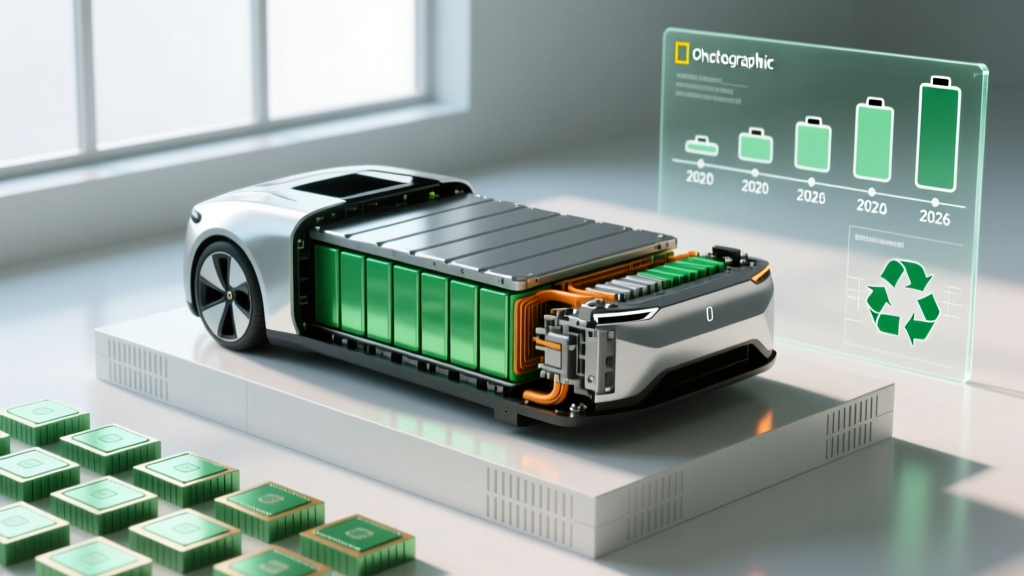
When a pack does reach ~70% SoH or below and is removed, it enters one of three paths: remanufacturing (weak modules replaced, pack reassembled), second-life applications (stationary energy storage for solar or grid buffering at 60–70% SoH), or recycling via an EV battery recycler that uses hydrometallurgical or pyrometallurgical processes to extract raw materials.
Factors That Accelerate (or Preserve) Battery Life
Not all miles are equal when it comes to degradation. The following factors have measurable, data-backed effects on how quickly a pack loses capacity:
Habits That Preserve Battery Health:
- Charge to 80% daily (NMC/NCA): Sustained high SoC stresses the cathode. LFP owners can charge to 100% regularly without significant penalty.
- Use Level 2 (home) charging as primary: 7–11 kW AC charging generates far less heat than 150–350 kW DC fast charging.
- Precondition before fast charging: Bring the pack to 30–50°C before DC charging to reduce lithium plating risk. Most EVs do this automatically when you navigate to a charger.
- Avoid prolonged storage at 100% or 0% SoC: If storing for 2+ weeks, leave the pack at ~50%.
- Use scheduled charging to minimize time spent at high SoC — set your charger to finish right before you leave.
Habits That Accelerate Degradation:
- Frequent DC fast charging: Packs DC-charged >3x/week show measurably faster degradation in Geotab and Recurrent datasets — roughly 1–2% additional loss over 5 years vs. primarily L2 charging.
- Extreme heat exposure: Sustained ambient temps above 95°F with no garage parking accelerate electrolyte decomposition. Active liquid cooling mitigates this substantially.
- Deep cycling to 0%: Regularly draining below 10% stresses the anode and can trigger copper dissolution in extreme cases.
- High-performance launch usage: Repeated hard acceleration draws extreme C-rates, generating internal heat.
How to Monitor Your Battery's State of Health (SoH)
State of Health (SoH) is the percentage of original capacity your pack currently holds. A new EV starts at 100% SoH; a 5-year-old pack at 91% SoH has lost 9% of its original energy storage.
How to check SoH by brand:
- Tesla: No native SoH display in the app. Use third-party tools like TeslaFi or Scan My Tesla (OBD-II dongle + app) to read BMS-reported capacity. Alternatively, charge to 100% and compare displayed range to original EPA rating.
- Hyundai / Kia: The infotainment system's EV diagnostics menu shows battery health percentage on most 2024+ models (Ioniq 5, EV6, EV9).
- Ford: The FordPass app and in-vehicle diagnostics display battery health status; the OBD-II port supports third-party SoH reads.
- GM (Ultium): The myChevrolet/myCadillac app provides battery health indicators; OnStar diagnostics reports include SoH data.
- Universal method: Charge to 100%, note the displayed range, and compare to the original EPA range. If your Ioniq 5 originally showed 303 miles at 100% and now shows 270, your SoH is approximately 89%. This is imprecise (temperature and recent driving style affect the estimate) but directionally useful.
For pre-purchase inspections on used EVs, request a battery health report from the dealer or use a service like Recurrent's free battery report (available for many models) which aggregates telematics data to provide an SoH estimate and range forecast.
When an EV Battery Recycler Gets Involved
An EV battery recycler enters the lifecycle at one of three points:
- Manufacturing scrap: Cell and pack production generates 5–10% scrap material (defective electrodes, trimmings, rejected cells). Recyclers like Redwood Materials and Li-Cycle process this directly back into cathode and anode precursor material.
- End-of-vehicle-life: When an EV is totaled, scrapped, or retired, the pack is removed. If SoH is above ~70%, it typically enters second-life stationary storage. Below ~60%, it goes to a recycler for material extraction.
- Warranty replacement packs: Failed packs returned under warranty are either remanufactured by the OEM or sent to a recycling partner for material recovery.
Modern hydrometallurgical recycling (used by Redwood Materials, Li-Cycle, and Circulor-tracked supply chains) recovers 90–95% of lithium, 95%+ of cobalt and nickel, and significant copper and aluminum. This recovered material is increasingly fed back into new battery production — Tesla, Panasonic, and Ford all source recycled cathode material as of 2025–2026.
The economics favor NMC/NCA recycling over LFP because of cobalt and nickel value. An NMC pack yields roughly $25–$40/kWh in recoverable material value; an LFP pack yields $8–$15/kWh. This gap is narrowing as lithium recovery processes improve and LFP volume scales.
Emerging Battery Tech: Solid-State and Silicon Anodes
Forward-looking context — not currently available in production vehicles:
- Solid-state batteries: Toyota, Samsung SDI, and QuantumScape are targeting limited production in 2027–2029. Promised benefits include 40–50% higher energy density, 10-minute fast charging, and improved safety (no liquid electrolyte). Realistic mass-market availability is 2029–2031 at earliest. Degradation and cycle-life data from production-scale cells is not yet published.
- Silicon-dominant anodes: Sila Nanotechnologies and Group14 are supplying silicon-carbon composite anodes to Panasonic and Mercedes-Benz (announced for future EQ models). These increase energy density 15–25% over graphite anodes. Early commercial deployment is expected in 2027–2028 model-year vehicles.
- Sodium-ion batteries: CATL and BYD are producing sodium-ion cells for lower-cost, shorter-range applications. Energy density is ~20–30% below LFP, but raw material costs are dramatically lower. Likely limited to budget city EVs and stationary storage in the near term.
None of these technologies change the current calculus for a 2026 EV purchase. Today's LFP and NMC packs, properly maintained, will last 150,000–250,000 miles before approaching the 70% SoH threshold where a recycler or second-life application becomes relevant.
Frequently Asked Questions
How long do EV batteries last in years and miles?
Most modern liquid-cooled EV batteries retain 80–88% of original capacity at 10 years / 150,000 miles. LFP chemistry packs often retain 88–93% at the same interval. Physical failure is rare; gradual capacity loss is the norm. Many packs remain functional (above 70% SoH) past 200,000 miles.
How much does an EV battery cost to replace in 2026?
Installed replacement costs range from approximately $9,000 for a 60 kWh LFP pack (Tesla Model 3 RWD) to $28,000+ for a 131–149 kWh NMC pack (F-150 Lightning Extended, Rivian R1T). Most owners never need a replacement — the battery outlasts the vehicle's economic life.
What does the federal battery warranty cover?
Minimum US coverage is 8 years / 100,000 miles (10/150k in CARB states), guaranteeing the pack retains at least 70% of original capacity. It covers manufacturing defects and abnormal degradation. It does not cover accident damage, flood, or aftermarket modifications. Hyundai/Kia and Rivian offer above-baseline terms.
How do I check my EV battery's State of Health?
Methods vary by brand: Hyundai/Kia show SoH in the infotainment diagnostics menu; Ford and GM offer health indicators via their apps. Tesla owners can use third-party OBD-II tools (TeslaFi, Scan My Tesla). The universal method is charging to 100% and comparing displayed range to the original EPA figure.
LFP vs NMC — which chemistry is better for me?
Choose LFP if you prioritize longevity, plan to keep the vehicle 10+ years, charge at home primarily, and don't need maximum single-charge range. Choose NMC/NCA if you need longer range per charge, drive frequently in cold climates, or need the lightest possible pack for performance. LFP tolerates 100% daily charging; NMC prefers 80% daily with 100% only for road trips.
What happens to my EV battery when it dies?
Retired packs enter one of three paths: remanufacturing (module replacement for continued vehicle use), second-life stationary energy storage (60–70% SoH is fine for solar/grid buffering), or recycling. An EV battery recycler recovers 90–95% of lithium, cobalt, and nickel using hydrometallurgical processes, feeding material back into new battery production.
Does frequent DC fast charging damage my battery?
It accelerates degradation modestly. Fleet data from Geotab shows vehicles DC fast-charged more than 3 times per week lose approximately 1–2% more capacity over 5 years compared to primarily Level 2-charged vehicles. Preconditioning the battery before fast charging and avoiding charging above 80% on DC mitigates most of this effect.
The bottom line: EV battery technology in 2026 is mature enough that the pack is no longer the liability it was perceived to be a decade ago. With proper care — primarily Level 2 charging, moderate SoC habits for NMC, and thermal preconditioning — most owners will sell or retire their vehicle long before the battery needs replacement. And when it finally does reach end-of-life, an EV battery recycler ensures that 90%+ of the critical minerals come back into the supply chain rather than sitting in a landfill.