Knowing how to recharge a battery in an electric vehicle goes far beyond plugging in. The chemistry inside your high-voltage traction pack, the state of charge (SoC) you leave it at overnight, and the temperatures you expose it to all determine whether that pack delivers 95% of its original capacity after eight years — or drops below the warranty threshold and needs attention. This guide walks through the science, the data, and the daily habits that keep an EV battery healthy for the long haul.
How Long Do EV Batteries Last?
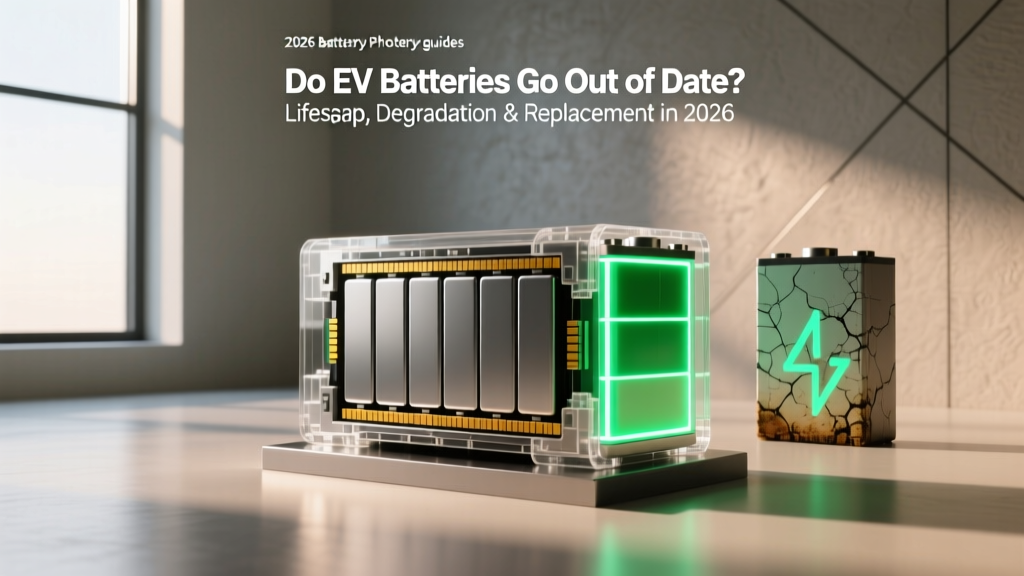
Most modern lithium-ion traction batteries are engineered to outlast the vehicle they power. Real-world fleet data from Recurrent Auto shows that the average EV battery retains roughly 90–95% of its original capacity after 5 years and 60,000 miles. By year 8 and 100,000 miles, most packs still hold 80–90%, well within manufacturer warranty thresholds.
That said, longevity is not uniform. A 2023 study published in Joule analyzed over 12,000 EV battery tests and found that batteries in temperate climates degraded roughly 1.5% per year, while those in hot climates (sustained above 90°F) lost closer to 2.5–3% annually. Cold climates introduce a different problem: reduced charging speed and temporary range loss, but less permanent degradation than heat.
Year 1: ~2–3% loss (initial formation drop) • Years 2–5: ~1–1.5% per year • Years 6–10: ~1–2% per year (gradual acceleration) • Expected SoH at 150,000 miles: 80–88%
The key takeaway: the steepest degradation happens early. After the first year or two, the curve flattens considerably. Most owners will trade or sell their EV before the battery reaches a state requiring replacement.
LFP vs. NMC/NCA: Which Battery Chemistry Is Better?
Not all EV batteries are built the same. The two dominant cathode chemistries in 2026 are Lithium Iron Phosphate (LFP) and Nickel Manganese Cobalt (NMC), with Nickel Cobalt Aluminum (NCA) used primarily by Tesla and a few others. Each has distinct trade-offs that affect how you should recharge and care for the battery.
| Attribute | LFP (Lithium Iron Phosphate) | NMC / NCA |
|---|---|---|
| Energy Density | Lower (~160 Wh/kg cell-level) — heavier pack for same range | Higher (~250 Wh/kg) — more range in less weight |
| Cycle Life | 3,000–5,000+ cycles before 80% SoH | 1,000–2,000 cycles before 80% SoH |
| Cold Performance | Weaker — slower charging, more range loss below 32°F | Better — preconditioning mitigates most cold issues |
| Recommended SoC | Charge to 100% regularly (helps BMS calibration) | 80% daily; 100% only for trips |
| Cost | ~15–20% cheaper per kWh — no cobalt or nickel | Higher raw-material cost |
| Typical Vehicles (2026) | Tesla Model 3 RWD, Model Y RWD, Ford Mustang Mach-E Select (base), BYD models | Tesla Long Range, Hyundai Ioniq 5/6, Kia EV6/EV9, Chevy Equinox EV, Rivian |
Which is better? It depends on your priorities. If you want maximum range per pound, need fast cold-weather charging, or tow frequently, NMC/NCA is the stronger pick. If you plan to keep the vehicle 10+ years, charge at home nightly, and want lower upfront cost, LFP's superior cycle life and 100%-friendly charging make it ideal. Tesla now recommends LFP-equipped Model 3 and Model Y owners charge to 100% at least once a week — a direct reversal of the NMC advice.
What Does the EV Battery Warranty Cover?
Federal law mandates a minimum 8-year/100,000-mile warranty on EV battery packs (10 years/150,000 miles in California and states that follow CARB standards). But the details matter — specifically, what capacity retention threshold triggers a claim and what's excluded.
| Manufacturer | Coverage Period | Capacity Threshold | Notes |
|---|---|---|---|
| Tesla | 8 yr / 120,000 mi (LR/AWD); 8 yr / 100,000 mi (RWD) | 70% retention | Module-level repair when possible |
| Hyundai / Kia | 10 yr / 100,000 mi | 70% retention | Among the longest coverage periods |
| Ford | 8 yr / 100,000 mi | 70% retention | Covers battery and hybrid components |
| GM (Chevy/Cadillac) | 8 yr / 100,000 mi | 70% retention (some models 60%) | Ultium platform packs |
| Rivian | 8 yr / 175,000 mi | 70% retention | Higher mileage cap reflects truck use |
A warranty claim requires the battery's State of Health (SoH) to drop below the stated threshold — not just a perceived loss of range. Manufacturers use diagnostic scans to verify. Damage from accidents, flooding, or unauthorized modifications is excluded. Importantly, gradual degradation that stays above 70% is considered normal wear, not a defect.
How Much Does an EV Battery Cost to Replace?
This is the question that keeps potential EV buyers up at night — but the data tells a less alarming story. Full battery replacement is rare within the first 10–15 years, and when it is needed, costs have fallen significantly.
| Vehicle / Pack Size | Battery Capacity | Replacement Cost (Parts + Labor) | When Typically Needed |
|---|---|---|---|
| Tesla Model 3 RWD (LFP) | ~60 kWh | $10,000–$14,000 | Rare before 200,000+ mi |
| Tesla Model Y LR (NMC) | ~75 kWh | $13,000–$18,000 | Rare before 180,000+ mi |
| Hyundai Ioniq 5 | 77.4 kWh | $14,000–$20,000 | Rare before 150,000+ mi |
| Ford F-150 Lightning (Extended) | ~131 kWh | $22,000–$32,000 | Rare before 150,000+ mi |
| Chevrolet Bolt EV/EUV (older) | 65 kWh | $9,000–$14,000 | Post-recall packs more reliable |
For context, the average gasoline vehicle will spend $6,000–$10,000 on engine and transmission repairs over the same mileage range. And most EV battery replacements involve individual module swaps rather than full pack replacements, which can cut costs by 40–60%. According to Consumer Reports, EVs have lower lifetime maintenance costs than internal-combustion vehicles, even accounting for the rare battery replacement.
Factors That Affect EV Battery Life
Understanding how to recharge a battery for maximum longevity means understanding what stresses lithium-ion cells. Here are the primary factors, ranked by impact:
1. State of Charge Habits
For NMC/NCA batteries, routinely sitting at 100% SoC accelerates electrolyte decomposition and cathode wear. The sweet spot for daily driving is 20–80%. LFP batteries are more tolerant of 100% states and actually benefit from periodic full charges to recalibrate the Battery Management System (BMS).
2. Extreme Temperatures
Heat is the enemy of lithium-ion longevity. Sustained exposure to ambient temperatures above 95°F (35°C) — especially while the battery is at high SoC — accelerates degradation. Cold doesn't permanently damage cells but temporarily reduces capacity and slows charging speeds. Preconditioning the battery (warming it before DC fast charging) is essential in winter to avoid lithium plating.
3. DC Fast Charging Frequency
DC fast charging at 150+ kW generates significant heat inside the cells. Occasional road-trip fast charging is fine, but daily reliance on DCFC without adequate thermal management will add up. Studies from the National Renewable Energy Laboratory (NREL) show that packs charged primarily on Level 2 (7–11 kW) degrade 20–30% less over 100,000 miles than those charged predominantly on DCFC.
4. Depth of Discharge
Regularly draining the battery to near 0% before recharging stresses cells more than shallow cycles. Plug in when you can — a 30–70% cycle is gentler than a 5–95% cycle, even though both deliver the same net energy.
5. Storage Conditions
Leaving an EV unplugged for weeks at very low or very high SoC, especially in hot weather, can cause irreversible capacity loss. If storing for more than two weeks, set the charge limit to 50–60% and keep the vehicle plugged in so the thermal management system can operate.
- Set charge limit to 80% for daily driving (NMC/NCA) or 100% (LFP)
- Plug in overnight on Level 2 whenever possible — shallow top-ups beat deep cycles
- Precondition the battery before DC fast charging in cold weather
- Avoid leaving the car at 100% SoC for more than a few hours in hot weather
- Use scheduled charging / scheduled departure to time your charge finish close to departure
- If storing for 2+ weeks, leave at ~50% SoC and plugged in
- Limit DC fast charging to road trips when Level 2 is available at home
How to Check and Monitor Battery Health (SoH)
State of Health (SoH) is a percentage representing the battery's current maximum capacity relative to its original capacity. A new battery is 100% SoH; a battery that can now hold only 72 kWh of its original 80 kWh is at 90% SoH.
Built-In Vehicle Tools
Most 2026 EVs include a battery health indicator in the infotainment system. Tesla's service menu (accessible via the software screen) shows estimated range at 100% compared to original. Hyundai's Bluelink and Kia's UVO/Kia Connect apps display SoH estimates. Ford's SYNC system on the Mustang Mach-E and F-150 Lightning provides a battery health readout in the settings.
OBD-II Diagnostic Apps
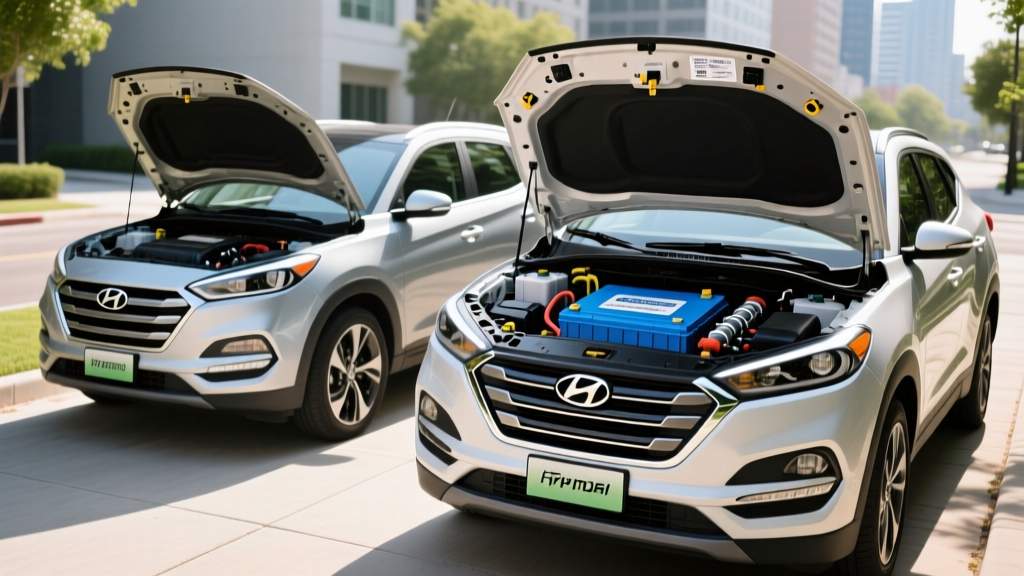
For more granular data, OBD-II dongles paired with apps like LeafSpy (Nissan Leaf), OBDeleven (VW Group), or Scan My Tesla can read individual cell voltages, pack temperature, and precise SoH figures from the BMS. These tools are particularly useful when buying a used EV and wanting independent verification.
Dealer Diagnostics
Any authorized dealer can run a full battery health report. If you suspect your SoH has dropped below the warranty threshold (typically 70%), request this scan. The dealer will compare measured capacity to the original spec and determine warranty eligibility.
How to Recharge a Battery for Maximum Lifespan
Putting it all together, here's the practical framework for how to recharge a battery in your EV to maximize its usable life:
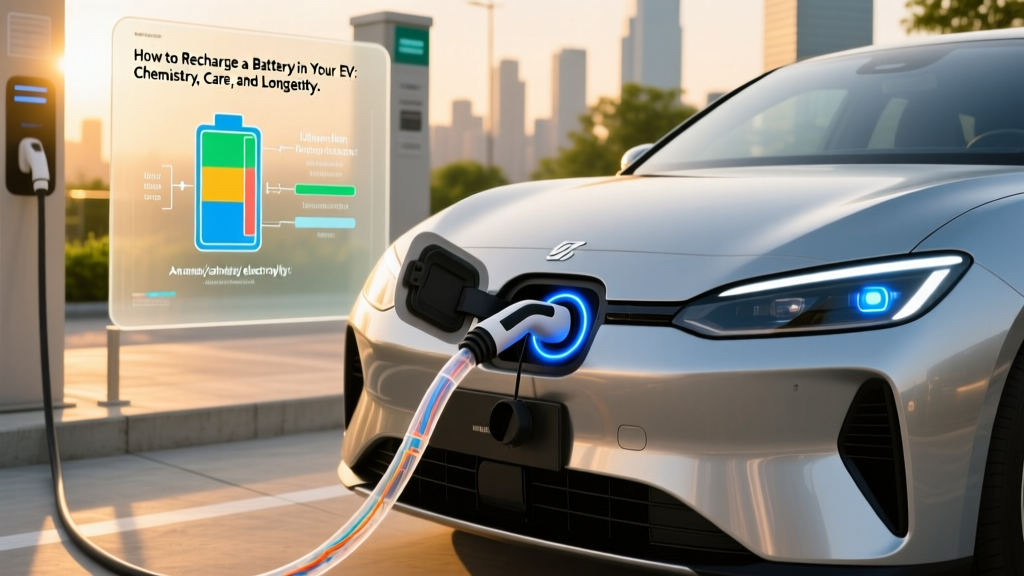
Level 2 home charging is your baseline. A 7.2–11.5 kW Level 2 charger (240V, 30–48 amp circuit) adds 25–44 miles of range per hour and generates minimal heat. This is the gentlest, most efficient way to recharge daily. Installation typically costs $800–$2,500 depending on panel capacity and run length, per U.S. Department of Energy estimates.
Use DC fast charging strategically. On road trips, DCFC at 150–350 kW is essential. But avoid using it as your primary charging method. When you do fast charge, precondition the battery (most EVs do this automatically when you navigate to a charger), and charge only to 80% — the charging curve tapers sharply above 80%, making the last 20% disproportionately slow and heat-intensive.
Charge to 100% only when needed (NMC/NCA). If you have a long drive ahead, charge to 100% but time it so you depart shortly after reaching full charge. Don't let the car sit at 100% overnight. LFP owners can disregard this — charge to 100% freely.
Let regen do the work. Moderate regenerative braking settings reduce the need for friction brakes and keep the battery in a gentle charge-discharge rhythm. Extreme regen settings on a cold, fully charged battery can stress cells — many EVs automatically limit regen when the battery is cold or near 100%.
Emerging Battery Technology: What's Next
Several next-generation technologies are in development, though none are widely available in production vehicles as of 2026:
Solid-state batteries replace the liquid electrolyte with a solid material, promising higher energy density (potentially 400+ Wh/kg), faster charging, and improved safety. Toyota has announced a solid-state battery targeting 2027–2028 production, initially in limited volumes. Samsung SDI and QuantumScape are also in advanced testing. Realistic mass-market availability is likely 2029–2031.
Silicon-dominant anodes can store roughly 10× more lithium ions than graphite anodes, boosting energy density. Companies like Sila Nanotechnologies and Group14 are supplying early production cells, with the Mercedes G-Class EV (announced) among the first potential applications. Expect incremental adoption through 2027–2028.
Sodium-ion batteries eliminate lithium entirely, using abundant sodium instead. CATL has begun limited production in China for smaller EVs. Energy density is lower than LFP, making sodium-ion best suited for city cars and stationary storage. U.S. availability is not expected before 2028.
These technologies are promising but remain in the announced or limited-production stage. Current LFP and NMC chemistries, properly cared for, remain excellent choices for 2026 buyers.
Frequently Asked Questions
How long do EV batteries last in years and miles?
Most EV batteries retain 80–90% of original capacity after 8 years and 100,000 miles. With proper care, many packs reach 200,000+ miles before dropping below 70% SoH. LFP chemistries tend to outlast NMC in cycle count, though NMC offers better energy density and cold performance.
How much does it cost to replace an EV battery?
Full pack replacement ranges from roughly $9,000 for a smaller pack (Chevy Bolt) to $32,000 for a large truck pack (F-150 Lightning Extended Range). However, most replacements involve individual modules at 40–60% less cost. Full replacement is rarely needed within the first 150,000 miles.
What does the battery warranty actually cover?
Federal minimum is 8 years/100,000 miles (10/150,000 in CARB states). Coverage applies if SoH drops below a stated threshold — typically 70% of original capacity. Exclusions include accident damage, flooding, and unauthorized modifications. Normal degradation above the threshold is not covered.
Is it bad to fast-charge my EV every day?
Daily DC fast charging isn't catastrophic, but it accelerates degradation compared to Level 2 charging. NREL data shows roughly 20–30% more capacity loss over 100,000 miles for DCFC-dominant charging patterns. If you must rely on DCFC, precondition the battery and limit charges to 80%.
LFP vs. NMC — which should I choose?
Choose LFP if you want maximum cycle life, plan to own the vehicle 10+ years, primarily charge at home, and don't need maximum range or cold-weather fast-charging speed. Choose NMC/NCA if you need the longest range, frequently drive in cold climates, or tow heavy loads. Both chemistries are proven and reliable in 2026.
How do I check my EV battery's State of Health?
Check the built-in battery health readout in your vehicle's infotainment or companion app. For more detail, use an OBD-II diagnostic tool like LeafSpy or Scan My Tesla. Dealers can run a full diagnostic scan that compares current capacity to original specifications.
Should I charge my EV to 100% every night?
For NMC/NCA batteries, no — set the limit to 80% for daily use. For LFP batteries, Tesla and other manufacturers recommend charging to 100% at least weekly to maintain BMS calibration. Always consult your owner's manual for chemistry-specific guidance.