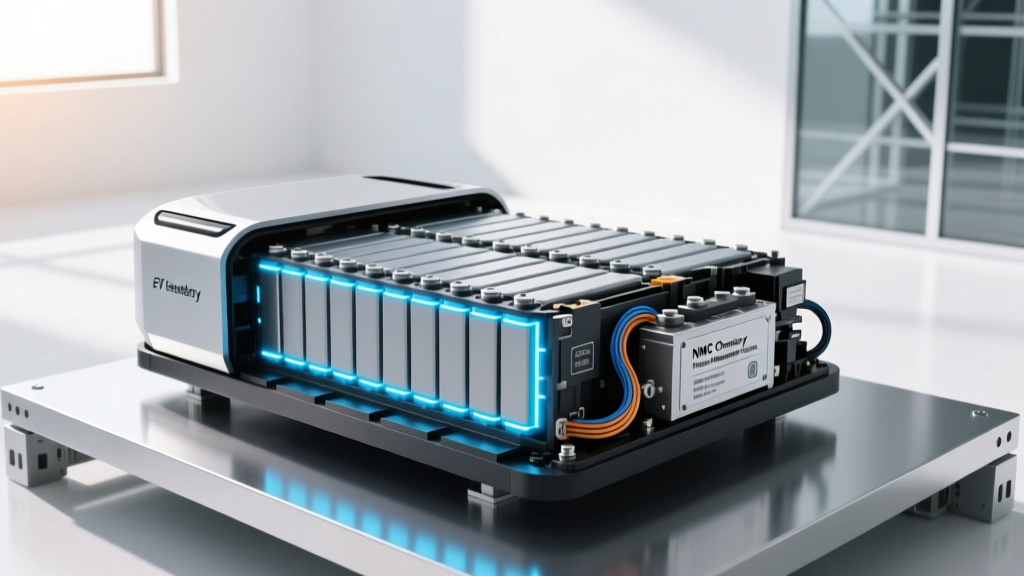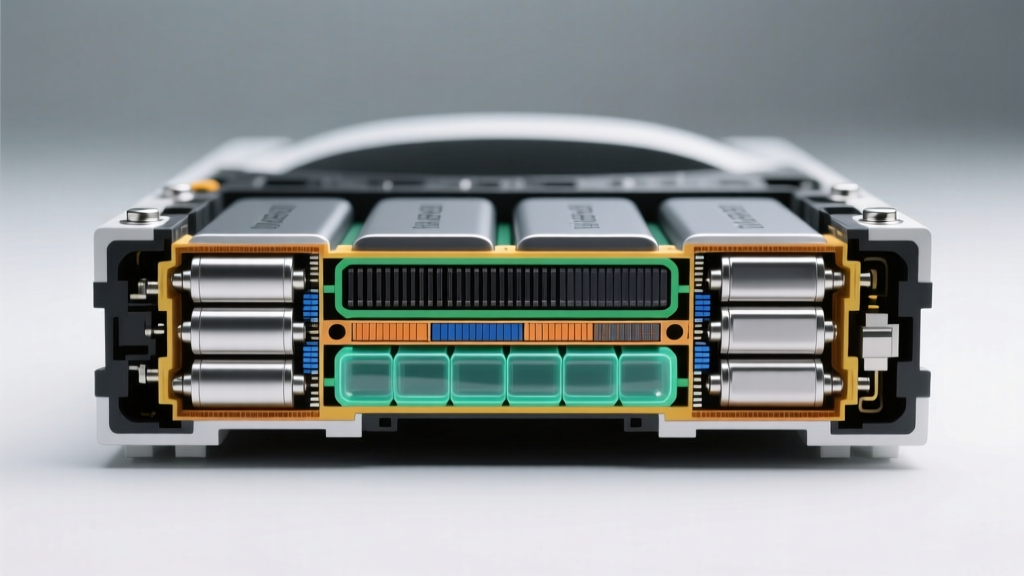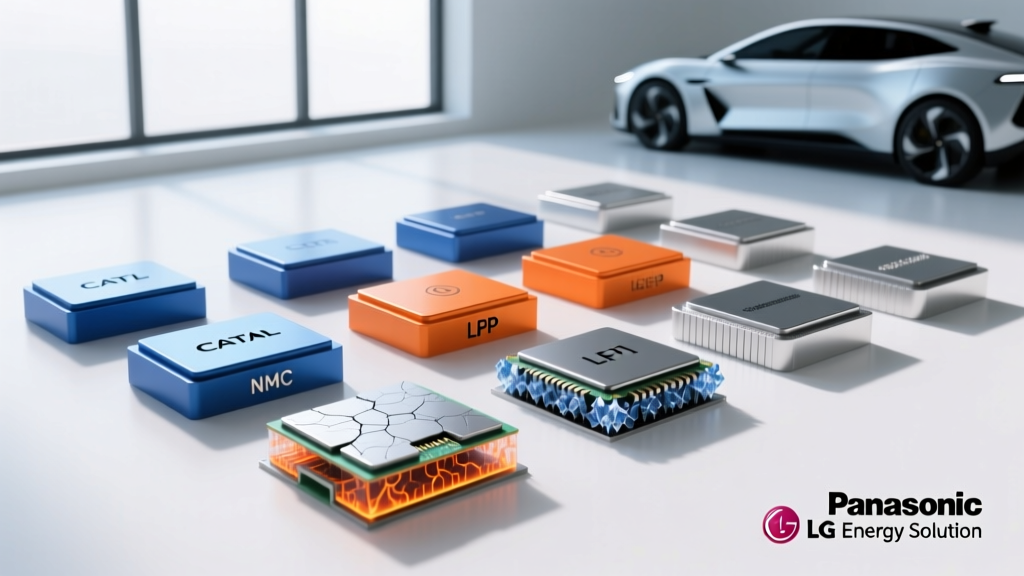
When automakers design an electric vehicle, one of the most consequential decisions they make isn't about horsepower or styling — it's which battery manufacturer supplies the cells. That choice determines your EV's range, charging speed, longevity, cold-weather performance, and ultimately what a replacement might cost a decade from now.
Yet most buyers never look past the badge on the hood. In 2026, the global EV battery supply chain is dominated by a handful of cell makers, each with distinct chemistry strategies and OEM partnerships. Understanding who builds your battery — and what chemistry they use — is one of the most practical things you can do before signing a purchase agreement.
The Major EV Battery Manufacturers and Their OEM Partners
Five companies account for roughly 80% of global EV battery cell production. Here's how they align with the vehicles you can actually buy in the U.S. market today:
| Manufacturer | Headquarters | Primary Chemistries | Key U.S. OEM Partners |
|---|---|---|---|
| CATL | China | LFP, NMC, sodium-ion (emerging) | Tesla (Model 3/Y Standard Range), Ford, BMW |
| BYD (FinDreams) | China | LFP (Blade Battery) | BYD vehicles, Tesla (select markets), Toyota |
| LG Energy Solution | South Korea | NMC (high-nickel NCMA) | GM (Ultium), Hyundai/Kia, Stellantis, Honda |
| Panasonic | Japan | NCA, NMC (cylindrical 4680) | Tesla (Long Range/Performance models) |
| SK On | South Korea | NMC (pouch cells) | Ford (F-150 Lightning, Mustang Mach-E), Hyundai |
Why does this matter to you? Because the manufacturer's chemistry choice cascades into everything you experience as an owner. An LFP cell from CATL in a Tesla Model 3 Rear-Wheel Drive behaves very differently over 100,000 miles than a high-nickel NMC pouch from SK On in a Ford F-150 Lightning — even though both vehicles are excellent in their segments.
LFP vs NMC: The Chemistry Trade-Off That Defines Your Ownership
The single most impactful decision a battery manufacturer makes is cell chemistry. In the U.S. market, you'll encounter two primary families: LFP (lithium iron phosphate) and NMC/NCA (nickel manganese cobalt / nickel cobalt aluminum). Each carries distinct engineering trade-offs.
| Attribute | LFP (e.g., CATL, BYD Blade) | NMC/NCA (e.g., LG, Panasonic, SK On) |
|---|---|---|
| Energy density (cell-level) | ~160–180 Wh/kg | ~220–280 Wh/kg |
| Cycle life (to 80% capacity) | 3,000–5,000+ cycles | 1,000–2,000 cycles |
| Calendar life | Excellent — slower degradation at rest | Good — degrades faster at high SoC |
| Cold-weather performance | Weaker — ~30–40% range loss below 20°F | Better — ~20–30% range loss below 20°F |
| DC fast-charge tolerance | High — handles frequent 100% charges well | Moderate — best kept 20–80% daily |
| Thermal runaway risk | Very low | Low, but higher than LFP |
| Cost per kWh (cell) | ~$70–90/kWh | ~$100–130/kWh |
| Best suited for | Standard-range models, daily commuters, hot climates | Long-range models, cold climates, performance trims |
The practical takeaway: If you're buying a Tesla Model 3 RWD or a base-range EV for commuting and can charge at home nightly, LFP is arguably the superior chemistry for longevity. If you need 320+ miles of EPA range, live in Minnesota, or regularly road-trip, NMC gives you the energy density you need.
Notably, LFP batteries don't contain cobalt or nickel, which reduces exposure to the supply-chain and human-rights concerns associated with those minerals — a factor in IRS §30D critical-mineral sourcing requirements for the federal tax credit.
How Long Do EV Batteries Actually Last? Degradation Data
This is the question every prospective EV owner asks, and the answer is more reassuring than the fear-mongering suggests. Modern battery packs from major manufacturers are engineered to outlast the typical ownership cycle of the vehicle itself.
Typical Degradation Curve (Aggregated Fleet Data):
- Year 1 (~12,000 mi): 2–5% capacity loss (initial formation loss)
- Year 3 (~36,000 mi): 5–8% total loss
- Year 5 (~60,000 mi): 8–12% total loss
- Year 8 (~96,000 mi): 10–15% total loss
- Year 10 (~120,000 mi): 12–20% total loss (highly usage-dependent)
Data from Recurrent Auto, which tracks over 15,000 EVs in real-world conditions, shows that the median Tesla Model 3 retains approximately 90% of its original range at 60,000 miles. Hyundai/Kia EVs with LG NMC cells show similar retention, with some Ioniq 5 owners reporting 93%+ State of Health at 50,000 miles.
LFP batteries from CATL and BYD are showing even flatter degradation curves in early fleet data, with some Tesla Model 3 RWD (LFP) vehicles retaining 95%+ capacity after 40,000 miles — consistent with LFP's superior cycle-life characteristics.
Crucially, degradation is non-linear: the steepest drop occurs in the first year or two, then the curve flattens considerably. A pack that retains 88% at year 4 will likely retain 82–85% at year 8, not continue dropping at the initial rate.
What Does the Battery Warranty Actually Cover?
Federal law in the U.S. mandates that EV batteries carry a minimum warranty of 8 years / 100,000 miles (10 years / 150,000 miles in CARB states like California). But the details vary significantly by manufacturer, and those details matter when you're 7 years into ownership.
| Automaker | Battery Supplier | Warranty Term | Capacity Threshold | Notes |
|---|---|---|---|---|
| Tesla | Panasonic / CATL | 8 yr / 120,000 mi (Long Range); 8 yr / 100,000 mi (RWD) | 70% retention | Transferable to second owner |
| Hyundai / Kia | LG Energy Solution / SK On | 10 yr / 100,000 mi | 70% retention | Among the longest in the industry |
| GM (Chevrolet/Cadillac) | LG (Ultium) | 8 yr / 100,000 mi | 70% retention | Modular pack — individual module replacement possible |
| Ford | SK On / CATL | 8 yr / 100,000 mi | 70% retention | F-150 Lightning: extended to 100,000 mi |
| BMW | CATL / Samsung SDI | 8 yr / 100,000 mi | 70% retention | iX and i4 covered under standard terms |
What triggers a warranty claim? If your battery's usable capacity drops below the stated threshold (typically 70% of original) within the warranty period, the manufacturer must repair or replace it at no cost. In practice, very few owners hit this threshold — as the degradation data above shows, most packs retain 80–88% at the 8-year mark.
What's NOT covered: Physical damage (collision, flooding), aftermarket modifications, and in some cases, failure to follow recommended charging practices (though this is rarely enforced). The warranty covers the high-voltage traction battery only — not the 12V auxiliary battery, which is a separate, conventional component.
EV Battery Replacement Cost: What You'd Actually Pay
Replacement cost is the specter that haunts EV forums, but context is essential: the vast majority of EV batteries never need full replacement. When they do, it's typically due to a manufacturing defect (covered by warranty) or physical damage, not simply "wearing out."
| Vehicle | Battery Size | Chemistry | Estimated Replacement Cost |
|---|---|---|---|
| Tesla Model 3 RWD | ~60 kWh (usable) | LFP (CATL) | $8,000–$12,000 |
| Tesla Model Y Long Range | ~75 kWh (usable) | NCA (Panasonic) | $12,000–$16,000 |
| Hyundai Ioniq 5 | 77.4 kWh (usable) | NMC (LG/SK On) | $11,000–$15,000 |
| Ford F-150 Lightning Ext. Range | ~131 kWh (usable) | NMC (SK On) | $18,000–$28,000 |
| Chevrolet Equinox EV | ~85 kWh (usable) | NMC (LG Ultium) | $10,000–$14,000 |
| BMW iX xDrive50 | ~105 kWh (usable) | NMC (Samsung SDI) | $16,000–$22,000 |
These figures include the battery module(s) and labor but can vary by region and dealership. Two trends are working in owners' favor: cell prices continue to decline (down roughly 14% year-over-year through 2025, per BloombergNEF), and modular pack designs — like GM's Ultium platform — allow technicians to replace individual modules rather than the entire pack, reducing out-of-warranty costs by 40–60%.
For perspective, a $14,000 battery replacement at year 12 on a vehicle you've driven 150,000 miles still represents a lower total cost per mile than a comparable gas vehicle's cumulative fuel and maintenance costs over the same period.
What Kills an EV Battery Early? Factors That Accelerate Degradation
Battery chemistry sets the baseline, but your habits determine whether you land on the optimistic or pessimistic end of the degradation curve. Here's what the data shows:
Battery Care Checklist for Maximum Longevity:
- Avoid sustained 100% SoC (NMC/NCA only): Daily charging to 80% significantly reduces calendar degradation on nickel-based chemistries. LFP owners should charge to 100% at least weekly for BMS calibration.
- Minimize DC fast-charging frequency: Occasional road-trip fast charging is fine, but daily reliance on 150+ kW DC charging accelerates degradation by ~1–2% annually vs. Level 2 home charging. The heat generated during high-C-rate charging stresses cell internals.
- Precondition before fast charging: Most modern EVs do this automatically when you navigate to a charger. A cold battery charged at high power suffers lithium plating — an irreversible capacity loss mechanism.
- Avoid extreme SoC storage: If storing your EV for weeks, aim for ~50% SoC. Storing at 100% or near 0% for extended periods accelerates calendar aging.
- Use climate-controlled parking when possible: Prolonged exposure to ambient temperatures above 95°F or below 10°F while at high SoC increases degradation. A garage is the simplest battery-care investment.
- Don't obsess over regen braking settings: While aggressive regen generates slightly more heat, the effect on battery life is negligible compared to SoC and temperature management.
The single most impactful habit? Charging to 80% daily on NMC vehicles and using a Level 2 home charger for the majority of your charging. Owners who do this consistently show 3–5% better capacity retention at the 5-year mark compared to those who DC fast-charge daily to 100%.
How to Monitor Your Battery's State of Health (SoH)
State of Health (SoH) is the percentage of your battery's original usable capacity that remains available. A new EV starts at 100% SoH; a vehicle showing 88% SoH at 50,000 miles is tracking well within normal parameters.
How to check SoH:
- In-vehicle displays: Tesla, BMW, and some Hyundai/Kia models now include battery health indicators in the infotainment system or service menu. Tesla's "Battery Health" screen (accessible via Service Mode) shows estimated range vs. original and a degradation percentage.
- OBD-II diagnostic tools: Devices like the OBDLink MX+ paired with apps such as EV Health or Scan My Tesla can read BMS-reported SoH, cell voltage variance, and pack temperature. This is the most accurate owner-accessible method.
- Third-party testing services: Companies like Recurrent and Geotab offer battery health reports that compare your pack's degradation to fleet averages for your specific model and chemistry.
- Dealership diagnostics: Any authorized service center can pull a full BMS report, including individual cell/module balance data. Request this before purchasing a used EV.
What to watch for: Cell voltage imbalance (variance >50 mV between cell groups) can indicate a weak module that may need replacement. A sudden drop in SoH — rather than gradual decline — often signals a specific cell or module failure, which on modular packs (GM Ultium, some Hyundai architectures) can be addressed without replacing the entire battery.
Emerging Battery Technology: What's Next and When
Battery manufacturers are investing heavily in next-generation chemistries, but timelines matter. Here's where the technology actually stands:
Solid-state batteries: Toyota, Samsung SDI, and QuantumScape are the most advanced. Toyota has announced a 2027–2028 production target for vehicles with solid-state cells offering ~750 km (466 mi) range and 10-minute fast charging. Samsung SDI targets 2027 for initial production. However, manufacturing yield challenges and cost remain significant barriers — expect solid-state cells to debut in premium/low-volume models before reaching mainstream pricing. These are announced targets, not guaranteed timelines.
Silicon-dominant anodes: Companies like Sila Nanotechnologies and Group14 are replacing graphite anodes with silicon composites, boosting energy density by 20–40%. Mercedes-Benz's upcoming G-Class EV (announced for late 2026/2027) is expected to feature silicon-anode cells from Group14. This technology is closer to mainstream adoption than solid-state.
Sodium-ion batteries: CATL has begun limited production of sodium-ion cells for lower-cost, shorter-range EVs primarily in the Chinese market. Sodium-ion offers lower energy density (~120–140 Wh/kg) but dramatically lower material costs and excellent cold-weather performance. U.S. availability is not expected before 2028–2029 at the earliest.
LMFP (lithium manganese iron phosphate): An evolution of LFP that adds manganese for ~15–20% higher energy density while retaining LFP's safety and cycle-life advantages. CATL and Gotion are producing LMFP cells, with U.S.-market vehicles expected within 1–2 model years.
Frequently Asked Questions
How long do EV batteries last in years and miles?
Based on fleet data from Recurrent Auto and manufacturer warranty structures, modern EV batteries from major manufacturers (CATL, LG, Panasonic, SK On, BYD) are designed to retain 70–80% of original capacity at 100,000–150,000 miles (8–10 years). Many packs exceed this, with some Tesla and Hyundai vehicles showing 85%+ retention at 120,000 miles. Full failure before 150,000 miles is rare outside of manufacturing defects, which are covered under warranty.
How much does it cost to replace an EV battery?
Out-of-warranty replacement costs range from approximately $8,000 for a smaller LFP pack (Tesla Model 3 RWD, ~60 kWh) to $28,000 for a large NMC pack (F-150 Lightning Extended Range, ~131 kWh). However, cell prices continue declining, and modular pack designs increasingly allow partial replacements. Most EV batteries never require full replacement — the vast majority outlast the vehicle's useful economic life or are covered under the federally mandated 8-year/100,000-mile minimum warranty.
What does the EV battery warranty cover?
All new EVs sold in the U.S. carry a battery warranty of at least 8 years / 100,000 miles (10 years / 150,000 miles in CARB states). The warranty covers capacity loss below a specified threshold — typically 70% of original usable capacity — as well as defects in materials and workmanship. It does not cover physical damage from collisions, flooding, or unauthorized modifications. The warranty covers only the high-voltage traction battery, not the separate 12V auxiliary battery.
How do I check and maximize my EV battery's health?
Check State of Health via your vehicle's service menu (Tesla, BMW), an OBD-II scanner with EV-compatible apps, or a dealership diagnostic report. To maximize longevity: charge NMC/NCA batteries to 80% for daily use (100% for LFP at least weekly for BMS calibration), minimize daily DC fast-charging, precondition the battery before fast charging, avoid storing the vehicle at extreme SoC levels for extended periods, and park in temperature-controlled environments when possible.
LFP vs NMC — which battery chemistry is better?
Neither is universally superior — it depends on your use case. LFP (from CATL, BYD) offers longer cycle life (3,000–5,000 cycles vs. 1,000–2,000), lower cost (~$70–90/kWh vs. $100–130/kWh), and better thermal safety, but has lower energy density (shorter range for the same pack weight) and worse cold-weather performance (~30–40% range loss below 20°F vs. 20–30% for NMC). Choose LFP for standard-range daily commuting in moderate climates. Choose NMC/NCA for long-range needs, cold climates, or performance-oriented driving.
Does fast charging damage my EV battery?
Occasional DC fast charging — such as on road trips — has a negligible effect on battery life. However, daily reliance on high-power DC fast charging (150+ kW) without Level 2 home charging accelerates degradation by approximately 1–2% per year compared to predominantly Level 2 charging, according to data from Geotab's fleet analysis. The primary mechanism is heat generation during high-C-rate charging. Always precondition your battery before fast charging to mitigate this effect.
The battery manufacturer behind your EV matters more than most buyers realize. Whether your cells came from CATL's LFP lines in Ningde, LG's NMC factory in Holland, Michigan, or Panasonic's 4680 line in Sparks, Nevada — understanding the chemistry inside your pack, monitoring its health, and following evidence-based care practices will ensure it delivers reliable service for well over a decade of driving.