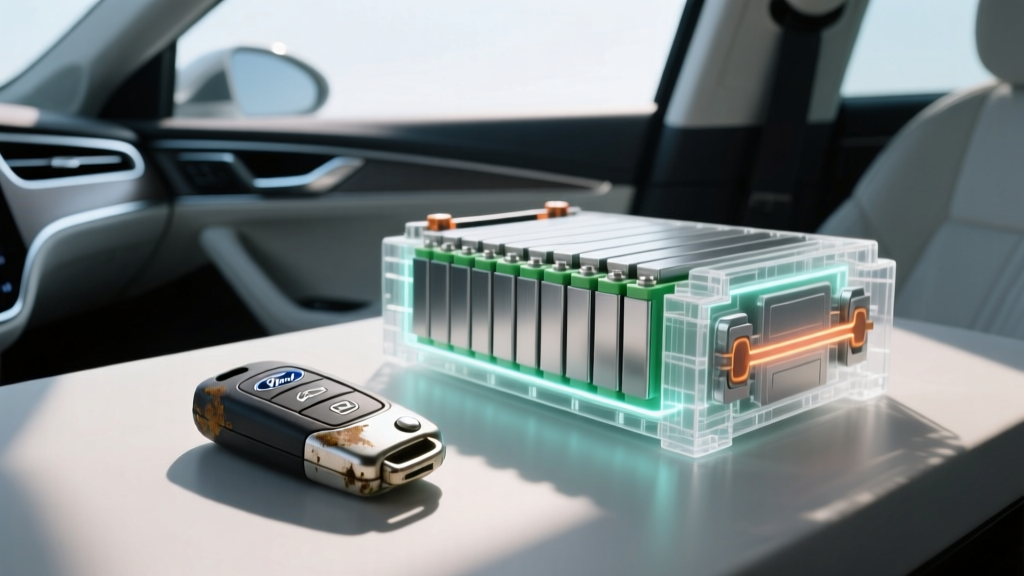
If you've ever searched for a 2016 Ford Fusion key fob battery (typically a CR2032 3V lithium coin cell) and wondered how that tiny power source relates to the massive high-voltage traction battery in a modern electric vehicle, you're not alone. The same fundamental electrochemistry — lithium ions moving between anode and cathode — scales from a 220 mAh coin cell powering a remote's RF transmitter to an 84 kWh pack propelling a 4,500-pound SUV down the highway. Understanding what degrades a battery, what the warranty actually covers, and what replacement really costs is essential for any current or prospective EV owner in 2026.
Chemistry 101: LFP vs NMC/NCA and Why It Matters
Not all lithium-ion batteries are created equal. The cathode chemistry determines energy density, cycle life, thermal stability, and cost. In 2026, two families dominate the EV market: LFP (lithium iron phosphate, LiFePO₄) and NMC/NCA (nickel manganese cobalt / nickel cobalt aluminum). Tesla's standard-range models, BYD's global lineup, and the base Ford Mustang Mach-E all use LFP, while long-range and performance trims from Hyundai, BMW, Rivian, and others rely on NMC or NCA.
| Attribute | LFP (Lithium Iron Phosphate) | NMC / NCA |
|---|---|---|
| Energy Density (cell-level) | ~160–180 Wh/kg | ~230–300 Wh/kg |
| Typical Cycle Life (to 80% SoH) | 3,000–5,000+ cycles | 1,000–2,500 cycles |
| Cold-Weather Performance | Reduced charge acceptance below 0 °C; needs preconditioning | Better low-temp discharge; still benefits from thermal mgmt |
| Cost (per kWh, 2026 pack-level) | ~$90–$110 | ~$120–$150 |
| Cobalt / Nickel Content | None (iron + phosphate) | Significant (supply-chain and ethical concerns) |
| Safety / Thermal Runaway | Higher onset temp (~270 °C); more stable | Lower onset (~150–210 °C); requires robust BMS |
| Charging to 100% Daily | Recommended by OEMs (no memory effect penalty) | Typically limited to 80–90% daily for longevity |
| Real-World Range Trade-Off | Heavier pack for same kWh → slightly less range | Lighter, denser pack → more range in same volume |
Which is better? It depends on your use case. If you prioritize longevity, lower cost, and daily commuting with home charging, LFP is the pragmatic pick — you can charge to 100% without guilt. If you need maximum range for road trips and live in a cold climate, NMC/NCA's higher energy density and better cold-weather discharge make it the stronger choice. Neither is universally superior; the chemistry is a design trade-off, not a hierarchy.
How Long Do EV Batteries Actually Last?
The short answer: longer than most buyers assume. Data from fleet operators, OEM warranty claims, and independent testing consistently shows that modern liquid-cooled EV batteries lose roughly 5–10% of their original capacity over the first 100,000 miles, then degrade more slowly thereafter. A 2025 analysis by Recurrent Auto, which aggregates real-world data from over 15,000 EVs, found that the median battery at 100,000 miles retained 90–94% of its original capacity, depending on chemistry and thermal management.
Typical Degradation Curve (Liquid-Cooled NMC Pack, Moderate Climate):
- Year 1 / 15,000 mi: ~2–4% loss (initial formation loss)
- Year 3 / 45,000 mi: ~5–7% total loss
- Year 5 / 75,000 mi: ~7–9% total loss
- Year 8 / 120,000 mi: ~10–14% total loss
- Year 10 / 150,000 mi: ~12–18% total loss
LFP packs typically show even slower degradation — often 8–12% loss at 150,000 miles — thanks to their inherently stable cathode structure.
For context, a 2026 Tesla Model Y Long Range with an EPA-estimated 330 miles of range when new might realistically deliver ~285–300 miles at 100,000 miles. That's a noticeable reduction, but the vehicle remains fully functional for daily driving and road trips. Most EV batteries will outlast the car's economic life — total battery failure before 150,000 miles is rare in liquid-cooled packs and usually covered under warranty.
What Does the Battery Warranty Actually Cover?
Federal law mandates a minimum 8-year / 100,000-mile warranty on EV battery packs for emissions-related compliance, and most OEMs extend this to 8 years / 100,000 miles (or 150,000 miles in CARB states like California, New York, and Massachusetts). The critical detail is the capacity retention threshold — the point at which the manufacturer considers the battery "failed" and will repair or replace it.
| OEM (2026 Models) | Warranty Term | Capacity Threshold | Notes |
|---|---|---|---|
| Tesla (Model Y / 3) | 8 yr / 120,000 mi (Long Range) | 70% retention | Standard Range (LFP): 8 yr / 100,000 mi, 70% |
| Hyundai / Kia (Ioniq 5, EV6) | 10 yr / 100,000 mi | 70% retention | Among the longest terms in the industry |
| Ford (Mustang Mach-E, F-150 Lightning) | 8 yr / 100,000 mi | 70% retention | Covers battery components and capacity |
| GM (Ultium platform: Blazer EV, Silverado EV) | 8 yr / 100,000 mi | 70% retention | Some commercial fleet terms differ |
| Rivian (R1T / R1S) | 8 yr / 175,000 mi | 70% retention | Extended mileage for adventure/fleet use |
| BMW (iX, i4) | 8 yr / 100,000 mi | 70% retention | Includes battery management system |
Key nuance: the warranty covers capacity degradation below the threshold, not gradual range loss above it. If your 300-mile EV drops to 215 miles (below 70%) at year 7, you're covered. If it drops to 225 miles (75%), that's considered normal wear. Also note that warranties typically exclude damage from accidents, flooding, improper charging equipment, or aftermarket modifications to the battery system. Always read your specific owner's manual warranty section — terms vary by model year and trim.
EV Battery Replacement Cost: What the Numbers Actually Look Like
This is the topic that generates the most anxiety — and the most misinformation. Headlines about $20,000 battery replacements are technically possible but context-free. Here's what the data shows in 2026:
| Vehicle Class / Example | Battery Size (kWh) | Out-of-Warranty Replacement Range | Typical Need Timeline |
|---|---|---|---|
| Compact EV (Nissan Leaf, Chevy Bolt EV) | 40–65 kWh | $6,500–$10,000 | Rarely needed; most packs outlive vehicle |
| Midsize Crossover (Tesla Model Y, Ioniq 5) | 75–84 kWh | $10,000–$16,000 | Typically 12–15+ years if at all |
| Full-Size Truck/SUV (F-150 Lightning, Rivian R1T) | 98–149 kWh | $15,000–$25,000 | Very rare; module-level repair often possible |
| Luxury Sedan (BMW i7, Mercedes EQS) | 100–118 kWh | $18,000–$30,000 | Extremely rare within vehicle's life |
Several factors make outright replacement less likely than feared. First, module-level repair is increasingly common: a technician can replace individual degraded or failed modules within the pack rather than the entire unit, reducing cost to $2,000–$5,000. Second, pack-level costs have fallen steadily — BloombergNEF's 2025 battery price survey reported average pack prices at ~$115/kWh, down from $1,200/kWh in 2010. Third, the vast majority of EV batteries are still under warranty when they reach end-of-life in the vehicle, and many packs are repurposed for stationary storage rather than recycled.
When is replacement actually needed? In practice, most EV batteries are never replaced during the car's usable life. The cases that do arise typically involve manufacturing defects (covered by warranty), physical damage from collisions or flooding, or extreme high-mileage fleet use exceeding 200,000+ miles. For a typical owner driving 12,000–15,000 miles per year, the battery will likely retain 75–85% capacity at the 10-year mark — well above the threshold where daily usability is compromised.
Factors That Accelerate (or Preserve) Battery Health
Battery degradation isn't random — it's driven by specific, controllable factors. Understanding these lets you maximize your pack's lifespan and resale value.
What Hurts Battery Longevity
- Frequent DC fast charging above 150 kW — High C-rates generate heat; sustained sessions at peak power stress cells. Occasional road-trip fast charging is fine, but daily reliance on 250+ kW chargers accelerates degradation by ~1–3% over 5 years compared to Level 2 home charging.
- Prolonged storage at 100% SoC — Lithium-ion cells experience elevated stress at high voltage. Leaving an NMC pack at 100% for weeks (especially in heat) accelerates calendar aging. LFP is more tolerant but still benefits from moderate storage SoC.
- Extreme heat exposure — Ambient temperatures above 95°F (35°C) combined with high SoC are the worst-case scenario. Vehicles without active liquid cooling (older Nissan Leaf, some early EVs) are most vulnerable.
- Deep discharge to 0% — Consistently running the battery to near-empty stresses the anode. The BMS maintains a hidden buffer (typically 2–5 kWh below the displayed 0%), but habitual deep cycling isn't ideal.
- Cold-weather DC fast charging without preconditioning — Attempting to charge at high power when the battery is below 40°F (4°C) can cause lithium plating on the anode, permanently reducing capacity. Always use your vehicle's preconditioning feature before fast charging in winter.
What Preserves Battery Longevity
- Level 2 home charging as your daily routine — Slow, steady charging at 7–11 kW generates minimal heat and is the gentlest method for long-term health.
- Keep SoC between 20–80% for NMC; 20–100% for LFP — Use your vehicle's charge-limit setting. Tesla, Hyundai, and Ford all allow you to set a daily charge ceiling.
- Use preconditioning — Activating battery warming before fast charging or before departure in cold weather protects the cells and improves charging speed.
- Drive it regularly — Batteries prefer moderate, regular cycling over long idle periods. If storing for 2+ weeks, set SoC to ~50%.
- Park in shade or a garage in hot climates — Reducing peak battery temperature by even 5–10°F meaningfully slows calendar degradation.
Monitoring Battery Health: Checking Your State of Health (SoH)
State of Health (SoH) is the percentage of original capacity your battery currently holds. A new EV has 100% SoH; a pack that held 84 kWh when new but now holds 76 kWh is at ~90.5% SoH. Monitoring this metric helps you track degradation, plan for warranty claims, and assess resale value.
How to check SoH in 2026:
- In-vehicle displays: Tesla's app (under Battery Health), Hyundai/Kia's EV diagnostics menu, and Ford's Pass app now show estimated SoH or capacity figures directly. BMW's iDrive system includes a battery health report in the service menu.
- OBD-II diagnostic tools: Third-party tools like OBDeleven (for VW/Audi/BMW) or LeafSpy Pro (for Nissan Leaf) can read detailed cell-level data, including individual module voltage variance and precise SoH percentage.
- Third-party services: Companies like Recurrent and Geotab offer fleet and individual battery health reports based on telematics data, comparing your pack's degradation to a cohort of identical vehicles.
- Dealer diagnostics: Any authorized service center can perform a full battery health check, typically as part of a scheduled service visit. This is the most reliable method for warranty claim documentation.
For used-EV buyers, requesting a battery health report before purchase is as essential as checking a Carfax. A 2022 model with 40,000 miles showing 94% SoH is a strong indicator of gentle use and proper charging habits. One showing 85% SoH at the same mileage may signal heavy fast-charging or extreme-climate exposure — and potential warranty coverage down the line.
Looking Ahead: Solid-State, Silicon Anodes, and Realistic Timelines
Next-generation battery technologies are frequently hyped, so it's worth separating announced milestones from showroom reality as of early 2026:
- Silicon-dominant anodes: Companies like Sila Nanotechnologies and Group14 are supplying silicon-composite anode materials to OEMs including Mercedes-Benz and Panasonic. These increase energy density by 15–25% over graphite anodes and are appearing in limited production vehicles (e.g., the Mercedes G-Class electric). Expect broader adoption by 2028–2029.
- Semi-solid-state batteries: NIO's 150 kWh semi-solid pack (available in China since 2024) demonstrates ~360 Wh/kg cell-level density. However, these remain expensive and limited to low-volume production. U.S.-market availability is not expected before 2028–2030.
- True solid-state batteries: Toyota, Samsung SDI, and QuantumScape continue to target 2027–2030 for initial production, but scaling challenges — manufacturing yield, cost, interface stability — remain significant. Toyota has announced a solid-state-equipped EV for 2027–2028, but initial volumes will be extremely limited. Mass-market solid-state EVs at competitive pricing are realistically a 2030+ proposition.
- Sodium-ion batteries: CATL and BYD have begun deploying sodium-ion packs in low-cost Chinese-market EVs. These offer lower energy density (~120–150 Wh/kg) but eliminate lithium entirely, reducing cost and supply-chain risk. U.S. adoption is possible for budget-oriented models by 2028–2029.
The practical takeaway: if you're buying an EV in 2026, current LFP and NMC chemistries are mature, well-understood, and backed by extensive real-world data. Waiting for solid-state means waiting years for limited availability at premium pricing. Today's batteries, properly cared for, will serve reliably for the life of the vehicle.
From Coin Cell to Crossover: The 12V vs. High-Voltage Distinction
A quick but important clarification, especially if you arrived here searching for a 2016 Ford Fusion key fob battery or a 12V replacement: every EV (and PHEV) actually has two batteries. The 12V auxiliary battery (a small lead-acid or increasingly lithium-iron-phosphate unit) powers the vehicle's electronics, lights, infotainment, and door locks — just like in a conventional car. It's the battery that powers your key fob's receiver and the one that occasionally needs a jump or replacement every 3–5 years.
The high-voltage traction battery (the 60–150 kWh pack discussed throughout this article) is the one that propels the vehicle. It operates at 400V or 800V, is sealed and liquid-cooled, and is entirely separate from the 12V system. The 12V battery is a $150–$300 maintenance item; the traction battery is the long-life, warrantied component that defines the EV's range and performance. Confusing the two is one of the most common sources of EV misinformation online.
Frequently Asked Questions
How long do EV batteries last in years and miles?
Most modern liquid-cooled EV batteries retain 80–90% of original capacity at 150,000 miles or 10–12 years. LFP chemistries often exceed this. Complete failure before 200,000 miles is uncommon. The battery will typically outlast the vehicle's economic life.
How much does it cost to replace an EV battery?
Out-of-warranty replacement ranges from ~$6,500 for a compact EV to $25,000+ for a full-size truck with a 150 kWh pack. However, most replacements are covered under the 8-year/100,000-mile warranty, and module-level repairs ($2,000–$5,000) are increasingly common as an alternative to full-pack replacement.
What does the EV battery warranty cover?
Federal law mandates at minimum 8 years / 100,000 miles of coverage for battery capacity loss below a defined threshold (typically 70% of original capacity). This covers manufacturing defects and abnormal degradation. It does not cover physical damage, improper use, or gradual capacity loss above the threshold. Check your specific OEM warranty for exact terms.
How do I check my EV's battery health?
Most 2026 EVs display battery health or State of Health (SoH) through the vehicle's app or diagnostic menu. Third-party OBD-II tools and services like Recurrent provide detailed cell-level data. Your dealer can also run a full diagnostic during a service visit.
LFP vs NMC — which battery chemistry should I choose?
Choose LFP if you want maximum cycle life, lower cost, and don't need the longest possible range — ideal for daily commuting and home charging. Choose NMC/NCA if you need maximum range per charge, better cold-weather performance, and frequently take road trips. Both are proven and reliable in 2026.
Does fast charging damage my EV battery?
Occasional DC fast charging (road trips, a few times a month) has minimal impact on modern liquid-cooled packs. Daily reliance on 150+ kW fast charging can accelerate degradation by ~1–3% over 5 years compared to Level 2 home charging. The bigger risk is fast charging in extreme cold without preconditioning, which can cause lithium plating.
Should I charge my EV to 100% every night?
For NMC/NCA batteries, set your daily charge limit to 80–90% and reserve 100% for road trips. For LFP batteries, most OEMs (including Tesla and BYD) recommend charging to 100% regularly, as LFP chemistry tolerates full SoC without the same degradation penalty. Always check your owner's manual for model-specific guidance.
Sources: fueleconomy.gov (EPA range and efficiency data), Recurrent Auto battery degradation research, OEM warranty documentation (Tesla, Hyundai, Ford, GM, Rivian, BMW). Tax credit and incentive rules per IRS §30D. All pricing and specifications reflect 2026 model-year data and are subject to change.