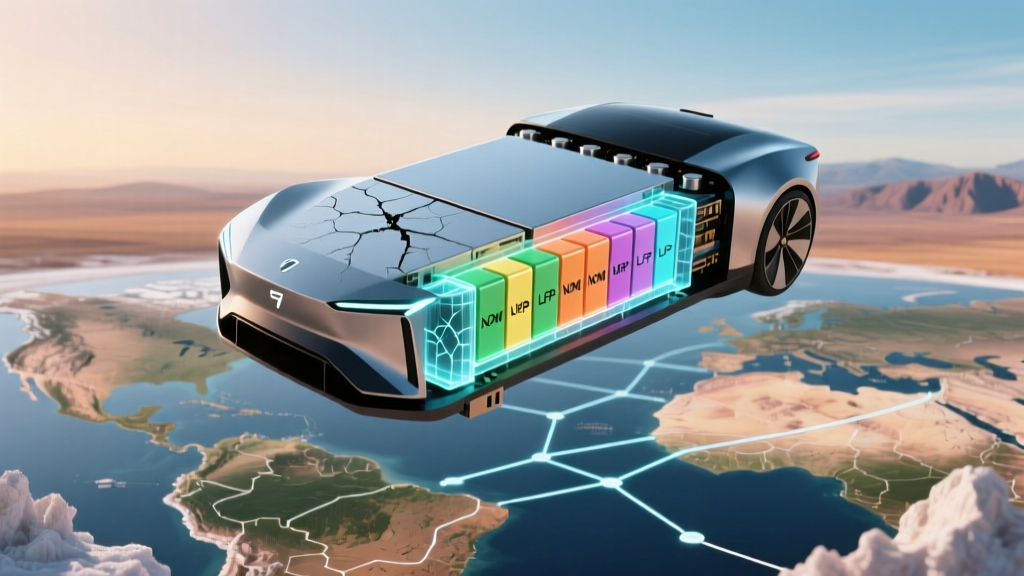
Every kilowatt-hour of EV battery capacity begins with raw materials pulled from the earth — and increasingly, that means the salt flats of South America's "Lithium Triangle." Argentina has emerged as one of the world's most prolific lithium producers, with output scaling rapidly through 2025 and into 2026 as automakers lock in supply chains for both NMC and LFP battery chemistries. For EV buyers, understanding where battery materials come from isn't just an academic exercise: it affects battery pricing, chemistry availability, federal tax credit eligibility under §30D critical-mineral sourcing rules, and ultimately the long-term cost of ownership.
This guide connects the dots from lithium extraction in Argentina's Jujuy, Salta, and Catamarca provinces to the battery pack under your EV's floor — covering chemistry trade-offs, real-world degradation data, warranty protections, replacement costs, and how to maximize your pack's lifespan.
Argentina's Lithium Boom and What It Means for EV Batteries
Argentina holds an estimated 21 million metric tons of lithium resources — the second-largest reserve globally after Chile — and has become the world's fourth-largest lithium producer as of 2025. Major projects including Olaroz (operated by Allkem/Livent), Cauchari-Olaroz (Ganfeng Lithium), and Sal de Vida are ramping production, with several new direct lithium extraction (DLE) facilities entering pilot or early production phases in 2026.
Why does this matter for your EV purchase? Three reasons:
- Price stabilization: Lithium carbonate prices spiked above $80,000/metric ton in late 2022 before crashing to roughly $15,000-$20,000/ton by mid-2025. Argentina's expanding supply contributes to the price moderation that has helped bring EV battery pack costs below $130/kWh at the cell level in 2026 — down from over $200/kWh just three years prior.
- Critical mineral sourcing for tax credits: Under IRS §30D rules, the federal clean vehicle credit requires that a growing percentage of critical minerals (including lithium) be extracted or processed in the U.S. or a free-trade-agreement partner. Argentina does not currently have a comprehensive FTA with the U.S., which complicates sourcing calculations for automakers. Buyers should verify current-year eligibility on a per-model basis at fueleconomy.gov.
- Chemistry availability: Argentine lithium (primarily from brine extraction) feeds into both NMC (nickel-manganese-cobalt) and LFP (lithium iron phosphate) cathode production, though LFP relies less on lithium intensity per kWh. As LFP adoption grows in U.S.-market EVs (Tesla Model 3 RWD, Ford Mustang Mach-E Select, and several 2026 entries), supply diversification from Argentina helps reduce single-source dependency on Australian hard-rock lithium.
LFP vs. NMC/NCA: Which Battery Chemistry Is Right for You?
The two dominant lithium-ion chemistries in 2026 EVs are LFP (lithium iron phosphate) and NMC/NCA (nickel-manganese-cobalt or nickel-cobalt-aluminum). Each has distinct trade-offs that affect range, longevity, cold-weather performance, and price.
| Attribute | LFP (Lithium Iron Phosphate) | NMC / NCA (Nickel-based) |
|---|---|---|
| Energy Density | ~160-180 Wh/kg (lower) | ~220-300 Wh/kg (higher) |
| Typical Cycle Life | 3,000-5,000+ cycles | 1,000-2,000 cycles |
| Cold-Weather Performance | Greater range loss below 32°F (~25-35% reduction) | Moderate range loss below 32°F (~15-25% reduction) |
| Cost per kWh (cell level) | ~$80-100/kWh | ~$110-140/kWh |
| Cobalt / Nickel Content | None (cobalt-free, nickel-free) | Contains nickel; some contain cobalt |
| Recommended Charge Habit | Can charge to 100% daily without significant harm | Best kept 20-80% daily; 100% for trips only |
| Thermal Stability | Excellent (higher runaway threshold) | Good (requires robust thermal management) |
| Common 2026 Applications | Tesla Model 3 RWD, Model Y RWD, Ford Mach-E Select, Rivian Standard | Tesla Long Range, Hyundai Ioniq 5/6, BMW iX, Lucid Air, Porsche Taycan |
The bottom line: If you prioritize maximum range per charge and live in a cold climate, NMC/NCA remains the stronger choice. If you plan to keep your EV for 10+ years, charge primarily at home, and want the lowest degradation risk, LFP's superior cycle life and 100% daily charging tolerance make it compelling — especially as LFP energy density continues improving.
Real-World EV Battery Degradation: What the Data Shows
Battery degradation — measured as the loss of usable capacity over time — is the single biggest longevity concern for EV owners. Here's what real-world data tells us as of 2026:
Typical Degradation Curve (NMC and LFP Packs, Combined Fleet Data):
- Year 1 / 15,000 miles: ~2-4% capacity loss (initial "break-in" drop)
- Year 3 / 45,000 miles: ~5-8% total capacity loss
- Year 5 / 75,000 miles: ~8-12% total capacity loss
- Year 8 / 120,000 miles: ~10-15% total capacity loss (NMC); ~6-10% (LFP)
- Year 10 / 150,000 miles: ~12-18% total capacity loss (NMC); ~8-12% (LFP)
Sources: Recurrent Auto fleet data (2025 report), Geotab longitudinal study of 10,000+ EVs, manufacturer warranty claim rates.
Several key takeaways emerge from this data:
- Degradation is non-linear. The steepest loss occurs in the first 12-24 months, then flattens significantly. Most packs settle into a slow, predictable decline.
- LFP degrades more slowly. Tesla Model 3 RWD owners (LFP) consistently report 90%+ capacity retention at 100,000 miles, compared to ~85-88% for equivalent NMC packs.
- Catastrophic failure is rare. Less than 1.5% of EV battery packs require full replacement due to defect or sudden failure, according to Geotab's multi-year analysis. The vast majority of packs outlast the vehicle's body and interior.
- Heat is the primary accelerator. Vehicles regularly operated and fast-charged in hot climates (Arizona, Texas, Southern California) show 2-4% greater degradation at the 5-year mark versus Pacific Northwest or Northeast vehicles.
EV Battery Warranty Terms: What's Actually Covered
Federal law mandates that EV battery warranties cover a minimum of 8 years / 100,000 miles (10 years / 150,000 miles in California and states adopting CARB standards). Most manufacturers exceed these minimums in meaningful ways:
| Manufacturer | Warranty Period | Mileage Limit | Capacity Retention Threshold | Chemistry Notes |
|---|---|---|---|---|
| Tesla (Model 3/Y RWD — LFP) | 8 years | 120,000 mi | 70% | LFP packs show minimal warranty claims |
| Tesla (Long Range / Performance) | 8 years | 120,000 mi (Model 3); 150,000 mi (Model S/X) | 70% | NMC/NCA |
| Hyundai / Kia | 10 years | 100,000 mi | 70% | NMC; among longest coverage |
| Ford (Mach-E, F-150 Lightning) | 8 years | 100,000 mi | 70% | NMC (extended range); LFP (standard) |
| General Motors (Ultium platform) | 8 years | 100,000 mi | 70% (60% on some commercial) | NMC (Ultium) |
| Rivian | 8 years | 175,000 mi (largest pack) | 70% | NMC; high mileage limit on Max Pack |
| BMW | 8 years | 100,000 mi | 70% | NMC (Gen5 eDrive) |
What triggers a warranty claim: If your battery's State of Health (SoH) drops below the stated threshold (typically 70% of original capacity) within the warranty period, the manufacturer will repair or replace modules or the full pack at no cost. In practice, very few packs fall below 70% within the warranty window — most retain 85-92% at the 8-year mark under normal use.
What's NOT covered: Gradual capacity loss above the threshold, damage from accidents, improper charging equipment, or modifications. Always use UL-listed charging equipment and follow manufacturer charging guidelines.
EV Battery Replacement Costs: When and How Much
While most EV batteries outlast the vehicle itself, out-of-warranty replacement is a legitimate cost consideration for high-mileage drivers and used-EV buyers:
| Vehicle / Pack Size | Battery Capacity | Estimated Replacement Cost (Parts + Labor) | Typical Replacement Trigger |
|---|---|---|---|
| Tesla Model 3 RWD (LFP) | ~60 kWh | $10,000 - $13,000 | Rare before 200,000+ mi |
| Tesla Model Y Long Range | ~75 kWh | $13,000 - $16,000 | Rare before 180,000+ mi |
| Hyundai Ioniq 5 | 77.4 kWh | $14,000 - $18,000 | Rare before 150,000+ mi |
| Ford F-150 Lightning (Extended Range) | ~131 kWh | $22,000 - $28,000 | Rare before 150,000+ mi |
| Chevrolet Bolt EV/EUV (older NMC) | ~65 kWh | $14,000 - $16,000 | Some early recalls; generally durable |
| BMW iX xDrive50 | ~105 kWh usable | $20,000 - $25,000 | Rare before 150,000+ mi |
Critical context: Battery replacement costs have declined roughly 40% since 2020 due to cell cost reductions and growing third-party refurbishment options. Companies like Redwood Materials and Circular Energy are building battery recycling and remanufacturing pipelines that will further reduce replacement costs through 2028 and beyond. Additionally, module-level replacement (swapping only degraded modules rather than the full pack) is available on many platforms and can cut costs by 50-70%.
Most EV owners will never need a full battery replacement. The median EV battery retains over 85% capacity at 150,000 miles, and the vehicle is typically retired, traded, or sold before the pack becomes unusable.
Factors That Accelerate (or Preserve) Battery Health
Battery longevity isn't purely a function of time — your habits matter significantly. Here's what the data shows:
Habits That Preserve Battery Health:
- ✅ Charge to 80% daily on NMC/NCA; 100% is fine for LFP
- ✅ Use Level 2 home charging (7-11 kW) as your primary method
- ✅ Precondition the battery before DC fast charging (most EVs do this automatically when navigating to a charger)
- ✅ Keep SoC between 20-80% for daily driving on NMC packs
- ✅ Park in shade or a garage in hot climates
- ✅ Drive moderately for the first 10-15 minutes in extreme cold to let the thermal management system warm the pack
Habits That Accelerate Degradation:
- ❌ Frequent DC fast charging (3+ sessions per week consistently over years)
- ❌ Regularly leaving NMC packs at 100% SoC for extended periods (days)
- ❌ Repeatedly draining below 10% SoC
- ❌ Consistent operation in extreme heat (>100°F ambient) without thermal preconditioning
- ❌ Aftermarket modifications to charging or battery management systems
On DC fast charging specifically: Occasional fast charging (1-2 sessions per week on road trips) has negligible impact on battery health. However, data from Recurrent Auto shows that vehicles DC fast-charging more than 3 times per week consistently over 3+ years show 2-3% greater capacity loss compared to primarily Level 2-charged vehicles. The heat generated during high-power charging (150-350 kW) stresses cells over time, though modern thermal management systems mitigate this substantially.
How to Monitor Your Battery's State of Health (SoH)
State of Health (SoH) represents your battery's current maximum capacity as a percentage of its original capacity. Here's how to check it:
- In-vehicle displays: Tesla provides a battery health estimate in the Service menu (Settings → Service → Battery Health). Hyundai/Kia's Bluelink app shows SoH. BMW's iDrive includes a battery health readout.
- OBD-II apps: Tools like LeafSpy (Nissan), ABRP + OBD dongle, or EV Health Check apps can read SoH data from the battery management system on most EVs.
- Dealer diagnostics: Any authorized service center can run a full battery health report, typically showing individual module voltage variance and total capacity in kWh.
- Third-party services: Recurrent Auto offers a free battery health report that compares your pack's degradation to similar vehicles in their fleet of 10,000+ monitored EVs.
For used-EV buyers, requesting a battery health report before purchase is as essential as a pre-purchase inspection on a gas car. A 2023 model with 40,000 miles showing 94% SoH is in excellent shape; one showing 82% warrants further investigation or price negotiation.
Looking Ahead: Solid-State, Silicon Anode, and Next-Gen Batteries
Several next-generation battery technologies are in active development, though none are available in U.S.-market consumer EVs as of 2026:
- Solid-state batteries: Toyota has announced production intent for 2027-2028, targeting 750 km (~466 miles) range with 10-minute fast charging. Samsung SDI and QuantumScape are also advancing solid-state prototypes. Realistic consumer availability: 2028-2030, initially in premium vehicles.
- Silicon anode technology: Companies like Sila Nanotechnologies and Group14 are producing silicon-dominant anode materials that boost energy density by 20-40% versus graphite. Early commercial deployments are appearing in select 2026 model-year cells, with broader adoption expected by 2027-2028.
- Sodium-ion batteries: CATL and BYD are producing sodium-ion cells for lower-cost, shorter-range EVs (primarily in China). These eliminate lithium entirely but offer lower energy density (~120-150 Wh/kg). U.S. market availability for passenger vehicles is uncertain before 2028.
These technologies are promising but remain preliminary for U.S. consumers. Current NMC and LFP chemistries, backed by supply chains that include Argentine lithium production, remain the practical choices for 2026 EV purchases.
Frequently Asked Questions
How long do EV batteries last in years and miles?
Most modern EV batteries retain 85-92% of original capacity at 8 years / 100,000-120,000 miles. LFP packs often retain 90%+ at this milestone. Based on current degradation data, the median EV battery will provide usable service for 15-20 years or 200,000+ miles before capacity drops below 70% — typically outlasting the vehicle's body, suspension, and interior.
How much does an EV battery cost to replace in 2026?
Full pack replacement costs range from roughly $10,000 for a 60 kWh LFP pack (Tesla Model 3 RWD) to $22,000-$28,000 for a 131 kWh pack (Ford F-150 Lightning Extended Range), including labor. Module-level repairs cost significantly less ($2,000-$6,000). However, fewer than 1.5% of packs require replacement due to defect, and most packs outlive the vehicle.
What does the EV battery warranty actually cover?
Federal law requires minimum 8-year/100,000-mile battery coverage (10 years/150,000 miles in CARB states). Warranties guarantee that the battery will retain at least 70% of original capacity within the warranty period. If SoH drops below this threshold, the manufacturer repairs or replaces the pack at no cost. Gradual capacity loss above 70% is considered normal wear and is not covered.
How do I check and maximize my EV battery's health?
Check SoH through your vehicle's built-in diagnostics (Tesla Service menu, Hyundai Bluelink app), an OBD-II reader with an EV-compatible app, or a dealer diagnostic report. To maximize longevity: use Level 2 home charging as your primary method, keep NMC packs between 20-80% SoC for daily use, precondition before fast charging, and avoid leaving the pack at 100% or below 10% for extended periods.
LFP vs NMC — which battery chemistry is better?
Neither is universally "better" — they serve different priorities. NMC/NCA offers higher energy density (more range per kWh, better cold-weather performance) and suits long-range and performance applications. LFP offers longer cycle life (3,000-5,000+ cycles), lower cost (~$80-100/kWh vs $110-140/kWh), better thermal stability, and can be charged to 100% daily without significant degradation — making it ideal for daily commuters who plan to keep their EV for 10+ years.
Does lithium mining in Argentina affect my EV purchase?
Indirectly, yes. Argentina's expanding lithium production helps stabilize global battery material prices, contributing to the declining cost of EV battery packs. However, because Argentina lacks a comprehensive U.S. free trade agreement, lithium sourced there may not count toward the §30D critical-mineral requirement for the federal tax credit. Always check fueleconomy.gov for the latest per-model credit eligibility before purchasing.
Understanding battery technology — from the lithium mined in Argentina's salt flats to the chemistry in your pack and the warranty protecting your investment — is the foundation of confident EV ownership. The data is clear: modern EV batteries are durable, well-warranted, and overwhelmingly likely to outlast the vehicles they power.