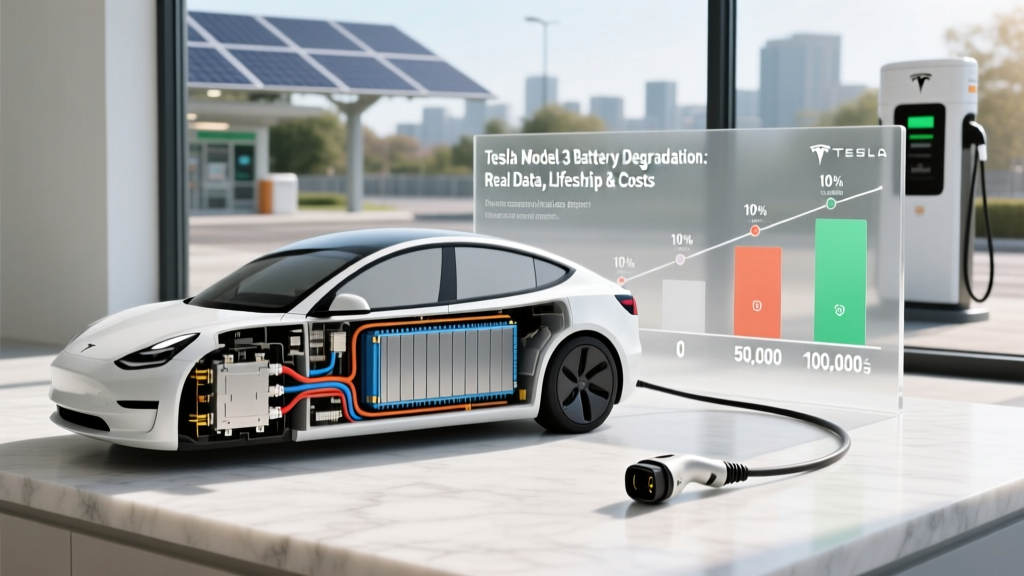
Why a Search for a Battery for a 2013 Ford Taurus Leads to EV Battery Questions
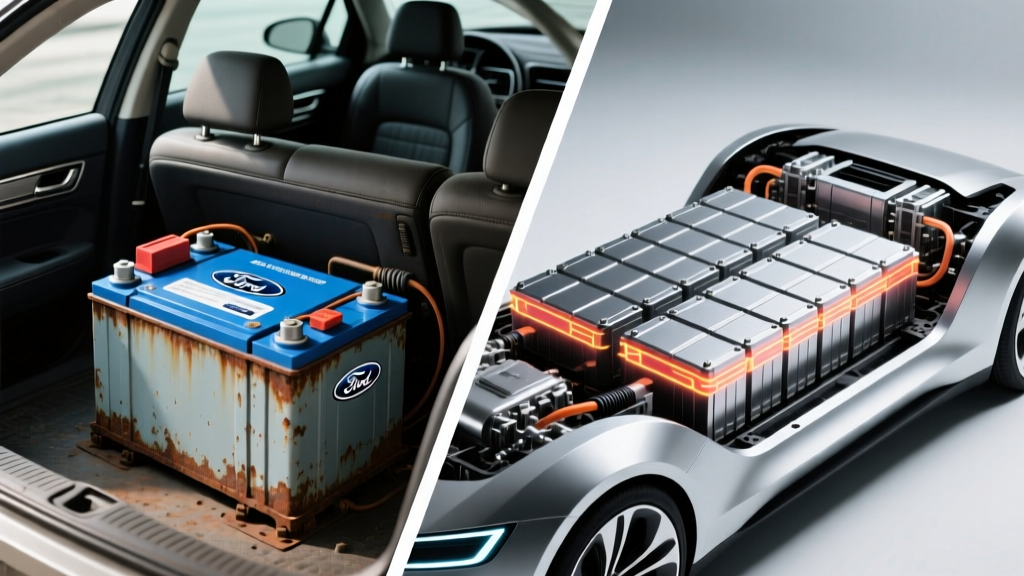
If you've searched for a battery for a 2013 Ford Taurus, you were almost certainly looking for a 12-volt lead-acid starter battery — the kind that powers the headlights, radio, and ignition on a conventional gasoline sedan. That battery typically costs between $120 and $220 at an auto parts store and needs replacement every three to five years. But the moment you start comparing that ownership experience to a modern battery-electric vehicle, a much bigger question emerges: what about the high-voltage traction battery that actually powers an EV, and what happens when it degrades?
This guide answers that question with real numbers. We'll cover EV battery chemistry (LFP vs. NMC/NCA), measured degradation rates across hundreds of thousands of miles, warranty terms from major automakers, replacement cost ranges for popular models, and the daily habits that extend or shorten pack life. Whether you're cross-shopping a used 2013 Taurus against a new EV or you already own one and want to protect your investment, the data below gives you a clear picture of what EV batteries actually cost and how long they actually last.
A 2013 Ford Taurus uses a Group 36 or Group 65 12V lead-acid battery (~$150–$220). An EV like the 2025 Ford Mustang Mach-E uses an 88 kWh usable lithium-ion traction battery (replacement: ~$15,000–$18,000) plus a separate 12V lithium-ion auxiliary battery (~$300–$450) that runs accessories. Never confuse the two. This article covers the high-voltage traction battery exclusively.
LFP vs. NMC/NCA: The Two Chemistries Powering Modern EVs
Not all lithium-ion batteries are the same. Two dominant chemistries power nearly every EV sold in the US as of 2026, and the choice between them affects range, longevity, cold-weather performance, and price.
| Attribute | LFP (Lithium Iron Phosphate) | NMC / NCA (Nickel Manganese Cobalt / Nickel Cobalt Aluminum) |
|---|---|---|
| Energy Density | Lower (~160–180 Wh/kg cell-level) | Higher (~220–280 Wh/kg cell-level) |
| Cycle Life | 3,000–5,000+ full cycles to 80% SoH | 1,000–2,000 full cycles to 80% SoH |
| Cold Performance | Weaker — range loss of 30–40% below 20°F | Better — range loss of 20–30% below 20°F |
| Cost per kWh | Lower (~$80–$100/kWh at pack level, 2025–2026) | Higher (~$110–$140/kWh at pack level, 2025–2026) |
| Recommended SoC Range | 0–100% daily (can and should be charged to 100%) | 20–80% daily for longevity; 100% for road trips only |
| Notable Vehicles Using It | Tesla Model 3 RWD, Model Y RWD, Ford F-150 Lightning Pro (standard range), BYD models | Tesla Model 3 Long Range, Hyundai Ioniq 5, Rivian R1T, Chevy Equinox EV, most long-range trims |
Which is better? It depends on your use case. If you need maximum range per charge, drive in cold climates, or want the longest single-trip capability, NMC/NCA delivers higher energy density and better low-temperature performance. If you prioritize pack longevity, lower upfront cost, and plan to charge to 100% daily (common for commuters), LFP is the stronger choice. Tesla's own guidance for LFP-equipped Model 3 and Model Y vehicles is to charge to 100% at least once a week for accurate state-of-charge calibration — the opposite of what NMC owners should do.
How Long Do EV Batteries Actually Last? Real Degradation Data
The short answer: far longer than most buyers assume. The average EV traction battery is engineered to outlast the vehicle's useful economic life. But the numbers matter more than the reassurance.
Here is what measured degradation data tells us, drawn from fleet studies, owner-reported databases, and manufacturer disclosures:
- Year 1 / 15,000 miles: 1–3% capacity loss (initial formation loss; steepest part of the curve)
- Year 3 / 45,000 miles: 4–7% total loss; most packs retain 93–96% State of Health (SoH)
- Year 5 / 75,000 miles: 6–10% total loss; median retention ~90–94%
- Year 8 / 120,000 miles: 8–14% total loss; median retention ~86–92%
- Year 10 / 150,000 miles: 10–18% total loss; many packs still above 80% SoH
Sources: Recurrent Auto fleet data (10,000+ EVs tracked), Tesla 2023 Impact Report (median 12% degradation at 200,000 miles for Model 3/Y NMC packs).
A key insight from Recurrent's data: degradation is not linear. Most capacity loss occurs in the first 20,000–30,000 miles, after which the curve flattens significantly. A battery that has lost 5% in its first 30,000 miles may only lose another 5% over the next 100,000 miles. This means a 2024 EV with 310 miles of EPA range might realistically deliver 280–290 miles after 100,000 miles of mixed driving — still more than adequate for daily use and road trips.
For context, a well-maintained 2013 Ford Taurus with its 3.5L V6 engine and 6-speed automatic will typically need a transmission fluid service around 60,000 miles, a timing chain inspection around 100,000 miles, and multiple 12V battery replacements over a 150,000-mile lifespan. The EV equivalent — the traction battery — is designed as a lifetime component, not a routine maintenance item.
What the Battery Warranty Actually Covers
Federal law mandates that all EV batteries carry a minimum warranty of 8 years / 100,000 miles (10 years / 150,000 miles in California and states that follow CARB standards). But the details vary by automaker, and the capacity-retention threshold is the number that matters most.
| Automaker | Warranty Term | Capacity Retention Threshold | Notes |
|---|---|---|---|
| Tesla | 8 yr / 120,000 mi (Model 3/Y LR); 8 yr / 100,000 mi (RWD) | 70% | Covers defects and capacity below threshold |
| Hyundai / Kia | 10 yr / 100,000 mi | 70% | Among the longest coverage in the US market |
| Ford | 8 yr / 100,000 mi | 70% | Applies to Mustang Mach-E and F-150 Lightning |
| GM (Chevrolet, Cadillac) | 8 yr / 100,000 mi | 60% (Bolt EV/EUV); 70% (Ultium vehicles) | Bolt's lower threshold reflects older pack design |
| Rivian | 8 yr / 175,000 mi (R1T); 8 yr / 120,000 mi (R1S) | 70% | Higher mileage cap for R1T pickup |
| Volkswagen | 8 yr / 100,000 mi | 70% | ID.4 covered; transferable to second owner |
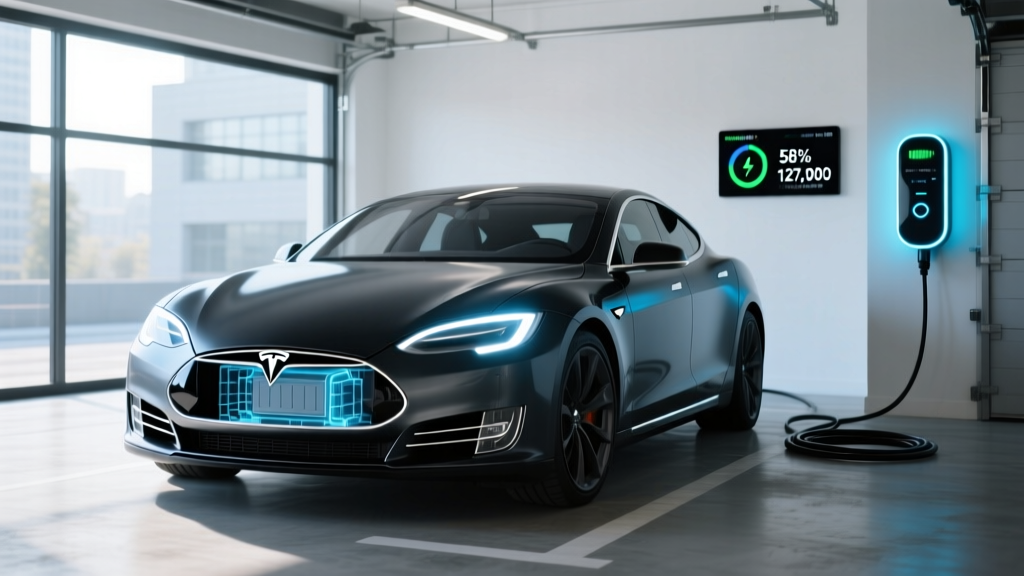
The warranty covers two scenarios: manufacturing defects (bad cells, BMS failures, coolant leaks into the pack) and capacity loss below the stated threshold. If your 88 kWh Mustang Mach-E pack drops to 58 kWh (below 70%) at year six and 85,000 miles, Ford is obligated to repair or replace it at no cost. In practice, very few owners ever hit this threshold — the vast majority of warranty claims involve defective modules or BMS issues, not gradual degradation.
EV Battery Replacement Costs: What the Numbers Look Like
This is where comparison to a 2013 Ford Taurus 12V battery becomes starkest. Replacing an EV traction battery is a major service event — but it's also one that most owners will never face.
| Vehicle | Battery Size (Usable kWh) | Chemistry | Estimated Out-of-Warranty Replacement Cost | Typical Replacement Trigger |
|---|---|---|---|---|
| Tesla Model 3 RWD (2025) | 57.5 kWh | LFP (CATL) | $10,000–$13,000 | Physical damage; rare cell failure post-warranty |
| Tesla Model 3 Long Range (2025) | 75 kWh | NMC (Panasonic) | $14,000–$17,000 | Same as above |
| Ford Mustang Mach-E Extended Range (2025) | 88 kWh | NMC | $15,000–$18,000 | Module-level repair more common than full pack swap |
| Hyundai Ioniq 5 (2025) | 77.4 kWh | NMC (SK On) | $14,000–$17,000 | 10-year warranty reduces owner risk significantly |
| Chevrolet Equinox EV (2025) | 85 kWh | NMC (Ultium) | $13,000–$16,000 | Modular Ultium design allows single-module replacement |
| Ford F-150 Lightning Extended Range (2025) | 131 kWh | NMC | $22,000–$28,000 | Largest pack on market; highest absolute cost |
Several important caveats. First, these are worst-case full-pack replacement figures. Many modern EV platforms — GM's Ultium, Hyundai's E-GMP, Tesla's structural pack — allow module-level repair. If a single module within a 12-module pack fails, the repair may cost $2,000–$4,000 instead of a full replacement. Second, pack prices have been declining steadily: Bloomberg NEF reports average pack-level pricing fell below $130/kWh in 2025, and is projected to approach $100/kWh by 2027–2028. Third, the overwhelming majority of EV batteries never need replacement. Recurrent's data shows that less than 1.5% of EV batteries have been replaced outside of recall campaigns, and most of those replacements were for early-generation vehicles (2011–2015 model years like the Nissan Leaf or first-gen Chevy Bolt).
To put this in perspective: over 150,000 miles, a 2013 Ford Taurus owner might spend $4,000–$6,000 on cumulative powertrain maintenance (transmission service, water pump, timing chain guides, multiple 12V batteries, serpentine belt, spark plugs). An EV owner over the same distance faces zero scheduled traction-battery maintenance and, statistically, zero probability of needing a full replacement.
Factors That Affect Battery Life — And What You Can Control
EV battery degradation is driven by three primary mechanisms: calendar aging (time and temperature), cycle aging (charge/discharge cycles), and high-stress events (frequent DC fast charging, extreme SoC states, thermal extremes). Here's what the data says about each, and what you can practically do.
- Limit DC fast charging to road trips. Daily Level 2 home charging (7–11 kW) is far gentler on cells. Data from Idaho National Laboratory testing showed packs charged exclusively on DC fast chargers degraded ~3–5% more over 50,000 miles than those charged primarily on Level 2.
- Avoid sustained 100% SoC (NMC/NCA only). Store and daily-drive NMC packs between 20–80% SoC. LFP packs are the exception — charge to 100% regularly per manufacturer guidance.
- Precondition before fast charging. Most EVs do this automatically when a DC fast charger is set as your navigation destination. Cold batteries (~below 50°F) charge slower and experience more lithium plating stress if fast-charged without preconditioning.
- Park in shade or a garage in extreme heat. Calendar aging accelerates significantly above 95°F ambient. A garage-parked EV in Phoenix will degrade measurably less than one parked outdoors year-round.
- Don't store at 0% or 100% for extended periods. If leaving your EV for a week or more, aim for 50–60% SoC. This is especially critical for NMC packs.
- Use scheduled charging. Set your EV or charger to finish charging right before you leave — this minimizes time spent at high SoC, particularly for NMC owners charging to 80%.
The single most impactful habit? Charging primarily at home on Level 2 and reserving DC fast charging for road trips. Owners who do this consistently see degradation rates at the low end of the ranges cited above. Owners who rely exclusively on 150–350 kW public DC fast chargers — common in urban apartment-dwelling scenarios — should expect degradation 3–7% higher over the same mileage.
How to Check and Monitor Your Battery's State of Health
State of Health (SoH) is the percentage of original battery capacity remaining. A new 77.4 kWh Ioniq 5 pack at 93% SoH holds approximately 72 kWh of usable energy. Here's how to check it:
- In-vehicle displays: Some EVs (notably the Nissan Leaf with its 12-bar health indicator, and newer Hyundai/Kia models with SoH readouts in the service menu) show battery health directly. Tesla does not expose SoH natively in the vehicle UI.
- OBD-II dongles + apps: Devices like the OBDLink MX+ (~$140) paired with apps such as EV Health or Scan My Tesla can read the battery management system's reported SoH, cell voltage variance, and pack temperature. This is the most reliable DIY method.
- Third-party services: Recurrent offers a free battery health report that compares your pack's degradation to their fleet database of similar vehicles. Some dealerships can also pull SoH data during service visits.
- Manual calculation: Charge to 100% (LFP) or 90% (NMC), note the displayed range, and compare to the EPA sticker adjusted for your SoC target. If your 310-mile EPA Ioniq 5 shows 275 miles at 90% SoC (projected ~306 miles at 100%), your SoH is approximately 99% — excellent.
For buyers evaluating a used EV, SoH is the single most important data point. A 2021 Tesla Model 3 Long Range with 45,000 miles and 94% SoH is a stronger buy than one with 30,000 miles and 89% SoH — the latter likely saw frequent DC fast charging or consistent 100% SoC storage.
What's Next: Solid-State and Silicon-Anode Batteries (Forward-Looking)
Two emerging technologies are frequently cited as the next leap in EV battery performance. Here's where they actually stand as of 2026:
Solid-state batteries replace the liquid electrolyte in current lithium-ion cells with a solid material (ceramic, sulfide, or polymer), promising higher energy density (potentially 400+ Wh/kg at cell level), faster charging, and improved safety. Toyota has announced a solid-state battery targeting 2027–2028 production in limited volumes, initially for luxury Lexus models. Samsung SDI and QuantumScape are also in late-stage development. However, manufacturing cost remains a significant barrier — current solid-state prototypes are estimated at 3–5x the cost per kWh of conventional lithium-ion cells. Realistic mass-market timeline: 2029–2032.
Silicon-anode batteries replace or supplement the graphite anode with silicon, which can store roughly 10x more lithium ions per gram. Companies like Sila Nanotechnologies and Group14 Technologies are supplying silicon-anode materials to battery manufacturers, with early production vehicles expected by 2027–2028. The primary challenge has been silicon's tendency to expand ~300% during lithiation, causing mechanical degradation. Recent nanostructured silicon approaches have largely solved this in lab settings, but scaling to automotive volumes at competitive cost is ongoing. Realistic mass-market timeline: 2027–2030.
Neither technology is available in any production vehicle sold in the US as of 2026. If you're buying an EV today or in the next two years, you'll be choosing between LFP and NMC/NCA — both of which are mature, well-understood, and backed by extensive real-world longevity data.
Frequently Asked Questions
How long do EV batteries last in years and miles?
Based on fleet data from Recurrent Auto and manufacturer reports, modern EV batteries (2020 and newer) typically retain 85–92% of their original capacity after 8 years and 120,000 miles. Many packs from Tesla, Hyundai, and GM have demonstrated 80%+ SoH at 200,000 miles. Most EV batteries will outlast the vehicle's economic lifespan without needing replacement.
How much does an EV battery cost to replace?
Full pack replacement ranges from approximately $10,000 for a Tesla Model 3 RWD (57.5 kWh LFP) to $22,000–$28,000 for a Ford F-150 Lightning Extended Range (131 kWh NMC). However, most modern packs support module-level repair at $2,000–$4,000 per module. Statistically, fewer than 1.5% of EV batteries have required replacement outside of recalls.
What does the EV battery warranty cover?
Federal law requires a minimum 8-year/100,000-mile warranty on EV batteries. Coverage includes manufacturing defects and capacity loss below a specified threshold — typically 70% of original capacity. Hyundai and Kia extend this to 10 years/100,000 miles. Check your specific automaker's terms, as thresholds and mileage caps vary.
How do I check my EV battery's health?
Use an OBD-II scanner (such as OBDLink MX+) paired with an EV-specific app to read SoH directly from the battery management system. Some vehicles display SoH natively. You can also compare your vehicle's displayed range at a known SoC to the original EPA rating as a rough estimate. For used-EV purchases, always request an SoH reading before committing.
LFP vs. NMC — which battery chemistry is better for me?
Choose LFP if: you want maximum cycle life (3,000–5,000+ cycles), lower cost, plan to charge to 100% daily, and live in a moderate climate. Choose NMC/NCA if: you need maximum range per charge, regularly drive in cold weather (below 32°F), or take frequent road trips where energy density matters. Both chemistries are proven to last well beyond 150,000 miles with proper care.
Can I replace a 2013 Ford Taurus 12V battery myself, and is it the same as an EV battery?
A 2013 Ford Taurus uses a conventional Group 36 or 65 lead-acid 12V battery (~$150–$220) that any owner can swap in 10 minutes with basic tools. This is entirely unrelated to an EV's high-voltage traction battery, which operates at 400–800V, weighs 800–1,500 lbs, and requires professional service with specialized equipment. Never attempt to service a high-voltage EV battery without manufacturer-certified training.