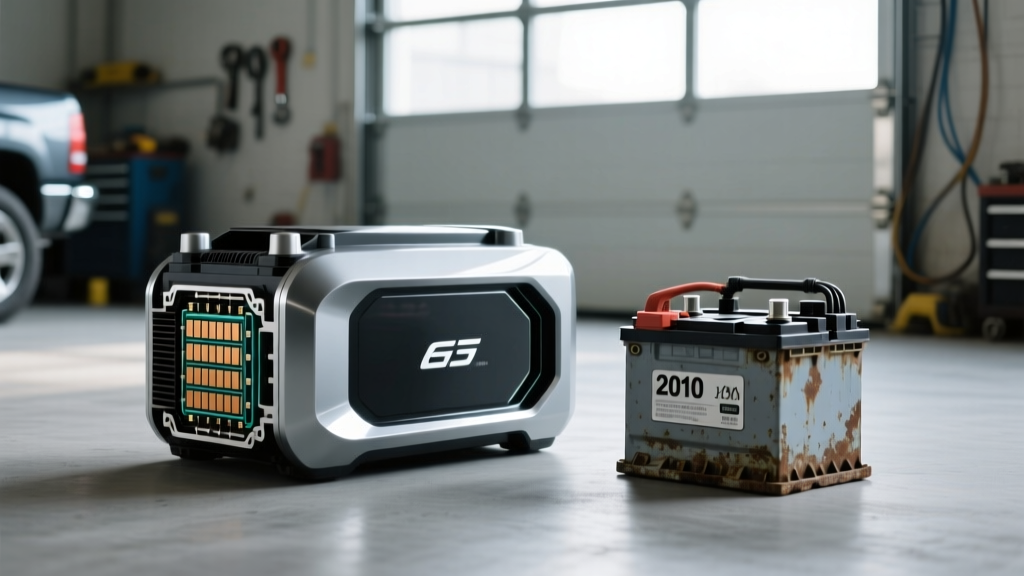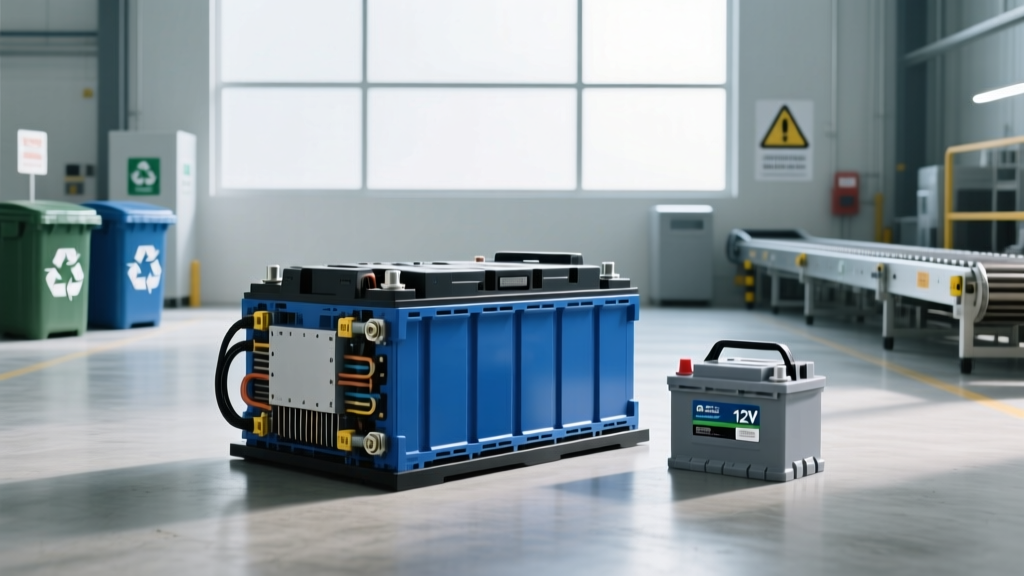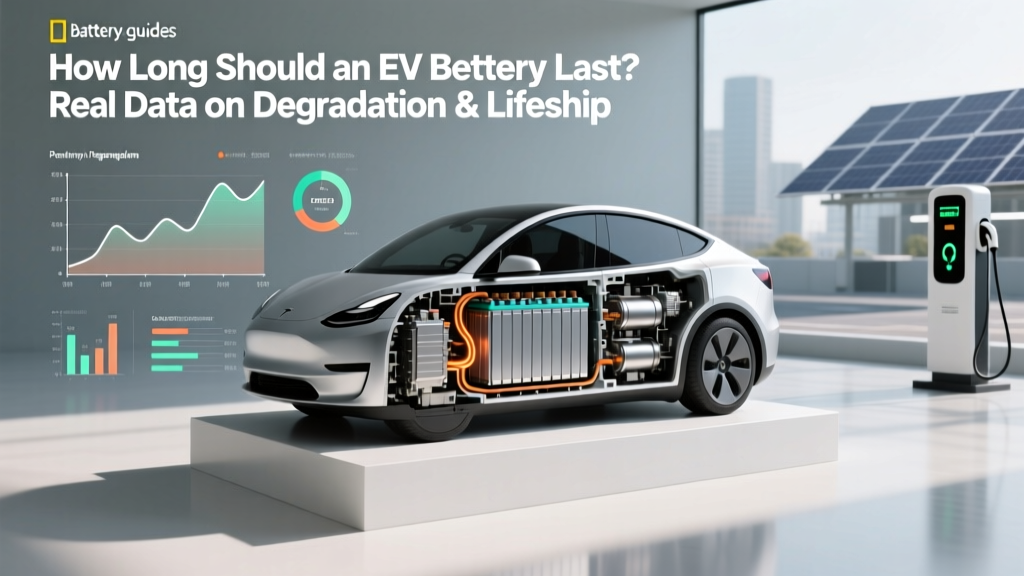
The single most persistent concern among EV shoppers isn't range or charging speed — it's longevity. How long should an EV battery last? The short answer, backed by millions of real-world miles of fleet and consumer data: most modern lithium-ion traction batteries will outlast the vehicle they're installed in, typically delivering 150,000 to 300,000+ miles before degradation becomes a practical concern. But that headline number masks important nuance around chemistry, climate, charging habits, and what "end of life" actually means for an EV battery.
This guide breaks down everything you need to know about EV battery lifespan in 2026 — from chemistry differences to real degradation curves, warranty fine print, replacement economics, and the habits that meaningfully extend (or shorten) your pack's useful life.
How Long Do EV Batteries Actually Last?
When we say an EV battery "lasts," we don't mean it suddenly dies like a phone battery at 0%. Battery end-of-life in automotive terms means the pack has degraded to roughly 70–80% of its original usable capacity. At that point, a vehicle originally rated for 300 miles of EPA range might deliver 210–240 miles — still perfectly functional for daily driving, just with reduced headroom.
Here's what the data shows across major chemistries and manufacturers:
Typical Degradation Trajectories (2026 fleet & consumer data):
- Year 1–2 (0–30,000 mi): 2–5% capacity loss — the steepest initial drop as the solid electrolyte interphase (SEI) layer stabilizes
- Year 3–5 (30,000–75,000 mi): Roughly 1–2% loss per year, linear and predictable
- Year 6–10 (75,000–150,000 mi): Continued gradual decline; most NMC packs retain 85–92% SoH; LFP packs often retain 90–95%+
- Year 10–15 (150,000–250,000+ mi): Many packs still above 80% SoH; some Tesla Model S/X packs from 2013–2015 have exceeded 300,000 miles at ~75% capacity
Sources: Geotab fleet data (50,000+ EVs tracked), Tesla Impact Reports, Recurrent Auto battery studies.
The median EV in the U.S. is driven about 12,000–14,000 miles per year (per FHWA data). That means a 200,000-mile battery lifespan translates to roughly 14–17 years of average use — well beyond the typical vehicle ownership cycle.
LFP vs NMC/NCA: Which Chemistry Lasts Longer?
Battery chemistry is the single biggest variable in longevity. In 2026, virtually all consumer EVs use one of two lithium-ion chemistries: LFP (lithium iron phosphate) or NMC/NCA (nickel manganese cobalt / nickel cobalt aluminum). They trade off in distinct ways.
| Attribute | LFP (LiFePO₄) | NMC / NCA |
|---|---|---|
| Cycle life | 3,000–5,000+ cycles | 1,000–2,500 cycles |
| Energy density | Lower (~160–200 Wh/kg cell-level) | Higher (~220–300 Wh/kg cell-level) |
| Calendar aging | Slower degradation at rest | Faster degradation, esp. at high SoC |
| Cold-weather performance | Weaker — more range loss below freezing | Better low-temp discharge & charge acceptance |
| Peak range per pack size | Lower (heavier for same kWh) | Higher (lighter, more compact) |
| Cost per kWh | Lower (~$75–95/kWh cell, 2026) | Higher (~$100–130/kWh cell, 2026) |
| Optimal daily SoC | Can charge to 100% regularly | Best kept 20–80% for daily use |
| Common in (2026 models) | Tesla Model 3/Y RWD, Ford Mustang Mach-E Select, Rivian Standard, BYD | Tesla Long Range, Hyundai Ioniq 5/6, Chevy Equinox EV, BMW iX, most luxury EVs |
| Cobalt/critical mineral concerns | None (iron + phosphate) | Contains cobalt, nickel — supply chain & ethical considerations |
The bottom line on chemistry: If your priority is maximum longevity and you don't need 350+ miles of range, LFP is the durability winner. If you need maximum range in a lighter, more compact package — and you're willing to manage charging habits — NMC/NCA delivers. Neither is "bad." The right choice depends on your driving pattern.
What Does the EV Battery Warranty Actually Cover?
Federal law mandates a minimum EV battery warranty of 8 years / 100,000 miles for emissions-related components in CARB states, and most manufacturers apply that standard nationwide. In California and states that follow CARB rules (now 17+ states), the mandate extends to 10 years / 150,000 miles.
But the fine print matters enormously. Here's how major manufacturers structure their coverage in 2026:
| Manufacturer | Warranty Period | Mileage Limit | Capacity Threshold | Notes |
|---|---|---|---|---|
| Tesla (Model 3/Y RWD — LFP) | 8 years | 100,000 mi | 70% retention | Long Range/Performance: 8 yr / 120,000 mi |
| Hyundai / Kia | 10 years | 100,000 mi | 70% retention | Among the longest coverage in the segment |
| Ford (Mach-E, F-150 Lightning) | 8 years | 100,000 mi | 70% retention | Covers battery components & capacity |
| General Motors (Ultium platform) | 8 years | 100,000 mi | 70% retention | Covers battery, motor, power electronics |
| Rivian | 8 years | 175,000 mi | 70% retention | Higher mileage cap reflects adventure-use positioning |
| BMW | 8 years | 100,000 mi | 70% retention | Optional extended coverage available |
Critical warranty nuances:
- Capacity threshold: Nearly all warranties trigger at 70% State of Health (SoH). If your 300-mile EV drops to 215 miles of range, you're eligible for repair or replacement. Below 70% but above total failure, the manufacturer decides whether to repair individual modules or replace the entire pack.
- What's excluded: Damage from accidents, flooding, unauthorized modifications, or using the battery as a stationary power source (unless V2H/V2G is explicitly supported and documented) can void coverage.
- Transferability: Most factory battery warranties transfer to second owners, which supports EV resale values — but always verify with the specific manufacturer.
How Much Does an EV Battery Replacement Cost?
This is where fear-mongering often outpaces reality. Yes, a full battery pack replacement is expensive. But it's also rare — most EVs are retired, totaled, or traded in before the pack needs replacement. The average age of a scrapped vehicle in the U.S. is about 15–17 years, and current data shows most packs still function at that age.
That said, here's what replacement costs look like in 2026 if you're out of warranty:
| Vehicle Category | Typical Pack Size | Replacement Cost (Parts + Labor) | Notes |
|---|---|---|---|
| Compact EV (e.g., Chevy Bolt, Nissan Leaf) | 40–65 kWh | $5,000–$9,000 | Smaller packs, more affordable per-kWh replacement |
| Mid-size crossover (e.g., Tesla Model Y, Ioniq 5) | 72–82 kWh | $8,000–$14,000 | Most common segment; module-level repair often possible |
| Large SUV / truck (e.g., F-150 Lightning, Rivian R1T) | 98–135 kWh | $12,000–$20,000+ | Largest packs; labor-intensive removal |
| Luxury sedan (e.g., Mercedes EQS, BMW i7) | 100–108 kWh | $15,000–$22,000+ | Complex thermal systems add labor cost |
Important context on replacement:
- Module-level repair: Many modern packs (Tesla 4680 structural packs excluded) allow individual module replacement rather than full-pack swap. A single failed module might cost $1,500–$3,500 to replace, restoring most capacity.
- Declining costs: Cell prices have fallen from ~$1,200/kWh in 2010 to roughly $80–110/kWh in 2026 (per BloombergNEF). Replacement costs continue to trend downward.
- Refurbished packs: A growing aftermarket supplies refurbished/remanufactured packs at 40–60% of new-pack cost, particularly for high-volume models like the Tesla Model 3 and Nissan Leaf.
- When is replacement typically needed? Based on current degradation data, the earliest most owners would face a capacity-driven replacement (outside of defect or damage) is 200,000–250,000 miles, and often much later. Many packs simply never need replacement within the vehicle's useful life.
What Actually Degrades an EV Battery? (And How to Slow It Down)
Lithium-ion batteries degrade through two mechanisms: cycle aging (wear from charging and discharging) and calendar aging (chemical changes that occur over time regardless of use). You can't stop either entirely, but you can significantly influence the rate.
The 5 Biggest Factors Affecting Battery Longevity
- Extreme State of Charge (SoC): Sitting at 100% SoC for extended periods accelerates NMC/NCA degradation by stressing the cathode structure. Conversely, regularly draining below 10% increases anode stress. Practical rule for NMC/NCA: daily charge to 80%, use 100% only for road trips. LFP packs tolerate 100% SoC much better and manufacturers often recommend periodic full charges for BMS calibration.
- High temperatures: Sustained battery temperatures above 95°F (35°C) accelerate electrolyte decomposition and SEI growth. This is why vehicles with active liquid cooling (Tesla, Hyundai E-GMP, GM Ultium) show measurably better longevity than passively cooled packs (older Nissan Leaf). Parking in shade or a garage in hot climates meaningfully extends pack life.
- Frequent DC fast charging at high power: Charging at 150–350 kW generates significant internal heat and lithium plating risk, especially when the pack is cold or near full. Occasional road-trip fast charging is fine. Daily fast-charging to 100%? That compounds wear. The charge curve matters: most EVs taper significantly above 80% SoC precisely to protect the battery.
- Cold-weather charging without preconditioning: Charging a frozen or near-freezing battery — especially at DC fast-charging speeds — causes lithium metal to plate onto the anode, a permanent and damaging process. Always precondition your battery before fast charging in cold weather (most modern EVs do this automatically when you navigate to a charger).
- High-mileage rapid cycling: Driving 200+ miles daily and fast-charging between full cycles wears cells faster than moderate use. Fleet data from Geotab shows high-utilization vehicles (delivery vans, ride-share) degrade ~1.5–2x faster than personal-use EVs, though even these fleets typically reach 150,000+ miles before hitting 70% SoH.
Battery Care Checklist for Maximum Longevity
- ✅ NMC/NCA owners: Set daily charge limit to 80%; charge to 100% only before long trips
- ✅ LFP owners: Charge to 100% at least once per week for BMS calibration (per manufacturer guidance)
- ✅ Minimize DC fast charging to road trips; use Level 2 home charging as your primary method
- ✅ Precondition the battery before fast charging in cold weather (navigate to charger via the car's nav system)
- ✅ Park in shade or a garage during hot weather; avoid prolonged exposure to 100°F+ ambient temps
- ✅ Don't let the car sit at 100% SoC for days — if you charge to full, drive it soon after
- ✅ Keep tire pressure optimized — lower rolling resistance means less energy drawn per mile, reducing cycle depth
- ✅ Use scheduled charging to finish charging just before you leave, minimizing time at high SoC
How to Check Your EV Battery's State of Health (SoH)
State of Health (SoH) is the percentage of original capacity your battery currently retains. A brand-new pack is 100% SoH; at 70% SoH, you've hit the typical warranty threshold. Here's how to monitor it in 2026:
Built-in Vehicle Displays
Some manufacturers now include SoH or degradation indicators directly in the infotainment system:
- Tesla: No native SoH display in the app, but the vehicle's rated range at 100% SoC, compared to original EPA range, provides a proxy. Third-party tools like TeslaFi or Scan My Tesla (via OBD-II) pull detailed battery data.
- Hyundai/Kia: The EV-specific menu in the cluster or head unit shows a battery health percentage on many 2024+ models.
- BMW: The iDrive system includes a battery health indicator under the vehicle status menu on iX and i4 models.
- Nissan: The Leaf has long included a 12-bar battery health gauge on the dash — one of the earliest consumer-facing SoH indicators.
OBD-II Diagnostic Tools
For deeper data, an OBD-II dongle paired with apps like Car Scanner, Leaf Spy (Nissan Leaf), or ABRP (A Better Route Planner) with OBD integration can read cell voltages, pack temperature, individual module balance, and precise SoH percentages. These tools are especially useful when evaluating a used EV purchase.
Dealer Diagnostics
Any authorized dealer can pull a full battery health report during service visits. If you're approaching a warranty mileage threshold and suspect elevated degradation, request this report proactively — it creates a paper trail for any future warranty claim.
What's Next? Solid-State, Silicon Anodes, and Future Battery Tech
Looking ahead, several next-generation battery technologies promise to reshape longevity, energy density, and charging speed — but realistic timelines matter.
- Solid-state batteries: Replace the liquid electrolyte with a solid ceramic or polymer layer, potentially doubling cycle life (5,000–10,000+ cycles), improving energy density by 30–50%, and enabling faster charging with lower degradation risk. Timeline: Toyota, Samsung SDI, and QuantumScape have announced pilot production for 2027–2028, with limited commercial availability in select models by 2029–2030. Mass-market adoption is not expected before 2032+. (U.S. DOE overview)
- Silicon-dominant anodes: Replacing graphite anodes with silicon can boost energy density by 20–40% and improve charge acceptance. Companies like Sila Nanotechnologies and Group14 are already supplying silicon-composite anodes to manufacturers including Mercedes-Benz and Panasonic. Timeline: Limited deployment in 2025–2026 luxury models; broader adoption expected 2027–2029.
- Sodium-ion batteries: Use abundant sodium instead of lithium, reducing cost and critical-mineral dependency. Energy density is lower (~120–160 Wh/kg), making these best suited for budget city EVs and stationary storage. CATL and BYD have begun limited production. Timeline: Emerging in Chinese-market micro-EVs now; U.S. availability uncertain before 2028+.
The practical takeaway: These technologies are real and progressing, but none are available in a vehicle you can buy today in the U.S. If you're deciding whether to buy an EV now or wait for solid-state — current lithium-ion packs already deliver 15–20 year lifespans. Waiting 5+ years for next-gen chemistry means 5+ more years of gasoline expenses.
Frequently Asked Questions
How long should an EV battery last in years?
Based on 2026 fleet data and manufacturer projections, most EV batteries will deliver 15–20+ years of service before degrading to 70% of original capacity. At average U.S. mileage (12,000–14,000 mi/year), that's well beyond the typical vehicle lifespan. Many packs will still be functional — just with reduced range — at 20+ years.
How much does it cost to replace an EV battery in 2026?
Full pack replacement ranges from roughly $5,000 for a compact EV (40–65 kWh) to $20,000+ for a large truck or luxury sedan (100+ kWh). However, module-level repairs can cost $1,500–$3,500, and most EVs never need a full battery replacement within their useful life. Cell pricing continues to decline year over year.
Does fast charging damage the battery?
Occasional DC fast charging (road trips, a few times per month) has minimal impact on modern batteries with active thermal management. Daily fast charging, especially to 100% SoC or in extreme heat/cold without preconditioning, does accelerate degradation. Level 2 home charging at 7–11 kW remains the gentlest and most cost-effective daily charging method.
Should I charge my EV to 100% every night?
It depends on chemistry. NMC/NCA owners should set a daily limit of 80% and reserve 100% charges for long trips. LFP owners are generally advised to charge to 100% at least weekly for accurate battery management system (BMS) calibration — LFP chemistry tolerates full charge much better. Always follow your specific manufacturer's guidance.
Is LFP better than NMC for longevity?
For pure cycle life and calendar longevity, yes — LFP is the clear winner, with 3,000–5,000+ cycle life versus 1,000–2,500 for NMC. The trade-offs are lower energy density (less range for the same pack weight) and weaker cold-weather performance. If you need maximum range or live in a very cold climate, NMC may still be the better fit — just manage your charging habits carefully.
What happens when an EV battery degrades past 70%?
The car still drives normally — you just have less range. A 300-mile EV at 70% SoH delivers roughly 210 miles, which is still sufficient for most daily commutes. If you're under warranty, the manufacturer will repair or replace the pack. Out of warranty, you can continue driving, pursue a module repair, or consider a refurbished pack replacement.
Does the federal tax credit cover battery replacement?
No. The IRS §30D clean vehicle credit applies only to the purchase of a new or qualified used EV, not to aftermarket battery replacements. However, if you purchase a used EV with a degraded battery, the used EV credit (up to $4,000, subject to income and price caps) can offset the vehicle purchase cost. Battery warranty claims are handled by the manufacturer, not through tax incentives.