If you are shopping for an electric vehicle or already own one, the single most expensive component in your car is the high-voltage traction battery. It is also the most misunderstood. Buyers worry about catastrophic replacement bills, while owners wonder whether every DC fast charge is quietly eroding their range. This guide cuts through the anxiety with hard data: real degradation curves from fleets and long-term tests, chemistry trade-offs that affect your daily driving, warranty terms that protect you, and the actual cost to replace a pack if the worst happens.
Let us be clear up front: modern EV batteries are lasting longer than most owners keep their cars. But "longer" is not the same as "forever," and the details matter when you are committing $40,000 or more to a vehicle you plan to drive for a decade.
LFP vs NMC: Which Battery Chemistry Is Right for You?
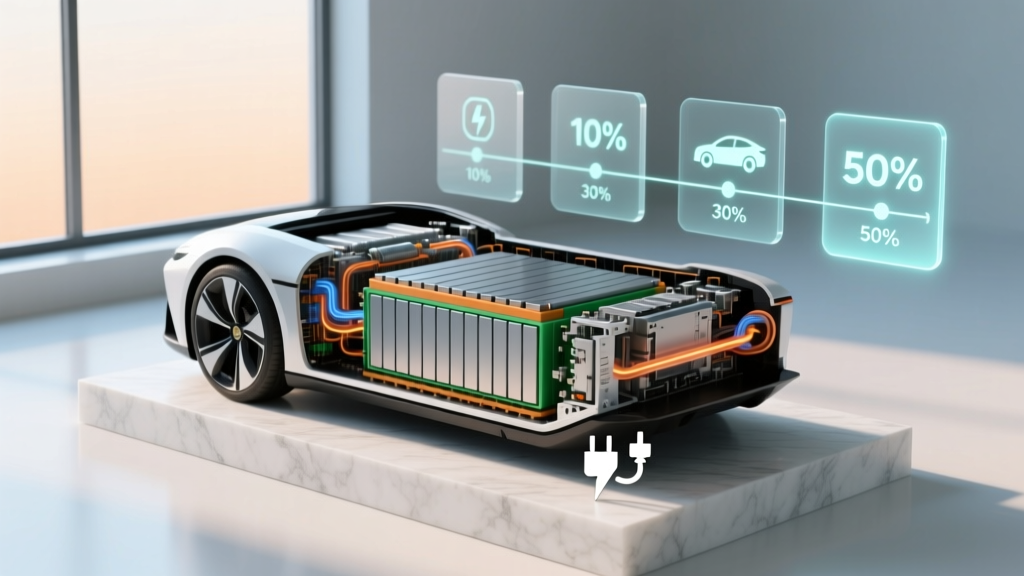
Not all EV batteries are the same. The two dominant lithium-ion chemistries in 2026 passenger vehicles are NMC (nickel manganese cobalt, sometimes NCA — nickel cobalt aluminum) and LFP (lithium iron phosphate). The chemistry inside your pack determines how much range you get per pound, how fast you can charge, how the battery handles winter cold, and how many charge cycles it will tolerate before meaningful degradation sets in.
NMC packs offer higher energy density — more kilowatt-hours (kWh) of stored energy in a lighter, more compact package. That is why most long-range and performance EVs still use NMC: the Tesla Model 3 Long Range, Hyundai Ioniq 5, BMW i4, and Ford Mustang Mach-E Extended Range all rely on it. The trade-off is a somewhat shorter cycle life, greater sensitivity to sustained high states of charge, and a higher materials cost tied to cobalt and nickel markets.
LFP batteries are heavier and less energy-dense, which historically limited them to shorter-range models. But LFP chemistry is far more tolerant of daily charging to 100%, handles more charge cycles before degrading, and avoids cobalt entirely — making it cheaper to produce. Tesla's Model 3 and Model Y Standard Range variants, the base Ford Mustang Mach-E Select, and several BYD models use LFP. If you primarily commute and can charge at home nightly, LFP may be the better long-term ownership play even if you sacrifice 30–50 miles of EPA range versus the NMC equivalent.
| Attribute | LFP (Lithium Iron Phosphate) | NMC / NCA (Nickel-based) |
|---|---|---|
| Energy Density | Lower (~160–180 Wh/kg cell-level) | Higher (~230–280 Wh/kg cell-level) |
| Typical EPA Range Impact | Shorter range for same pack weight | Longer range or lighter pack for same range |
| Cycle Life | 3,000–5,000+ cycles to 80% capacity | 1,000–2,000 cycles to 80% capacity |
| Daily Charging to 100% | Recommended — no penalty | Not ideal — 80% daily recommended |
| Cold-Weather Performance | Moderate — slower charging in freezing temps | Better — preconditioning mitigates most losses |
| Cost per kWh (pack level) | ~$90–$110 | ~$120–$150 |
| Notable 2026 Models | Tesla Model 3 RWD, Model Y RWD, BYD Seal | Tesla Model 3 LR, Ioniq 5, BMW i4 eDrive40 |
The short answer on chemistry: if you need maximum range for road trips and live in a cold climate, NMC still holds an edge. If you charge at home daily, drive under 50 miles round-trip, and want a battery that will likely outlast the car's body, LFP is a compelling choice. Neither is universally "better" — it depends on your driving pattern.
How Long Do EV Batteries Actually Last?
The question every prospective buyer asks: will I need a new battery, and when? Based on data from high-mileage fleets, long-term owner reports, and manufacturer testing, the answer is reassuring — but nuanced.
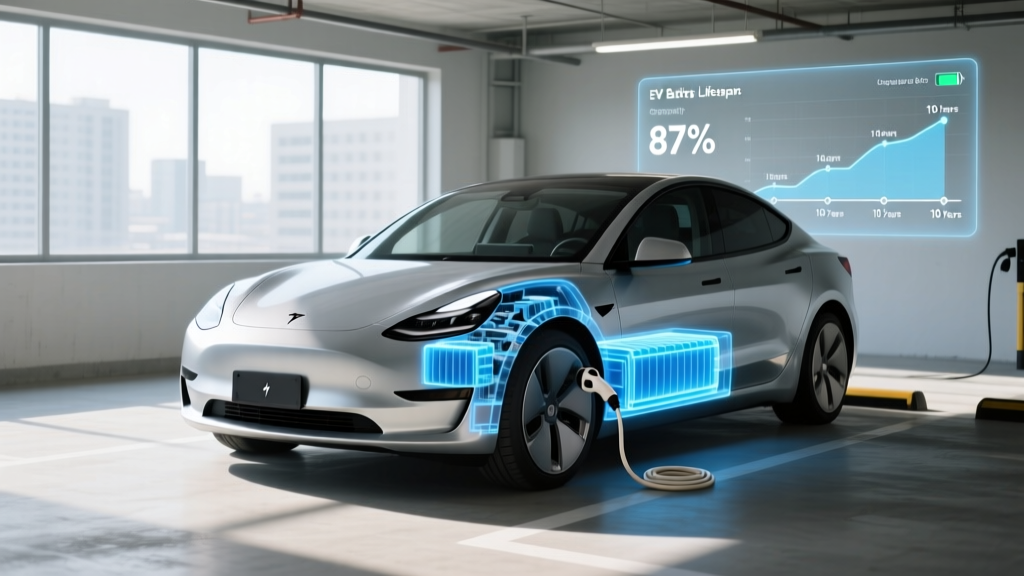
Most modern EV batteries are engineered to retain 70–80% of their original capacity after 150,000–200,000 miles or 10–15 years of typical use. That does not mean the battery "dies" at that point. It means a vehicle originally rated for 300 miles of EPA range might deliver 210–240 miles when new-equivalent driving conditions are matched. For most drivers, that is still a usable daily range.
Real-world degradation data points from the field:
- Tesla Model 3/Y (NMC, 2018–2023): Tesla's 2024 Impact Report cited an average of ~12% capacity loss at 150,000 miles across its fleet. Independent data from Recurrent Auto (a battery analytics firm tracking over 15,000 EVs) showed similar figures — approximately 88–92% state of health (SoH) at 100,000 miles for liquid-cooled packs.
- Chevrolet Bolt EV/EUV (NMC, 2017–2023): Early Bolts saw some cells replaced under warranty, but fleet-wide data showed ~90% SoH at 80,000 miles for vehicles that avoided frequent DC fast charging.
- Nissan Leaf (passive air-cooled, 2011–2025): The Leaf is the cautionary tale. Without active liquid cooling, early 24 kWh Leafs in hot climates lost 20–30% capacity within 5 years. The later 62 kWh Leaf Plus fared better but still degraded faster than liquid-cooled competitors.
- LFP Tesla Model 3 RWD (2021–present): Early data from Recurrent Auto suggests LFP packs are holding above 95% SoH at 50,000 miles — consistent with the chemistry's superior cycle life.
The pattern is clear: liquid-cooled packs from mainstream manufacturers are holding up well. The days of rapid, cliff-like battery failure are largely behind us — provided the pack has active thermal management.
EV Battery Degradation: What the Data Shows
Degradation is not linear. Most EV batteries experience a steeper drop in the first 10,000–20,000 miles (typically 2–5% loss as the cell chemistry stabilizes), followed by a long, slow decline of roughly 1–2% per year or per 10,000–15,000 miles. Here is what a typical NMC degradation curve looks like for a liquid-cooled pack:
- 0–20,000 miles: ~2–5% capacity loss (initial settling)
- 20,000–60,000 miles: ~2–4% additional loss (total: 5–9%)
- 60,000–100,000 miles: ~3–5% additional loss (total: 8–14%)
- 100,000–150,000 miles: ~3–5% additional loss (total: 11–19%)
- 150,000–200,000 miles: ~3–6% additional loss (total: 14–25%)
Note: LFP packs typically show less total loss at each interval. Hot climates and frequent DC fast charging shift these figures upward by 3–8 percentage points.
According to data published by the National Renewable Energy Laboratory (NREL), modern lithium-ion EV batteries in moderate climates with Level 2 home charging can be expected to retain approximately 75–85% of original capacity at 150,000 miles. That aligns with what we see in owner-reported data across major EV forums and fleet analytics platforms.
What Does the EV Battery Warranty Cover?
Federal law in the United States mandates that EV batteries carry a minimum warranty of 8 years or 100,000 miles (whichever comes first). In California Air Resources Board (CARB) states — which include California, New York, Massachusetts, and several others — the requirement extends to 10 years or 150,000 miles. Most manufacturers meet or exceed these minimums.
The critical detail is the capacity retention threshold. A warranty does not cover gradual, normal degradation. It covers the battery falling below a specified state of health percentage. For nearly every major automaker in 2026, that threshold is 70% of original capacity.
| Manufacturer | Warranty Period | Mileage Limit | Capacity Threshold | CARB-State Extension |
|---|---|---|---|---|
| Tesla (Model 3/Y NMC) | 8 years | 120,000 mi | 70% | Varies by state |
| Tesla (Model 3/Y LFP) | 8 years | 100,000 mi | 70% | Varies by state |
| Hyundai / Kia | 10 years | 100,000 mi | 70% | 10 yr / 150,000 mi |
| Ford (Mach-E, F-150 Lightning) | 8 years | 100,000 mi | 70% | Varies by state |
| BMW (i4, iX) | 8 years | 100,000 mi | 70% | Varies by state |
| Volkswagen (ID.4) | 8 years | 100,000 mi | 70% | Varies by state |
| Chevrolet (Blazer EV, Equinox EV) | 8 years | 100,000 mi | 70% | Varies by state |
| Rivian (R1T, R1S) | 8 years | 175,000 mi | 70% | Varies by state |
A few things to note. Rivian's 175,000-mile limit is the most generous in the industry, reflecting their truck and adventure-use positioning. Hyundai and Kia offer the longest time-based coverage at 10 years. In every case, the warranty covers defects and excessive degradation — not damage from accidents, flooding, or unauthorized modifications.
If your battery falls below the threshold within the warranty period, the manufacturer will typically replace failed modules or the entire pack at no cost. In practice, most warranty claims involve individual module replacement rather than a full pack swap, which is faster and less invasive.
EV Battery Replacement Cost: What You Will Actually Pay
This is the number that generates the most fear — and the most misinformation. Yes, a full high-voltage battery replacement is expensive. But context matters enormously.
First, most EV batteries never need replacement during the vehicle's useful life. The data from Recurrent Auto, Consumer Reports, and manufacturer warranty claim rates all point to the same conclusion: out-of-warranty battery failure is rare for liquid-cooled packs. The Nissan Leaf's early air-cooled designs were the exception, not the rule.
Second, when replacement is needed, it is often a partial fix. Modern EV packs are composed of multiple modules (typically 8–16 depending on the platform). A single failed module can be replaced for $1,500–$4,000 including labor, restoring the pack to functional health without the cost of a full swap.
That said, here is what a full pack replacement costs in 2026 if you are out of warranty and the entire unit needs to be replaced:
| Vehicle | Battery Size (kWh) | Chemistry | Estimated Parts Cost | Labor | Total Estimate |
|---|---|---|---|---|---|
| Tesla Model 3 RWD | 60 kWh | LFP | $6,500–$8,500 | $1,500–$2,500 | $8,000–$11,000 |
| Tesla Model Y Long Range | 75 kWh | NMC | $9,000–$12,000 | $1,500–$2,500 | $10,500–$14,500 |
| Hyundai Ioniq 5 | 77.4 kWh | NMC | $9,500–$13,000 | $2,000–$3,000 | $11,500–$16,000 |
| Ford Mustang Mach-E ER | 91 kWh | NMC | $12,000–$16,000 | $2,000–$3,000 | $14,000–$19,000 |
| Ford F-150 Lightning ER | 131 kWh | NMC | $16,000–$22,000 | $2,500–$4,000 | $18,500–$26,000 |
| Chevrolet Equinox EV | 85 kWh | NMC | $10,000–$14,000 | $2,000–$3,000 | $12,000–$17,000 |
| Rivian R1T (Large Pack) | 135 kWh | NMC | $17,000–$23,000 | $2,500–$4,000 | $19,500–$27,000 |
These figures are based on out-of-warranty pricing from manufacturer service centers and independent EV repair shops as of early 2026. Costs have been declining — roughly 8–12% per year on a per-kWh basis — as cell manufacturing scales and second-life battery markets develop. By the time a 2026 model year EV actually needs an out-of-warranty replacement (likely 2036 or later), prices will almost certainly be substantially lower.
It is also worth noting that Consumer Reports has found that the total cost of EV ownership — factoring in fuel savings, reduced maintenance, and tax incentives — still beats comparable gasoline vehicles even when a battery replacement is modeled at year 15.
Factors That Accelerate Battery Degradation
Your battery's lifespan is not fixed. How you charge, drive, and store your EV has a measurable impact on how quickly the cells lose capacity. Here are the factors ranked by impact, based on cell-testing data and fleet analytics:
- Avoid sustained 100% SoC (NMC only): For NMC packs, set your daily charge limit to 80%. Reserve 100% for road trips. LFP owners can charge to 100% daily without concern — in fact, Tesla recommends periodic 100% charges for LFP to recalibrate the BMS.
- Minimize DC fast charging when possible: DC fast charging at 150+ kW generates significant heat. Occasional use on road trips is fine — the thermal management system handles it. But if you DC fast charge daily because you lack home charging, expect 2–5% more degradation over 100,000 miles compared to Level 2 home charging. Studies from the Idaho National Laboratory confirmed that exclusive DC fast charging accelerated capacity loss by approximately 5–8 percentage points over 50,000 miles versus Level 2 charging.
- Precondition before fast charging: If your EV offers battery preconditioning (Tesla, Hyundai/Kia E-GMP, BMW, Ford), always navigate to the charger through the car's built-in navigation. This warms the pack to the optimal ~30–35°C for fast charging, reducing stress on the cells and actually speeding up your charge session.
- Avoid extreme SoC in extreme heat: Parking a fully charged NMC battery in 100°F+ ambient heat for extended periods accelerates calendar degradation. If you live in Phoenix or Las Vegas, charge to 80% and park in shade or a garage when possible.
- Do not let SoC sit at 0%: If your EV will be stored for weeks, leave it at approximately 50% SoC. Extended storage at very low states of charge can cause copper dissolution in the anode, which is irreversible.
- Use regen braking moderately: Aggressive regenerative braking in cold weather (below freezing) can stress cells that have not been warmed up. Most modern EVs automatically limit regen when the battery is cold, but if yours does not, ease into it for the first few miles.
How to Monitor Your EV Battery Health
State of Health (SoH) is the metric that tells you what percentage of your battery's original capacity remains. Unlike the 12V auxiliary battery (which powers accessories and is a separate, inexpensive component), the high-voltage traction battery's SoH directly affects your range.
Here is how to check it on popular 2026 platforms:
- Tesla: No built-in SoH display in the car's UI. However, you can calculate it manually: charge to 100%, note the displayed range, and compare it to the original EPA-rated range. For a more precise reading, third-party apps like Tessie or TeslaFi pull data from the vehicle's API and estimate SoH. Tesla service centers can also run a diagnostic on request.
- Hyundai / Kia: The infotainment system includes a battery health readout under EV settings > Battery. It displays SoH as a percentage. Hyundai's Bluelink connected services also reports this remotely.
- Ford: The FordPass app and in-vehicle settings show an estimated range at full charge. Comparing this to the original sticker range gives a rough SoH. Ford dealerships can run a full Battery Health Check diagnostic.
- BMW: The iDrive system provides a battery capacity display under the EV menu. BMW's Connected Drive services also tracks long-term capacity trends.
- OBD-II tools: For any EV, an OBD-II dongle paired with an app like LeafSpy (Nissan), ABRP (general), or Torque Pro with EV-specific PIDs can read the battery management system's internal SoH estimate. This is the most accurate consumer-accessible method.
A practical benchmark: if your SoH drops below 80% while still under warranty, you likely have a valid claim. Below 70%, you almost certainly do. Between 80–90% at 60,000–80,000 miles is normal and not a cause for concern.
What Comes After Lithium-Ion? Solid-State and Beyond
If you have followed EV news, you have seen promises of solid-state batteries — cells that replace the liquid electrolyte with a solid material, offering higher energy density, faster charging, and reduced fire risk. Here is where the technology actually stands in 2026:
- Toyota: Has announced a solid-state battery pilot for a limited-production vehicle, targeting 2027–2028. The company claims 750 km (~465 miles) of range and 10-minute fast charging. However, this remains a low-volume, high-cost application. Mass-market solid-state Toyotas are not expected before 2030.
- Samsung SDI: Supplying solid-state cells for pilot programs with European automakers. Production-scale availability is projected for 2028–2029 at the earliest.
- QuantumScape: The Volkswagen-backed startup has delivered prototype cells to OEM partners for testing. Independent verification of long-term cycle life at production scale has not yet been published. Realistic market availability: 2029–2031.
- Silicon anode batteries: A nearer-term improvement. Companies like Sila Nanotechnologies and Group14 are supplying silicon-dominant anode materials that boost energy density by 15–25% within existing lithium-ion form factors. These are beginning to appear in 2026 model-year vehicles as incremental upgrades rather than revolutionary new packs.
The honest assessment: solid-state batteries are real and progressing, but they will not affect the purchase decision for anyone buying an EV between now and 2030. The current generation of liquid-cooled lithium-ion packs — both NMC and LFP — are mature, well-understood, and lasting long enough that most first owners will sell the car before the battery needs attention.
Frequently Asked Questions
How long do EV batteries last in years and miles?
Most modern liquid-cooled EV batteries retain 70–85% of their original capacity at 150,000–200,000 miles or 10–15 years. They do not "die" at that point — they simply offer reduced range. Many packs continue functioning well beyond 200,000 miles with usable capacity. Air-cooled batteries (like early Nissan Leafs) degraded faster, but active thermal management has largely solved this.
How much does an EV battery cost to replace?
A full out-of-warranty pack replacement ranges from approximately $8,000 for a 60 kWh LFP pack (Tesla Model 3 RWD) to $20,000–$27,000 for large 130+ kWh packs (F-150 Lightning Extended Range, Rivian R1T). However, most replacements involve individual modules at $1,500–$4,000 rather than the entire pack. The vast majority of EV batteries never require replacement during the first owner's tenure.
What does the EV battery warranty actually cover?
EV battery warranties cover defects and excessive capacity loss — specifically, the battery falling below 70% of its original capacity within 8 years / 100,000 miles (federal minimum) or 10 years / 150,000 miles in CARB states. They do not cover damage from accidents, misuse, or unauthorized modifications. Normal gradual degradation above the threshold is not covered.
How do I check and maximize my EV battery health?
Monitor SoH through your vehicle's built-in battery display, connected apps (TeslaFi, FordPass, Bluelink), or an OBD-II reader with EV-specific PIDs. To maximize lifespan: charge NMC packs to 80% daily (100% is fine for LFP), rely primarily on Level 2 home charging, precondition the battery before DC fast charging, avoid parking at 100% SoC in extreme heat, and never store the vehicle at 0% SoC for extended periods.
Is LFP or NMC better for my EV battery?
Neither is universally better. LFP offers longer cycle life (3,000–5,000+ cycles vs 1,000–2,000), lower cost, and the ability to charge to 100% daily without degradation concerns — making it ideal for commuters with home charging. NMC offers higher energy density (more range per pound), better cold-weather performance, and faster DC charging speeds — making it preferable for long-range driving and cold climates. Choose based on your driving pattern, not on the assumption that one chemistry is superior in all scenarios.
Does DC fast charging damage my EV battery?
Occasional DC fast charging on road trips has a minimal impact on battery health — modern thermal management systems keep cell temperatures in check. However, exclusive reliance on DC fast charging (150+ kW) for daily charging has been shown in Idaho National Laboratory testing to accelerate degradation by approximately 5–8 percentage points over 50,000 miles compared to Level 2 charging. If you have home charging access, use Level 2 for daily needs and reserve DC fast charging for trips.