If you've ever replaced a 12V lead-acid battery in a gas SUV — say, a 2008 Jeep Liberty battery (Group 34, roughly $150–$220 at an auto-parts store, swapped in ten minutes with a wrench) — you might wonder how that experience maps onto a modern electric vehicle's high-voltage traction battery. The short answer: it doesn't, and that's actually good news. EV battery packs are engineered for 150,000–200,000+ miles of service, backed by federally mandated warranties, and built from chemistries that have evolved dramatically over the last decade.
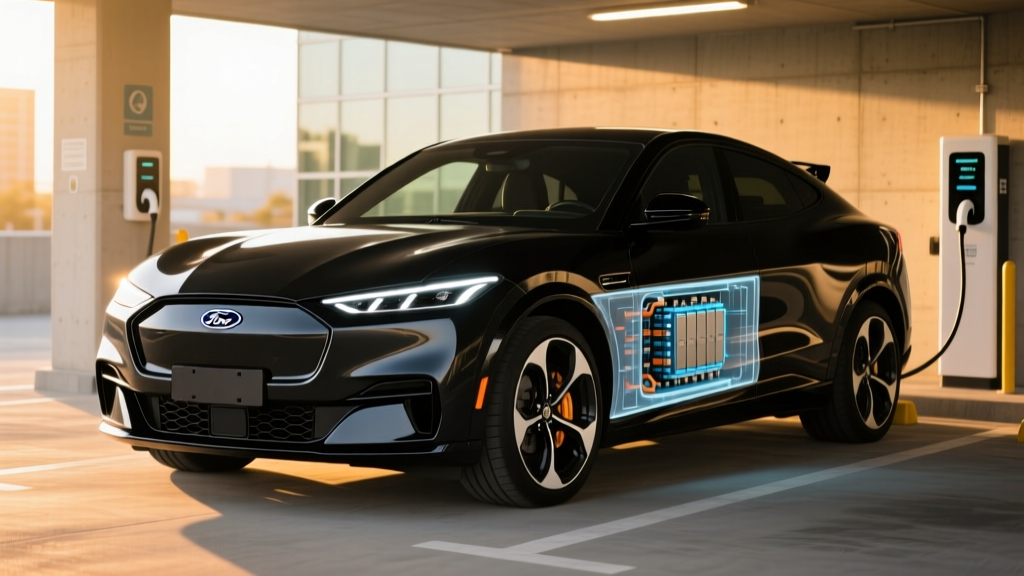
This guide breaks down exactly what powers today's EVs, how long those packs last, what replacement actually costs in 2026, and how to monitor and maximize your battery's State of Health (SoH). Whether you're cross-shopping a Tesla Model Y, a Ford Mustang Mach-E, or a BYD-pack LFP sedan, the chemistry and care principles are the same.
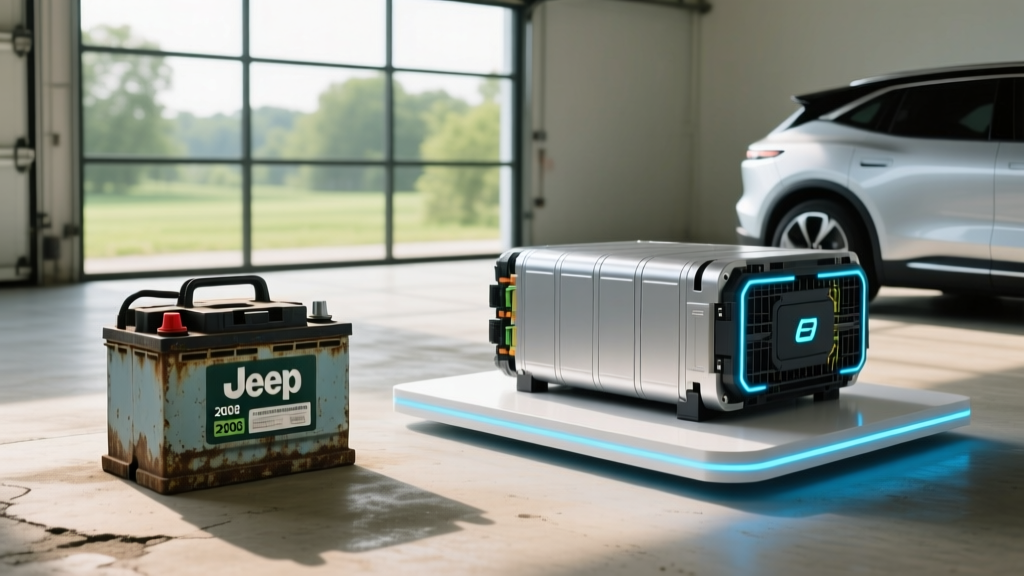
Why a 2008 Jeep Liberty Battery Is Nothing Like an EV Traction Battery
The 2008 Jeep Liberty uses a conventional 12V lead-acid SLI (Starting, Lighting, Ignition) battery. It delivers a short, high-amperage burst to crank a 3.7L V6, then gets recharged by the alternator. Typical lifespan: 3–5 years. Replacement cost: under $250.
An EV's high-voltage traction battery (typically 400V or 800V) is a fundamentally different system. It stores tens of kilowatt-hours (kWh) of energy — the total energy capacity, not to be confused with kW, which is the rate of power delivery or charging. A 2026 Tesla Model Y Long Range, for example, carries roughly 75 kWh of usable energy in an NMC (nickel manganese cobalt) pack; a base-model BYD Dolphin uses a ~60 kWh LFP (lithium iron phosphate) Blade battery.
These packs weigh 700–1,200 lbs, contain thousands of individually managed cells, use liquid thermal management systems, and are monitored by a Battery Management System (BMS) that balances cell voltages, limits charge/discharge rates, and protects against thermal runaway. You don't swap one in a driveway — and you rarely need to.
LFP vs. NMC/NCA: The Chemistry Trade-Offs That Matter
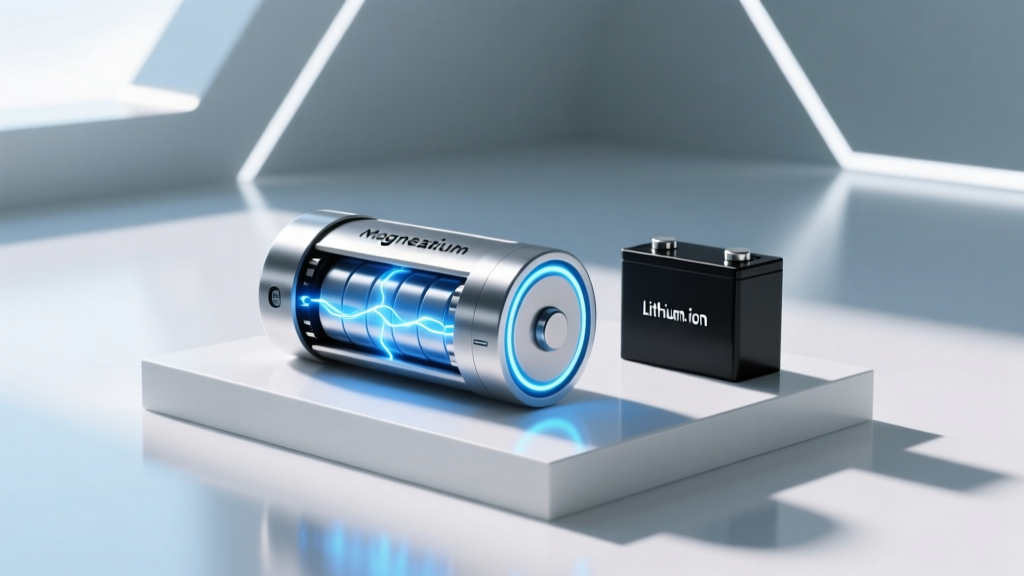
Two dominant lithium-ion chemistries power nearly every EV sold in the US in 2026. Understanding the difference is the single most important factor in predicting your battery's lifespan, range behavior, and long-term value.
| Attribute | LFP (Lithium Iron Phosphate) | NMC / NCA (Nickel Manganese Cobalt / Nickel Cobalt Aluminum) |
|---|---|---|
| Energy Density | Lower (~160 Wh/kg cell-level) | Higher (~250–300 Wh/kg cell-level) |
| Typical Cycle Life | 3,000–5,000+ full cycles | 1,000–2,000 full cycles |
| Cold-Weather Performance | Weaker below 32°F; slower charging, more range loss | Better low-temp conductivity |
| Cost per kWh (2026) | ~$80–100/kWh at pack level | ~$110–140/kWh at pack level |
| Recommended Daily SoC | 100% OK (and recommended for BMS calibration) | 80% daily; 100% only for trips |
| Cobalt Content | None | Varies (low-cobalt NMC trending) |
| Common In (2026 US) | Tesla Model 3/Y RWD, Ford Mustang Mach-E Select, BYD, Rivian Standard | Tesla LR/Performance, Hyundai Ioniq 5/6 LR, BMW iX, Lucid, Cadillac Lyriq |
Which is better? Neither is universally superior. LFP wins on longevity, cost, and daily convenience (charge to 100% without guilt). NMC wins on range per pound and cold-weather usability. If you live in Minnesota and road-trip frequently, NMC's energy density and cold performance justify the trade-off. If you commute 40 miles daily in California and want a pack that'll outlast the car's body, LFP is the pragmatic pick.
How Long Do EV Batteries Actually Last? Degradation Data
EV batteries don't "die" suddenly — they gradually lose capacity, measured as State of Health (SoH). A pack at 90% SoH holds 90% of its original kWh. Most manufacturers warranty the pack down to 70% SoH over 8 years or 100,000 miles (whichever comes first), and federal law (EPA guidance) effectively mandates this minimum for emissions-related components, which includes the traction battery on PHEVs.
Real-world degradation benchmarks (aggregated from fleet data, Recurrent Auto, and manufacturer reports):
- Year 1: ~2–5% loss (initial "break-in" degradation, steeper curve)
- Years 2–4: ~1–2% per year (linear, gradual)
- Years 5–8: ~1% per year (plateau phase)
- At 100,000 miles: Most NMC packs retain 85–92% SoH; most LFP packs retain 90–95% SoH
- At 150,000 miles: NMC typically 80–88%; LFP typically 87–93%
- At 200,000 miles: LFP packs commonly above 85% SoH; NMC packs 75–85%
Tesla's own 2024 Impact Report (the most recent published fleet data) showed Model 3/Y packs retaining ~88% capacity at 200,000 miles on average. Recurrent Auto's fleet studies of over 15,000 vehicles confirm that catastrophic pack failure before 150,000 miles is statistically rare — well under 2% of vehicles.
The practical takeaway: for most owners, the battery will outlast the vehicle's useful economic life. You're far more likely to sell or total the car from a collision than to need a full pack replacement.
What the Battery Warranty Actually Covers
Every new EV sold in the US carries a high-voltage battery warranty. Here's how the major manufacturers structure theirs in 2026:
| Manufacturer | Warranty Term | Capacity Retention Threshold | Notes |
|---|---|---|---|
| Tesla | 8 yr / 100,000 mi (RWD); 8 yr / 120,000 mi (LR/Perf) | 70% SoH | LFP RWD uses lower-mileage threshold |
| Hyundai / Kia | 10 yr / 100,000 mi | 70% SoH | Among the longest in the industry |
| Ford | 8 yr / 100,000 mi | 70% SoH | Covers Mach-E, F-150 Lightning |
| GM (Chevy/Cadillac) | 8 yr / 100,000 mi | 70% SoH (60% on some Ultium commercial) | Varies by model; check window sticker |
| Rivian | 8 yr / 120,000 mi (Standard); 8 yr / 175,000 mi (Max) | 70% SoH | Max Pack warranty is class-leading |
| BMW | 8 yr / 100,000 mi | 70% SoH | Extended coverage available in some states |
What's covered: Capacity loss below the threshold, cell/module defects, BMS failures, and manufacturing defects. The manufacturer will repair or replace (often with a refurbished pack of equivalent capacity) at no cost.
What's typically excluded: Damage from accidents, flooding, unauthorized modifications, or using non-approved charging equipment. Cosmetic corrosion on the casing is also excluded. Always read the specific warranty booklet — terms vary.
EV Battery Replacement Cost: What You'd Actually Pay
If your pack falls outside warranty — say, at 160,000 miles on a 9-year-old vehicle — replacement is a real expense, but context matters. Here's the 2026 landscape:
| Battery Size / Application | Estimated Replacement Cost (Parts + Labor) | Typical When Needed |
|---|---|---|
| 40–60 kWh (compact EV, e.g., Chevy Bolt, Nissan Leaf) | $6,000–$10,000 | Rarely; usually post-warranty, high-mileage |
| 70–85 kWh (mid-size, e.g., Model Y, Mach-E, Ioniq 5) | $10,000–$16,000 | 150,000+ mi, or 10+ years |
| 90–115 kWh (large, e.g., Model S, F-150 Lightning Extended, Rivian Max) | $15,000–$22,000 | Very rare; most packs outlast vehicle |
| PHEV pack (10–25 kWh, e.g., RAV4 Prime, Wrangler 4xe) | $4,000–$8,000 | 100,000–150,000 mi in some climates |
For comparison, that 2008 Jeep Liberty battery you picked up at AutoZone for $180? A full EV pack replacement is 40–100× that cost — but you're also replacing a system that stored 75,000 Wh vs. the Liberty's ~600 Wh, and it lasted 4–5× longer in real-world use.
Importantly, most EV owners never pay this. Packs are lasting longer than projected, and a growing aftermarket for refurbished and salvaged packs (from totaled vehicles) is bringing costs down. Companies like Redwood Materials and Spiers New Technologies offer remanufactured modules at 40–60% of new-pack pricing.
Five Factors That Accelerate (or Preserve) Battery Life
Not all miles are created equal when it comes to degradation. Here's what the data shows:
- DC fast-charging frequency: Occasional fast charging (1–2x/week) has minimal impact. Daily 150+ kW DC charging adds ~1–3% extra degradation over 100k miles vs. Level 2 home charging. The heat generated at high C-rates stresses cells. Preconditioning your battery before a fast-charge session (most EVs do this automatically when you navigate to a charger) reduces this significantly.
- Extreme temperatures: Sustained operation above 95°F or below 10°F accelerates calendar aging. Vehicles with active liquid thermal management (Tesla, Hyundai E-GMP, GM Ultium, Rivian) handle this far better than passively cooled packs (older Nissan Leaf). Garage parking in Phoenix or Minneapolis meaningfully extends pack life.
- State of Charge habits: For NMC packs, storing at 100% SoC for days at a time is the single worst habit. Daily charging to 80% and avoiding sub-10% for extended periods keeps the pack in its happy zone. LFP packs are more tolerant of 100% SoC and actually benefit from periodic full charges for BMS cell-balancing.
- Depth of discharge: Shallow cycles (20%–80%) are easier on cells than full 0%–100% cycles. This is why PHEVs with small packs that cycle deeply every day show slightly higher degradation rates per mile than large-pack BEVs that rarely dip below 30%.
- Calendar aging: Even a parked EV degrades. A pack stored at 50% SoC in a 70°F garage will lose ~1–2% per year to calendar aging alone. Stored at 100% SoC in 100°F heat? That jumps to 3–5% per year.
How to Check and Monitor Your Battery's State of Health
You don't need to guess whether your pack is degrading normally. Multiple tools give you visibility:
In-vehicle displays: Most modern EVs show estimated range at full charge, which — when tracked over time at consistent temperatures — reveals capacity trends. Tesla's service menu (accessible via the software screen) shows a degradation graph. Hyundai/Kia's infotainment includes an EV battery health screen on 2024+ models.
OBD-II dongles and apps: Tools like OBDeleven, Car Scanner ELM OBD2, and Scan My Tesla read the BMS-reported SoH directly. The BMS tracks cumulative energy throughput, internal resistance, and cell-voltage spread — the raw data behind the SoH percentage.
Third-party services: Recurrent Auto (free for owners) provides fleet-benchmarked degradation reports, comparing your pack against thousands of identical vehicles. Some dealerships now include a certified SoH report with pre-purchase inspections on used EVs — always ask for one.
What to watch for: A sudden drop in range (more than 5% in a month without seasonal change), a cell-voltage spread exceeding 100mV between modules, or a BMS fault code. These warrant a service visit, as they may indicate a failing module rather than normal degradation.
What's Next: Solid-State, Silicon Anode, and Beyond
Multiple next-generation battery technologies are in development, but it's critical to separate laboratory milestones from showroom reality.
Solid-state batteries replace the liquid electrolyte with a solid ceramic, polymer, or sulfide separator. The theoretical advantages are enormous: 2× energy density, faster charging (potentially 10–80% in under 10 minutes), and near-zero fire risk. Toyota has announced a solid-state EV for "2027–2028" production, and Samsung SDI is targeting 2027 for limited deployment. However, manufacturing yield challenges and cost remain significant hurdles. Realistic mass-market availability: 2029–2032 for premium vehicles, later for affordable segments.
Silicon-dominant anodes (replacing graphite) offer 20–40% more energy density and are already shipping in limited applications. Group14 Technologies and Sila Nanotechnologies supply silicon-carbon composite anodes to Mercedes-Benz (EQG) and Panasonic (for Tesla's 4680 cells). This is incremental but real tech, available now in select 2025–2026 models.
Sodium-ion batteries use abundant, cheap sodium instead of lithium. CATL has begun shipping Na-ion packs in Chinese-market vehicles, with energy density around 140 Wh/kg — suitable for city cars and LFP-adjacent applications. US availability is likely 2028+ for entry-level EVs.
None of these technologies make today's EVs obsolete. Current LFP and NMC packs are mature, reliable, and improving incrementally every model year. If you're buying in 2026, buy for the chemistry and warranty in front of you — not the technology on a PowerPoint slide.
Frequently Asked Questions
How long do EV batteries last in years and miles?
Most modern EV batteries are designed to last 150,000–200,000 miles (roughly 12–15 years for an average driver) while retaining 70–85% of original capacity. LFP packs often exceed 200,000 miles above 85% SoH. The vehicle's body, suspension, or electronics are more likely to fail first.
How much does an EV battery cost to replace out of warranty?
Between $6,000 and $22,000 depending on pack size and vehicle, with most mid-size BEV packs (70–85 kWh) falling in the $10,000–$16,000 range including labor. Refurbished packs from certified recyclers can reduce this by 40–60%. For context, a 2008 Jeep Liberty battery replacement runs $150–$220 — but that lead-acid battery only lasted 3–5 years.
What does the EV battery warranty actually cover?
Federally, manufacturers must warrant the battery for at least 8 years / 100,000 miles (longer in CARB states like California, where it's 10 years / 150,000 miles for PZEV components). Coverage includes capacity loss below ~70% SoH, manufacturing defects, and BMS failures. Damage from accidents, flooding, or unauthorized modifications is excluded.
How do I check my EV battery's health?
Use the vehicle's built-in battery health screen (Tesla, Hyundai, BMW), an OBD-II app like Car Scanner or Scan My Tesla to read BMS-reported SoH, or a free service like Recurrent Auto for fleet-benchmarked reports. Track your full-charge range estimate monthly at consistent temperatures for a low-tech trend line.
LFP vs. NMC — which chemistry should I choose?
Choose LFP if you prioritize longevity (3,000+ cycle life), lower cost, cobalt-free sourcing, and daily 100% charging convenience — and you don't need maximum range or live in a very cold climate. Choose NMC if you need the longest possible range per charge, better cold-weather performance, and faster DC charging speeds — and you're willing to charge to 80% daily and 100% only for road trips.
Does fast charging damage my EV battery?
Minimally, if done in moderation. Occasional DC fast charging (1–3 sessions per week) adds roughly 1–3% extra degradation over 100,000 miles compared to exclusive Level 2 home charging. The bigger risk is sustained high-temperature operation without preconditioning. Modern BMS systems actively manage charge rates to protect the pack — the car will throttle charging speed if cells get too hot.
Can I upgrade my EV's battery to a larger capacity later?
Generally, no. Battery packs are structurally integrated, BMS-calibrated to specific cell configurations, and warranty-voided by unauthorized swaps. A few exceptions exist (Renault Zoe offered a battery upgrade program in Europe; some Tesla owners have swapped to larger packs via salvage), but this is not a standard or supported option for most vehicles.
The evolution from a $180 lead-acid 2008 Jeep Liberty battery to a $12,000 liquid-cooled, BMS-managed, 75 kWh lithium-ion pack isn't just a cost increase — it's a fundamental shift in how we think about vehicle longevity. Today's EV batteries are built to outlast the cars they power, backed by warranties that protect your investment, and engineered with chemistries that keep getting better. The data is clear: battery replacement anxiety, while understandable, is not supported by the real-world evidence.