Whether you're evaluating a long-range commuter EV or a battery powered skid steer for a construction fleet, the high-voltage traction battery is the single most expensive component in the machine. Understanding its chemistry, degradation behavior, warranty coverage, and eventual replacement cost is essential for making an informed purchase — and for maximizing the pack's useful life once you own it.
This guide covers the core battery technology concepts that apply across electrified vehicles, from 60 kWh passenger car packs to the 40–80 kWh lithium-ion systems found in electric compact equipment like battery powered skid steers. We'll break down LFP versus NMC chemistry with hard numbers, review real-world degradation data, outline what warranties actually cover, and explain how to monitor and preserve State of Health (SoH).
LFP vs NMC/NCA: Which Battery Chemistry Is Right for Your Application?
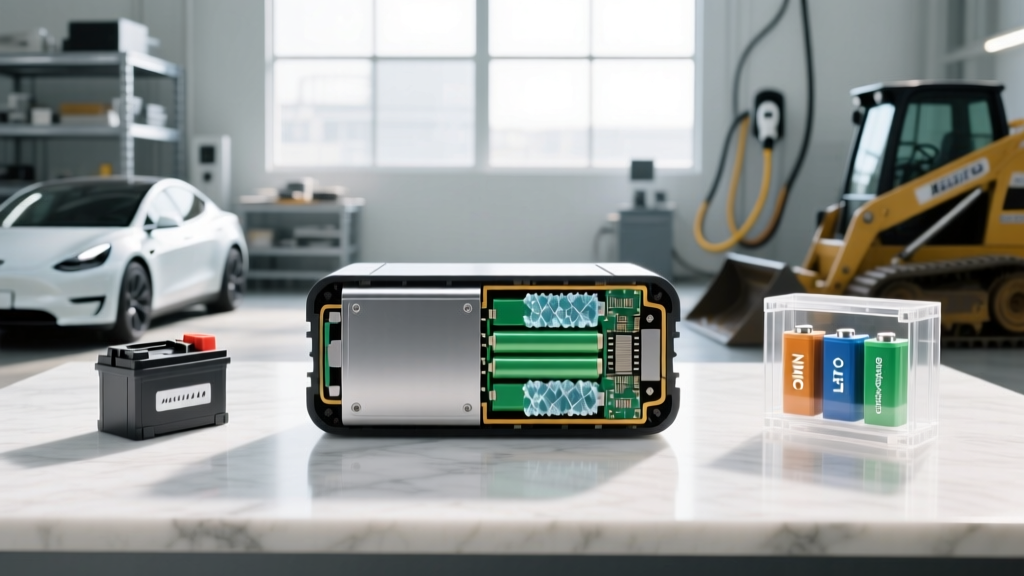
Most EVs and electric equipment sold today use one of two lithium-ion cathode chemistries: LFP (lithium iron phosphate) or NMC/NCA (nickel manganese cobalt / nickel cobalt aluminum). The choice between them involves real trade-offs — there is no universally "better" option.
| Attribute | LFP (Lithium Iron Phosphate) | NMC / NCA (Nickel-based) |
|---|---|---|
| Energy Density (cell-level) | 160–180 Wh/kg | 220–300 Wh/kg |
| Typical Cycle Life | 3,000–5,000+ cycles to 80% SoH | 1,000–2,500 cycles to 80% SoH |
| Cold-Weather Performance | Moderate — slower charging below 32°F; range loss ~30-40% | Better low-temp conductivity; range loss ~20-30% |
| Thermal Stability | Excellent — very low risk of thermal runaway | Good but requires more active thermal management |
| Cobalt/Nickel Content | None — lower supply-chain and ethical concerns | Contains cobalt and/or nickel — higher material cost volatility |
| Cost per kWh (pack-level, 2026) | ~$90–$110 | ~$120–$150 |
| Common Use Cases | Standard-range EVs (Tesla Model 3 RWD, BYD), fleet vehicles, battery powered skid steers, stationary storage | Long-range EVs (Model 3 LR, Ioniq 5, F-150 Lightning Extended), performance models |
For a battery powered skid steer or other heavy-duty electric equipment, LFP is often the preferred chemistry. These machines prioritize cycle life and durability over maximum energy density — a skid steer doesn't need 350 miles of range, but it does need to survive thousands of charge-discharge cycles in dusty, high-vibration job-site conditions. LFP's superior cycle life (3,000–5,000+ cycles vs. NMC's 1,000–2,500) and lower cost per kWh make it well-suited to this application.
For passenger EVs where range-per-charge is a primary purchase driver, NMC/NCA remains the go-to for long-range trims because its higher energy density packs more kWh into the same physical space. Standard-range trims increasingly use LFP — Tesla's rear-wheel-drive Model 3, for example, uses an LFP pack and recommends charging to 100% daily, which NMC owners should generally avoid.
How Long Do EV Batteries Actually Last?
The short answer: most EV batteries outlast the vehicles they're installed in. Data from fleets, long-term owners, and manufacturer studies consistently show that modern lithium-ion packs retain usable capacity well beyond 150,000 miles.
Real-World Degradation Data Points:
- Tesla 2025 Impact Report: Model 3/Y vehicles showed an average of ~12% battery degradation at 200,000 miles — meaning ~88% State of Health (SoH) retained.
- Geotab fleet study (2024, 10,000+ EVs): Average annual degradation of 1.8% across all chemistries; LFP-equipped vehicles averaged ~1.2%/year vs. ~2.3%/year for NMC under similar duty cycles.
- Nissan Leaf (passive-cooled, older NMC): Earlier-generation Leafs (2011–2017) with passive air cooling showed 20–30% degradation at 80,000–100,000 miles in hot climates — a data point that drove the industry toward active liquid cooling.
- Battery powered skid steer field data: Early adopters report LFP packs in electric compact equipment retaining 90%+ SoH after 2,000–3,000 operational hours (~3–5 years of typical job-site use), consistent with LFP's high cycle-life advantage.
Most automakers design battery packs to retain 70–80% of original capacity after 8 years or 100,000–150,000 miles, whichever comes first. In practice, liquid-cooled packs in moderate climates frequently exceed these thresholds. A battery isn't "dead" at 70% SoH — it simply offers reduced range or runtime, much like a smartphone that no longer lasts a full day but still functions.
What Does the Battery Warranty Actually Cover?
Federal law in the United States mandates that EV battery warranties last a minimum of 8 years / 100,000 miles (in California Air Resources Board states, the requirement extends to 10 years / 150,000 miles for certain components). Most manufacturers exceed the federal floor.
| Manufacturer / Model | Warranty Term | Capacity Retention Threshold | Chemistry |
|---|---|---|---|
| Tesla Model 3 RWD | 8 yr / 100,000 mi | 70% | LFP |
| Tesla Model 3 Long Range | 8 yr / 120,000 mi | 70% | NMC |
| Hyundai Ioniq 5 | 10 yr / 100,000 mi | 70% | NMC |
| Ford F-150 Lightning | 8 yr / 100,000 mi | 70% | NMC |
| Chevrolet Equinox EV | 8 yr / 100,000 mi | 60% (GM Ultium) | NMC |
| Typical battery powered skid steer (e.g., electric compact loader) | 3–5 yr / hour-based (varies by OEM) | 70–80% | LFP (most common) |
Key warranty nuances to understand:
- Capacity threshold matters: A warranty that replaces the battery only below 60% SoH is meaningfully weaker than one at 70%. If your pack degrades to 72% in year 7, you're covered under a 70% threshold warranty but would be out of luck under a 60% threshold.
- "Defect" vs. "degradation": Warranties cover manufacturing defects (dead cells, BMS failures, coolant leaks) from day one. Gradual capacity loss is only covered if it falls below the stated retention threshold within the warranty period.
- Transferability: Most factory battery warranties transfer to second owners, which supports EV resale values — but always confirm with the manufacturer before buying used.
- Off-road/commercial equipment: Battery powered skid steers and similar machines often have shorter, hour-based warranties (e.g., 3 years or 5,000 hours) because they operate in harsher conditions. Review the OEM warranty booklet carefully.
How Much Does an EV Battery Replacement Cost?
Battery replacement is the most-cited fear among prospective EV buyers — but context is critical. The vast majority of EV owners never need a full battery replacement during their ownership. When replacement is needed, it's typically due to a manufacturing defect (covered under warranty) or physical damage (covered by insurance), not end-of-life degradation.
| Vehicle / Equipment | Battery Size (kWh) | Estimated Replacement Cost | Notes |
|---|---|---|---|
| Tesla Model 3 (LFP, Standard Range) | ~60 kWh | $10,000–$14,000 | LFP packs cheaper; third-party options emerging |
| Hyundai Ioniq 5 (NMC) | ~77.4 kWh | $14,000–$20,000 | OEM replacement through dealer |
| Ford F-150 Lightning (Extended Range) | ~131 kWh | $22,000–$32,000 | Large pack; highest cost tier |
| Chevrolet Bolt EV | ~65 kWh | $9,000–$14,000 | Recall replacement was free; out-of-warranty pricing lower due to smaller pack |
| Battery powered skid steer (electric compact loader) | ~40–80 kWh | $12,000–$25,000 | Varies widely by manufacturer; LFP packs trending lower |
According to NREL (National Renewable Energy Laboratory) and industry analysts at BloombergNEF, average lithium-ion pack prices have fallen from over $1,000/kWh in 2010 to roughly $110–$140/kWh at the pack level in 2025–2026. LFP packs are at the lower end of that range. Replacement costs include labor, diagnostic fees, and dealer markup, which is why the installed price is significantly higher than raw cell cost.
When is replacement typically needed? For passenger EVs, a full pack replacement due to degradation alone is rare before 200,000+ miles. For commercial electric equipment like battery powered skid steers operating daily charge cycles, a pack refresh may be considered at 8,000–12,000 operational hours if runtime has dropped below job requirements — but many fleets report packs lasting the practical life of the machine.
What Factors Affect Battery Life — and How Do You Maximize It?
Battery degradation is driven by a combination of chemical and mechanical stressors. Understanding these lets you build habits that extend pack life by years.
Battery Care Checklist for Maximum Longevity:
- Avoid sustained 100% State of Charge: For NMC/NCA packs, charge to 80% for daily use; reserve 100% for road trips. LFP packs are an exception — most OEMs (Tesla, BYD) recommend periodic 100% charges to allow the BMS to calibrate cell balancing.
- Minimize DC fast charging frequency: Occasional fast charging is fine, but daily use of 150+ kW DC chargers accelerates degradation. Studies show packs primarily charged on Level 2 (7–19 kW AC) degrade ~30% slower over 5 years than those primarily DC fast-charged. If you must fast-charge daily, precondition the battery (most EVs do this automatically when a charger is set in the navigation).
- Avoid extreme State of Charge in extreme temperatures: Don't leave an NMC pack at 100% SoC in 100°F+ heat, and avoid letting the pack sit at very low SoC (below 10%) in sub-freezing conditions for extended periods.
- Use preconditioning: Preconditioning warms or cools the battery to its optimal operating temperature before fast charging or hard driving. This reduces lithium plating risk in cold weather and thermal stress in heat. Most EVs activate this automatically when a DC charger is entered in the nav system.
- Drive moderately when the battery is cold: In sub-30°F weather, limit aggressive acceleration for the first 10–15 minutes of driving until the thermal management system has warmed the pack.
- Keep the pack between 20–80% SoC for storage: If the vehicle or equipment will sit unused for weeks, aim for ~50% SoC. Avoid storing at 100% or near 0%.
These guidelines apply whether you're managing a fleet of battery powered skid steers or a single commuter EV. Fleet telematics systems on commercial equipment often enforce charge limits and preconditioning schedules automatically, which is one reason fleet packs tend to degrade more predictably than consumer-owned packs.
How to Check and Monitor Battery State of Health (SoH)
State of Health (SoH) is the percentage of original battery capacity that remains usable. A new battery is at 100% SoH; a battery that now holds 55 kWh out of its original 77 kWh is at ~71% SoH.
Methods for checking SoH:
- In-vehicle displays: Many 2024–2026 EVs include a battery health indicator in the infotainment or driver display. Hyundai/Kia, BMW, and Mercedes-Benz provide SoH percentage readouts. Tesla does not show SoH directly but displays current max range, from which SoH can be inferred.
- OBD-II diagnostic tools: Devices like the OBD Eleven or Leaf Spy (for Nissan Leaf) read SoH directly from the battery management system. Third-party apps like Teslalogger or TeslaFi track Tesla battery health over time using API data.
- Dealer diagnostic reports: Any authorized dealer can run a battery health check that provides SoH, cell voltage variance, and cooling system status. Request this when buying a used EV — it's the single most important pre-purchase data point.
- Commercial equipment telematics: Battery powered skid steers from manufacturers like Volvo CE, CASE, and Caterpillar typically include fleet management portals that display SoH, cycle counts, and thermal event logs. This data is invaluable for predicting when a pack may need service.
According to fueleconomy.gov, maintaining awareness of your battery's SoH helps you plan for warranty claims before the coverage period expires and make informed decisions about charging habits.
Emerging Battery Tech: Solid-State and Silicon Anode — Realistic Timelines
Next-generation battery technologies are frequently hyped, but it's important to separate announced milestones from production reality.
Solid-state batteries replace the liquid electrolyte in current lithium-ion cells with a solid material (ceramic, sulfide, or polymer), promising higher energy density (potentially 400+ Wh/kg at the cell level), faster charging, and improved safety. Toyota has announced a target for limited solid-state EV production by 2027–2028, while QuantumScape continues to ship prototype cells to automotive partners. However, manufacturing yield, cost, and scalability challenges remain significant. Realistic timeline for broad commercial availability: 2029–2032 at the earliest, and initially in premium/high-cost applications.
Silicon anode technology replaces or supplements the graphite anode with silicon, which can store roughly 10× more lithium ions per gram. Companies like Sila Nanotechnologies and Group14 are already shipping silicon-dominant anode materials in limited production — the Mercedes-Benz G-Class 580e uses a silicon-anode battery from Factorial Energy. This technology is closer to scale than solid-state and is expected to appear in more 2026–2028 model-year EVs, offering 10–20% energy density improvements over current graphite-anode cells.
For battery powered skid steers and commercial equipment, these advances matter primarily for cost reduction and duty-cycle extension. LFP's current cost and cycle-life advantages make it likely to remain the dominant chemistry in electric compact equipment through at least 2030, with solid-state or silicon-anode adoption following once manufacturing costs drop to parity.
Frequently Asked Questions
How long do EV batteries last in years and miles?
Most modern liquid-cooled EV batteries retain 70–88% of original capacity at 150,000–200,000 miles (roughly 10–15 years of average driving). LFP packs tend to last longer by cycle count than NMC. For commercial equipment like battery powered skid steers, expect 5,000–12,000+ operational hours before significant capacity loss, depending on duty cycle and climate.
How much does an EV battery cost to replace?
Out-of-warranty replacement costs range from ~$9,000 for a smaller pack (Chevrolet Bolt, ~65 kWh) to $22,000–$32,000 for a large pack (F-150 Lightning Extended Range, ~131 kWh). Battery powered skid steer packs typically cost $12,000–$25,000 to replace. However, most owners never need a replacement — warranty covers defects, and degradation rarely renders a pack unusable within the vehicle's life.
What does the EV battery warranty cover?
Federal minimum is 8 years / 100,000 miles. Coverage includes manufacturing defects (cell failures, BMS faults, coolant leaks) from day one, and capacity retention guarantees (typically 70% SoH) over the warranty period. If your battery drops below the threshold within the term, the manufacturer replaces or repairs it at no cost. Commercial equipment warranties are typically shorter (3–5 years / hour-based).
How do I check my EV battery health?
Use the vehicle's built-in battery health display (if equipped), an OBD-II diagnostic tool, or a dealer service visit. For commercial electric equipment, check the fleet management telematics portal. Track SoH over time to identify abnormal degradation and file warranty claims before coverage expires.
LFP vs NMC — which is better and why?
Neither is universally better. LFP wins on cycle life (3,000–5,000+ cycles), cost (~$90–110/kWh), safety, and cobalt-free sourcing — making it ideal for standard-range EVs, fleet vehicles, and battery powered skid steers. NMC wins on energy density (220–300 Wh/kg) and cold-weather performance, making it better for long-range passenger EVs where maximizing miles-per-charge is the priority. Your use case determines the right chemistry.
Does frequent DC fast charging damage the battery?
Occasional DC fast charging is fine. Daily fast charging at 150+ kW does accelerate degradation compared to Level 2 (AC) charging — studies show roughly 20–30% more capacity loss over 5 years for packs primarily fast-charged. Mitigate this by preconditioning the battery before charging (most EVs do this automatically) and using Level 2 for routine daily charging when possible.
Can I upgrade my battery to a newer chemistry later?
In most cases, no. Battery packs are engineered for specific vehicle architectures, and swapping chemistries requires BMS reprogramming, thermal management recalibration, and physical fitment. Some manufacturers (notably NIO in China) offer battery swap programs, but this isn't available for most vehicles in the U.S. market. For commercial equipment, check with the OEM about pack refresh or upgrade programs.
For the latest on EV battery requirements tied to the federal §30D tax credit — including battery component sourcing and critical mineral rules — consult IRS.gov's clean vehicle credit page. Battery sourcing rules affect which vehicles qualify for up to $7,500 in credits, and these requirements have tightened significantly through 2025–2026.