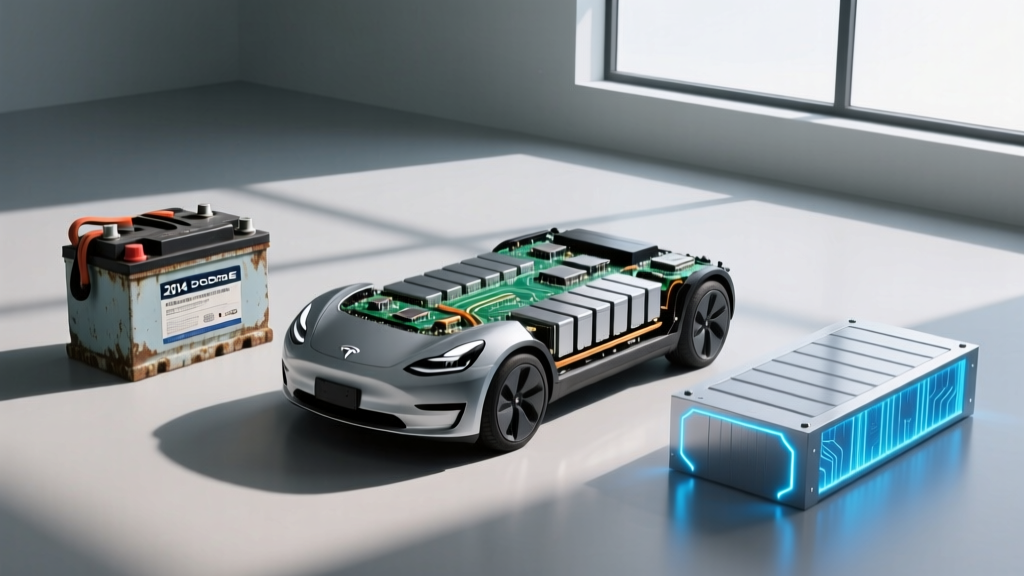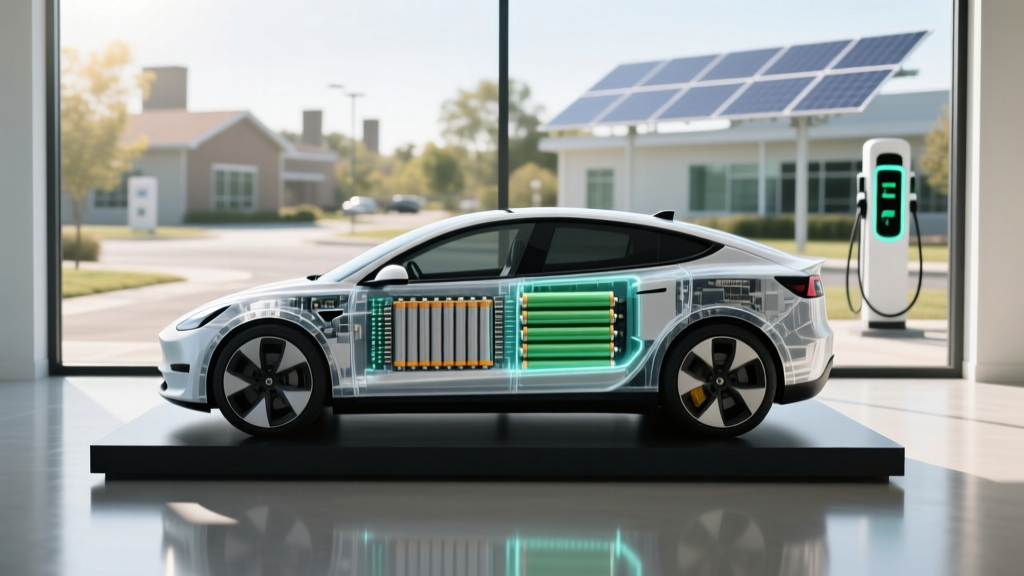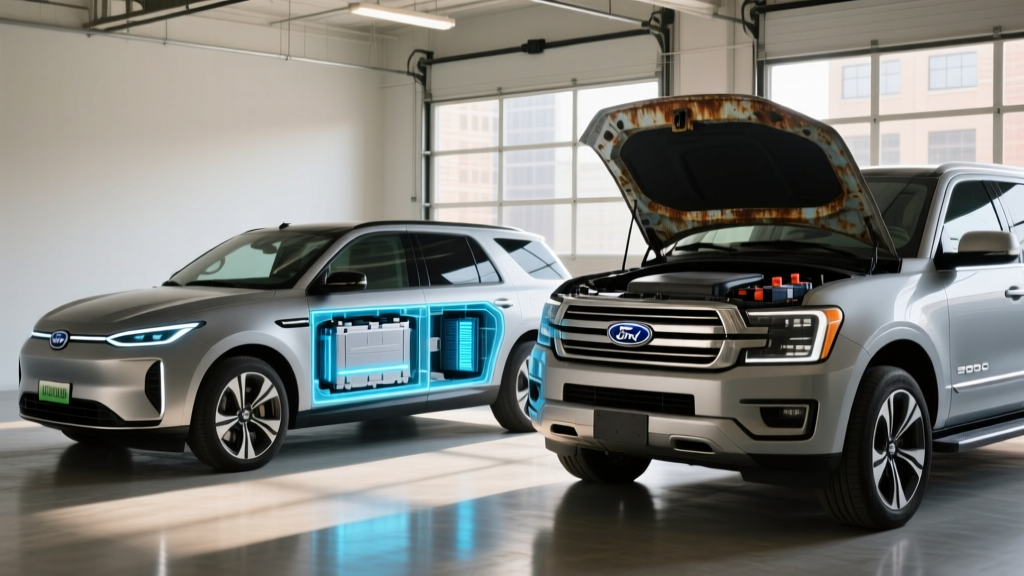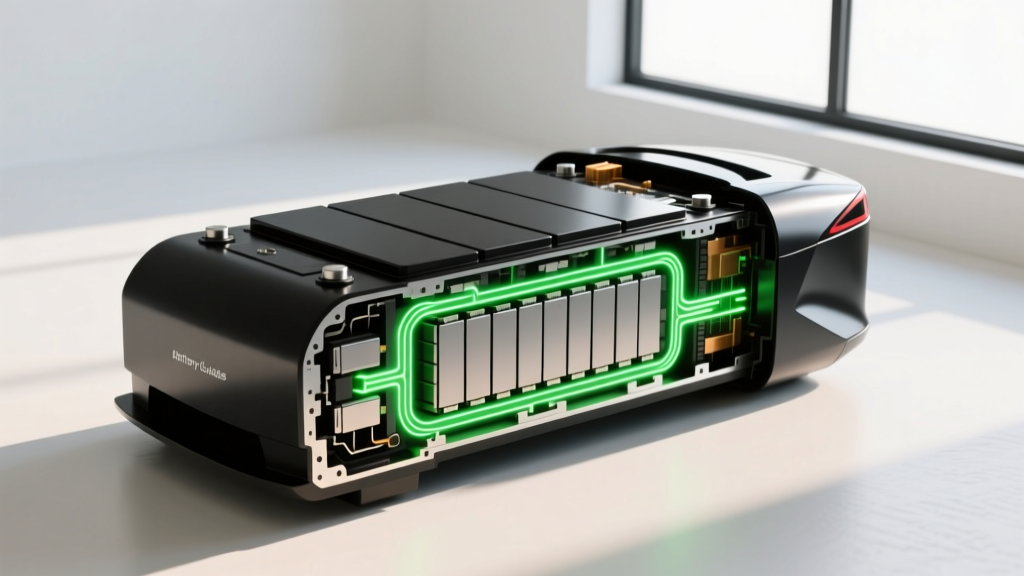
If you landed here searching for a battery for 2015 Honda Pilot, you are almost certainly looking for a 12-volt lead-acid or AGM auxiliary battery — the kind that sits under the hood, cranks the engine, and runs your radio when the car is off. That is a fundamentally different component from the high-voltage lithium-ion traction battery that powers an electric vehicle. This guide is about the latter: the 60–120 kWh packs that propel modern EVs, how long they last, what they cost to replace, and how to keep them healthy for 150,000+ miles.
Understanding EV battery technology is critical because the traction pack is the single most expensive component in any electric car. It stores and delivers the energy (measured in kilowatt-hours, or kWh) that determines your range, and it accepts power (measured in kilowatts, or kW) when you plug in. Confusing these two units is the most common mistake new EV buyers make — kWh is the tank size, kW is the hose speed.
LFP vs NMC: The Chemistry Choice That Defines Your EV
Every EV battery on the road today uses one of two dominant lithium-ion chemistries: lithium iron phosphate (LFP) or nickel manganese cobalt (NMC), with NCA (nickel cobalt aluminum) used primarily by Tesla. The chemistry determines energy density, cycle life, cold-weather behavior, and cost — and the choice has become a major buyer decision in 2026.
| Attribute | LFP (LiFePO₄) | NMC / NCA |
|---|---|---|
| Energy Density | ~160–180 Wh/kg (lower) | ~230–300 Wh/kg (higher) |
| Cycle Life | 3,000–5,000+ cycles | 1,000–2,000 cycles |
| Cold Performance | Weaker below 32°F; slower charging | Better low-temp output |
| Cost per kWh | ~$90–110 (cheaper) | ~$120–150 |
| Thermal Stability | Excellent; lower fire risk | Good with active cooling |
| State of Charge Limit | Can charge to 100% daily | Best kept at 80% daily |
| Common Vehicles (2026) | Tesla Model 3 RWD, Ford Mustang Mach-E Select, base BYD models | Tesla Long Range, Hyundai Ioniq 5, Rivian R1T, Porsche Taycan |
The practical takeaway: LFP is better for daily commuting and long ownership because you can charge to 100% without accelerated degradation, and the cycle life is dramatically longer. NMC is better if you need maximum range in a cold climate or want the lightest pack for performance applications. Tesla, Ford, and several Chinese manufacturers have shifted standard-range models to LFP, while reserving NMC/NCA for Long Range and Performance trims.
How Long Do EV Batteries Actually Last?
The short answer: longer than most buyers assume. Data from fleet operators, manufacturer warranty claims, and independent testing shows that modern liquid-cooled EV batteries retain 85–92% of original capacity after 100,000 miles, with degradation slowing significantly after the initial break-in period.
Typical EV Battery Degradation Curve (Liquid-Cooled Packs):
- Year 1 / ~12,000 miles: 2–5% loss (initial formation loss; steepest part of the curve)
- Year 3 / ~36,000 miles: 5–8% total loss
- Year 5 / ~60,000 miles: 7–10% total loss
- Year 8 / ~100,000 miles: 8–15% total loss
- Year 10+ / 150,000+ miles: 12–20% total loss (pack still functional, range reduced)
Source: Geotab fleet data of 6,300+ EVs; Geotab Battery Health Study. Recurrent Automotive's 2025 data of 15,000+ vehicles shows similar curves.
A critical nuance: degradation is not linear. The battery loses capacity quickly in the first 20,000–30,000 miles as the solid electrolyte interphase (SEI) layer forms on the anode. After that, the curve flattens considerably. A pack that has lost 10% by year 5 may only lose another 5% by year 10.
For context, the average American drives about 13,500 miles per year according to FHWA data. Most EV owners will sell or trade the vehicle before the battery reaches a state of health (SoH) low enough to warrant replacement.
What Does the EV Battery Warranty Actually Cover?
Federal law mandates a minimum battery warranty of 8 years / 100,000 miles (10 years / 150,000 miles in California Air Resources Board states). But the details vary significantly by manufacturer, and the capacity retention threshold — the point at which the manufacturer considers the battery "failed" — is where the real differences emerge.
| Manufacturer | Duration | Mileage | Capacity Threshold | Notes |
|---|---|---|---|---|
| Tesla (Model 3/Y LFP) | 8 years | 100,000 mi | 70% | Shorter mileage for LFP RWD |
| Tesla (Long Range/Performance) | 8 years | 120,000 mi | 70% | NMC/NCA packs |
| Hyundai / Kia (E-GMP) | 10 years | 100,000 mi | 70% | Among the longest duration |
| Ford (Mustang Mach-E) | 8 years | 100,000 mi | 70% | Standard across trims |
| Rivian (R1T/R1S) | 8 years | 175,000 mi | 70% | Highest mileage cap |
| GM (Ultium platforms) | 8 years | 100,000 mi | 70% | Covers Cadillac, Chevy, GMC EVs |
| BMW (iX / i4) | 8 years | 100,000 mi | 70% | Includes cell-level replacement |
The 70% threshold is industry standard. If your 82 kWh pack drops below ~57 kWh of usable capacity within the warranty period, the manufacturer must repair or replace it at no cost. In practice, very few packs fall below this threshold under normal use — most retain 85%+ at 100,000 miles.
EV Battery Replacement Cost: What to Budget (and When)
Replacement cost is the single biggest fear for EV skeptics, and it deserves honest numbers. Here is what out-of-warranty battery replacement actually costs in 2026, by pack size and vehicle class:
| Vehicle Class | Battery Size | Replacement Cost (Parts + Labor) | Typical Replacement Timeline |
|---|---|---|---|
| Compact EV (Chevy Bolt, Nissan Leaf) | 40–65 kWh | $5,500–$9,000 | Rare before 150,000 mi |
| Midsize sedan/crossover (Model 3, Ioniq 6) | 60–82 kWh | $8,000–$14,000 | Rare before 150,000 mi |
| Large SUV / truck (Rivian R1T, F-150 Lightning) | 100–135 kWh | $14,000–$22,000 | Rare before 150,000 mi |
| Luxury performance (Taycan, Model S) | 80–100 kWh | $12,000–$20,000 | Rare before 150,000 mi |
Important context that fear-mongering headlines omit: most EV batteries outlive the vehicle they are installed in. The average age of a scrapped car in the US is 15–16 years. At current degradation rates, a well-maintained EV battery will retain 75–85% of its capacity at that age — reduced range, yes, but fully functional.
Additionally, cell-level repair is increasingly available. Rather than replacing the entire pack, specialized shops and some manufacturers can identify and swap individual degraded modules for $1,500–$4,000, restoring most of the lost capacity. BMW and Hyundai have confirmed module-level service capability for their current platforms.
Five Factors That Accelerate (or Preserve) Battery Health
Not all miles are equal when it comes to battery wear. These five factors have the greatest measurable impact on long-term State of Health:
Battery Care Checklist for Maximum Longevity:
- Avoid sustained 100% State of Charge: For NMC/NCA packs, daily charge limit of 80% reduces degradation by ~30% over 5 years vs. charging to 100% nightly. LFP packs can safely charge to 100% daily (this is actually recommended for cell balancing).
- Minimize DC fast charging frequency: Occasional road-trip fast charging is fine. But daily reliance on 150+ kW DC fast charging accelerates lithium plating and SEI growth. Data from Recurrent Automotive shows vehicles that fast-charge more than 3x/week degrade ~2–3% faster over 100,000 miles than those primarily charging at Level 2.
- Precondition before fast charging: Cold batteries charged at high power suffer accelerated wear. Use your EV's navigation-based preconditioning (Tesla, Hyundai, Ford all offer this) to warm the pack to 70–90°F before arriving at a DC fast charger.
- Avoid extreme storage states: Leaving an EV at 100% SoC in 95°F+ heat for weeks, or at 5% SoC in sub-zero cold, causes measurable calendar degradation. For long parking, set the charge limit to 50–60%.
- Use Level 2 home charging as your primary method: Slow, steady 7–11 kW charging generates minimal heat stress and is the gentlest charging method for any lithium-ion chemistry.
How to Check Your EV Battery's State of Health
State of Health (SoH) is the percentage of original capacity your battery retains. A new pack is 100% SoH; a pack that originally held 82 kWh but now holds 74 kWh is at ~90% SoH. Here is how to monitor it:
Built-in vehicle displays: Tesla shows battery health in the service menu (accessible via the touchscreen). Hyundai/Kia provides a battery health percentage in the EV settings. BMW's iDrive includes a battery condition report. Not all manufacturers surface this data directly.
OBD-II diagnostic apps: Tools like LeafSpy (Nissan), Teslalogger/Scan My Tesla, and ABRP OBD dongles can read detailed cell-level data including individual cell voltages, pack temperature, and calculated SoH. These cost $20–$80 for the hardware and are the most granular option for owners who want full visibility.
Third-party services: Recurrent offers a free battery health report that compares your pack's degradation to a database of 15,000+ similar vehicles. Some dealerships can pull a battery health report during service visits — ask for it by name.
The DIY range test: Charge to 100% (on an LFP pack, or occasionally on NMC), reset the trip meter, drive your normal route until ~10% remaining, and note the miles driven. Compare this to the EPA-rated range when new. This crude method gives a rough SoH estimate without any tools.
What About the Battery for 2015 Honda Pilot?
To directly address the search that may have brought you here: the battery for 2015 Honda Pilot is a 12-volt Group 24F or Group 35 lead-acid or AGM battery, typically costing $120–$220 at an auto parts store. It powers the starter motor, lights, and electronics — it has nothing to do with electric propulsion. The 2015 Pilot is a conventional V6 gasoline SUV with no high-voltage battery of any kind.
If you are considering the transition from a gas vehicle like the 2015 Pilot to an EV, the battery technology discussed in this guide is what replaces your fuel tank. A modern EV pack like the 82 kWh NMC unit in a Hyundai Ioniq 5 or the 60 kWh LFP pack in a Tesla Model 3 RWD will outlast the engine and transmission in your Pilot, require zero maintenance (no fluid changes, no belts, no spark plugs), and deliver the equivalent of 100–130 MPGe. The EPA's EV technology overview provides a solid primer on how these systems compare to internal combustion.
Emerging Battery Technology: What Is Real vs. Hype
Two technologies dominate EV battery headlines, and both deserve realistic timelines rather than hype:
Solid-state batteries replace the liquid electrolyte with a solid ceramic or polymer, promising higher energy density (potentially 400+ Wh/kg), faster charging, and improved safety. Toyota has announced limited production for 2027–2028, and Samsung SDI and QuantumScape are in pilot manufacturing. However, solid-state is not available in any production vehicle as of 2026. Manufacturing yield, cost, and scaling challenges remain. Expect solid-state to appear first in limited-run luxury vehicles (>$80,000) around 2028–2029, with mainstream availability no earlier than 2030–2032.
Silicon anode technology (replacing graphite anodes with silicon-dominant materials) offers 20–40% energy density improvement and is closer to market. Sila Nanotechnologies and Group14 are supplying silicon anode materials to battery manufacturers, with early commercial cells appearing in 2025–2026 production. This is an incremental improvement to existing NMC chemistry, not a revolution — but it will meaningfully increase range within the same pack volume.
Sodium-ion batteries (using sodium instead of lithium) are entering production in China for low-cost, short-range EVs. CATL and BYD have begun shipping sodium-ion packs in city cars. These are cheaper and use no critical minerals, but have ~30% lower energy density. Expect sodium-ion to appear in US-market compact EVs and fleet vehicles around 2027–2028.
Frequently Asked Questions
How long do EV batteries last in years and miles?
Modern liquid-cooled EV batteries typically last 150,000–250,000 miles before dropping below 70% capacity. In years, that translates to 12–18 years for the average driver. Most EV batteries will outlast the vehicle they are installed in.
How much does an EV battery cost to replace?
Out-of-warranty replacement costs range from $5,500 for a compact EV pack to $22,000 for a large truck/SUV pack, including labor. Module-level repair (replacing only degraded cells) costs $1,500–$4,000. Very few owners ever pay this — most batteries are covered by the 8-year/100,000-mile warranty.
What does the EV battery warranty cover?
Federal law requires at minimum 8 years / 100,000 miles of battery coverage (10/150,000 in CARB states). The warranty guarantees the battery will retain at least 70% of its original capacity. If it falls below that threshold, the manufacturer repairs or replaces it at no cost. Coverage includes defects, premature degradation, and cell failures.
How do I check and maximize my EV battery health?
Check SoH through your vehicle's built-in battery health display, an OBD-II diagnostic app (LeafSpy, Scan My Tesla), or a free Recurrent battery report. Maximize health by charging to 80% daily (NMC) or 100% (LFP), using Level 2 home charging as primary, minimizing DC fast charging to road trips only, preconditioning before fast charging, and avoiding prolonged storage at extreme SoC levels.
LFP vs NMC — which chemistry is better and why?
LFP is better for daily commuting, warm climates, and long ownership: it lasts 3,000–5,000 cycles, can charge to 100% daily, and costs less. NMC is better for maximum range, cold climates, and performance: it offers higher energy density and better low-temperature output but should be limited to 80% daily charge. Neither is universally superior — the right choice depends on your driving pattern and climate.
Will future battery tech make my current EV obsolete?
Incremental improvements (silicon anodes, better thermal management) will continue, but solid-state batteries are not expected in mainstream vehicles before 2030. Current EV batteries are mature, reliable technology — not a placeholder. Waiting for the "next big thing" means waiting 4–6+ years for limited availability at premium prices.