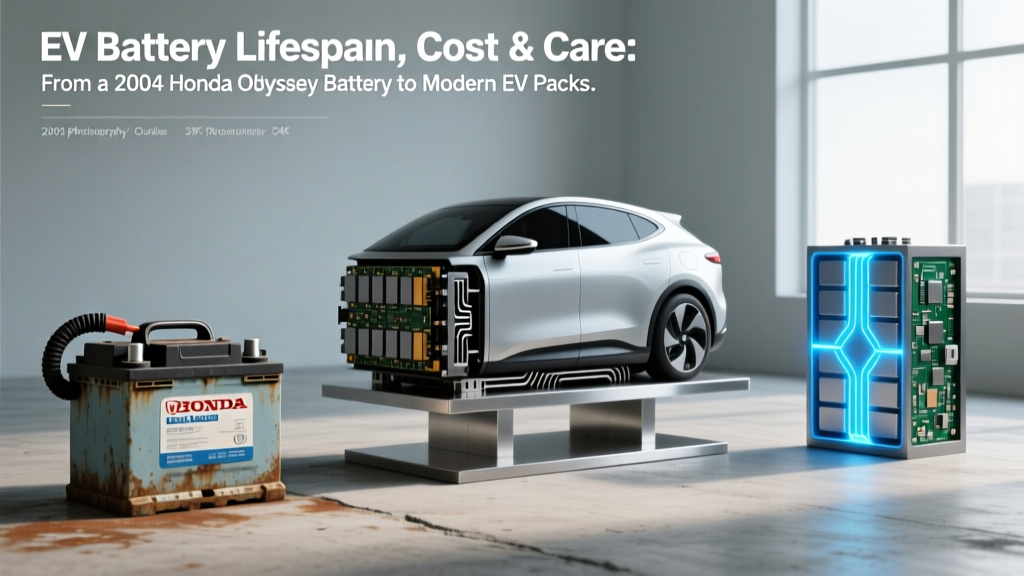
If you've ever replaced a 2004 Honda Odyssey battery, you already understand the basics of automotive energy storage: batteries degrade, they cost real money to replace, and their lifespan depends heavily on how you treat them. The difference is that a minivan's 12-volt lead-acid starter battery costs about $150–$250 and lasts 3–5 years. A modern electric vehicle's high-voltage traction battery pack stores 60–100+ kilowatt-hours (kWh) of energy, costs $5,000–$20,000+ to replace, and is engineered to outlast the vehicle itself.
This guide breaks down exactly what EV battery ownership looks like in 2026 — chemistry trade-offs, real-world degradation data, warranty protections, replacement economics, and the daily habits that maximize pack longevity.
LFP vs NMC: The Chemistry Decision Every EV Buyer Faces
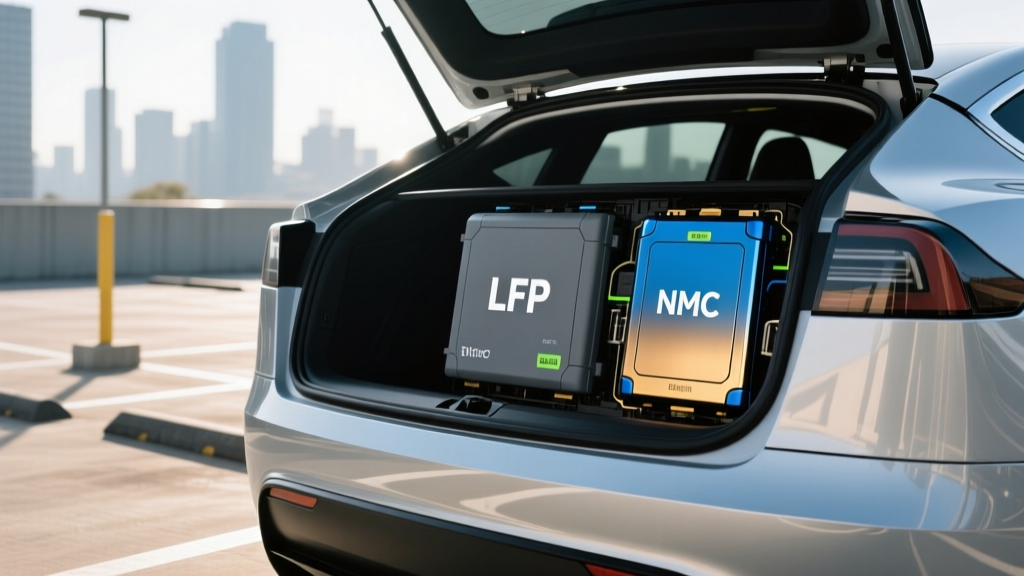
The two dominant lithium-ion chemistries in 2026 EV battery packs are lithium iron phosphate (LFP) and nickel manganese cobalt (NMC), with nickel cobalt aluminum (NCA) used primarily by Tesla and a few others. The chemistry inside your pack dictates range, longevity, cost, and cold-weather behavior — and it's not something you can change after purchase.
| Attribute | LFP (Lithium Iron Phosphate) | NMC/NCA (Nickel-based) |
|---|---|---|
| Energy Density | Lower (~150–180 Wh/kg cell-level) | Higher (~220–300 Wh/kg cell-level) |
| Cycle Life | 3,000–5,000+ cycles to 80% SoH | 1,000–2,000 cycles to 80% SoH |
| Cold Performance | Weaker; ~15–25% range loss below 32°F | Better; ~10–20% range loss below 32°F |
| Cost per kWh | Lower ($80–$110/kWh pack-level in 2026) | Higher ($110–$145/kWh pack-level) |
| Thermal Stability | Superior; less prone to thermal runaway | Good, but requires more active management |
| Typical Use Cases | Standard-range models, fleet vehicles, daily commuters | Long-range, performance, and AWD models |
| Examples (2026) | Tesla Model 3 RWD, Ford Mustang Mach-E Select (LFP option), BYD models | Tesla Model Y Long Range, Hyundai Ioniq 5, Chevy Equinox EV Extended Range |
Which is better? Neither is universally superior. If you prioritize maximum range and cold-weather performance and plan to keep the vehicle 8–10 years, NMC/NCA's higher energy density matters. If you charge at home nightly, drive under 250 miles daily, and want maximum cycle life with lower cost, LFP is the pragmatic choice. LFP also tolerates regular 100% state-of-charge (SoC) sessions better than NMC, simplifying daily habits.
How Long Do EV Batteries Actually Last?
The short answer: far longer than most buyers assume. The high-voltage traction battery in a modern EV is engineered for 150,000–300,000+ miles before reaching its warranty-defined end of life (typically 70% remaining capacity). For context, the average American drives about 14,000 miles per year, meaning a battery rated for 200,000 miles represents roughly 14 years of use.
Real-World Degradation Data Points
Based on aggregated fleet data and owner reports through 2025–2026:
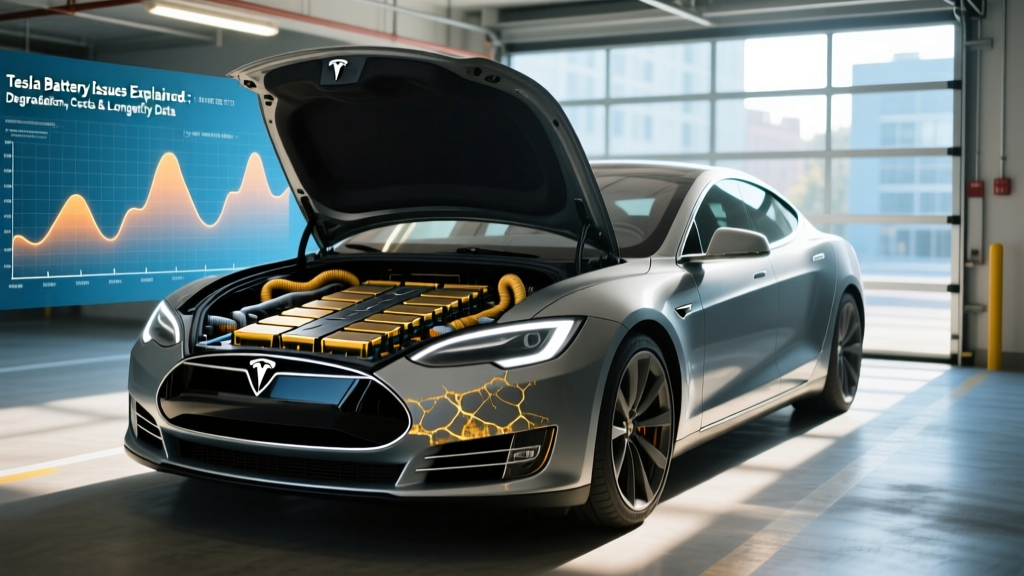
- Tesla Model 3/Y (NMC/NCA): Average ~5–7% capacity loss at 100,000 miles; ~10–12% at 200,000 miles (Source: Tesla Impact Reports, Recurrent Auto fleet data)
- Chevrolet Bolt EV/EUV (NMC): ~6–8% loss at 80,000 miles; many packs retaining 88–92% SoH at 100,000 miles (Source: Recurrent Auto)
- Nissan LEAF (NMC, passively cooled): Higher degradation rates — 10–15% loss by 80,000 miles in hot climates due to lack of active thermal management
- Hyundai/Kia E-GMP platform (Ioniq 5, EV6, NMC): ~4–6% loss at 60,000 miles based on early owner telemetry
- LFP packs (Tesla Model 3 RWD, BYD): Slower degradation curves; many showing <5% loss at 100,000 miles
The degradation curve is not linear. Most packs experience a steeper initial drop of 2–4% in the first year or 20,000 miles, then plateau into a slow, linear decline of roughly 0.5–1% per year or 10,000–15,000 miles thereafter.
Unlike the 2004 Honda Odyssey battery — a 12V lead-acid unit that fails abruptly and catastrophically (usually on a cold morning) — EV traction batteries degrade gradually. You don't wake up to a dead pack; you simply notice your EPA-rated 310-mile range now delivers 280 miles over time.
What Does the EV Battery Warranty Cover?
Federal law in the United States mandates that EV battery packs carry a minimum warranty of 8 years or 100,000 miles (whichever comes first). In California Air Resources Board (CARB) states — which include California, Colorado, Connecticut, Maine, Massachusetts, New Jersey, New York, Oregon, Rhode Island, Vermont, and Washington — the mandate extends to 10 years or 150,000 miles.
| Manufacturer | Warranty Term | Capacity Retention Threshold | Notes |
|---|---|---|---|
| Tesla (Model 3/Y) | 8 yr / 120,000 mi (Long Range); 8 yr / 100,000 mi (RWD) | 70% | Includes drive unit |
| Hyundai / Kia | 10 yr / 100,000 mi | 70% | Among the most generous terms |
| General Motors (Chevy/GMC/Cadillac) | 8 yr / 100,000 mi | 70% (most models); 60% (Lyriq) | Ultium platform |
| Ford (Mustang Mach-E, F-150 Lightning) | 8 yr / 100,000 mi | 70% | Includes battery and electric powertrain components |
| Volkswagen (ID.4) | 8 yr / 100,000 mi | 70% | Modular MEB pack allows partial module replacement |
| BMW (i4, iX) | 8 yr / 100,000 mi | 70% | Gen5 eDrive system |
| Rivian (R1T, R1S) | 8 yr / 175,000 mi | 70% | Higher mileage cap reflects adventure-use positioning |
| Lucid (Air) | 8 yr / 100,000 mi | 70% | 900V architecture |
The critical number is the capacity retention threshold. Most manufacturers guarantee that the battery will retain at least 70% of its original capacity during the warranty period. If your 82 kWh pack drops below 57.4 kWh of usable capacity within 8 years/100,000 miles, the manufacturer must repair or replace it at no cost. Some manufacturers replace the entire pack; others swap individual degraded modules — a more cost-effective approach that is becoming standard on modular architectures like VW's MEB and GM's Ultium.
EV Battery Replacement Cost: What to Expect in 2026
Here's the concern that keeps prospective EV buyers awake at night. The reality: most EV batteries never need replacement during typical ownership. According to Recurrent Auto's 2025 fleet analysis, fewer than 2% of EVs have required out-of-warranty battery replacements. But if you're planning to keep a vehicle 15+ years, or buying used with an older pack, replacement economics matter.
| Vehicle / Platform | Battery Size (kWh) | Estimated Pack Cost | Labor + Misc. | Total Range |
|---|---|---|---|---|
| Chevrolet Bolt EV/EUV | 65 kWh (NMC) | $6,500–$9,000 | $1,500–$2,500 | $8,000–$11,500 |
| Tesla Model 3 (Standard/LFP) | 60 kWh (LFP) | $5,000–$7,500 | $1,500–$2,000 | $6,500–$9,500 |
| Tesla Model Y (Long Range/NMC) | 75 kWh (NMC) | $8,000–$12,000 | $1,500–$2,500 | $9,500–$14,500 |
| Hyundai Ioniq 5 / Kia EV6 | 77.4 kWh (NMC) | $8,500–$13,000 | $2,000–$3,000 | $10,500–$16,000 |
| Ford F-150 Lightning (Extended) | 131 kWh (NMC) | $15,000–$22,000 | $3,000–$4,500 | $18,000–$26,500 |
| Lucid Air (Grand Touring) | 112 kWh (NMC) | $14,000–$20,000 | $3,000–$4,000 | $17,000–$24,000 |
| Rivian R1T/R1S (Max Pack) | 149 kWh (NMC) | $18,000–$25,000 | $3,000–$5,000 | $21,000–$30,000 |
Several factors are pushing costs downward. Battery cell prices have fallen roughly 80% since 2013, and LFP chemistry — which uses no nickel or cobalt — is inherently cheaper to produce. Modular pack designs (VW MEB, GM Ultium) allow technicians to replace individual degraded modules for $1,500–$4,000 per module rather than swapping the entire pack. By the late 2020s, pack-level costs are projected to dip below $80/kWh for LFP and $100/kWh for NMC, further reducing replacement sticker shock.
When is replacement typically needed? Based on current degradation curves, most packs will retain 75–85% capacity at 150,000–200,000 miles. A full replacement is usually only necessary after 200,000+ miles or 15+ years — and even then, a pack at 70% SoH still functions; it simply offers reduced range.
Factors That Accelerate (or Slow) Battery Degradation
Not all miles are equal when it comes to battery wear. The following factors have the largest measurable impact on long-term state of health (SoH):
Battery Care Checklist: Maximize Your Pack's Lifespan
- Avoid frequent DC fast charging. Occasional road-trip fast charging is fine, but daily use of 150+ kW DC chargers accelerates degradation. Studies from the Idaho National Laboratory found that packs exclusively DC fast-charged showed ~10% more degradation over 50,000 miles compared to Level 2 charging. Reserve DCFC for trips; use Level 2 at home for daily needs.
- Manage state of charge (SoC) for NMC/NCA. For nickel-based packs, keep daily SoC between 20% and 80%. Charging to 100% and leaving the car parked for days stresses the cells. LFP packs are more tolerant of 100% SoC — Tesla and BYD actually recommend periodic full charges for LFP to maintain cell-balancing accuracy.
- Minimize extreme-temperature exposure. Lithium-ion cells degrade faster at sustained high temperatures (above 95°F / 35°C) and suffer temporary capacity loss in deep cold (below 20°F / -7°C). Park in shade or a garage when possible. Most modern EVs have active thermal management (liquid cooling/heating) that mitigates this, but it can't fully offset weeks parked in an Arizona summer.
- Use preconditioning before fast charging. Preconditioning warms the battery to its optimal charging temperature (typically 85–95°F / 30–35°C), which improves charge speed and reduces stress. Most EVs do this automatically when you navigate to a DC fast charger — make sure the feature is enabled in your vehicle settings.
- Avoid deep discharges. Regularly running the battery below 10% SoC stresses cells. If your daily commute is 40 miles round-trip on a 300-mile pack, you're in the ideal 20–60% daily window.
- Limit high-power launches when the pack is hot. Repeated hard acceleration (Ludicrous/Plaid mode, Launch Control) generates internal heat. One or two runs are fine; doing it daily in summer adds thermal cycling wear.
How to Monitor Your Battery's State of Health (SoH)
State of Health (SoH) is expressed as a percentage: a brand-new pack is 100% SoH, and a pack that has lost 12% of its original capacity sits at 88% SoH. Here's how to check it:
- In-vehicle displays: Tesla offers a battery health readout in the Service menu (introduced in 2023 software updates). Hyundai/Kia's infotainment system includes an EV battery diagnostics page showing SoH percentage. BMW's iDrive provides a battery health indicator under the EV-specific menus.
- OBD-II apps and dongles: Third-party tools like OBDeleven (VW/Audi), LeafSpy (Nissan LEAF), and Scan My Tesla can pull granular battery data — individual cell voltages, pack temperature, SoH estimate, and cycle count — via the OBD-II port.
- Manufacturer service centers: Any authorized dealer can run a full battery diagnostic. Request this during routine service or before purchasing a used EV.
- Third-party services: Companies like Recurrent Auto offer free battery health reports that compare your pack's degradation to a fleet of identical vehicles, providing context on whether your SoH is typical, above-average, or concerning.
For used-EV buyers, a SoH report is non-negotiable. A 2022 Hyundai Ioniq 5 with 45,000 miles showing 94% SoH is in excellent shape. The same vehicle at 88% SoH warrants further investigation — it may indicate heavy DC fast-charging use or exposure to extreme heat.
The 12V Auxiliary Battery: A Separate Concern
Every EV still carries a conventional 12-volt auxiliary battery — just like the one in your 2004 Honda Odyssey — that powers the infotainment system, lights, door locks, and control computers. This battery is completely separate from the high-voltage traction pack and has its own lifespan (typically 3–5 years, $150–$350 to replace). Some 2025–2026 models, including newer Teslas and the Hyundai Ioniq 6, have switched to 12V lithium-iron-phosphate auxiliary batteries that last 8–10+ years and weigh significantly less. If your EV won't "start" (i.e., the screens won't power on), it's almost always the 12V battery — not the traction pack.
Emerging Battery Tech: Solid-State and Silicon Anodes
Several next-generation battery technologies are in active development, but none are commercially available in production EVs as of 2026. Here's a realistic timeline:
- Silicon-dominant anodes: Replacing graphite anodes with silicon can increase energy density by 20–40%. Companies like Sila Nanotechnologies and Group14 Technologies are supplying silicon anode materials to automakers. Expect initial production vehicles with partial silicon anodes (blended with graphite) around 2027–2028. Full silicon anodes face swelling and cycle-life challenges still being resolved.
- Solid-state batteries: These replace the liquid electrolyte with a solid material, promising higher energy density, faster charging, and improved safety. Toyota has announced a solid-state battery targeting 2027–2028 production in limited volumes, with a claimed 466-mile (750 km) range. Samsung SDI and QuantumScape are also advancing prototypes. However, manufacturing scale-up and cost remain enormous hurdles. Widespread solid-state adoption at competitive pricing is realistically a 2030+ proposition.
- Sodium-ion batteries: CATL and BYD are producing sodium-ion cells for lower-cost, shorter-range applications. These trade energy density for extremely low cost and abundant raw materials. Expect to see them in budget EVs and fleet vehicles by 2027, primarily in Chinese-market models initially.
None of these technologies should delay an EV purchase today. Current lithium-ion packs — whether LFP or NMC — already deliver 250–400 miles of EPA range, 150,000–300,000+ mile lifespans, and 10–80% DC fast charging in 18–30 minutes. The improvements coming are incremental, not revolutionary in a way that justifies waiting.
Frequently Asked Questions
How long do EV batteries last in years and miles?
Most modern EV traction batteries are engineered to retain 70–85% of their original capacity at 150,000–200,000 miles, which translates to roughly 12–18 years of average use (14,000 miles/year). Federal warranty mandates require coverage for at least 8 years/100,000 miles. Based on fleet data from Recurrent Auto, the vast majority of packs outlast the vehicle they're installed in.
How much does it cost to replace an EV battery?
Out-of-warranty replacement costs range from approximately $6,500 for a smaller pack (Tesla Model 3 LFP, 60 kWh) to $26,500+ for a large pack (Ford F-150 Lightning Extended Range, 131 kWh). Most owners never face this cost — under 2% of EVs have required out-of-warranty battery replacements as of 2025. Modular pack designs also allow partial module replacement at $1,500–$4,000 per module rather than full-pack swaps.
What does the EV battery warranty actually cover?
Battery warranties cover capacity loss below a defined threshold — typically 70% of original capacity — within the warranty term (8 years/100,000 miles for most brands; 10 years/100,000 miles for Hyundai/Kia; 8 years/175,000 miles for Rivian). If your battery drops below the threshold, the manufacturer repairs or replaces it at no cost. Warranties do not cover damage from accidents, flooding, or unauthorized modifications. Check your specific owner's manual for exact terms.
LFP vs NMC — which chemistry should I choose?
Choose LFP if you want lower cost, longer cycle life, better thermal safety, and don't need maximum range — it's ideal for daily commuters charging at home. Choose NMC/NCA if you need the longest possible EPA range, better cold-weather performance, or plan frequent road trips where every mile of range counts. Both chemistries are proven and reliable through hundreds of thousands of real-world miles.
Does frequent DC fast charging damage the battery?
Exclusive reliance on DC fast charging does accelerate degradation compared to Level 2 home charging — Idaho National Laboratory testing showed roughly 10% additional capacity loss over 50,000 miles. However, occasional fast charging during road trips (1–2 times per week or less) has minimal measurable impact on modern packs with active thermal management. The practical advice: charge at home on Level 2 for daily use, and use DC fast charging for road trips without worry.
How do I check my EV battery's health before buying used?
Request a battery health diagnostic from the manufacturer's service department, or use a third-party service like Recurrent Auto's free battery report. Some vehicles (Tesla, Hyundai/Kia, BMW) display SoH percentage directly in the infotainment system. For a more detailed analysis, OBD-II tools like Scan My Tesla or LeafSpy can pull individual cell voltage data and cycle counts.