How Long Do EV Batteries Actually Last?
The short answer: longer than most buyers assume. The high-voltage traction battery in a modern electric vehicle is engineered to outlast the car's mechanical components. Data from Recurrent Auto's 2025 fleet study of over 15,000 EVs shows that the median battery retains approximately 88–92% of its original capacity after 100,000 miles, with most packs retaining above 80% well past the 150,000-mile mark.
That said, battery life in electric cars isn't a single number. It depends on chemistry, thermal management, charging habits, and climate. A 2024 Tesla Model 3 with an LFP (lithium iron phosphate) pack driven in moderate climates and charged primarily at home will degrade differently than a 2025 Hyundai Ioniq 5 with an NMC (nickel manganese cobalt) pack that DC fast-charges daily in Phoenix heat. Understanding these variables — not just the EPA range sticker — is what separates informed EV ownership from anxious guesswork.
LFP vs NMC/NCA: Which Chemistry Lasts Longer?
The two dominant lithium-ion chemistries in 2026 EVs have fundamentally different aging profiles, energy densities, and cost structures. Neither is universally "better" — the right choice depends on how you drive and charge.
| Attribute | LFP (Lithium Iron Phosphate) | NMC / NCA (Nickel-based) |
|---|---|---|
| Typical cycle life | 3,000–5,000+ cycles | 1,000–2,000 cycles |
| Energy density | ~160 Wh/kg (lower) | ~250–300 Wh/kg (higher) |
| Cold-weather performance | Moderate — slower charge acceptance below 32°F | Better — more consistent low-temp discharge |
| Recommended daily SoC | 100% (LFP benefits from full charges) | 80% (daily); 100% only for trips |
| Cost per kWh | ~$90–110 (lower) | ~$130–160 (higher) |
| Thermal stability | Excellent — less prone to thermal runaway | Good — requires robust BMS/cooling |
| Common in (2026 models) | Tesla Model 3 RWD, BYD vehicles, Ford Mustang Mach-E Select (some trims) | Tesla Model Y Long Range, Hyundai Ioniq 5/6, BMW iX, most long-range trims |
The trade-off in plain terms: LFP batteries last significantly longer in cycle life and tolerate 100% daily charging without accelerated wear, making them ideal for commuters who charge at home every night. The cost is lower range per pound — a 60 kWh LFP pack is heavier and bulkier than a 60 kWh NMC pack, which is why LFP typically appears in standard-range or base trims. NMC packs deliver more range in a lighter package but age faster if routinely charged to 100% or exposed to sustained high temperatures.
If you're buying an EV primarily for daily commuting under 60 miles and have reliable home charging, LFP is the longevity play. If you need 300+ miles of EPA range for road trips and can discipline yourself to charge to 80% on ordinary days, NMC delivers the range density you need.
Real-World Degradation: What the Data Shows
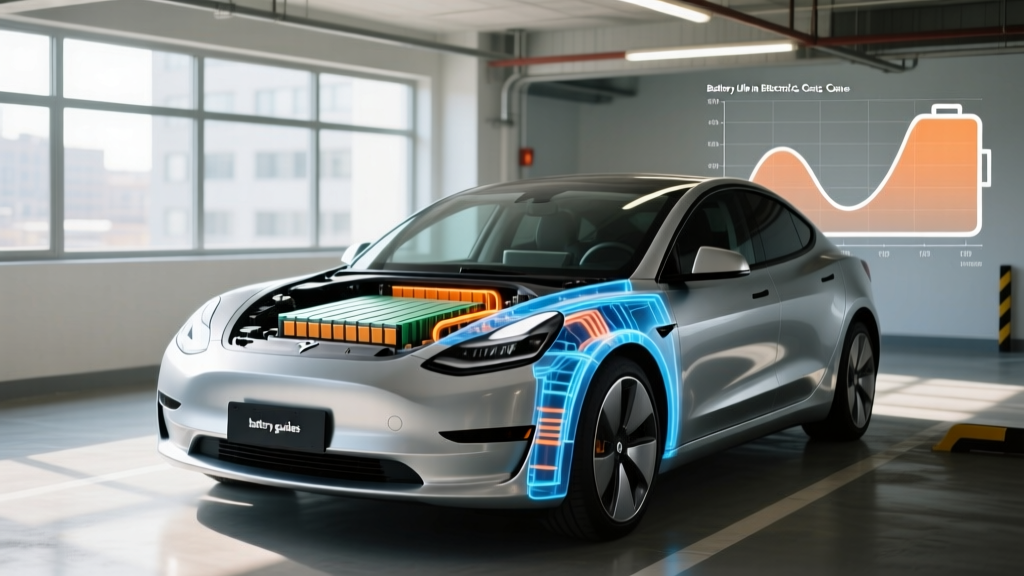
Battery degradation follows a characteristic curve: a steeper initial drop (roughly 2–4% in the first year or 20,000 miles) as the solid electrolyte interphase (SEI) layer stabilizes, followed by a long, slow linear decline. Most EVs plateau around 90–94% State of Health (SoH) for years before gradually tapering further.
| Mileage | Typical Capacity Retained (SoH) | Real-World Impact |
|---|---|---|
| 0–20,000 mi | 96–98% | Negligible — within normal variance |
| 50,000 mi | 92–96% | ~10–15 mi less range on a 300-mi pack |
| 100,000 mi | 88–93% | ~20–35 mi less range on a 300-mi pack |
| 150,000 mi | 83–90% | ~30–50 mi less range on a 300-mi pack |
| 200,000 mi | 78–87% | Noticeable but still functional for most drivers |
Source context: These figures synthesize data from Recurrent Auto's longitudinal fleet analysis and are consistent with findings published by Geotab's EV battery degradation study across 6,300 vehicles. Individual results vary — Teslas with active liquid thermal management tend toward the higher end; passively cooled older Nissan Leafs toward the lower end.
A concrete example: the 2026 Tesla Model 3 Long Range has an EPA-estimated 363 miles of range on its ~82 kWh NMC battery. At 100,000 miles with 90% SoH, you'd see roughly 327 miles of EPA-equivalent range — still ample for most drivers. In real-world highway conditions (70–75 mph, moderate temperatures), expect roughly 270–290 usable miles when new, scaling proportionally with degradation.
What the Battery Warranty Actually Covers
Federal regulation mandates that EV battery warranties cover at least 8 years or 100,000 miles (whichever comes first) in most states, and 10 years/150,000 miles in California Air Resources Board (CARB) states including California, New York, Massachusetts, Oregon, and Washington. Manufacturers often exceed these minimums.
| Manufacturer (2026 Models) | Warranty Period | Capacity Retention Threshold | Notes |
|---|---|---|---|
| Tesla (Model 3/Y) | 8 yr / 120,000 mi (LR/AWD); 8 yr / 100,000 mi (RWD) | 70% of original capacity | Covers defects AND degradation below threshold |
| Hyundai / Kia | 10 yr / 100,000 mi | 70% (some models 65%) | Among the longest coverage periods |
| Ford (Mach-E, F-150 Lightning) | 8 yr / 100,000 mi | 70% of original capacity | Transferable to second owner |
| BMW (iX, i4) | 8 yr / 100,000 mi | 70% of original capacity | Includes battery management system components |
| Chevrolet (Equinox EV, Blazer EV) | 8 yr / 100,000 mi | 70% of original capacity | GM's Ultium platform warranty |
Critical detail: The warranty threshold (typically 70%) is the trigger for a warranty claim — not the point at which the battery "fails." A battery at 72% SoH still functions; it just has 28% less range than new. In practice, very few modern liquid-cooled EV batteries drop below 70% within the warranty period under normal use. The warranty protects you against outlier defects and premature degradation, not normal aging.
Always read the fine print. Some warranties cover only manufacturing defects, not gradual capacity loss. The manufacturers listed above cover both, but confirm current terms with the dealer before purchase — warranty details can shift by model year.
EV Battery Replacement Costs: When and How Much
This is the question that drives the most anxiety, and the data tells a reassuring story: the vast majority of EV batteries are never replaced during the vehicle's useful life. When replacement is necessary, it's typically due to a manufacturing defect (covered under warranty) or collision damage (covered by insurance), not end-of-life degradation.
| Vehicle / Battery Size | Out-of-Warranty Replacement Cost (2025–2026) | Typical Replacement Trigger |
|---|---|---|
| Tesla Model 3 RWD (~60 kWh LFP) | $8,000–$12,000 | Collision damage; rare cell failure post-warranty |
| Tesla Model Y Long Range (~82 kWh NMC) | $12,000–$16,000 | Collision damage; module-level fault |
| Hyundai Ioniq 5 (~77.4 kWh NMC) | $11,000–$15,000 | Collision or rare thermal event |
| Ford F-150 Lightning Extended Range (~131 kWh NMC) | $18,000–$25,000+ | Collision; largest consumer packs cost most |
| Chevrolet Bolt EV (older, ~65 kWh NMC) | $14,000–$16,000 (declining with aftermarket) | Recall replacements largely covered by GM |
Cost trend: Battery pack prices have fallen from over $1,000/kWh in 2010 to approximately $115–135/kWh at the cell level in 2025–2026, according to BloombergNEF. Installed pack costs (including BMS, cooling, housing) run higher, but the trajectory is downward. Third-party refurbishers are also emerging, offering module-level repairs for $2,000–$6,000 instead of full-pack replacement — a growing option for out-of-warranty vehicles.
For context, a conventional vehicle's transmission replacement costs $3,000–$7,000 and is far more likely to be needed within 150,000 miles than an EV battery replacement. The fear of a $20,000 surprise bill is understandable but statistically unlikely for any modern, liquid-cooled EV.
Factors That Accelerate (or Preserve) Battery Life
Not all miles are created equal. A battery charged gently at home in San Diego will age differently from one DC fast-charged daily in Houston. Here are the variables you can control — and the ones you can't.
- Minimize DC fast charging when possible. Occasional road-trip fast charging is fine; daily reliance on 150+ kW chargers accelerates SEI growth and lithium plating. Aim for Level 2 home charging as your primary routine.
- Follow the 20–80% rule for NMC/NCA. Daily charging to 100% stresses nickel-based cathodes. Set your charge limit to 80% and only charge to 100% when departing on a trip. (LFP owners: charge to 100% regularly — LFP chemistry needs full cycles for accurate SoC calibration.)
- Avoid prolonged storage at extreme SoC. Don't leave your EV sitting at 100% for days in summer heat, and don't let it sit at 0% for extended periods. If storing for weeks, target 50–60% SoC.
- Use preconditioning. Preconditioning warms the battery before fast charging or hard acceleration in cold weather. Most EVs do this automatically when you navigate to a charger; enable it in your app settings. A cold battery charged at high power suffers lithium plating — permanent capacity loss.
- Park in shade or a garage when possible. Sustained high ambient temperatures (above 95°F) accelerate electrolyte decomposition. A garage in Phoenix is worth more than a garage in Portland, battery-wise.
- Don't obsess over regen strength. Aggressive regenerative braking returns energy to the battery at high C-rates, but modern BMS systems manage this safely. The effect on degradation is minor compared to temperature and SoC habits.
The single biggest controllable factor is heat exposure combined with high state of charge. An NMC battery held at 100% SoC in 110°F ambient heat will degrade measurably faster than one held at 70% in 70°F conditions. Liquid-cooled thermal management (standard on virtually all 2026 EVs) mitigates this significantly, but physics still applies.
How to Check Your Battery's State of Health
State of Health (SoH) is the percentage of original capacity your battery currently retains. Unlike a gas gauge, there's no universal dashboard SoH readout, but several methods exist:
In-vehicle displays: Tesla provides a battery health estimate in the Service menu (Software > Service Mode > Battery Health). Hyundai/Kia includes SoH percentage in the EV battery information screen on newer models. BMW's iDrive system surfaces battery condition data in the service menu.
OBD-II diagnostic tools: Devices like the OBDLink SX or vLinker FD, paired with apps such as Car Scanner or Leaf Spy (for Nissan Leaf), can read SoH directly from the BMS. This is the most accurate consumer-accessible method and takes about 2 minutes.
Third-party services: Companies like Recurrent offer free battery health reports that connect to your vehicle's telematics data and provide degradation curves benchmarked against similar vehicles. Several pre-purchase inspection services now include battery health reports for used EVs.
Manual estimation: Charge to 100% (on an NMC vehicle, do this occasionally for calibration), note the displayed range, and compare to the original EPA figure adjusted for the vehicle's configuration. A 2026 Model Y Long Range showing 295 miles at 100% versus its 330-mile EPA rating suggests roughly 89% SoH — though displayed range estimates fluctuate with recent driving patterns and aren't perfectly linear.
Emerging Battery Tech: What's Next (and When)
Several next-generation technologies promise step-change improvements in energy density, charging speed, and longevity. None are available in consumer vehicles as of 2026, but timelines are crystallizing:
Solid-state batteries: Replace the liquid electrolyte with a solid ceramic or polymer layer, enabling lithium-metal anodes and energy densities above 400 Wh/kg. Toyota has announced a solid-state EV for 2027–2028 production; Samsung SDI targets 2027; QuantumScape's cells are in prototype testing with Volkswagen. Real-world availability in volume production is announced for 2027–2029 but remains unconfirmed at scale. Expect initial deployment in premium vehicles at significant cost premiums.
Silicon-dominant anodes: Replacing graphite anodes with silicon can boost energy density by 20–40%. Sila Nanotechnologies and Group14 Technologies are supplying early-production cells; the Mercedes G-Class electric (2025) incorporated silicon-anode cells from Sila. This technology is scaling now and will likely reach mainstream EVs by 2027–2028.
Sodium-ion batteries: Cheaper than lithium, with no critical mineral supply constraints, but lower energy density (~140 Wh/kg). CATL and BYD are deploying sodium-ion in Chinese-market city cars. US availability is not expected before 2028 and likely limited to short-range urban vehicles.
Practical takeaway: If you need an EV today, current lithium-ion technology (LFP and NMC) is mature, well-warrantied, and proven to last 150,000–200,000+ miles. Waiting for solid-state means waiting at minimum 2–3 years for limited availability at premium pricing. The batteries in 2026 EVs are not a compromise — they're the product of 15 years of iterative improvement.
Frequently Asked Questions
How long do EV batteries last in years and miles?
Most modern liquid-cooled EV batteries retain 85–92% capacity at 150,000 miles and remain functional well beyond 200,000 miles. In years, that translates to 15–20+ years of typical driving (12,000–15,000 mi/year). The battery rarely determines the vehicle's end of life.
How much does it cost to replace an EV battery?
Full pack replacement ranges from roughly $8,000 for a 60 kWh pack to $25,000+ for a 131 kWh pack (like the F-150 Lightning Extended Range). However, most replacements are covered by warranty (defects) or insurance (collision). Module-level repairs from third parties can cost $2,000–$6,000. Out-of-pocket full replacements on a non-damaged battery are rare.
What does the EV battery warranty cover?
Federally mandated minimum coverage is 8 years/100,000 miles (10 yr/150,000 mi in CARB states). Most manufacturers cover both manufacturing defects and capacity loss below a threshold — typically 70% of original capacity. Confirm specific terms for your model year, as details can vary by trim and chemistry.
How do I check my EV battery health?
Use your vehicle's built-in service menu (Tesla, Hyundai, BMW), an OBD-II scanner with an EV-compatible app (Car Scanner, Leaf Spy), or a third-party service like Recurrent. Manual estimation by comparing current full-charge range to original EPA range gives a rough SoH approximation.
LFP vs NMC — which battery chemistry is better for me?
Choose LFP if you want maximum cycle life, can charge to 100% daily without worry, primarily commute under 200 miles, and want lower cost. Choose NMC if you need 300+ miles of range, road-trip frequently, and can manage an 80% daily charge limit. Both chemistries are proven to last the vehicle's lifetime with proper care.
Does frequent DC fast charging damage the battery?
Occasional DC fast charging (road trips, a few times per month) has minimal impact on modern batteries with active thermal management. Daily reliance on 150+ kW DC charging does accelerate degradation — studies show roughly 2–5% additional capacity loss over 100,000 miles compared to Level 2 charging. Use Level 2 as your primary routine and fast-charge when you need it.
Should I be worried about battery replacement on a used EV?
Check the SoH before buying (via OBD-II or a service like Recurrent), confirm remaining warranty coverage, and compare capacity retention to fleet averages for that model. A 2022 EV with 40,000 miles and 94% SoH is in excellent shape. The risk of needing a replacement on a well-maintained, liquid-cooled EV is low.
Sources: Recurrent Auto Battery Degradation Research, U.S. Department of Energy / fueleconomy.gov, IRS Clean Vehicle Credit Guidelines (§30D).