How Long Do EV Batteries Actually Last?
The short answer: most modern EV traction batteries will outlast the vehicle they're installed in. But "battery life" means different things to different buyers — some want to know when capacity drops below a usable threshold, others want to know when a full replacement is necessary. The data tells a reassuring story, provided you understand the chemistry inside your pack and how your habits affect it.
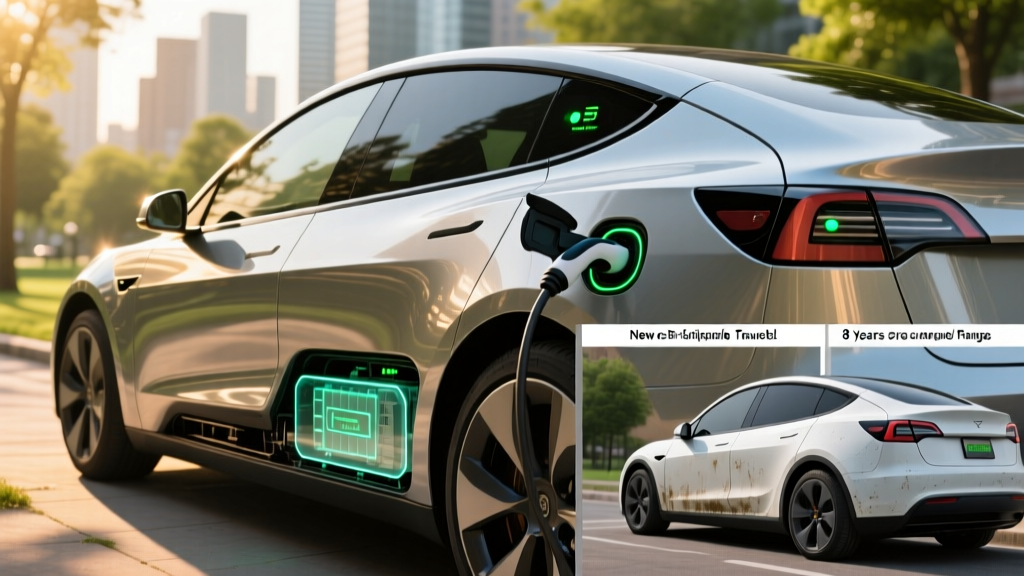
Based on aggregated fleet data from sources like Recurrent Auto and long-term owner tracking, the average EV battery in 2026 retains roughly 90–95% of its original capacity after 5 years and 75,000 miles. Degradation is not linear — it's steepest in the first 1–2 years (typically 2–5% loss as the solid electrolyte interphase layer stabilizes), then flattens to roughly 1–2% per year thereafter.
Federal law mandates that EV batteries carry a minimum warranty of 8 years or 100,000 miles (10 years/150,000 miles in California and states adopting CARB standards). Most manufacturers guarantee the pack will retain at least 70% of its original capacity during that period. In practice, very few packs fall below that threshold within the warranty window.
LFP vs NMC vs NCA: Which Chemistry Powers Your EV?
Not all EV batteries are the same. The two dominant lithium-ion chemistries in 2026 are LFP (lithium iron phosphate) and NMC/NCA (nickel manganese cobalt / nickel cobalt aluminum). Your battery's chemistry determines its energy density, cycle life, cold-weather behavior, and cost — and it's the single biggest factor in how your pack ages.
| Attribute | LFP (LiFePO₄) | NMC / NCA |
|---|---|---|
| Energy Density | Lower (~160–180 Wh/kg cell-level) | Higher (~220–260 Wh/kg cell-level) |
| Cycle Life | 3,000–5,000+ cycles to 80% SoH | 1,000–2,000 cycles to 80% SoH |
| Cold-Weather Performance | More range loss below 32°F; slower cold charging | Better low-temp conductivity and range retention |
| Charging to 100% | Safe and recommended periodically for BMS calibration | Daily 80% limit recommended; 100% for trips only |
| Cost | Lower — no cobalt or nickel; ~$100–120/kWh pack-level | Higher — commodity-sensitive; ~$130–160/kWh pack-level |
| Common 2026 Applications | Tesla Model 3/Y RWD, Ford Mustang Mach-E Select, base Chevy Equinox EV | Tesla Long Range, Hyundai Ioniq 5/6, Rivian R1T/R1S, BMW iX, most luxury EVs |
Which is better? It depends on your use case. If you drive moderate daily distances, charge primarily at home, and want maximum pack longevity, LFP is the stronger choice — its cycle life is 2–3x that of NMC. If you need maximum range in a single charge, frequently road-trip in cold climates, or tow heavy loads, NMC/NCA's higher energy density is worth the trade-off.
EV Battery Degradation: What the Data Shows
Degradation is measured as a percentage loss of original usable capacity, tracked via State of Health (SoH). A new battery starts at 100% SoH; when it drops to 70–80%, you'll notice reduced range but the vehicle remains fully drivable.
Here's what aggregated real-world data from Geotab's fleet study of over 10,000 EVs and manufacturer-reported figures indicate for typical degradation curves:
- Year 1 (0–15k mi): 2–4% loss — initial SEI layer formation
- Year 2 (15–30k mi): 1–2% additional loss
- Year 3–5 (30–75k mi): ~1–1.5% per year, gradual
- Year 6–8 (75–120k mi): ~1% per year; total loss typically 10–15%
- Year 10+ (150k+ mi): Most packs still above 80% SoH with proper care
LFP packs generally show 1–2% less total degradation at equivalent mileages due to superior cycle stability.
Outliers exist. Some early Nissan Leaf models (passive air-cooled packs) showed 20–25% degradation by year 5 in hot climates. Modern liquid-cooled thermal management systems in 2026 vehicles from Tesla, Hyundai, BMW, GM, and Ford have largely eliminated this failure mode.
What Does the EV Battery Warranty Cover?
Every new EV sold in the US in 2026 carries a federally mandated battery warranty. Here's how the major manufacturers structure theirs:
| Manufacturer | Duration | Mileage | Capacity Threshold |
|---|---|---|---|
| Tesla (Model 3/Y) | 8 years | 100,000–120,000 mi (varies by trim) | 70% retention |
| Hyundai / Kia | 10 years | 100,000 mi | 70% retention |
| General Motors (Ultium) | 8 years | 100,000 mi | 70% retention |
| Ford | 8 years | 100,000 mi | 70% retention |
| BMW | 8 years | 100,000 mi | 70% retention |
| Rivian | 8 years | 175,000 mi | 70% retention |
What triggers a warranty claim: If your battery's SoH drops below the stated threshold (typically 70%) within the warranty period, the manufacturer will repair or replace the pack — or individual modules, depending on the architecture — at no cost to you. This covers defects and abnormal degradation, not physical damage from collisions or flooding.
Important nuance: The warranty covers the high-voltage traction battery, not the 12V auxiliary battery that powers lights, infotainment, and computers. The 12V battery in an EV is a standard lead-acid or lithium unit that typically lasts 3–5 years and costs $150–$400 to replace — the same as any conventional vehicle.
How Much Does an EV Battery Replacement Cost?
This is the question that generates the most anxiety — and the most misinformation. Here are the facts for 2026:
| Vehicle / Pack Size | Battery Chemistry | Estimated Replacement Cost |
|---|---|---|
| Tesla Model 3 RWD (~60 kWh) | LFP | $8,000–$12,000 |
| Tesla Model Y LR (~75 kWh) | NMC | $12,000–$16,000 |
| Hyundai Ioniq 5 (~77.4 kWh) | NMC | $11,000–$15,000 |
| Ford F-150 Lightning Ext. Range (~131 kWh) | NMC | $18,000–$25,000 |
| Chevy Equinox EV (~85 kWh) | NMC (Ultium) | $12,000–$17,000 |
| BMW iX xDrive50 (~111.5 kWh) | NMC | $18,000–$24,000 |
When is replacement actually needed? Almost never during normal ownership. Pack-level replacement is typically only necessary after a collision, flood damage, or extreme degradation well beyond 200,000 miles. Many modern packs use modular architectures (GM's Ultium, some BMW designs) that allow individual module replacement at 20–30% of a full pack cost.
Pack prices have dropped from over $1,000/kWh in 2010 to roughly $110–$140/kWh at the pack level in 2026, according to BloombergNEF data. That downward trend continues, meaning a replacement in 2034 will likely cost significantly less than today's estimates.
5 Factors That Accelerate (or Preserve) Battery Life
Your battery's lifespan isn't just a function of time — it's shaped by how you charge, drive, and store the vehicle. Here are the five factors with the largest measurable impact:
- Avoid chronic DC fast charging. Occasional road-trip fast charging is fine, but daily use of 150+ kW DC chargers generates sustained heat that accelerates electrolyte decomposition. Studies show exclusive DCFC use can add 2–4% additional degradation over 5 years vs. primarily Level 2 charging.
- Maintain 20–80% State of Charge for daily use (NMC/NCA). Storing an NMC battery at 100% SoC for extended periods stresses the cathode. LFP owners can charge to 100% regularly without harm — in fact, periodic 100% charges are recommended for BMS calibration.
- Precondition before fast charging. Most 2026 EVs automatically warm the battery when you navigate to a charger. A cold battery (below 50°F) charged at high power experiences lithium plating, a permanent degradation mechanism. Always use your car's preconditioning feature.
- Minimize extreme-temperature storage. Parking in 100°F+ heat for weeks at high SoC, or leaving the car at 0°F for extended periods at low SoC, both accelerate calendar aging. A garage or shaded spot makes a measurable difference.
- Drive moderately when the battery is cold. Aggressive acceleration demands high current from a cold pack, increasing internal resistance and stress. Allow 5–10 minutes of gentle driving or use preconditioning in freezing weather.
How to Check Your EV Battery's State of Health
State of Health (SoH) is the metric that tells you how much of your battery's original capacity remains. Here's how to monitor it in 2026:
Manufacturer Apps and In-Car Displays
Most 2026 EVs provide SoH data through the manufacturer's mobile app or a service menu. Tesla owners can access battery health through the service menu or third-party tools. Hyundai/Kia's Bluelink app provides range-based estimates. GM's myChevrolet/myCadillac apps include battery condition monitoring.
OBD-II Diagnostic Tools
Devices like the OBDLink SX or Car Scanner ELM adapter, paired with apps such as EV Health or LeafSpy (for Nissan), can read the BMS (Battery Management System) directly to report precise SoH percentages, cell voltage spreads, and cycle counts.
Dealer Diagnostic Reports
Any authorized service center can pull a full battery health report during routine service. Request this before purchasing a used EV — a SoH reading below 85% on a vehicle under 60,000 miles may indicate a warranty-eligible issue.
Third-Party Battery Certifications
Services like Recurrent now offer battery health reports that provide verified SoH data, useful for both ownership tracking and resale value documentation.
What's Next: Solid-State and Silicon-Anode Batteries
Next-generation battery technologies promise step-change improvements in energy density, charging speed, and longevity — but realistic timelines matter.
Solid-state batteries replace the liquid electrolyte with a solid ceramic, polymer, or sulfide material, potentially doubling energy density and enabling 10-minute fast charges with minimal degradation. Toyota has announced a 2027–2028 production timeline for solid-state EVs, while Samsung SDI and QuantumScape target limited production in the 2028–2030 window. These will debut in premium vehicles at significant cost premiums before reaching mainstream pricing.
Silicon-anode batteries (used in limited form by companies like Sila Nanotechnologies and Group14) replace graphite anodes with silicon, boosting energy density by 20–40%. These are closer to mass adoption — appearing in some 2026–2027 model-year vehicles in hybrid form (silicon-graphite composites) — and offer meaningful range gains without the manufacturing challenges of full solid-state designs.
Bottom line: If you're buying in 2026, today's LFP and NMC chemistries are mature, well-understood, and backed by extensive warranty coverage. Waiting for solid-state means waiting 3–5 years for limited-availability, premium-priced vehicles. Current batteries are not a compromise — they're a proven technology with real-world track records spanning billions of miles.
Frequently Asked Questions
How long do EV batteries last in years and miles?
Most modern EV batteries (2022 and newer) are designed to retain 70–85% of their original capacity after 10–15 years and 150,000–200,000 miles. They rarely require full replacement during the vehicle's usable life. Federal warranty minimums cover at least 8 years / 100,000 miles at 70% capacity retention.
How much does it cost to replace an EV battery?
Out-of-warranty replacement costs range from roughly $8,000 for a smaller LFP pack (60 kWh) to $25,000 for a large NMC pack (130+ kWh). However, full replacements are extremely rare — most degradation-related claims are handled under warranty, and modular designs increasingly allow partial repairs at a fraction of full-pack cost.
Does fast charging damage the battery?
Occasional DC fast charging has minimal impact. Chronic daily use of high-power DCFC (150+ kW) without adequate thermal management can add 2–4% extra degradation over 5 years compared to Level 2 home charging. Modern 2026 EVs actively manage charge rates and battery temperature to mitigate this, but Level 2 remains the gentler option for daily use.
Is LFP better than NMC for battery longevity?
For pure cycle life and calendar longevity, yes — LFP batteries typically endure 3,000–5,000+ charge cycles vs. 1,000–2,000 for NMC. LFP also tolerates regular 100% charging and has lower material costs. The trade-off is lower energy density (heavier pack for the same range) and reduced cold-weather performance.
Should I be worried about battery degradation on a used EV?
Check the SoH before buying. A used EV at 50,000–80,000 miles with 88–93% SoH is typical and healthy. Below 80% SoH at that mileage may signal a warranty claim opportunity. Always verify the remaining battery warranty transfers to the new owner — under federal law, it must.
What voids an EV battery warranty?
Typical exclusions include physical damage (collision, flood, fire), unauthorized modifications to the battery or BMS, use of non-certified charging equipment that causes damage, and failure to follow the manufacturer's maintenance schedule. Normal degradation within the stated threshold is always covered.