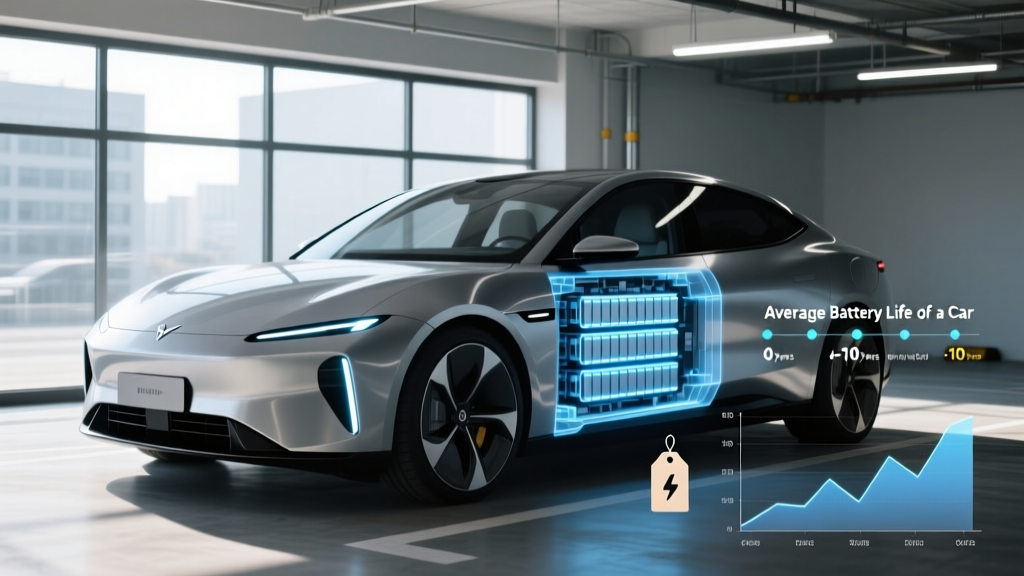
If you're researching the average battery life of a car — specifically an electric vehicle — the short answer is reassuring: modern EV traction batteries are engineered to outlast most conventional powertrains. Data from manufacturers, fleet operators, and independent testing shows that the majority of EV battery packs retain 85–95% of their original capacity after 100,000 miles, and most will function well beyond 200,000 miles before degrading to a point where replacement becomes worth considering.
But "battery life" isn't a single number. It depends on chemistry, charging habits, climate, and how you define end-of-life. This guide breaks down the real data, the chemistry trade-offs between LFP and NMC, what warranties actually cover, and what a replacement would cost if you ever need one.
How Long Do EV Batteries Actually Last?
The U.S. Department of Energy and manufacturer durability testing indicate that most modern liquid-cooled EV battery packs are designed for a usable lifespan of 150,000 to 200,000+ miles — roughly 15 to 20 years of average driving — before capacity drops below 70% of original. "End-of-life" in the EV industry doesn't mean the battery stops working; it means the pack has degraded to a threshold (typically 70–80% State of Health) where reduced range becomes noticeable on daily drives.
Real-world fleet data supports this. Tesla's 2025 Impact Report showed that Model S and Model X vehicles retained approximately 85% of battery capacity at 200,000 miles. Hyundai and Kia's E-GMP platform vehicles (Ioniq 5, EV6) have shown similar trajectories in European fleet studies, with roughly 90% retention at 60,000 miles.
- Year 1 / 15,000 mi: ~3–5% loss (initial formation degradation)
- Year 3 / 45,000 mi: ~6–8% total loss
- Year 5 / 75,000 mi: ~8–10% total loss
- Year 8 / 120,000 mi: ~12–15% total loss
- Year 10 / 150,000 mi: ~15–18% total loss
Note: Degradation is not linear. The steepest loss occurs in the first year, then the curve flattens significantly. LFP packs tend to show slightly slower long-term degradation but may start with marginally lower energy density.
For context, the average American drives about 14,500 miles per year according to the Federal Highway Administration. At that rate, a 200,000-mile battery lifespan represents nearly 14 years of use — longer than most people keep a car.
LFP vs NMC: Which Battery Chemistry Lasts Longer?
The two dominant lithium-ion chemistries in today's EVs are LFP (lithium iron phosphate) and NMC/NCA (nickel manganese cobalt / nickel cobalt aluminum). They differ meaningfully in longevity, energy density, cold-weather behavior, and cost.
| Factor | LFP (LiFePO4) | NMC / NCA |
|---|---|---|
| Cycle Life | 3,000–6,000+ cycles | 1,000–2,500 cycles |
| Energy Density | Lower (~160 Wh/kg cell-level) | Higher (~250–300 Wh/kg cell-level) |
| Cold-Weather Performance | More range loss in freezing temps (~35–40% reduction) | Moderate loss (~25–30% reduction) |
| Recommended SoC for Daily Use | Can charge to 100% regularly | Best kept 20–80% for daily; 100% for trips only |
| Cost per kWh | Lower (~$80–100/kWh cell-level in 2026) | Higher (~$110–140/kWh cell-level in 2026) |
| Notable Vehicles (2026) | Tesla Model 3 RWD, Model Y RWD, Ford Mustang Mach-E Select (LFP option) | Hyundai Ioniq 5, Kia EV6, BMW iX, most long-range AWD trims |
The bottom line: If longevity is your top priority and you live in a moderate climate, LFP is the stronger choice — its cycle life is roughly 2–3x that of NMC. If you need maximum range in a lighter package, regularly drive in cold weather, or want the fastest DC charging speeds, NMC/NCA remains the better fit. Neither chemistry is "bad"; both are proven to last well beyond 150,000 miles with proper care.
What Does the EV Battery Warranty Actually Cover?
Federal law in the United States mandates that EV battery packs carry a minimum warranty of 8 years or 100,000 miles (whichever comes first). In California Air Resources Board (CARB) states — which include California, New York, Massachusetts, and several others — that requirement extends to 10 years or 150,000 miles.
Most manufacturers exceed the federal minimum. The warranty typically guarantees that the battery will retain a specified percentage of its original capacity — usually 70%, though some brands use 65% or 75% as the threshold.
| Manufacturer (2026 Models) | Warranty Period | Capacity Retention Threshold |
|---|---|---|
| Tesla (Model 3, Model Y) | 8 yr / 120,000 mi (Long Range, Performance); 8 yr / 100,000 mi (RWD) | 70% |
| Hyundai (Ioniq 5, Ioniq 6) | 10 yr / 100,000 mi | 70% |
| Kia (EV6, EV9) | 10 yr / 100,000 mi | 70% |
| Ford (Mach-E, F-150 Lightning) | 8 yr / 100,000 mi | 70% |
| BMW (iX, i4) | 8 yr / 100,000 mi | 70% |
| Chevrolet (Equinox EV, Blazer EV) | 8 yr / 100,000 mi | 70% |
Key distinction: The warranty covers capacity loss below the stated threshold under normal use. It does not cover damage from accidents, flooding, improper modifications, or use of non-approved charging equipment. If your battery drops to 69% State of Health within the warranty window, the manufacturer is obligated to repair or replace it — often with a refurbished pack that meets the threshold, not necessarily a brand-new one.
How Much Does It Cost to Replace an EV Battery?
This is the question that generates the most anxiety, but it needs context: the vast majority of EV owners will never need a battery replacement. Most packs outlast the vehicle's useful life or its time in the original owner's hands. That said, if you plan to keep an EV for 15+ years or buy a high-mileage used EV, here's what replacement costs look like in 2026.
| Vehicle / Pack Size | Battery Capacity | Estimated Replacement Cost (Parts + Labor) |
|---|---|---|
| Tesla Model 3 RWD (LFP) | ~60 kWh | $8,000–$12,000 |
| Tesla Model Y Long Range | ~75 kWh | $12,000–$16,000 |
| Hyundai Ioniq 5 | 77.4 kWh | $14,000–$18,000 |
| Ford F-150 Lightning Extended Range | 131 kWh | $18,000–$25,000 |
| Chevrolet Equinox EV | ~85 kWh | $12,000–$16,000 |
Several factors are pushing costs down over time. Cell-level pricing has fallen roughly 80% since 2013, and module-level repair (replacing individual faulty modules rather than the entire pack) is becoming more common at specialized EV shops, often cutting costs by 40–60% versus a full pack swap. Third-party and refurbished packs are also increasingly available for popular models.
When is replacement typically needed? In practice, almost never during the first 10–12 years. The scenarios where replacement becomes economically justified are usually: (1) a manufacturing defect that falls just outside warranty, (2) physical damage from road debris or flooding, or (3) a 15+ year-old vehicle where gradual degradation has brought usable range below the owner's daily needs.
Factors That Accelerate (or Slow) Battery Degradation
Not all miles are equal when it comes to battery wear. Here's what the data shows about the biggest factors:
- Limit DC fast charging to road trips. Frequent use of 150+ kW DC fast charging generates sustained high heat, which accelerates electrolyte decomposition. Occasional fast charging is fine — daily fast charging is what adds wear. Aim for Level 2 (7–11.5 kW) as your daily charging method.
- Avoid extreme State of Charge for storage. For NMC batteries, don't leave the car sitting at 100% SoC for days. Charge to 80% for daily use and only top up to 100% when you're about to drive. LFP batteries can be charged to 100% regularly — in fact, Tesla recommends periodic 100% charges for LFP to maintain accurate SoC calibration.
- Precondition before fast charging. Most modern EVs automatically precondition the battery when you navigate to a DC fast charger. This brings the pack to optimal temperature (roughly 95–105°F / 35–40°C), enabling peak charge rates and reducing stress. If your car offers preconditioning, use it.
- Park in shade or a garage during extreme heat. Sustained ambient temperatures above 95°F (35°C) with a high SoC is one of the worst conditions for long-term battery health. A garage or shaded spot meaningfully reduces passive thermal stress.
- Don't obsess over avoiding low SoC. Dropping to 10% occasionally won't harm the pack. What causes wear is sitting at very low SoC (below 5%) for extended periods — days or weeks — which can stress cell balancing.
- Use regenerative braking normally. Regen does not meaningfully accelerate degradation. The energy recaptured during deceleration is a small fraction of what the pack handles during acceleration.
Cold weather note: Lithium-ion batteries lose range in freezing temperatures — typically 20–40% depending on chemistry and whether the vehicle has a heat pump. This is temporary range loss, not permanent degradation. However, charging a cold battery (especially at high DC rates) without preconditioning can cause lithium plating, which does cause permanent damage. Modern thermal management systems largely prevent this, which is why preconditioning matters.
How to Check and Monitor Your Battery's State of Health
State of Health (SoH) is the percentage of original battery capacity remaining. A new EV has 100% SoH; a pack at 85% SoH has lost 15% of its original capacity. Here's how to check it:
In-Vehicle Displays
Some EVs show SoH directly. Hyundai/Kia's E-GMP vehicles include a battery health indicator in the settings menu. Tesla does not display SoH natively, but you can estimate it by comparing your current rated range at 100% charge to the original EPA-rated range.
Third-Party Apps and OBD-II Tools
Apps like TeslaFi (Tesla-specific), LeafSpy (Nissan Leaf), and OBD-II dongles paired with apps like OBDeleven or Carista can pull SoH data directly from the Battery Management System (BMS). For a one-time check, many dealerships can run a battery health diagnostic during a service visit.
The Manual Calculation Method
Charge to 100%, note the displayed range, and divide by the original EPA range. If your Ioniq 5 originally showed 303 miles at 100% and now shows 272, that's roughly 90% SoH. This method isn't perfectly precise (displayed range varies with recent driving efficiency), but it's a reliable trend indicator when checked periodically under similar conditions.
What's Next: Solid-State Batteries and Silicon Anodes
Two technologies are frequently cited as the next leap in battery longevity, but it's critical to separate lab progress from production reality.
Solid-state batteries replace the liquid electrolyte with a solid material (ceramic, sulfide, or polymer). In theory, they offer higher energy density, faster charging, reduced fire risk, and longer cycle life. Toyota has announced plans for limited solid-state EV production in the 2027–2028 timeframe, and Samsung SDI has begun pilot production. However, manufacturing scalability and cost remain significant hurdles. Widespread, affordable solid-state EVs are realistically a 2029–2032 proposition, not something available or worth waiting for in 2026.
Silicon anode technology replaces the graphite anode with silicon-dominant materials, boosting energy density by 20–40%. Companies like Sila Nanotechnologies and Group14 are already supplying silicon-anode materials to battery manufacturers, and some 2025–2026 model-year EVs incorporate partial silicon anodes. This is a real, incremental improvement happening now — not a future promise — though full silicon anodes with long cycle life are still in development.
For buyers in 2026, today's lithium-ion packs (both LFP and NMC) are mature, well-understood, and backed by robust warranties. Waiting for solid-state is not a practical purchase strategy.
Frequently Asked Questions
How long do EV batteries last in years and miles?
Most modern EV batteries are designed to last 150,000–200,000+ miles (roughly 15–20 years of average driving) before degrading to 70–80% of original capacity. Fleet data from Tesla and Hyundai/Kia show 85–90% retention at 100,000–200,000 miles with normal use. The battery doesn't "die" at this point — it simply offers less range.
How much does an EV battery cost to replace in 2026?
Full pack replacement ranges from approximately $8,000 for a smaller LFP pack (e.g., Tesla Model 3 RWD, ~60 kWh) to $25,000 for a large NMC pack (e.g., F-150 Lightning Extended Range, 131 kWh). Module-level repair at specialized shops can reduce costs by 40–60%. Most EV owners never need a replacement during their ownership.
What does the battery warranty cover?
Federal law requires a minimum 8-year/100,000-mile battery warranty. Most manufacturers guarantee the pack will retain 70% of original capacity during that period. In CARB states, coverage extends to 10 years/150,000 miles. The warranty covers degradation and manufacturing defects but not physical damage, accidents, or improper use.
LFP vs NMC — which is better for longevity?
LFP (lithium iron phosphate) has a significant cycle-life advantage: 3,000–6,000+ cycles versus 1,000–2,500 for NMC. LFP also tolerates daily 100% charges, which simplifies ownership. NMC offers higher energy density (more range per pound), better cold-weather performance, and faster DC charging speeds. For pure longevity, LFP wins. For maximum range and cold-climate usability, NMC is preferable.
Does fast charging damage the battery?
Occasional DC fast charging (road trips, a few times a month) causes negligible additional wear on modern liquid-cooled packs. Daily reliance on 150+ kW DC fast charging does accelerate degradation over time due to sustained heat. Level 2 home charging (7–11.5 kW) is the optimal daily method for long-term health.
Can I check my battery health myself?
Yes. Some vehicles display SoH in the settings menu (Hyundai/Kia). For others, third-party apps like TeslaFi or OBD-II diagnostic tools can pull SoH data from the BMS. The simplest method: charge to 100%, compare the displayed range to the original EPA figure, and track the trend over time.
Should I wait for solid-state batteries before buying an EV?
No. Solid-state batteries are not commercially available in mass-production EVs as of 2026. Toyota targets limited production around 2027–2028, and broad affordability is likely a 2029–2032 timeline. Today's lithium-ion packs are proven, warrantied, and cost-effective. Waiting for solid-state means delaying an EV purchase by 3–6+ years with no guaranteed price advantage.