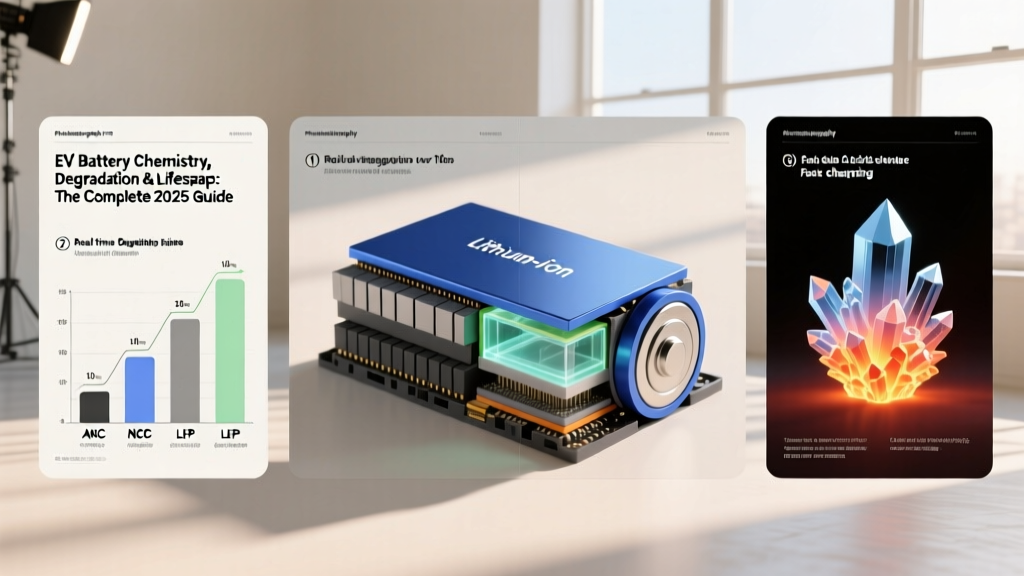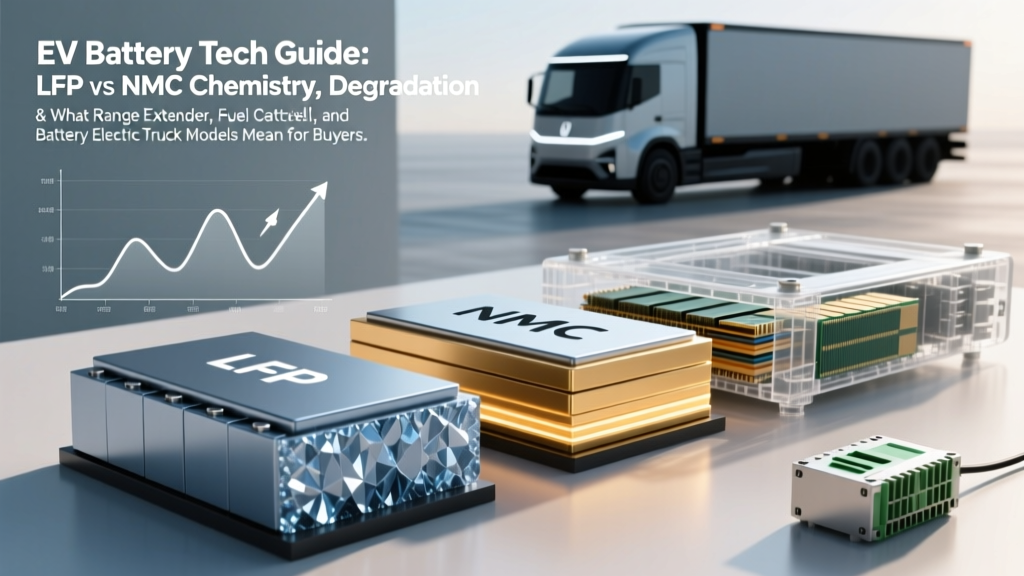
Electric vehicle batteries have evolved rapidly over the past five years, splitting into distinct chemistries, architectures, and powertrain strategies that confuse even seasoned car shoppers. Whether you're evaluating a long-range sedan with an NMC pack, a fleet-oriented battery electric truck with LFP cells, a hydrogen fuel cell SUV, or a range extender model from a manufacturer like BMW or Mazda, the battery remains the single most expensive component in the vehicle — and the one buyers worry about most.
This guide breaks down exactly what's inside today's EV batteries, how long they realistically last, what warranties actually cover, what replacement costs look like in 2026, and how emerging powertrain types — battery electric trucks, hydrogen fuel cell vehicles, and range extender models — handle energy storage differently. Every claim here is backed by data, not marketing.
LFP vs NMC vs NCA: EV Battery Chemistry Explained
The two dominant lithium-ion chemistries in passenger EVs today are LFP (lithium iron phosphate) and NMC/NCA (nickel manganese cobalt / nickel cobalt aluminum). Each has distinct trade-offs that affect range, longevity, cold-weather performance, and price. Here's how they compare head to head:
| Attribute | LFP (Lithium Iron Phosphate) | NMC / NCA (Nickel-Based) |
|---|---|---|
| Energy Density | ~160–180 Wh/kg (lower) | ~220–300 Wh/kg (higher) |
| Cycle Life | 3,000–5,000+ cycles to 80% capacity | 1,000–2,000 cycles to 80% capacity |
| Cold-Weather Performance | More range loss below 32°F; slower charging in cold | Better low-temp conductivity; less winter range penalty |
| Thermal Stability / Safety | Excellent — less prone to thermal runaway | Good, but requires more active thermal management |
| Cost (per kWh) | ~$80–$100/kWh at pack level | ~$110–$140/kWh at pack level |
| Cobalt Content | None | Contains cobalt (supply-chain and ethical concerns) |
| Typical Use Case | Standard-range models, fleet/commercial, battery electric trucks | Long-range, performance, premium models |
| SoC Recommendation | Can charge to 100% regularly without significant harm | Best kept 20–80% for daily use; 100% for trips only |
The practical takeaway: If you want maximum range in a lighter package and don't mind more careful charging habits, NMC/NCA is the better choice. If you prioritize long-term durability, lower cost, and simpler daily charging (regular 100% top-offs are fine), LFP is increasingly compelling — especially for standard-range trims and commercial battery electric truck models where cycle life matters more than energy density.
Major manufacturers using LFP in 2026 include Tesla (Model 3/Y Standard Range), Ford (base Mustang Mach-E), BYD (all models), and Rivian (EDV commercial vans). NMC/NCA dominates in long-range and performance trims across Hyundai, Kia, BMW, Mercedes, and GM's Ultium platform.
How Long Do EV Batteries Actually Last? Degradation Data
Battery degradation — the gradual loss of usable capacity over time — is the number-one concern for prospective EV buyers. The good news: modern thermal management systems and improved cell chemistry have made catastrophic battery failure rare. Most EV batteries outlast the vehicles they're installed in.
Here's what real-world degradation data shows across major platforms:
| Vehicle / Platform | Chemistry | Avg. Capacity Loss at 100k Miles | Avg. Capacity Loss at 150k Miles | Source |
|---|---|---|---|---|
| Tesla Model 3/Y (NMC/NCA) | NCA / NMC | ~8–10% | ~12–15% | Tesla 2025 Impact Report; Recurrent Auto |
| Tesla Model 3 RWD (LFP) | LFP | ~4–6% | ~7–9% | Recurrent Auto fleet data |
| Hyundai Ioniq 5 / Kia EV6 | NMC | ~6–8% | ~10–12% | Owner surveys; fueleconomy.gov |
| Chevrolet Bolt EV/EUV (pre-2025) | NMC | ~7–9% | ~11–14% | Recurrent Auto; Bolt owner forums |
| Ford F-150 Lightning (Extended) | NMC | ~8–11% | ~13–16% | Ford fleet data; owner reports |
| BYD Seal / Atto 3 | LFP (Blade) | ~3–5% | ~6–8% | BYD internal data; EU fleet testing |
Key insight: Degradation is not linear. Most packs lose 2–5% in the first year (the "break-in" period), then settle into a slow, predictable decline of roughly 1–2% per year under normal use. LFP packs consistently show lower degradation than NMC at equivalent mileage, which is why LFP is becoming the default for high-mileage and commercial applications.
For context, a 2026 model with a 75 kWh NMC battery losing 12% over 150,000 miles would still retain ~66 kWh of usable capacity — roughly equivalent to a brand-new 2020 EV. The vehicle remains fully functional; you just have somewhat less range.
Battery Warranty Terms: What Manufacturers Actually Cover
Federal law mandates a minimum battery warranty of 8 years / 100,000 miles for EVs sold in the US (10 years / 150,000 miles in CARB states like California, New York, and others). Most manufacturers meet or exceed this baseline, but the details matter — especially the capacity retention threshold.
| Manufacturer | Warranty Period | Mileage Limit | Capacity Threshold | Notes |
|---|---|---|---|---|
| Tesla (Model 3/Y NMC) | 8 years | 120,000 mi | 70% retention | Long Range & Performance only |
| Tesla (Model 3 RWD LFP) | 8 years | 100,000 mi | 70% retention | Standard Range |
| Hyundai / Kia (E-GMP) | 10 years | 100,000 mi | 70% retention | Ioniq 5, EV6, EV9 |
| GM (Ultium platform) | 8 years | 100,000 mi | 70% retention | Equinox EV, Blazer EV, Silverado EV |
| Ford (F-150 Lightning) | 8 years | 100,000 mi | 70% retention | Both battery sizes |
| Rivian (R1T / R1S) | 8 years | 175,000 mi | 70% retention | Higher mileage limit for truck use |
| BMW (iX / i4 / Neue Klasse) | 8 years | 100,000 mi | 70% retention | Includes NMC and upcoming LFP trims |
What the warranty covers: Defects in materials and workmanship, plus capacity loss below the stated threshold. If your 82 kWh pack drops below 57.4 kWh (70%) within the warranty period, the manufacturer must repair or replace it — typically with a refurbished or remanufactured unit, not necessarily brand-new.
What it doesn't cover: Damage from accidents, flooding, improper charging equipment, unauthorized modifications, or failure to follow the owner's manual maintenance schedule. Read the fine print in your warranty booklet.
EV Battery Replacement Cost: What to Budget and When
This is where fear-mongering usually takes over, so let's ground this in reality. Most EV batteries never need replacement during normal ownership. The data from Recurrent Auto and warranty claim records shows that fewer than 2–3% of EV batteries are replaced under warranty, and the vast majority of those are due to manufacturing defects caught early — not end-of-life degradation.
That said, if you're buying a used EV with 150,000+ miles, or planning to keep a new EV for 15+ years, here's what out-of-warranty replacement looks like in 2026:
| Vehicle | Battery Size (Usable) | Chemistry | Replacement Cost Range | Notes |
|---|---|---|---|---|
| Tesla Model 3 RWD | 57 kWh | LFP | $7,000–$10,000 | LFP packs are cheaper; reman available |
| Tesla Model Y Long Range | 75 kWh | NMC | $12,000–$16,000 | Structural pack; labor-intensive |
| Hyundai Ioniq 5 | 72.6 kWh | NMC | $11,000–$15,000 | E-GMP platform; modular repair possible |
| Ford F-150 Lightning Ext. | 131 kWh | NMC | $20,000–$28,000 | Large pack; highest cost in light trucks |
| Chevrolet Equinox EV | 85 kWh | NMC (Ultium) | $12,000–$17,000 | Ultium modular design aids partial repair |
| Rivian R1T (Max Pack) | 141 kWh | NMC | $22,000–$30,000 | Largest consumer pack on market |
When is replacement typically needed? For most owners, never. If degradation does push a pack below practical usability, it usually happens at 200,000+ miles or 15+ years — at which point the vehicle's resale value is often less than the replacement cost. Module-level repair (replacing individual cell modules rather than the entire pack) is increasingly available on Ultium, E-GMP, and Tesla platforms, cutting costs by 40–60%.
For battery electric truck models like the F-150 Lightning, Silverado EV, and Rivian R1T, the larger pack sizes mean higher absolute replacement costs, but these vehicles also see heavier use, so the cost-per-mile equation still favors electrification over diesel for most commercial and heavy-use scenarios.
Factors That Affect EV Battery Life — and How to Maximize It
Battery longevity isn't random. Specific habits and environmental factors accelerate or slow degradation. Here's what the data says matters most:
EV Battery Care Checklist
- Limit DC fast charging to road trips. Frequent use of 150+ kW DC fast charging adds thermal stress. Occasional use is fine; daily fast-charging accelerates degradation by an estimated 1–3% over the battery's life vs. Level 2 home charging.
- Avoid extreme State of Charge (SoC) storage. For NMC/NCA packs, don't leave the vehicle parked at 100% or below 10% for extended periods (days to weeks). The 20–80% range is the longevity sweet spot. LFP packs tolerate 100% storage better, but still shouldn't sit at 0% for long.
- Precondition before fast charging. Battery preconditioning warms the pack to optimal charging temperature (~77–95°F). Most EVs do this automatically when you navigate to a charger. In cold weather, preconditioning can mean the difference between a 35 kW and a 150 kW peak charge rate.
- Use a Level 2 home charger for daily charging. A 7–11 kW Level 2 charger (240V, 32–48A) generates far less heat than DC fast charging and is ideal for overnight top-ups. Installation typically costs $500–$2,000 depending on panel capacity and run length.
- Minimize exposure to extreme heat. Prolonged parking in 100°F+ ambient temperatures without thermal management active accelerates calendar degradation. Garage parking or shaded spots help significantly in hot climates.
- Don't baby it excessively. The difference between "perfect" battery care and "normal" use is typically 2–4% capacity over 10 years. Drive the car. Use the range. The battery management system (BMS) handles most protection automatically.
Battery Electric Trucks, Hydrogen Fuel Cells, and Range Extenders: How Energy Storage Differs
Not every electrified vehicle relies on a single large battery. As manufacturers diversify powertrains for different use cases, three distinct architectures have emerged — each with different implications for battery size, chemistry, and longevity.
Battery Electric Trucks
Battery electric truck models from manufacturers like Ford (F-150 Lightning), GM (Silverado EV), Rivian (R1T), and Tesla (Cybertruck) use large NMC packs — typically 100–141 kWh usable — to deliver 250–400 miles of EPA range plus substantial towing and payload capacity. The trade-off is weight (these packs add 1,200–2,000 lbs) and higher replacement cost. For commercial fleet use, some manufacturers are exploring LFP packs for battery electric trucks to prioritize cycle life over energy density, accepting slightly lower range for 3,000+ cycle durability.
Hydrogen Fuel Cell Vehicles (FCEVs)
Hydrogen fuel cell models like the Toyota Mirai and Hyundai Nexo use a much smaller battery (typically 1–2 kWh) as a buffer, with a fuel cell stack generating electricity from compressed hydrogen on demand. The small battery experiences minimal degradation because it operates in a narrow SoC window and rarely sees deep cycling. However, hydrogen refueling infrastructure remains extremely limited in the US — essentially confined to California — making FCEVs impractical for most buyers. The fuel cell stack itself has a lifespan of roughly 150,000–200,000 miles before efficiency declines, and stack replacement costs $8,000–$15,000.
Range Extender Models (EREVs)
Range extender electric vehicles (EREVs) use a smaller battery (typically 30–50 kWh) paired with a gasoline engine that acts solely as a generator — it never drives the wheels directly. The BMW i3 REx (discontinued) pioneered this approach; current examples include the Mazda MX-30 R-EV (available in select markets) and several Chinese-market models from Li Auto and BYD. Because EREV batteries are smaller and frequently cycled between 20–80% SoC with the engine kicking in as a buffer, degradation patterns differ from pure BEVs. Expect 8–12% loss over 100,000 miles on a 40 kWh EREV pack, though the smaller pack means lower replacement cost ($4,000–$7,000) when the time comes.
Which architecture is right for you? Pure battery electric models (including trucks) offer the lowest operating cost and widest charging access. Hydrogen fuel cells make sense only if you have reliable hydrogen station access and need fast refueling. Range extenders suit drivers who want electric daily commuting with gas-powered road-trip flexibility but don't want a full PHEV powertrain.
How to Check Your EV's Battery Health (State of Health)
State of Health (SoH) is the percentage of original capacity your battery retains. A new EV has 100% SoH; a battery at 85% SoH holds 85% of its original kWh. Here's how to monitor it:
- In-vehicle displays: Tesla, Hyundai/Kia, BMW, and Mercedes now include battery health indicators in the infotainment or service menus. Tesla's "Battery Health" screen (added in 2024 software updates) shows estimated SoH percentage directly.
- OBD-II diagnostic tools: Third-party apps like LeafSpy (Nissan), OBDeleven (VW/Audi), and Scan My Tesla read the BMS-reported SoH via the OBD-II port. These typically cost $20–$60 for the adapter plus a free or low-cost app.
- Dealer diagnostic reports: Request a battery health check during service visits. Most manufacturers can print a detailed SoH report showing individual module balance, internal resistance, and capacity estimates.
- Third-party services: Companies like Recurrent Auto offer free battery health reports that compare your pack's degradation to a fleet of identical vehicles — useful context for understanding whether your degradation is typical or concerning.
- Manual calculation: Charge to 100% (or a known SoC), note the displayed range, and compare to the EPA-rated range at the same SoC. If your 310-mile EPA vehicle shows 265 miles at 100%, that's roughly 85% SoH — though this method is approximate because displayed range estimates vary with recent driving patterns and temperature.
When to be concerned: If SoH drops below 90% within the first 30,000 miles, or below 80% before 100,000 miles, contact the manufacturer — you may have a defective module eligible for warranty repair.
Emerging Battery Technology: Solid-State, Silicon Anode, and What's Real
Several next-generation battery technologies are in development, but timelines matter. Here's a realistic assessment as of 2026:
Solid-state batteries replace the liquid electrolyte with a solid material, promising higher energy density (400+ Wh/kg), faster charging, and improved safety. Toyota has announced limited solid-state production for 2027–2028 in select models, initially in small volumes for premium vehicles. Samsung SDI and QuantumScape are targeting 2028–2030 for broader availability. These are not currently available in any production vehicle. Expect solid-state to reach mainstream, affordable EVs no earlier than 2030–2032.
Silicon anode technology increases the silicon content in the anode (replacing graphite), boosting energy density by 10–20% without changing the cathode chemistry. Sila Nanotechnologies and Group14 are already supplying silicon-dominant anode materials to manufacturers. The 2026 Mercedes G-Class EV uses a silicon-anode battery with ~25% higher energy density than conventional NMC. This technology is real and shipping now, but currently limited to premium applications due to cost.
Sodium-ion batteries are emerging as a low-cost alternative for budget and commercial EVs, using abundant sodium instead of lithium. CATL and BYD are producing sodium-ion cells for Chinese-market vehicles, with energy density around 140–160 Wh/kg. US-market availability is expected around 2028–2029, likely in entry-level models and fleet vehicles.
Semi-solid-state batteries (a hybrid approach using some liquid electrolyte with solid separators) are already in limited production from NIO and WeLion in China, offering ~360 Wh/kg. These bridge the gap between current lithium-ion and full solid-state, but remain expensive and limited in availability.
The honest assessment: current LFP and NMC chemistries will dominate through at least 2030. Next-gen technologies will arrive incrementally in premium segments first, with mainstream trickle-down taking 3–5 years after initial launch.
Frequently Asked Questions
How long do EV batteries last in years and miles?
Based on current degradation data, most modern EV batteries retain 75–85% of original capacity at 150,000 miles (roughly 10–12 years of average use). LFP packs trend toward the higher end of that range. Very few batteries fail catastrophically — gradual capacity loss is the norm, and the vehicle remains fully drivable even at 70% SoH. According to Recurrent Auto, fewer than 3% of EV batteries in their study fleet required replacement.
How much does an EV battery cost to replace?
Out-of-warranty replacement costs range from roughly $7,000 for a small LFP pack (Tesla Model 3 RWD) to $28,000+ for a large battery electric truck pack (F-150 Lightning Extended Range, Rivian R1T Max). However, most batteries never need replacement, and module-level repairs can cut costs by 40–60% on platforms that support it. Check current pricing through your manufacturer's service department, as costs continue to decline roughly 5–8% annually.
What does the EV battery warranty cover?
Federal law requires a minimum 8-year / 100,000-mile battery warranty (10 years / 150,000 miles in CARB states). Coverage includes defects and capacity loss below a stated threshold — typically 70% of original capacity. The warranty does not cover accident damage, improper charging, or unauthorized modifications. Full warranty terms are available on each manufacturer's website and through the IRS clean vehicle credit guidelines for related tax credit implications.
How do I check and maximize my EV battery health?
Monitor SoH through your vehicle's built-in battery health display, OBD-II diagnostic tools (LeafSpy, Scan My Tesla), or dealer service reports. To maximize longevity: prioritize Level 2 home charging over DC fast charging, keep NMC packs between 20–80% SoC for daily use (LFP packs tolerate 100% better), precondition before fast charging in cold weather, and avoid prolonged storage at extreme SoC levels or in high heat.
LFP vs NMC — which battery chemistry is better?
Neither is universally "better" — it depends on your priorities. LFP offers superior cycle life (3,000–5,000 cycles vs. 1,000–2,000), lower cost, better safety, and simpler daily charging habits (100% is fine). NMC/NCA delivers higher energy density (more range in a lighter, smaller pack), better cold-weather performance, and faster peak charging speeds. For daily commuters and fleet users, LFP is increasingly the pragmatic choice. For long-range road-trippers and performance-oriented buyers, NMC remains the standard.
Do hydrogen fuel cell vehicles have batteries that degrade?
FCEVs like the Toyota Mirai have very small buffer batteries (1–2 kWh) that operate in a narrow SoC range and experience minimal degradation. The primary longevity concern in a fuel cell vehicle is the fuel cell stack itself, which typically lasts 150,000–200,000 miles before efficiency declines meaningfully. Stack replacement costs $8,000–$15,000.
Are range extender (EREV) batteries different from full EV batteries?
EREV batteries are smaller (30–50 kWh vs. 60–140 kWh for BEVs) and designed for frequent partial cycling rather than deep discharge. The gasoline generator kicks in before the battery depletes fully, which keeps the pack in a moderate SoC range — actually beneficial for longevity. Replacement costs are proportionally lower due to the smaller pack size.