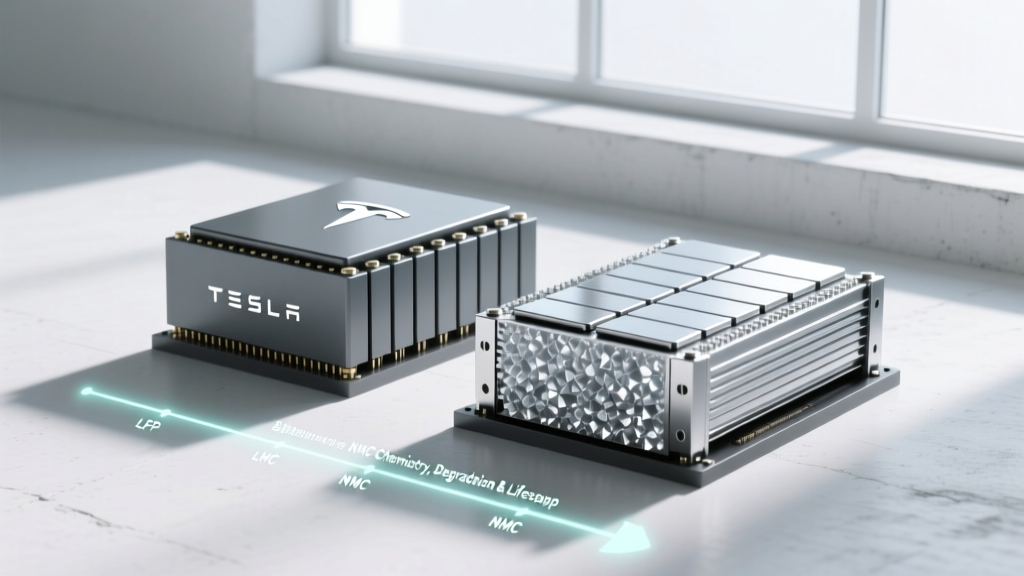
Search for "battery stove" and you'll find two very different products colliding in the same keyword space: portable electric cooktops powered by lithium iron phosphate (LFP) battery packs, and the growing number of EV owners wondering if their car's traction battery can double as a backup power source or cooking solution during outages. Both trends trace back to the same underlying technology — lithium-ion cell chemistries that now power everything from 1,000-watt camping stoves to 100 kWh electric SUVs.
This guide breaks down the battery science behind EVs and portable battery-powered stoves, focusing on what EV buyers and owners actually need to know: chemistry trade-offs, real degradation numbers, warranty coverage, replacement costs, and how to monitor and maximize the lifespan of the most expensive component in your vehicle.
LFP vs NMC/NCA: The Chemistry Decision That Shapes Your EV
Every EV sold in 2026 uses one of two dominant lithium-ion chemistries in its high-voltage traction battery: lithium iron phosphate (LFP) or nickel manganese cobalt / nickel cobalt aluminum (NMC/NCA). The choice affects your range, charging habits, cold-weather performance, and long-term durability.
LFP chemistry has surged in popularity — Tesla equips the Model 3 and Model Y Standard Range (rear-wheel-drive) trims with LFP packs, Ford uses LFP in the Mustang Mach-E Select, and Rivian offers LFP in the R1S and R1T Standard battery. The same LFP cells are the reason portable "battery stoves" and power stations from brands like EcoFlow, Jackery, and Bluetti can safely sit in your kitchen or campsite without the thermal runaway risks associated with higher-energy-density chemistries.
| Attribute | LFP (LiFePO₄) | NMC / NCA |
|---|---|---|
| Energy Density | Lower (~160–180 Wh/kg cell-level) | Higher (~220–260 Wh/kg cell-level) |
| Cycle Life | 3,000–6,000+ cycles to 80% SoH | 1,000–2,500 cycles to 80% SoH |
| Cold-Weather Performance | Weaker below 32°F; slower charging, ~15–25% range loss | Better low-temp conductivity; ~10–20% range loss |
| Thermal Stability | Excellent; onset of thermal runaway ~518°F (270°C) | Good; onset ~410°F (210°C) |
| Cost per kWh | Lower; no cobalt or nickel | Higher; commodity-sensitive supply chain |
| Recommended SoC Habit | Can charge to 100% daily | Best kept 20–80% daily; 100% for trips only |
| Typical Use in 2026 EVs | Standard Range trims, fleet vehicles, battery stoves/portable stations | Long Range, Performance, and luxury trims |
| §30D Tax Credit Sourcing | Easier to meet critical-mineral requirements (iron, phosphate) | Cobalt/nickel sourcing under increasing scrutiny |
The bottom line: If you prioritize longevity, lower cost, and daily charging simplicity, LFP is the stronger pick — and it's why the battery stove market standardized on LFP for consumer safety. If you need maximum range per charge and better winter performance, NMC/NCA delivers higher energy density at the cost of more careful state-of-charge management.
How Long Do EV Batteries Actually Last? Degradation Data
The most persistent fear among prospective EV buyers is that the traction battery will fail prematurely, leaving them with a five-figure replacement bill. The data tells a more reassuring story: most modern EV batteries are engineered to outlast the vehicles they're installed in.
Battery degradation is measured as a percentage loss of original usable capacity, tracked via State of Health (SoH). A battery at 90% SoH holds 90% of its original kilowatt-hours. Here's what real-world data shows across major platforms:
| Source / Study | Fleet / Sample | Average Degradation | Timeframe |
|---|---|---|---|
| Geotab fleet study (2024 update) | ~10,000 EVs across 65+ models | ~2.3% average loss per year | Over 10+ years of data |
| Tesla Impact Report 2024 | Model S/X fleet | ~12% loss at 200,000 miles | High-mileage cohort |
| Tesla Impact Report 2024 | Model 3/Y (NMC + LFP) | ~8% loss at 200,000 miles | High-mileage cohort |
| Recurrent Auto battery report | Chevy Bolt EV/EUV fleet | ~6–8% average loss | At ~80,000 miles |
| Nissan Leaf owner data | 40 kWh and 62 kWh packs | ~10–15% loss (passive thermal management) | At 80,000–100,000 miles |
The Nissan Leaf's higher degradation rate illustrates a critical variable: thermal management. The Leaf uses passive air cooling, while virtually every other modern EV uses active liquid cooling and heating. Liquid-cooled packs consistently show lower degradation because they keep cells within the optimal 59–95°F (15–35°C) operating window during charging and driving.
For context, the EPA range you see on the window sticker already accounts for a small factory buffer (typically 3–8% of gross capacity is locked off). So when your battery degrades 10% over 100,000 miles, you're losing that percentage of the usable capacity — meaning a 310-mile EPA-rated EV might realistically deliver 275–280 miles at 100k miles in moderate climates.
Battery Warranty Coverage: What's Protected and What Isn't
Federal law mandates that EV battery warranties cover a minimum of 8 years or 100,000 miles (whichever comes first) in most states, and 10 years or 150,000 miles in California Air Resources Board (CARB) states including California, Colorado, Connecticut, Maine, Maryland, Massachusetts, New Jersey, New York, Oregon, Rhode Island, Vermont, Virginia, and Washington.
| Manufacturer | Warranty Period | Capacity Retention Threshold | Chemistry |
|---|---|---|---|
| Tesla (Model 3/Y RWD — LFP) | 8 yr / 100,000 mi | 70% of original capacity | LFP |
| Tesla (Model 3/Y LR/Perf — NMC) | 8 yr / 120,000 mi | 70% | NMC |
| Hyundai / Kia (Ioniq 5, EV6, EV9) | 10 yr / 100,000 mi | 70% | NMC |
| Ford (Mustang Mach-E, F-150 Lightning) | 8 yr / 100,000 mi | 70% | NMC / LFP (Mach-E Select) |
| Rivian (R1S / R1T) | 8 yr / 175,000 mi | 70% | NMC / LFP (Standard) |
| GM (Chevrolet Equinox EV, Blazer EV) | 8 yr / 100,000 mi | 70% | NMC (Ultium) |
| BMW (i4, iX, i7) | 8 yr / 100,000 mi | 70% | NMC |
What's covered: Defects in materials or workmanship, and capacity dropping below the stated threshold (typically 70%). If your 82 kWh usable pack falls below ~57 kWh within the warranty window, the manufacturer must repair or replace it at no cost.
What's typically NOT covered: Damage from accidents, flooding, or improper modifications; cosmetic issues; degradation from consistently ignoring manufacturer charging guidance (though this is rarely enforced in practice); and the 12V auxiliary battery, which is covered under a separate, shorter warranty (usually 3 yr / 36,000 mi).
EV Battery Replacement Cost: When, Why, and How Much
Here's the reality that most EV owners never face: full traction battery replacement is rare. Geotab's fleet data and manufacturer reports show that catastrophic battery failure (sudden, total loss of function) affects well under 1% of EVs. The more common scenario is gradual degradation — and as the data above shows, most packs retain 80–90% capacity well past 150,000 miles.
When replacement IS needed — typically due to a manufacturing defect, physical damage, or extreme degradation on older models with passive thermal management — here's what it costs:
| Model | Battery Capacity | Chemistry | Estimated Replacement Cost |
|---|---|---|---|
| Tesla Model 3 (Standard Range) | ~60 kWh | LFP | $10,000 – $13,000 |
| Tesla Model Y (Long Range) | ~75 kWh | NMC | $12,000 – $16,000 |
| Ford Mustang Mach-E (Extended Range) | ~91 kWh | NMC | $15,000 – $22,000 |
| Chevrolet Bolt EV | ~65 kWh | NMC | $13,000 – $16,000 |
| Hyundai Ioniq 5 (Long Range) | ~77.4 kWh | NMC | $12,000 – $18,000 |
| Ford F-150 Lightning (Extended Range) | ~131 kWh | NMC | $22,000 – $32,000 |
| Rivian R1T (Max Pack) | ~149 kWh | NMC | $25,000 – $35,000 |
| Mercedes EQS | ~107.8 kWh | NMC | $22,000 – $30,000 |
Costs have been declining steadily — roughly 8–12% per year on a per-kWh basis — driven by manufacturing scale and chemistry improvements. LFP packs are notably cheaper to replace than NMC packs of equivalent capacity because iron and phosphate are far less expensive than nickel and cobalt. This cost advantage is one reason battery stove manufacturers and portable power station companies standardized on LFP.
Module-level repair: Some manufacturers (notably BMW, Rivian, and Hyundai/Kia) design packs with individually replaceable modules. Instead of replacing the entire battery, a technician can swap out a single degraded or defective module for $2,000–$5,000. This approach is becoming more common and significantly reduces out-of-warranty risk.
Factors That Accelerate (or Preserve) Battery Life
Not all miles are created equal when it comes to battery wear. The following factors have the most measurable impact on long-term State of Health:
State of Charge (SoC) Habits
For NMC/NCA batteries, the electrochemical stress is highest at the extremes — below 10% and above 90% SoC. Daily charging to 80% and avoiding letting the pack sit at 100% for extended periods can add years of useful life. LFP batteries are more tolerant of 100% SoC, and Tesla, Ford, and Rivian all recommend periodic 100% charges for LFP packs to maintain accurate battery management system (BMS) calibration.
DC Fast Charging Frequency
Occasional DC fast charging (1–2 sessions per week at 150–350 kW) has minimal measurable impact on modern liquid-cooled packs. However, exclusive reliance on DC fast charging — especially at peak rates above 200 kW in hot weather — has been shown in Geotab's data to correlate with slightly higher degradation (~0.5–1% additional loss per year). The battery's thermal management system works harder during fast charging, and sustained high C-rates accelerate electrolyte decomposition.
Temperature Extremes
Cold weather doesn't permanently damage batteries, but it does reduce available range (15–30% loss below freezing is normal) and slows charging speeds due to the BMS limiting current to protect cold cells. Hot weather is the greater long-term concern: sustained ambient temperatures above 95°F (35°C), combined with high SoC, accelerate calendar degradation. This is why vehicles with active liquid cooling consistently outperform passively cooled packs in hot climates.
Preconditioning
Using your EV's preconditioning feature — which warms the battery to optimal temperature before fast charging — is one of the simplest and most impactful things you can do. Tesla's navigation-initiated preconditioning, Hyundai/Kia's battery heating mode, and Ford's charging prep feature all bring the pack to ~86–95°F before you plug in, enabling faster charging and reducing thermal stress. In cold weather, preconditioning can cut your 10–80% charge time by 30–50%.
Battery Care Checklist for Maximum Longevity
- NMC/NCA daily limit: Set charge limit to 80% for daily use; 100% only for road trips
- LFP daily limit: Charge to 100% at least once per week for BMS calibration
- DC fast charging: Use when needed, but favor Level 2 home charging for daily top-ups
- Precondition before fast charging: Always use nav-to-charger or manual preconditioning
- Avoid prolonged storage at extremes: If storing for 2+ weeks, set SoC to ~50%
- Minimize high-SoC + high-heat: Don't charge to 100% and park in direct sun in summer
- Use scheduled charging: Charge during off-peak hours when ambient temps are cooler
- Monitor SoH periodically: Check via the vehicle app or third-party tools (see below)
Monitoring Battery Health: How to Check Your SoH
State of Health is the single most important metric for evaluating your EV battery's condition — whether you're a current owner tracking degradation or a used-EV buyer assessing a prospective purchase.
Built-in tools: Tesla provides a battery health estimate in the Service menu (Settings → Service → Battery Health Test on 2024+ software). Hyundai and Kia offer battery condition checks through dealer diagnostics. Ford's MyFordPass app includes a battery health indicator on newer model years.
OBD-II diagnostic tools: Third-party devices like the OBDLink SX/MX+ paired with apps such as EV Bat Life or Leaf Spy Pro (for Nissan Leaf) can read BMS-reported capacity data directly. These tools typically report SoH as a percentage, along with cell voltage balance data and pack temperature.
Charging-data analysis: Services like Recurrent Auto (free enrollment) connect to your vehicle's telematics and provide ongoing SoH tracking, benchmarked against similar vehicles in their fleet. This is particularly useful for establishing a degradation trend over time rather than relying on a single snapshot.
Dealer diagnostics: Any authorized service center can perform a full battery health report. This is recommended before purchasing a used EV, especially one outside its original warranty window. Ask for the printout showing measured capacity in kWh versus original rated capacity.
Battery Stoves, V2L, and the Home-Energy Intersection
The "battery stove" concept — a portable electric cooktop powered by a self-contained lithium battery pack — has gained traction among campers, tailgaters, and homeowners seeking backup cooking options during power outages. Products like the EcoFlow Induction Cooktop paired with a Delta Pro power station use LFP chemistry for the same reasons automakers do: thermal stability, long cycle life, and safety in consumer environments.
But EV owners have a larger version of this capability built into their vehicles. Vehicle-to-Load (V2L) allows you to power external devices — including induction cooktops, space heaters, and power tools — directly from your EV's traction battery. The Hyundai Ioniq 5, Ioniq 6, Kia EV6, EV9, Ford F-150 Lightning, and Rivian R1S/R1T all offer V2L capability, typically at 1.9–3.6 kW of continuous output through an adapter plugged into the charge port or a dedicated interior outlet.
A typical portable induction cooktop draws 1,000–1,800 watts. Running one from an F-150 Lightning's 131 kWh battery for an hour of cooking uses roughly 1.5–1.8 kWh — about 1.4% of total capacity. That's negligible for a single meal but adds up during extended outage use.
Vehicle-to-Home (V2H) takes this further: the F-150 Lightning with Ford's Charge Station Pro can power an entire home during an outage at up to 9.6 kW, providing 3–10 days of backup power depending on household consumption. GM has announced V2H capability for Ultium-based vehicles beginning with 2026 model-year trucks and SUVs, and Hyundai's E-GMP platform supports V2H with the appropriate bidirectional charger.
Emerging Battery Technology: Solid-State and Silicon Anodes
Several next-generation battery technologies are in development, and it's worth understanding their realistic timelines — none are available in production vehicles as of 2026.
Solid-state batteries replace the liquid electrolyte with a solid conductor, promising higher energy density (potentially 400+ Wh/kg at the cell level), faster charging, and improved safety. Toyota has announced plans for a solid-state-equipped EV by 2027–2028, and Samsung SDI targets 2027 for mass production. However, manufacturing scale-up and cost reduction remain significant hurdles. Expect solid-state batteries to debut in premium/limited-production vehicles first, with mainstream adoption likely in the 2030–2032 timeframe.
Silicon anode technology (used in early form by GM's Ultium platform and by startups like Sila Nanotechnologies) replaces graphite anodes with silicon-dominant composites, increasing energy density by 20–40%. Mercedes-Benz's upcoming G-class EV (announced for 2025) uses Sila's silicon anode cells. This technology is closer to mainstream deployment than solid-state and is already appearing in limited production applications.
Sodium-ion batteries are being developed by CATL and BYD as a low-cost alternative to LFP for entry-level EVs and energy storage. They offer lower energy density but eliminate lithium entirely from the supply chain. Expect sodium-ion packs in budget EVs from Chinese manufacturers first, with potential US-market availability in the 2028–2030 window.
For current EV buyers, these technologies are forward-looking context, not purchase-decision factors. Today's LFP and NMC packs are mature, well-understood, and backed by extensive real-world data.
Frequently Asked Questions
How long do EV batteries last in years and miles?
Based on fleet data from Geotab and manufacturer reports, modern liquid-cooled EV batteries typically retain 80–90% of original capacity at 150,000–200,000 miles. At an average degradation rate of 1.5–2.5% per year, most packs will deliver 15–20 years of usable service before falling to 70% capacity — the threshold at which range reduction becomes noticeable in daily driving. Many EV batteries will outlast the rest of the vehicle.
How much does an EV battery cost to replace?
Full traction battery replacement costs range from roughly $10,000 for a smaller LFP pack (e.g., Tesla Model 3 Standard Range, ~60 kWh) to $30,000–$35,000 for a large NMC pack (e.g., Rivian R1T Max Pack, ~149 kWh or Ford F-150 Lightning Extended Range, ~131 kWh). However, full replacement is rare — under 1% of EVs require it. Module-level repair, where available, costs $2,000–$5,000. Most replacements occur under warranty at no cost to the owner.
What does the EV battery warranty actually cover?
Federal minimum battery warranty coverage is 8 years / 100,000 miles (10 years / 150,000 miles in CARB states). The warranty covers defects and capacity loss below a stated threshold — typically 70% of original usable capacity. If your pack falls below this threshold within the warranty period, the manufacturer must repair or replace it. The warranty does not cover physical damage, accidents, or the 12V auxiliary battery.
How do I check my EV battery's State of Health?
Options include: the vehicle's built-in battery health test (available on Tesla, some Hyundai/Kia models via dealer); OBD-II diagnostic tools like OBDLink paired with EV-specific apps; telematics services like Recurrent Auto that provide ongoing SoH tracking; and dealer diagnostic reports, which are recommended before purchasing a used EV. Ask for measured kWh capacity versus original rated capacity.
LFP vs NMC — which battery chemistry is better for me?
Choose LFP if you want maximum cycle life, lower replacement cost, the ability to charge to 100% daily without concern, and better thermal safety. Choose NMC/NCA if you need the longest possible range per charge, better cold-weather performance, and faster DC charging in winter conditions. LFP dominates standard-range trims and portable applications (including battery stoves and power stations). NMC dominates long-range and performance trims. Neither is universally "better" — the right choice depends on your driving patterns, climate, and charging access.
Does frequent DC fast charging damage the battery?
Occasional DC fast charging has minimal impact on modern liquid-cooled packs. Geotab's data shows that vehicles that fast-charge frequently (3+ times per week) exhibit roughly 0.5–1% additional annual degradation compared to those that primarily use Level 2 charging. The bigger risk is fast-charging at peak rates (200+ kW) in hot weather without preconditioning. Always precondition your battery before fast charging to minimize thermal stress.
Can I use my EV to power a battery stove or induction cooktop?
Yes, if your vehicle supports V2L (Vehicle-to-Load). The Hyundai Ioniq 5, Kia EV6/EV9, Ford F-150 Lightning, and Rivian R1S/R1T can all output 1.9–3.6 kW through V2L adapters — enough to run a standard 1,800W portable induction cooktop. A one-hour cooking session uses approximately 1.5–1.8 kWh, which is 1–2% of most EV battery capacities. For extended outage use, monitor your SoC to ensure you retain enough charge for driving.
For official battery warranty details and federal requirements, refer to fueleconomy.gov's EV technology guide. For current §30D tax credit rules that factor in battery sourcing requirements, consult the IRS clean vehicle credit page.