The Chemistry Under Your Floor: LFP vs NMC/NCA Explained
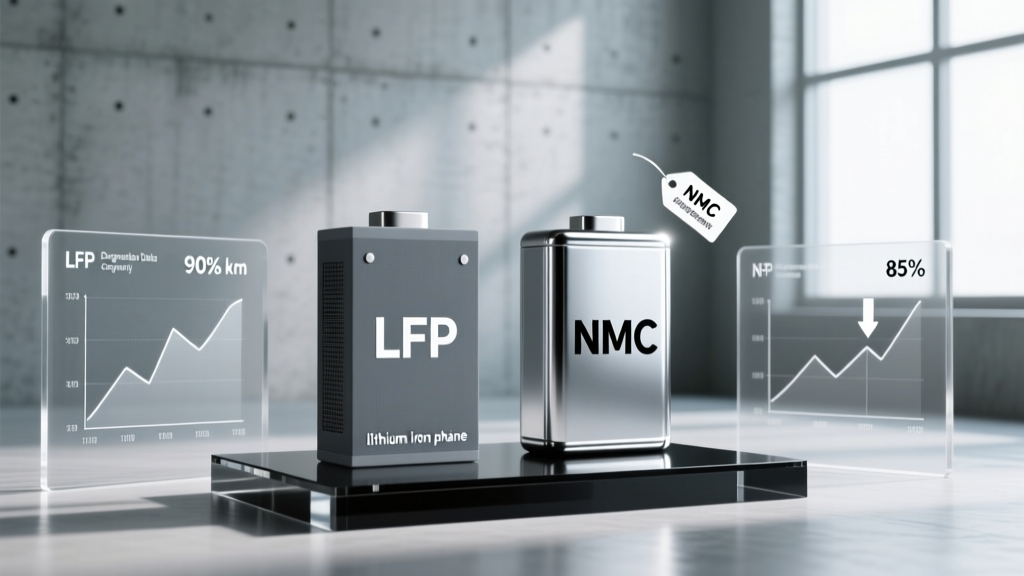
Every EV battery pack boils down to a cathode chemistry choice, and in 2026 the market has largely settled into two camps: lithium iron phosphate (LFP) and nickel manganese cobalt (NMC) or nickel cobalt aluminum (NCA). The chemistry determines your pack's energy density, cycle life, cold-weather behavior, and ultimately the vehicle's price tag. Here is how they stack up against each other in measurable terms.
| Attribute | LFP (LiFePO₄) | NMC / NCA |
|---|---|---|
| Cell-level energy density | 160–180 Wh/kg | 220–300 Wh/kg |
| Typical cycle life (to 80% SoH) | 3,000–5,000+ cycles | 1,000–2,000 cycles |
| Cold-weather range loss (20°F) | ~30–40% reduction | ~20–30% reduction |
| Recommended daily SoC ceiling | 100% (benefits from periodic full charges for BMS calibration) | 80% for daily use; 100% for trips only |
| Thermal runaway risk | Very low | Low but higher than LFP |
| Cobalt/nickel content | None | Significant (supply-chain and cost implications) |
| Relative pack cost (2026) | ~$100–120/kWh at pack level | ~$130–160/kWh at pack level |
| Notable 2026 vehicles using | Tesla Model 3/Y RWD, Ford Mustang Mach-E Select, Rivian R1S Standard | Hyundai Ioniq 5, Kia EV6, BMW iX, Chevy Silverado EV, Lucid Air |
Which is better? There is no universal winner. LFP excels for buyers who want maximum longevity, can charge at home nightly to 100%, and don't need the longest possible single-charge range. NMC/NCA is the pick for drivers who need 300+ miles of EPA range in a lighter package and can manage an 80% daily charge limit. If you live in a cold climate and regularly drive long distances in winter, NMC's better low-temperature performance is a real advantage. If you plan to keep the vehicle 10+ years and want the slowest degradation curve available, LFP's cycle-life edge is hard to beat.
How Long Do EV Batteries Actually Last?
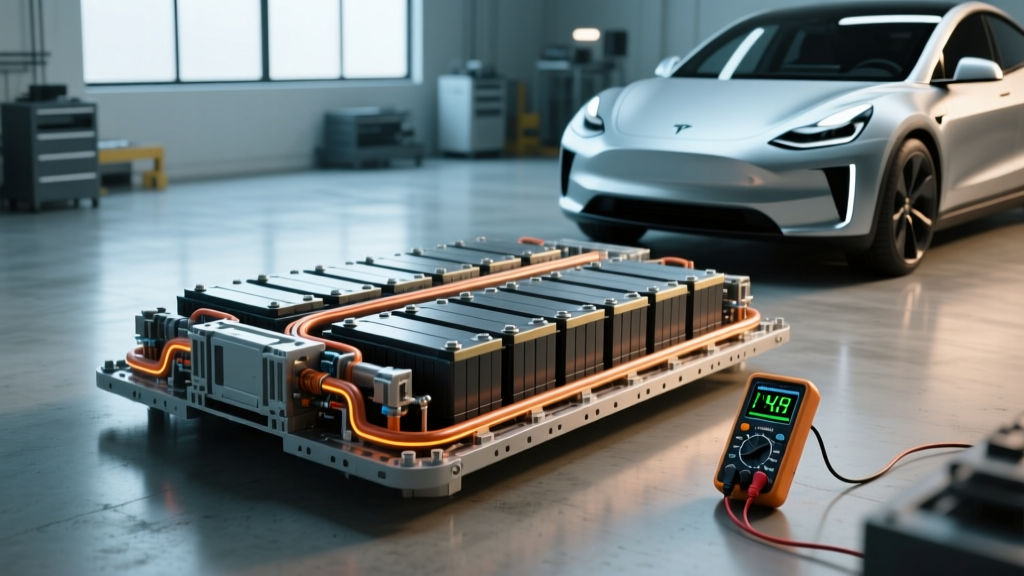
The short answer: far longer than most first-time EV buyers expect. The high-voltage traction battery in a modern EV is engineered to outlast the vehicle's economic life in most cases. But "last" needs definition — a battery doesn't suddenly die; it gradually loses capacity.
Based on aggregated fleet data from sources including Geotab's long-term EV battery health study and manufacturer-reported figures, here is what degradation looks like in practice:
Typical EV Battery Degradation Curve (Aggregated Fleet Data)
- Year 1 / ~15,000 miles: 1–3% capacity loss (initial formation loss, then stabilizes)
- Year 3 / ~45,000 miles: 4–7% total loss
- Year 5 / ~75,000 miles: 7–12% total loss
- Year 8 / ~120,000 miles: 10–17% total loss
- Year 10 / ~150,000 miles: 12–22% total loss (highly dependent on climate and charging habits)
Note: Vehicles with active liquid thermal management (Tesla, Hyundai E-GMP, GM Ultium, BMW) cluster on the lower end. Passive-cooled packs (older Nissan Leaf) degrade faster, especially in hot climates.
A 2026 Tesla Model 3 Long Range with an NMC pack rated at 82 kWh usable might retain roughly 70–75 kWh after 150,000 miles — enough to deliver around 280–290 miles of its original 341-mile EPA range. That's still very usable for daily driving, and it's why most EV batteries never need full replacement before the car is retired or totaled.
What the Battery Warranty Actually Covers
Federal law in the United States mandates that EV batteries carry a minimum warranty of 8 years or 100,000 miles (whichever comes first). In California Air Resources Board (CARB) states, that extends to 10 years or 150,000 miles. Most manufacturers meet or exceed these minimums, and the warranty typically guarantees that the battery will retain at least 70% of its original capacity over the warranty period.
| Manufacturer / Model | Warranty Period | Mileage Cap | Minimum Capacity Retention |
|---|---|---|---|
| Tesla Model 3 / Model Y (Long Range) | 8 years | 120,000 miles | 70% |
| Tesla Model 3 / Model Y (RWD — LFP) | 8 years | 100,000 miles | 70% |
| Hyundai Ioniq 5 / Kia EV6 | 10 years | 100,000 miles | 70% |
| Chevrolet Equinox EV / Blazer EV (Ultium) | 8 years | 100,000 miles | 70% (some trims 60% for commercial use) |
| Ford Mustang Mach-E / F-150 Lightning | 8 years | 100,000 miles | 70% |
| BMW i4 / iX | 8 years | 100,000 miles | 70% |
| Rivian R1T / R1S | 8 years | 175,000 miles | 70% |
Key warranty fine print: The warranty covers defects and excessive degradation — not damage from accidents, flooding, or unauthorized modifications. Some manufacturers prorate coverage after a certain point, while others offer full replacement. If your battery drops below the threshold (e.g., 70% capacity at year 6), the manufacturer will typically replace failed modules rather than the entire pack, restoring capacity above the guaranteed floor. Always check the specific warranty booklet for your model year, as terms can shift.
EV Battery Replacement Cost: What You'd Actually Pay
This is the question that generates the most anxiety, and the most misinformation. Here are the real-world numbers as of 2026, based on manufacturer service bulletins, third-party repair shop quotes, and Recurrent Auto industry analysis:
| Vehicle | Pack Size (Usable kWh) | Full Pack Replacement (Parts + Labor) | Module-Level Repair (if available) |
|---|---|---|---|
| Tesla Model 3 RWD (LFP) | ~57.5 kWh | $8,000–$12,000 | $2,000–$4,000 per module section |
| Tesla Model Y Long Range (NMC) | ~75 kWh | $12,000–$16,000 | $3,000–$5,000 per module section |
| Hyundai Ioniq 5 (NMC) | ~77.4 kWh | $11,000–$15,000 | $2,500–$4,500 per module |
| Ford F-150 Lightning Extended Range | ~131 kWh | $18,000–$25,000+ | Module repair emerging; limited availability |
| Chevrolet Silverado EV (Ultium, 200+ kWh) | ~200 kWh | $25,000–$35,000+ | Ultium's modular design allows individual module swap ($1,500–$3,000 ea.) |
| BMW iX xDrive50 | ~111.5 kWh | $16,000–$22,000 | $3,000–$5,500 per module |
When is replacement typically needed? In most cases, it isn't. Out-of-warranty full pack replacements remain rare. Data from Recurrent Auto and Geotab consistently shows that the vast majority of EV batteries retain 80%+ capacity at 100,000 miles and 70%+ at 150,000 miles. When failures do occur, they're more often isolated module or sensor faults — fixable for a fraction of a full-pack swap — than wholesale cell degradation. The modular architectures in GM's Ultium platform and Hyundai's E-GMP are specifically designed to make module-level repair practical and affordable.
What Kills a Battery Early: Factors That Accelerate Degradation
Not all miles are created equal when it comes to battery wear. The following factors have the most measurable impact on long-term State of Health (SoH):
Battery Longevity — Do's and Don'ts
- ✔ Do charge to 80% daily (for NMC/NCA). Sustained time at 100% SoC accelerates electrolyte oxidation and lithium plating. LFP is the exception — periodic 100% charges help the BMS calibrate.
- ✔ Do use Level 2 (home AC charging) as your primary method. Slow charging generates less heat and stress on cells.
- ✔ Do precondition the battery before DC fast charging in cold weather. Most EVs do this automatically when you navigate to a charger.
- ✔ Do keep SoC between 20% and 80% for daily driving when possible. The extremes (below 10%, above 90%) are where degradation accelerates.
- ✘ Don't DC fast-charge exclusively. Studies show packs that rely solely on DCFC degrade 2–5% more over 100,000 miles vs. those primarily using Level 2. Use fast charging for road trips, not daily top-ups.
- ✘ Don't store the vehicle at 100% SoC for extended periods. If leaving for a week or more, aim for ~50% SoC.
- ✘ Don't ignore extreme heat. Parking in direct sun in 100°F+ weather with a high SoC is the worst-case scenario for calendar aging. Garage parking or shade matters in hot climates.
- ✘ Don't let the battery sit at very low SoC (below 5%) for more than a day or two. This can cause copper dissolution in the anode current collector.
Thermal management is the single biggest differentiator between brands. Vehicles with active liquid cooling and heating — essentially every mainstream EV sold in the U.S. since 2020 — age far more gracefully than older passively cooled designs. If you're buying used and considering a pre-2018 Nissan Leaf or early Fiat 500e, factor in accelerated degradation, especially if you live in a hot climate.
How to Check and Monitor Your Battery's State of Health
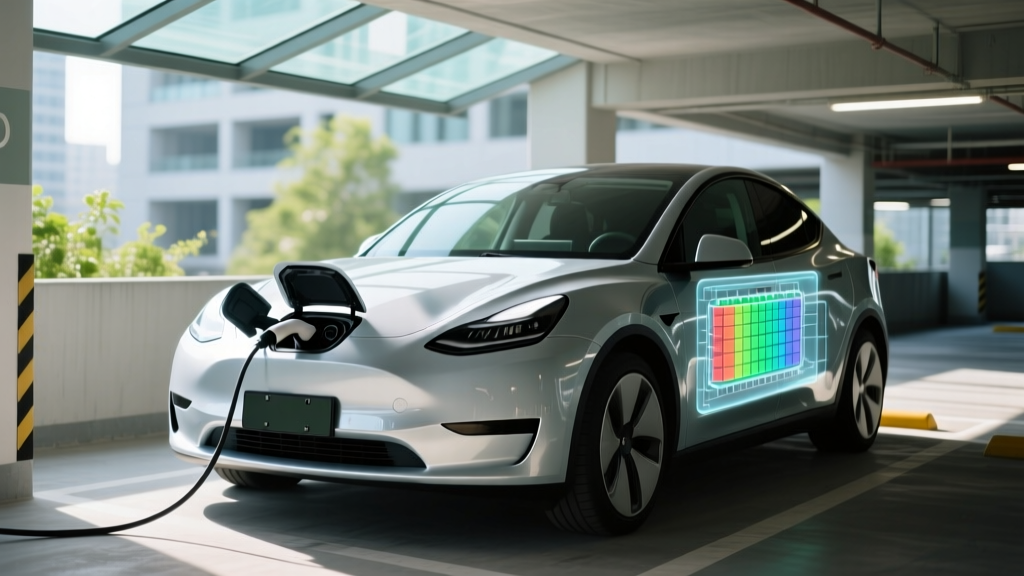
State of Health (SoH) is the metric that tells you what percentage of your battery's original capacity remains. A new EV starts at 100% SoH; at 70% SoH, your 300-mile EPA range has effectively become ~210 miles. Here's how to check it:
In-vehicle displays: Some manufacturers provide a battery health indicator directly in the infotainment system. Hyundai/Kia offers a battery health readout in the EV settings menu on E-GMP vehicles (Ioniq 5, EV6, Ioniq 6). Tesla does not natively display SoH as a percentage, but you can estimate it by comparing your current maximum rated range at 100% charge to the original EPA figure.
OBD-II diagnostic tools: Devices like the OBDLink SX or Carly adapter, paired with apps such as EVNotify, LeafSpy (for Nissan), or Scan My Tesla, can read the battery management system's internal SoH estimate. These readings are typically accurate within 1–2% and update as the BMS recalibrates.
Third-party services: Companies like Recurrent offer battery health reports that compare your pack's degradation against a fleet of identical vehicles. Some dealerships can also pull SoH data during service visits — request it explicitly, as it's not always included in standard diagnostics.
The manual method: Charge to 100%, note the displayed range, and divide by the original EPA range. This is imprecise (displayed range is an estimate, not a measurement), but it's a useful trend indicator if you log it monthly. A sudden drop of more than 2–3% in a single month warrants a service visit.
Looking Ahead: Solid-State, Silicon Anodes, and What's Realistic
Next-generation battery technologies are in active development, but timelines matter. Here's where things stand as of 2026:
Solid-state batteries replace the liquid electrolyte with a solid ceramic, polymer, or sulfide material. The theoretical benefits are significant: higher energy density (potentially 400–500 Wh/kg at the cell level), faster charging, and improved safety due to the elimination of flammable electrolyte. Toyota has announced solid-state-equipped vehicles for limited production around 2027–2028, and Samsung SDI is targeting 2027 for mass production. However, manufacturing yield, cost (currently 3–5x conventional lithium-ion), and cycle-life validation remain unresolved challenges. Expect solid-state to appear first in premium, low-volume applications before reaching mainstream price points — realistically not before 2030 for vehicles under $50,000.
Silicon anode technology is closer to market. Companies like Sila Nanotechnologies and Group14 Technologies are supplying silicon-dominant anode materials that boost energy density by 20–40% over conventional graphite anodes. Mercedes-Benz's EQG (G-Class EV) and certain Porsche applications are early adopters. This is an incremental improvement to existing lithium-ion architecture, not a wholesale replacement, and it's already shipping in limited 2025–2026 model-year vehicles.
Sodium-ion batteries are emerging as a low-cost alternative for shorter-range and stationary applications. CATL has begun mass production, and these cells use abundant sodium instead of lithium. Energy density is lower (~120–160 Wh/kg), making them better suited for city EVs and LFP-adjacent applications than long-range vehicles. Watch for them in budget EVs from Chinese manufacturers entering global markets by 2027–2028.
The practical takeaway: today's lithium-ion batteries (both LFP and NMC) are mature, well-understood, and backed by robust warranties. There is no compelling reason to delay an EV purchase waiting for solid-state — the batteries in 2026 vehicles will serve most owners well for 10–15 years and 150,000–200,000+ miles.
Frequently Asked Questions
How long do EV batteries last in years and miles?
Most modern EV batteries are designed to retain 70%+ of their original capacity after 8–10 years and 100,000–150,000 miles. Real-world fleet data from Geotab and Recurrent Auto shows median degradation of roughly 1.5–2% per year for liquid-cooled packs. Many EV batteries will outlast the vehicle's useful economic life without needing replacement.
How much does it cost to replace an EV battery?
Full pack replacement ranges from approximately $8,000 for a smaller pack (Tesla Model 3 RWD, ~57.5 kWh) to $25,000–$35,000 for large packs (F-150 Lightning Extended Range, Chevy Silverado EV). However, module-level repairs — available on platforms like GM Ultium and Hyundai E-GMP — can cost $1,500–$5,000 per module. Full replacements are rare; most degradation-related claims involve module swaps under warranty.
What does the EV battery warranty cover?
Federal minimum is 8 years/100,000 miles (10 years/150,000 miles in CARB states). The warranty guarantees the battery will retain at least 70% of its original capacity. It covers defects and abnormal degradation but excludes accident damage, flooding, and unauthorized modifications. Some manufacturers, like Hyundai, offer 10-year coverage even outside CARB states.
How do I check my EV battery health?
Use your vehicle's built-in battery health display (available on Hyundai/Kia E-GMP models), an OBD-II scanner with an EV-compatible app (EVNotify, Scan My Tesla, LeafSpy), or a third-party service like Recurrent. The simplest manual method is to charge to 100%, record the displayed range, and compare it to the original EPA range — log this monthly to track trends.
LFP vs NMC — which battery chemistry should I choose?
Choose LFP if you want maximum cycle life (3,000–5,000+ cycles), plan to keep the vehicle 10+ years, charge at home regularly, and don't need the longest single-charge range. LFP tolerates 100% daily charging. Choose NMC/NCA if you need 300+ miles of EPA range, live in a cold climate (better winter performance), or want a lighter pack. NMC requires an 80% daily charge limit for optimal longevity. Both chemistries are reliable; the right choice depends on your driving pattern and ownership timeline.
Does frequent DC fast charging damage the battery?
Exclusively relying on DC fast charging (DCFC) accelerates degradation by roughly 2–5% over 100,000 miles compared to primarily using Level 2 AC charging, according to studies from the Idaho National Laboratory and Geotab. Occasional fast charging on road trips is fine — the issue is daily, repeated high-power charging that keeps cells at elevated temperatures. If you have home Level 2 access, use DCFC for trips and stick to Level 2 for daily needs.
Can extreme temperatures permanently damage my EV battery?
Short-term exposure to extreme cold or heat causes temporary range loss, not permanent damage — the battery management system (BMS) protects against this. However, prolonged storage at high SoC in extreme heat (above 95°F) accelerates calendar aging. The worst scenario is a fully charged battery sitting in a hot parking lot for weeks. Active thermal management systems in modern EVs mitigate this significantly, but garage parking or shade still helps in hot climates.