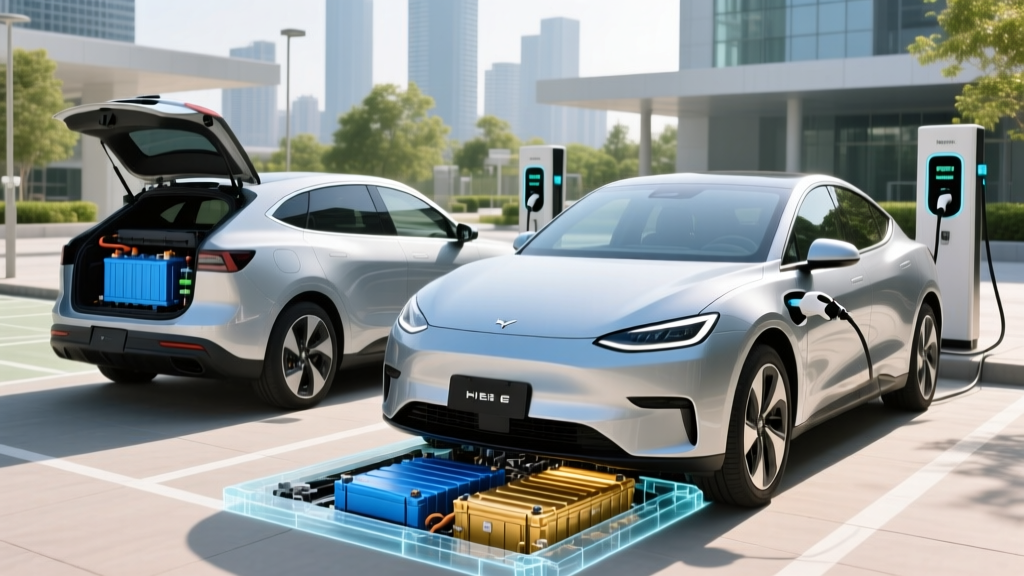
The high-voltage traction battery is the single most expensive component in any electric vehicle — and the one most shoppers worry about. Will it last? What happens when it degrades? How much does replacement cost? These are fair questions, and the answers are far more reassuring than the headlines suggest.
Based on fleet data, manufacturer warranty claims, and independent testing through 2025–2026, most modern EV batteries outlast the vehicles they power. But longevity isn't guaranteed — it depends on chemistry, charging habits, climate, and thermal management. This guide gives you the exact numbers.
EV Battery Chemistry: LFP vs NMC vs NCA
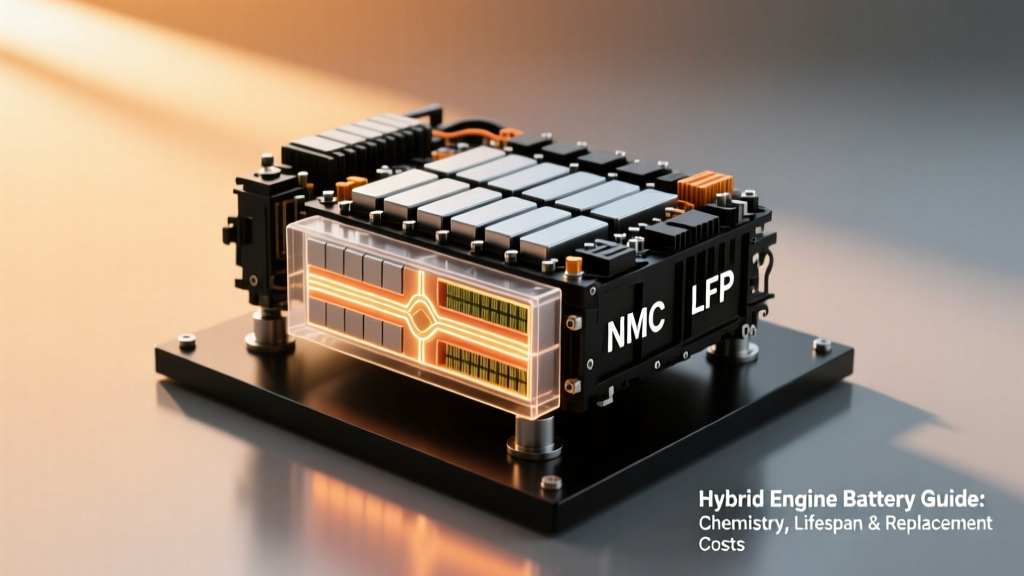
Not all lithium-ion packs are built the same. The cathode chemistry determines energy density, cycle life, cold-weather behavior, and cost. In 2026, two families dominate the US market:
- NMC (Nickel Manganese Cobalt) / NCA (Nickel Cobalt Aluminum): Higher energy density, better cold-weather performance, but more expensive and shorter cycle life. Used in most long-range models (Tesla Model 3 Long Range, Hyundai Ioniq 5, Ford Mustang Mach-E Extended Range).
- LFP (Lithium Iron Phosphate): Lower energy density and reduced range per kWh, but significantly longer cycle life, lower cost, and no cobalt. Increasingly used in standard-range models (Tesla Model 3 RWD, base Ford Mustang Mach-E, some BYD imports).
| Attribute | LFP | NMC / NCA |
|---|---|---|
| Energy Density | ~150–170 Wh/kg (lower) | ~220–270 Wh/kg (higher) |
| Typical Cycle Life | 3,000–5,000+ cycles | 1,000–2,000 cycles |
| Cold-Weather Performance | Moderate loss at 0°F; preconditioning critical | Better low-temp output |
| Cost per kWh | ~$90–$110 (2026 pack-level) | ~$120–$150 |
| Recommended Charge Ceiling | 100% daily OK | 80% daily; 100% for trips only |
| Cobalt / Ethical Sourcing | Cobalt-free | Contains cobalt (varies) |
| Common In 2026 Models | Tesla Model 3 RWD, base Mach-E, BYD | Model 3 LR, Ioniq 5, Rivian, most luxury EVs |
Which is better? For daily commuting and long-term ownership (10+ years), LFP is the durability winner — you can charge to 100% every night without accelerated wear. For maximum range and road-trip capability, NMC/NCA packs still lead. Neither is "bad"; they serve different use cases.
How Long Do EV Batteries Actually Last?
The short answer: 15–20 years or 200,000–300,000+ miles for most modern packs before they degrade below 70–80% of original capacity. That exceeds the median US vehicle lifespan of ~12 years (BTS data).
Real-world degradation data points from fleet studies and owner reporting through 2025:
Degradation Data Snapshot
- Tesla Model 3/Y (NMC, 2019–2022): ~5–7% loss at 100,000 miles; ~10–12% at 200,000 miles (Tesla Impact Report, Recurrent Auto fleet data).
- Chevrolet Bolt EV/EUV (NMC, 2017–2023): ~6–8% loss at 80,000 miles; some early 2017 units recalled for fire risk — replacement packs show <4% loss at 60k miles.
- Nissan LEAF (passive air cooling, 2011–2017): 15–25% loss by 80,000 miles — a cautionary tale on thermal management. 2018+ LEAF with active cooling performs far better (~8% at 80k).
- LFP-equipped Tesla Model 3 RWD (2022–2025): <3% reported loss at 60,000 miles (Recurrent Auto, 2025 fleet report).
Most degradation occurs in the first 1–2 years (the "break-in curve"), then slows to roughly 1–2% per year thereafter. A 2024 Tesla Model Y with 80 kWh usable that starts at 310 miles EPA range will likely still deliver ~270–280 miles at year 10.
Battery Warranty: What's Actually Covered
Federal law mandates a minimum 8 years / 100,000 miles warranty on EV battery packs (10 years / 150,000 miles in CARB states like California, New York, and Massachusetts). Most manufacturers exceed this baseline:
| Manufacturer | Warranty Term | Capacity Retention Threshold |
|---|---|---|
| Tesla (Model 3/Y) | 8 yr / 120,000 mi (LR); 8 yr / 100,000 mi (RWD) | 70% |
| Hyundai / Kia | 10 yr / 100,000 mi | 70% |
| Ford (Mach-E, F-150 Lightning) | 8 yr / 100,000 mi | 70% |
| General Motors (Ultium platform) | 8 yr / 100,000 mi | 70% |
| Rivian | 8 yr / 175,000 mi | 70% |
| BMW (iX, i4) | 8 yr / 100,000 mi | 70% |
| Volkswagen (ID.4) | 8 yr / 100,000 mi | 70% |
Key caveat: The warranty replaces or repairs the pack only if capacity drops below the threshold (typically 70%). A pack at 72% SoH at 95,000 miles is out of luck — it hasn't "failed" by the warranty's definition. This is why tracking State of Health matters.
EV Battery Replacement Cost: What Owners Actually Pay
If a pack does fail outside warranty — rare but possible — replacement is expensive. Costs vary enormously by pack size, chemistry, and labor:
| Model | Pack Size | Chemistry | Replacement Cost (Parts + Labor) |
|---|---|---|---|
| Chevrolet Bolt EV | 65 kWh | NMC | $14,000–$16,000 |
| Tesla Model 3 RWD | 60 kWh | LFP | $12,000–$14,500 |
| Tesla Model Y Long Range | 82 kWh | NMC | $16,000–$20,000 |
| Ford F-150 Lightning Ext. Range | 131 kWh | NMC | $20,000–$28,000 |
| Hyundai Ioniq 5 | 77.4 kWh | NMC | $14,000–$18,000 |
| Rivian R1T (Large Pack) | 135 kWh | NMC | $22,000–$30,000 |
| Nissan LEAF (40 kWh) | 40 kWh | NMC | $6,500–$9,000 |
When is replacement actually needed? Almost never during normal ownership. Most packs are retired with the car at 150,000–250,000 miles still holding 70–80% capacity. Full replacement is typically a last-resort option for high-mileage fleet vehicles or collision-damaged packs. Module-level repair (replacing individual failed modules rather than the whole pack) is increasingly available at independent EV shops for $3,000–$8,000.
Factors That Accelerate Battery Degradation
Lithium-ion cells degrade through chemical side reactions. You can't stop degradation, but you can slow it significantly:
Battery Care Checklist — Maximize Lifespan
- Avoid sustained 100% SoC (NMC/NCA): Charge to 80% daily; 100% only before road trips. LFP owners: 100% daily is fine — Tesla and Ford explicitly recommend it for cell balancing.
- Don't sit at low SoC: Storing an EV below 10% for weeks causes copper dissolution. Keep storage SoC at 40–60%.
- Minimize DC fast charging as a daily routine: Occasional Supercharging is fine; daily 150+ kW sessions accelerate wear. Level 2 home charging (7–11 kW) is gentler on cells.
- Precondition in cold weather: A cold battery charged at high power suffers lithium plating. Use scheduled departure preconditioning — it warms the pack before you plug in.
- Avoid extreme heat exposure: Park in shade or garages when possible. Sustained 100°F+ ambient temps without active cooling degrade NMC faster.
- Don't obsess over regen braking settings: Regen current is well within safe C-rates; it does not meaningfully harm the pack.
The single biggest longevity factor is thermal management. Liquid-cooled packs (Tesla, Hyundai E-GMP, GM Ultium, Ford, Rivian) degrade far slower than passively cooled packs (early Nissan LEAF, early Fiat 500e). When shopping used, prioritize liquid-cooled architectures.
How to Check Your Battery's State of Health (SoH)
State of Health (SoH) is the percentage of original capacity your pack can still hold. A new EV has 100% SoH; a pack at 85% SoH that originally held 80 kWh now holds ~68 kWh usable.
How to check SoH:
- In-vehicle displays: Tesla shows battery health in the service menu (or via the Tesla app in 2025+ updates). Hyundai/Kia includes SoH in the EV settings menu on 2023+ models. BMW iDrive shows it under "Vehicle Status → Battery."
- OBD-II diagnostics: Apps like Scan My Tesla, Leaf Spy (Nissan), or Car Scanner ELM OBD2 read the BMS (Battery Management System) directly via the OBD-II port. This gives the most accurate SoH reading.
- Third-party services: Companies like Recurrent Auto provide battery health reports based on telematics data — useful for used-EV buyers.
- Manual calculation: Fully charge to 100%, note the displayed range, and compare to the original EPA figure. If your 310-mile Model Y shows 265 miles at 100%, that's ~85% SoH (adjusting for known EPA-vs-real-world offsets).
When to worry: If SoH drops more than 3–4% in a single year after the initial break-in period, or if you notice sudden range cliffs (a sign of module imbalance), have the BMS evaluated by a qualified EV technician.
What's Next: Solid-State, Silicon Anode, and Beyond
Next-generation battery tech promises step-change improvements — but timelines remain fluid. Here's the realistic 2026 outlook:
- Silicon-dominant anodes: Already in limited production (GM Ultium uses silicon-carbon anode blends; Porsche/Group PowerCo testing). Increases energy density 10–20%. Available now in select models, scaling through 2028.
- Semi-solid-state: NIO (China) and Toyota (pilot production) are shipping or testing cells with solid electrolyte separators. Toyota targets limited 2027–2028 production. Range claims of 600+ miles (WLTP) — expect ~450 EPA if it reaches the US.
- Full solid-state: Toyota, Samsung SDI, and QuantumScape target 2028–2030 production. Promises 2x energy density, 10-minute fast charges, and no fire risk. Realistically, expect limited luxury-EV availability by 2030 at premium pricing.
- Sodium-ion: CATL shipping in Chinese-market EVs (BYD Seagull). Lower energy density but very cheap and cobalt-free. Unlikely in US-market long-range EVs before 2029; possible in budget city cars.
Bottom line: If you're buying in 2026, current NMC and LFP chemistries are mature, reliable, and well-understood. Waiting for solid-state means a 3–5 year delay with no guarantee of affordable pricing at launch.
Frequently Asked Questions
How long do EV batteries last in years and miles?
Modern liquid-cooled EV batteries typically last 15–20 years or 200,000–300,000+ miles before degrading below 70% of original capacity. LFP chemistry may extend this to 300,000–500,000 miles based on cycle-life data. Most packs are retired with the vehicle, not replaced.
How much does an EV battery cost to replace?
Out-of-warranty replacement ranges from ~$6,500 (Nissan LEAF 40 kWh) to $28,000+ (Ford F-150 Lightning 131 kWh or Rivian R1T Large Pack). Module-level repair is often possible for $3,000–$8,000. Full pack replacement during normal ownership is rare — most packs outlast the car.
What does the EV battery warranty cover?
Federal minimum is 8 years / 100,000 miles (10/150k in CARB states). Coverage triggers only if capacity drops below the stated threshold (typically 70% of original). Defects, module failures, and BMS malfunctions are covered. Gradual degradation above the threshold is not.
How do I check and maximize my battery's health?
Check SoH via in-vehicle menus, OBD-II apps (Scan My Tesla, Leaf Spy), or third-party services like Recurrent Auto. Maximize lifespan by charging NMC to 80% daily (100% OK for LFP), preconditioning in cold weather, minimizing daily DC fast charging, and avoiding storage at very low or very high SoC.
LFP vs NMC — which battery chemistry is better?
For daily commuting, long ownership horizons, and budget-conscious buyers, LFP wins on cycle life and cost — and you can charge to 100% without guilt. For maximum range, road-trip capability, and cold-weather performance, NMC/NCA still leads. Neither is inherently superior; the right choice depends on your driving pattern.
Does fast charging damage my EV battery?
Occasional DC fast charging (road trips, 1–2x per week) causes negligible extra wear on liquid-cooled packs. Daily 150+ kW fast charging without preconditioning does accelerate degradation modestly — studies suggest 1–3% additional loss over 100,000 miles vs. Level 2-only charging. For daily use, a home Level 2 charger at 7–11 kW is ideal.
Will my EV battery need to be replaced before I sell the car?
Statistically, no. Data from fueleconomy.gov and fleet operators shows the vast majority of EV batteries retain 80–90% SoH at typical trade-in mileage (80,000–120,000 miles). Used-EV buyers should verify SoH via OBD-II scan before purchase, but replacement anxiety is largely overblown for 2020+ models with active thermal management.