Buying or owning an electric vehicle means living with one large lithium-ion battery pack — and unlike a gas tank, its capacity shrinks over time. For EV shoppers and current owners, the central question isn't just "how far does it go?" but "how to know if a battery is good" after years of use. The answer depends on chemistry, driving habits, climate, and how you read the health metrics your car provides.
This guide breaks down the data behind EV battery longevity, from State of Health (SoH) readings to real-world degradation curves, so you can evaluate any pack — whether factory-new, certified pre-owned, or 80,000 miles deep into daily service.
EV Battery Chemistry: LFP vs NMC and Why It Matters for Longevity
Not all EV batteries are built the same. The two dominant cathode chemistries in 2026 passenger vehicles are lithium iron phosphate (LFP) and nickel manganese cobalt (NMC) or its variant NCA (nickel cobalt aluminum). The chemistry inside your pack dictates energy density, cycle life, cold-weather behavior, and ultimately how the battery ages.
LFP batteries (found in standard-range Tesla Model 3/Y, Ford Mustang Mach-E Select, Rivian Standard packs, and many Chinese-market EVs) use iron and phosphate — abundant, stable materials. They sacrifice some energy density for dramatically longer cycle life and higher thermal stability. Tesla recommends LFP owners charge to 100% regularly, which keeps the battery management system (BMS) calibrated and actually benefits cell balancing.
NMC/NCA batteries (used in most long-range and performance EVs, including the Hyundai Ioniq 5 Long Range, BMW iX, and Tesla Long Range/Performance trims) pack more energy into the same volume, giving greater range per kWh. But they degrade faster when held at high or low states of charge and are more sensitive to sustained heat.
| Attribute | LFP (Lithium Iron Phosphate) | NMC / NCA |
|---|---|---|
| Energy density | ~160–180 Wh/kg (lower) | ~220–260 Wh/kg (higher) |
| Typical cycle life | 3,000–5,000+ cycles to 80% SoH | 1,000–2,500 cycles to 80% SoH |
| Cold-weather performance | Greater range loss below 32°F; slower charge acceptance | Better low-temp conductivity; heat pump helps |
| Recommended daily SoC | 100% (aids BMS calibration) | 80% daily; 100% only for trips |
| Thermal stability | Excellent — less prone to thermal runaway | Good with active cooling; more sensitive |
| Cost per kWh (pack level) | ~$90–$110 | ~$120–$145 |
| Common applications | Standard-range trims, fleet vehicles | Long-range, performance, luxury EVs |
Which is better? If your priority is maximum range in a single charge and you live in a cold climate, NMC is the stronger pick. If you want a battery that will likely outlast the vehicle itself and you mostly drive daily commutes under 200 miles, LFP offers superior longevity at a lower cost. Neither chemistry is universally "better" — the right choice depends on your driving profile.
How Long Do EV Batteries Actually Last?
The short answer: far longer than most buyers expect. Data aggregated from fleet operators, manufacturer warranty claims, and independent testing groups like Recurrent Auto shows that the median modern EV battery retains 90–95% of its original capacity after 5 years / 75,000 miles. Catastrophic failure (a pack that bricks or drops below 70% capacity) is rare — affecting well under 2% of vehicles in large sample sets.
Here's what the degradation curve typically looks like:
- Year 1 / 15,000 mi: ~3–5% capacity loss (initial "break-in" drop)
- Year 3 / 45,000 mi: ~7–9% loss total
- Year 5 / 75,000 mi: ~9–12% loss total
- Year 8 / 120,000 mi: ~12–17% loss total
- Year 10 / 150,000 mi: ~15–22% loss total (varies widely by climate and charging habits)
LFP packs tend to show slower degradation, with many fleet samples retaining 92–96% after 5 years.
The degradation curve is not linear. Most capacity loss occurs in the first 12–18 months as the solid electrolyte interphase (SEI) layer stabilizes on the anode. After that, loss slows to roughly 1–2% per year under normal use. A 2026 Hyundai Ioniq 5 Long Range with its 77.4 kWh NMC pack, for example, will likely still deliver ~250 miles of real-world range (from an EPA-rated 305 miles) at the 100,000-mile mark.
How to Check Your EV Battery Health (State of Health Explained)
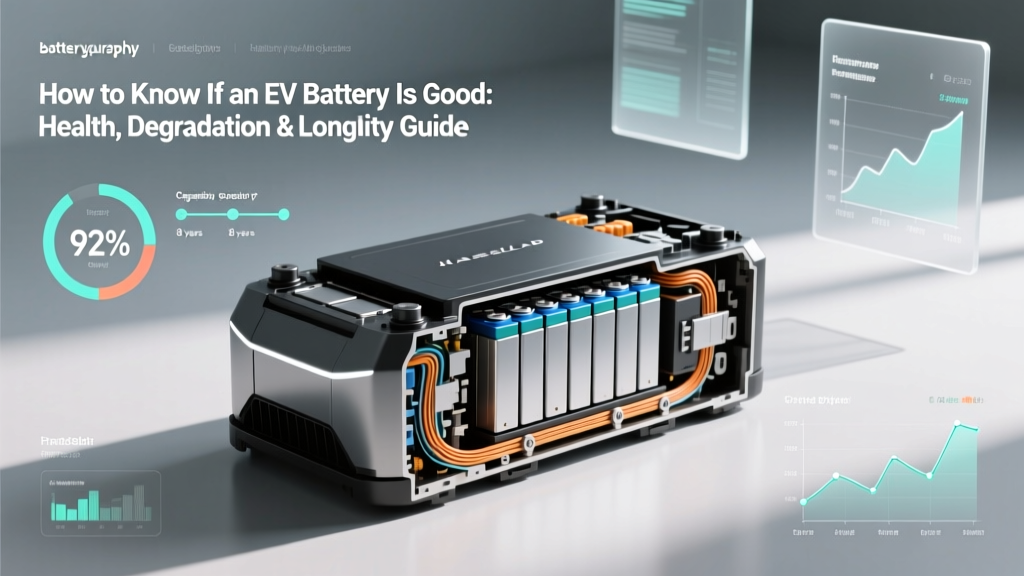
State of Health (SoH) is the percentage of a battery's current maximum capacity compared to its original factory capacity. A brand-new pack reads 100% SoH. A pack that held 77.4 kWh when new but now holds 70 kWh sits at roughly 90.4% SoH.
Here's how to check it on popular 2026 EVs:
- Tesla (Model 3/Y/S/X): The in-car Service menu (introduced in 2023 software updates) displays a battery health test result. You can also run a manual test by charging to 100% and noting the displayed range vs. the EPA sticker. Third-party apps like Tessie or TeslaFi log SoH over time from BMS data.
- Hyundai/Kia (Ioniq 5/6, EV6/EV9): The EV-specific settings menu shows battery health as a percentage. Hyundai dealers can pull a detailed diagnostic with cell-level voltage variance.
- Ford (Mach-E, F-150 Lightning): FordPass displays estimated battery health. For a precise reading, a dealer OBD-II scan reveals individual module capacity.
- BMW (iX, i4, i7): The iDrive system shows SoH under the charging settings. BMW's diagnostic tool (ISTA) gives a granular breakdown.
- Universal method: An OBD-II dongle paired with apps like ABRP (A Better Routeplanner), Car Scanner, or LeafSpy (Nissan Leaf) can read BMS data on most EVs, including individual cell voltages and pack SoH.
What SoH number should concern you? A reading below 80% on a vehicle with under 100,000 miles is a red flag — and likely triggers a warranty replacement. Above 85% at 80,000 miles is typical and healthy. Between 80–85% at 100,000+ miles is normal aging.
What Does the EV Battery Warranty Actually Cover?
Federal law mandates that EV battery warranties last a minimum of 8 years or 100,000 miles (whichever comes first). In California Air Resources Board (CARB) states — which include California, New York, Massachusetts, Oregon, Washington, and several others — that minimum extends to 10 years or 150,000 miles.
But the critical detail is the capacity retention threshold: the SoH percentage below which the manufacturer must repair or replace the pack. Most brands set this at 70%, though some are more generous.
| Manufacturer | Warranty Period | Mileage Cap | Capacity Threshold | CARB-State Extension |
|---|---|---|---|---|
| Tesla (Model 3/Y — LFP) | 8 years | 100,000 mi | 70% | Yes (10 yr / 150k mi) |
| Tesla (Model S/X) | 8 years | 150,000 mi | 70% | Yes (10 yr / 150k mi) |
| Hyundai / Kia | 8 years | 100,000 mi | 70% | Yes (10 yr / 150k mi) |
| Ford | 8 years | 100,000 mi | 70% | Yes (10 yr / 150k mi) |
| BMW | 8 years | 100,000 mi | 70% | Yes (10 yr / 150k mi) |
| GM (Chevrolet, Cadillac) | 8 years | 100,000 mi | 60% (some models 70%) | Yes (10 yr / 150k mi) |
| Rivian | 8 years | 175,000 mi | 70% | Yes (10 yr / 150k mi) |
| Volkswagen (ID.4) | 8 years | 100,000 mi | 70% | Yes (10 yr / 150k mi) |
What's covered: Capacity loss below the threshold, defective modules, BMS failures, and thermal management system defects that cause battery damage. What's not covered: Cosmetic damage, capacity loss from abuse (e.g., leaving the car at 0% SoC for months), or damage from accidents, flooding, or unauthorized modifications.
Warranty replacements don't always mean a brand-new pack. Manufacturers may install a refurbished or remanufactured pack that meets the capacity threshold — which is standard industry practice and functionally equivalent.
How Much Does an EV Battery Replacement Cost?
Out-of-warranty battery replacement is the scenario that generates the most anxiety — and the most misleading headlines. Here are the real numbers for 2026:
| Vehicle | Battery Size (kWh) | Chemistry | Replacement Cost Range |
|---|---|---|---|
| Tesla Model 3 Standard Range | 60 kWh | LFP | $8,000 – $12,000 |
| Tesla Model Y Long Range | 75 kWh | NMC | $12,000 – $16,000 |
| Hyundai Ioniq 5 Long Range | 77.4 kWh | NMC | $11,000 – $15,000 |
| Ford F-150 Lightning Extended Range | 131 kWh | NMC | $18,000 – $28,000 |
| Chevrolet Equinox EV | 85 kWh | NMC | $12,000 – $17,000 |
| BMW iX xDrive50 | 105.2 kWh (usable) | NMC | $16,000 – $22,000 |
| Nissan Leaf (40 kWh pack) | 40 kWh | NMC | $6,500 – $9,000 |
| Rivian R1T Large Pack | 135 kWh | NMC | $20,000 – $30,000 |
These figures include parts and labor at a dealership or certified EV service center. Independent EV shops may offer lower pricing, especially for module-level repairs (replacing only degraded modules rather than the entire pack), which can cut costs by 40–60%.
When is replacement actually needed? The vast majority of EV owners will never need a battery replacement. Data from Consumer Reports and warranty claim statistics indicate that fewer than 1.5% of EVs require a pack swap during the warranty period. Most packs retain 75–85% capacity at 150,000 miles — still functional for daily driving, just with reduced range. The more realistic concern is selling a high-mile EV at a depreciation discount reflecting its lower SoH, not writing a five-figure check for a new pack.
Factors That Accelerate (or Slow) Battery Degradation
Your driving and charging habits measurably impact how quickly your pack loses capacity. Here are the primary factors, ranked by impact:
- Limit DC fast charging to road trips. Daily use of 150+ kW chargers generates sustained heat that accelerates SEI growth and lithium plating. Weekly or occasional fast charging has negligible impact.
- Avoid extreme SoC for long periods. For NMC packs, don't store the car above 80% or below 20% for more than a few days. LFP is more tolerant of 100% SoC.
- Use scheduled charging. Set your car to finish charging to 80% right before you leave — this minimizes time spent at high SoC.
- Precondition before fast charging. Most EVs do this automatically when you navigate to a charger. A warm battery (65–95°F internal temp) charges faster and with less stress.
- Park in shade or a garage in hot climates. Sustained ambient temperatures above 95°F with a high SoC is one of the worst combinations for NMC chemistry.
- Don't baby it too much. Driving the car regularly (even short trips) keeps the BMS active and cell balancing functional. A parked EV at low SoC for months causes more harm than daily use.
- Use Level 2 home charging as your primary method. 7–11 kW charging generates minimal heat and is the gentlest way to replenish the pack.
A 2024 study by the Idaho National Laboratory found that vehicles that relied exclusively on DC fast charging showed approximately 0.3–0.5% additional capacity loss per year compared to vehicles that primarily used Level 2 charging. That's meaningful over a decade but not catastrophic — it underscores that fast charging is a tool, not a daily necessity.
Emerging Battery Tech: What's Coming and When
Several next-generation battery technologies are in development, though none are available in production passenger vehicles as of 2026:
Solid-state batteries replace the liquid electrolyte with a solid ceramic, polymer, or sulfide material. This promises higher energy density (potentially 400+ Wh/kg at the cell level), faster charging, and improved safety. Toyota has announced limited solid-state production for 2027–2028, initially in small volumes for premium models. Samsung SDI and QuantumScape are targeting similar timelines. Expect solid-state to reach mainstream, affordable EVs no earlier than 2030–2032.
Silicon-dominant anodes (replacing graphite) can increase energy density by 20–40%. Companies like Sila Nanotechnologies and Group14 are supplying early silicon-anode materials to manufacturers, and some premium models in 2026 use partial silicon blends. Full silicon anodes with acceptable cycle life remain in development.
Sodium-ion batteries use abundant sodium instead of lithium, offering lower cost and excellent cold-weather performance at the expense of energy density. CATL has begun production for Chinese-market vehicles, but US-market adoption for passenger cars is not expected before 2028–2029.
For buyers today, these technologies are forward-looking context, not purchase factors. Current LFP and NMC packs are mature, well-understood, and backed by extensive warranty coverage. Waiting for solid-state means waiting at least 4–6 years for meaningful market availability.
Frequently Asked Questions
How long do EV batteries last in years and miles?
Most modern EV batteries (2021 and newer) retain 75–85% of their original capacity at 150,000 miles or 10 years. LFP chemistry packs often exceed this. Catastrophic failure is rare — under 2% of vehicles in large fleet studies. Many packs will outlast the vehicle's body and interior.
How much does it cost to replace an EV battery?
Out-of-warranty replacement ranges from roughly $6,500 for a small pack (Nissan Leaf 40 kWh) to $28,000+ for large packs (Ford F-150 Lightning Extended Range 131 kWh). Most owners never need a replacement — fewer than 1.5% of vehicles require a warranty swap. Module-level repairs at independent shops can cut costs significantly.
What does the EV battery warranty cover?
Federally mandated minimum coverage is 8 years / 100,000 miles (10 years / 150,000 miles in CARB states). The warranty covers capacity loss below a threshold (typically 70% SoH), defective modules, and BMS failures. It does not cover damage from accidents, abuse, or long-term storage at 0% SoC.
How do I check my EV battery health?
Most modern EVs display State of Health (SoH) in the vehicle's settings menu or companion app. You can also use an OBD-II dongle with apps like Tessie, Car Scanner, or ABRP to read BMS data. For the most precise reading, a dealer diagnostic scan shows individual cell voltages and module-level health.
LFP vs NMC — which battery chemistry is better for longevity?
LFP batteries offer significantly longer cycle life (3,000–5,000+ cycles vs. 1,000–2,500 for NMC) and tolerate 100% daily charging. NMC provides higher energy density (more range per kWh) and better cold-weather performance. For maximum battery lifespan, LFP is the clear winner. For maximum range in a given vehicle size, NMC is preferable.
Does fast charging damage my EV battery?
Occasional DC fast charging (road trips, a few times per month) has minimal impact on battery health. Daily exclusive fast charging adds approximately 0.3–0.5% extra capacity loss per year. The bigger risk is sustained heat — preconditioning your battery before fast charging and avoiding back-to-back fast charges in hot weather mitigates most of the degradation.
Should I buy an extended battery warranty?
For most buyers, no. The federally mandated 8-year / 100,000-mile warranty already covers the period when catastrophic failure is most likely (manufacturing defects typically appear early). Extended warranties may make sense for high-mileage drivers planning to keep a vehicle past 120,000 miles, but compare the premium cost against the statistical likelihood of a claim.
Knowing whether an EV battery is good comes down to reading the data: check SoH regularly, understand your pack's chemistry, follow moderate charging habits, and trust the warranty as your safety net. The evidence from millions of EVs on the road is clear — modern battery packs are far more durable than early EV skeptics predicted, and with basic care, they'll serve you well for the life of the vehicle.