What a "Battery Farm" Actually Means in the EV Supply Chain
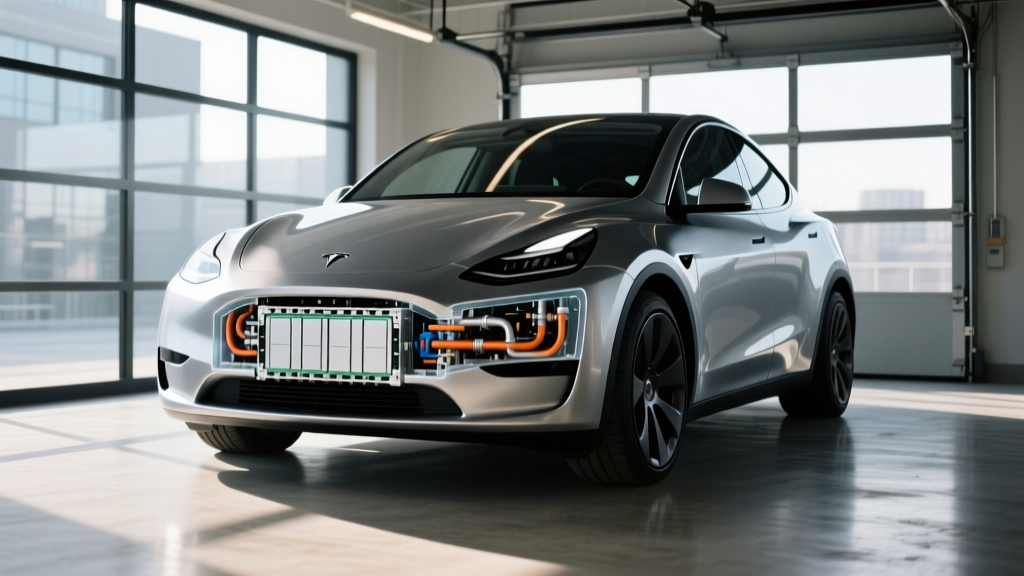
When industry insiders say battery farm, they are usually referring to one of two things: the massive gigafactory campuses where lithium-ion cells are manufactured at scale (think CATL's Fujian complex or Tesla's Gigafactory Nevada), or the utility-scale battery energy storage systems (BESS) that buffer grid power for EV charging stations. Either way, the cells that end up in your EV begin their life in an industrial environment optimized for throughput, consistency, and chemistry control — long before they are grouped into modules, packs, and ultimately a vehicle skateboard.
For EV buyers and owners, understanding this upstream origin matters because it directly shapes the three questions that dominate ownership forums: how long will my battery last, what will it cost to replace, and which chemistry should I choose? This guide walks through each of those questions with hard data, current warranty terms, and real-world context you can use at the dealership or in your garage.
LFP vs NMC vs NCA: The Chemistry Decision That Follows You for a Decade
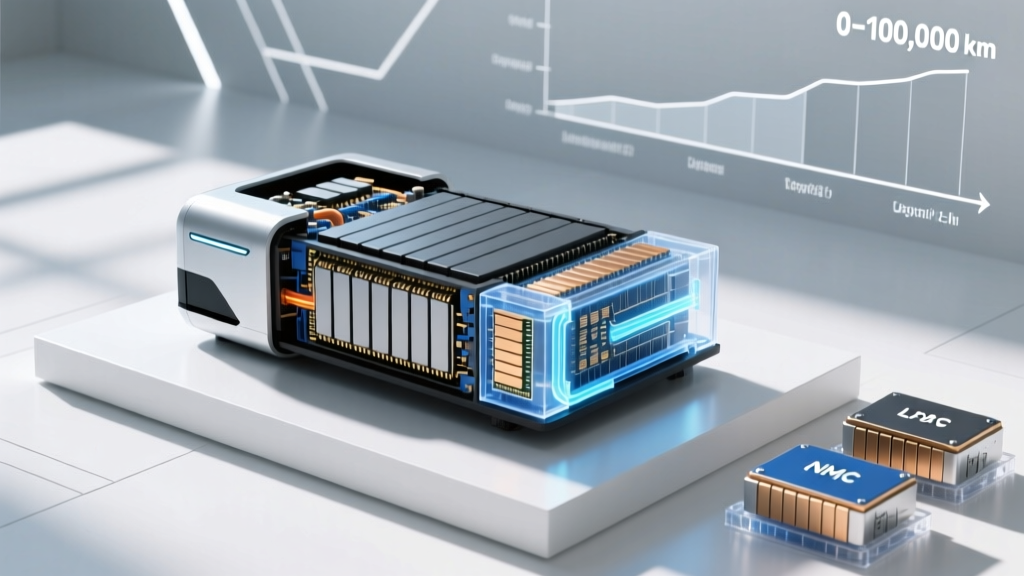
Every EV sold in the U.S. today uses one of three dominant cathode chemistries: lithium iron phosphate (LFP), nickel manganese cobalt (NMC), or nickel cobalt aluminum (NCA). The choice is baked into the cells that roll off the battery farm floor, and it affects range, longevity, cold-weather behavior, and price.
| Attribute | LFP (LiFePO₄) | NMC (Ni-Mn-Co) | NCA (Ni-Co-Al) |
|---|---|---|---|
| Energy Density (cell-level) | ~160–180 Wh/kg | ~220–260 Wh/kg | ~250–270 Wh/kg |
| Typical Cycle Life | 3,000–5,000+ cycles | 1,500–2,500 cycles | 1,200–2,000 cycles |
| Cold Performance (0 °C range retention) | ~70–78% | ~80–88% | ~82–90% |
| Thermal Stability | Excellent (higher runaway threshold) | Good | Good (requires robust BMS) |
| Cost per kWh (cell) | ~$70–90 | ~$100–130 | ~$110–140 |
| Recommended Daily Charge Limit | 100% SoC acceptable | 80% SoC for daily use | 80% SoC for daily use |
| Notable U.S. Applications (2026 MY) | Tesla Model 3 RWD, Model Y RWD, Ford Mustang Mach-E Select (LFP option) | Hyundai Ioniq 5, Kia EV6, Chevy Equinox EV, most long-range trims | Tesla Model S/X, Rivian R1T/R1S (large pack) |
The practical takeaway: If your commute is under 80 miles round-trip and you live in a moderate climate, LFP's lower energy density is irrelevant — you gain a battery that tolerates daily 100% charging, lasts more cycles, and costs less. If you need maximum highway range or frequently drive in sub-freezing weather, NMC/NCA still delivers the edge.
How Long Do EV Batteries Actually Last? Degradation Data by the Numbers
The fear that an EV battery will "die" at 100,000 miles is not supported by fleet data. Most modern packs lose capacity gradually, and the vast majority of vehicles reach end-of-life (due to collision, rust, or economic obsolescence) with the original battery still functional.
Typical Degradation Curve (NMC packs, aggregated fleet data):
- Year 1 / ~15,000 mi: 2–4% capacity loss (initial SEI layer formation — steepest part of the curve)
- Year 3 / ~45,000 mi: 5–7% cumulative loss
- Year 5 / ~75,000 mi: 7–10% cumulative loss
- Year 8 / ~120,000 mi: 10–14% cumulative loss
- Year 10+ / 150,000+ mi: 12–18% cumulative loss (highly variable based on usage)
Sources: Geotab fleet telemetry (6,300+ EVs), Recurrent Auto battery health data, Tesla Impact Reports. LFP packs tend to show 1–3% less loss at equivalent milestones due to superior cycle life.
Real-world example: A 2022 Tesla Model 3 Long Range (82 kWh NMC pack, EPA 358 mi) showing 10% degradation at 75,000 miles would retain roughly 322 miles of EPA-equivalent range — still more than adequate for most drivers. According to fueleconomy.gov, the average American drives ~14,000 miles per year, meaning most owners will not reach 150,000 miles in a decade of ownership.
What the Battery Warranty Actually Covers (and What It Doesn't)
Federal law effectively mandates an 8-year / 100,000-mile minimum warranty on EV battery packs for emissions-related compliance, and most manufacturers meet or exceed this baseline. The key detail is the capacity retention threshold — the point at which the manufacturer considers the pack "defective" and will repair or replace it.
| Manufacturer | Duration | Mileage | Capacity Threshold | Notes |
|---|---|---|---|---|
| Tesla (Model 3/Y) | 8 years | 100,000–120,000 mi (varies by trim) | 70% retention | Long Range/Performance: 120k mi |
| Hyundai / Kia | 10 years | 100,000 mi | 70% retention | Among the longest in the industry |
| Ford (Mach-E, F-150 Lightning) | 8 years | 100,000 mi | 70% retention | Module-level repair where possible |
| GM (Ultium platform) | 8 years | 100,000 mi | 70% retention | Covers Bolt EUV, Equinox EV, Blazer EV, Silverado EV |
| Rivian | 8 years | 175,000 mi | 70% retention | Higher mileage cap reflects truck use case |
| BMW (iX, i4) | 8 years | 100,000 mi | 70% retention | Includes thermal management system |
Critical nuance: The warranty covers defects and abnormal degradation — not gradual, expected capacity loss above the threshold. If your pack retains 72% of its original capacity at year 8, you have a functional battery that simply holds less energy, not a warranty claim. Also excluded: damage from collisions, flooding, unauthorized modifications, or using the pack as a stationary storage unit (V2G setups may void coverage — check your terms).
EV Battery Replacement Cost: What It Really Costs and When You'd Need It
Out-of-warranty battery replacement is the single largest potential expense in EV ownership, but the context matters enormously. Most EVs will never need a full pack replacement during their useful life. When they do, it is typically due to a manufacturing defect caught under warranty, physical damage from a collision or ground strike, or — in rare cases — extreme degradation from abuse (repeated 100% SoC fast-charging in desert heat, for example).
| Vehicle / Pack Size | Battery Capacity | Estimated Replacement Cost (Parts + Labor) |
|---|---|---|
| Tesla Model 3 RWD (LFP) | ~60 kWh | $12,000–$16,000 |
| Tesla Model Y Long Range (NMC) | ~82 kWh | $16,000–$22,000 |
| Hyundai Ioniq 5 (NMC) | 77.4 kWh | $14,000–$19,000 |
| Ford F-150 Lightning Extended Range | ~131 kWh | $22,000–$32,000 |
| Chevy Equinox EV (Ultium) | ~85 kWh | $14,000–$18,000 |
| Rivian R1T Large Pack | ~149 kWh | $25,000–$35,000 |
| BMW iX xDrive50 | ~111.5 kWh | $20,000–$28,000 |
Costs are trending downward. Cell prices fell below $100/kWh at the pack level for LFP in 2025, and continued manufacturing scale from battery farm output is pushing NMC costs lower as well. Additionally, a growing number of independent EV repair shops now offer module-level replacement — swapping only the degraded or faulty modules within a pack rather than the entire assembly — for $3,000–$8,000 depending on the vehicle. This option is not yet available for all models but is expanding.
Five Factors That Accelerate (or Preserve) Battery Health
Degradation is not purely a function of time. Your habits have measurable impact on how quickly capacity fades. Based on fleet telemetry data from Geotab and Recurrent Auto, these are the variables that matter most:
Battery Care Checklist for Maximum Longevity:
- Avoid sustained high SoC (NMC/NCA only): Set daily charge limit to 80%. Reserve 100% for road trips. LFP owners: 100% daily is fine — in fact, periodic 100% charges help the BMS recalibrate cell balancing.
- Minimize DC fast charging frequency: Occasional fast charging is fine; daily 150+ kW sessions accelerate calendar aging. Data shows vehicles that fast-charge more than 3x/week degrade ~1–2% more over 5 years than those primarily using Level 2.
- Precondition before fast charging: Use your car's navigation-routed preconditioning (Tesla, Hyundai/Kia, GM Ultium all support this) to bring the battery to ~30–35 °C before arriving at a DC charger. This reduces lithium plating risk and improves charge speed.
- Avoid prolonged storage at extremes: If leaving the car for 2+ weeks, aim for ~50% SoC. Do not store at 100% in summer heat or below 10% in winter cold.
- Use the heat pump and cabin preconditioning: In cold weather, preconditioning while plugged in draws grid power instead of battery energy, preserving range and reducing the depth-of-discharge cycles that contribute to wear.
How to Check Your Battery's State of Health (SoH)
State of Health (SoH) is the percentage of original capacity your pack currently retains. A new battery is 100% SoH; one that has degraded to hold 88 kWh out of its original 100 kWh is at 88% SoH. Monitoring this metric is the single best way to track your battery's trajectory and detect abnormal degradation early.
Manufacturer Built-In Tools
Most modern EVs expose SoH data through the infotainment system or companion app, though the level of detail varies:
- Tesla: No native SoH percentage in the UI, but the service menu (accessible via a long-press on the model badge in the software screen) shows rated range at 100% — compare this to the original EPA figure to estimate SoH. Third-party tools like Tessie or Teslamate log detailed battery data via the vehicle API.
- Hyundai/Kia: The EV menu in the infotainment system shows battery health as a percentage. The Kia Connect / Hyundai Bluelink app also surfaces this data.
- GM (Ultium): The myChevrolet / myCadillac app includes a battery health indicator. On the Bolt EV/EUV (pre-Ultium), the hidden "Battery Info" screen in the diagnostic menu shows SoH directly.
- Ford: The FordPass app provides a battery state-of-health readout for Mach-E and F-150 Lightning owners.
- BMW: The iDrive system and My BMW app include battery health status under the vehicle details section.
Third-Party and OBD-II Options
For deeper telemetry, an OBD-II dongle paired with apps like Car Scanner EV, Leaf Spy (Nissan Leaf), or OBDeleven (VW/Audi) can read cell-level voltage data, internal resistance, and precise SoH. These tools are invaluable when evaluating a used EV — a 5-minute OBD-II scan reveals more about battery condition than any test drive.
What's Next: Solid-State, Silicon Anodes, and Realistic Timelines
Emerging battery technologies promise step-change improvements in energy density, charge speed, and safety. However, none are currently available in production vehicles sold in the U.S., and timelines remain fluid:
- Solid-state batteries: Toyota has announced pilot production for 2027–2028 with a target of 750 km (~466 mi) range and 10-minute fast charging. Samsung SDI and QuantumScape are also pursuing solid-state cells. Realistic U.S. availability in volume production: 2029–2031 at the earliest. These are announced/preliminary targets, not shipping products.
- Silicon-dominant anodes: Companies like Sila Nanotechnologies and Group14 are replacing graphite anodes with silicon composites, boosting energy density by 20–40%. Early applications are appearing in niche vehicles (Mercedes G-Class electric prototype) and consumer electronics. Broader EV adoption: 2027–2029.
- Sodium-ion batteries: CATL has begun shipping sodium-ion cells in Chinese-market EVs (Chery). Lower energy density than LFP but cheaper and free of lithium/cobalt. U.S. market relevance: possible for budget/urban EVs by 2028+.
For buyers shopping today, these technologies are context, not a reason to delay a purchase. Current LFP and NMC chemistries are mature, well-understood, and backed by comprehensive warranties. The cells coming off today's battery farms are the best the industry has ever produced in terms of consistency and longevity.
Frequently Asked Questions
How long do EV batteries last in years and miles?
Most modern EV battery packs are designed to last 15–20 years or 200,000+ miles before degrading below 70% of original capacity. Fleet data from Recurrent Auto shows that the average EV battery loses roughly 8–12% capacity over the first 8 years of typical use. Many packs outlive the vehicle they are installed in.
How much does it cost to replace an EV battery?
Full pack replacement costs range from approximately $12,000 for smaller LFP packs (e.g., Tesla Model 3 RWD) to $35,000 for large truck packs (e.g., Rivian R1T). However, most replacements are covered under the 8–10 year / 100,000–175,000 mile warranty. Module-level repairs at independent shops can cost $3,000–$8,000 and are becoming more widely available.
What does the EV battery warranty cover?
Standard battery warranties cover defects in materials/workmanship and abnormal degradation below a specified threshold (typically 70% capacity retention) for 8–10 years and 100,000–175,000 miles, depending on the manufacturer. They do not cover damage from accidents, flooding, unauthorized modifications, or normal gradual capacity loss above the threshold.
How do I check and maximize my EV battery health?
Check SoH through your vehicle's infotainment system, companion app, or an OBD-II scanner with EV-specific software. To maximize longevity: charge NMC/NCA to 80% daily (100% for LFP), minimize frequent DC fast charging, precondition before fast charging, avoid prolonged storage at extreme SoC levels, and use cabin preconditioning while plugged in during cold weather.
LFP vs NMC — which battery chemistry is better?
Neither is universally "better" — they serve different use cases. LFP offers longer cycle life (3,000–5,000+ cycles), lower cost (~$70–90/kWh), better thermal stability, and tolerance for daily 100% charging, but with ~20–30% lower energy density and slightly worse cold-weather performance. NMC delivers higher range per kWh and better cold-weather efficiency, making it preferable for long-range trims and cold climates. For most daily commuters, LFP is the pragmatic choice; for road-trippers and cold-weather drivers, NMC remains the stronger option.
Does fast charging damage my EV battery?
Occasional DC fast charging causes negligible additional degradation. However, fleet data shows that vehicles fast-charging more than 3 times per week experience roughly 1–2% more capacity loss over 5 years compared to vehicles primarily using Level 2 home charging. Preconditioning the battery before fast charging significantly mitigates this effect by reducing lithium plating risk at the anode.
Battery health and warranty data referenced from manufacturer specifications, fueleconomy.gov, Geotab fleet analytics, and Recurrent Auto research. Tax credit eligibility for EV purchases is governed by IRS §30D rules including MSRP caps, buyer income limits, and battery component/critical mineral sourcing requirements — consult irs.gov or a tax professional for your specific situation.