If you've searched for "expenation battery" or "EV battery expiration," you're likely wondering whether electric vehicle batteries have a hard expiration date — a point where they simply stop working. The short answer: no. EV traction batteries don't expire like a carton of milk. They gradually lose capacity over time and miles, a process called degradation. The practical question is how much capacity you'll retain after 8, 10, or 15 years, and what it costs if a replacement is eventually needed.
This guide covers the chemistry, the data, the warranties, and the real-world ownership math so you can evaluate battery longevity with numbers, not fear.
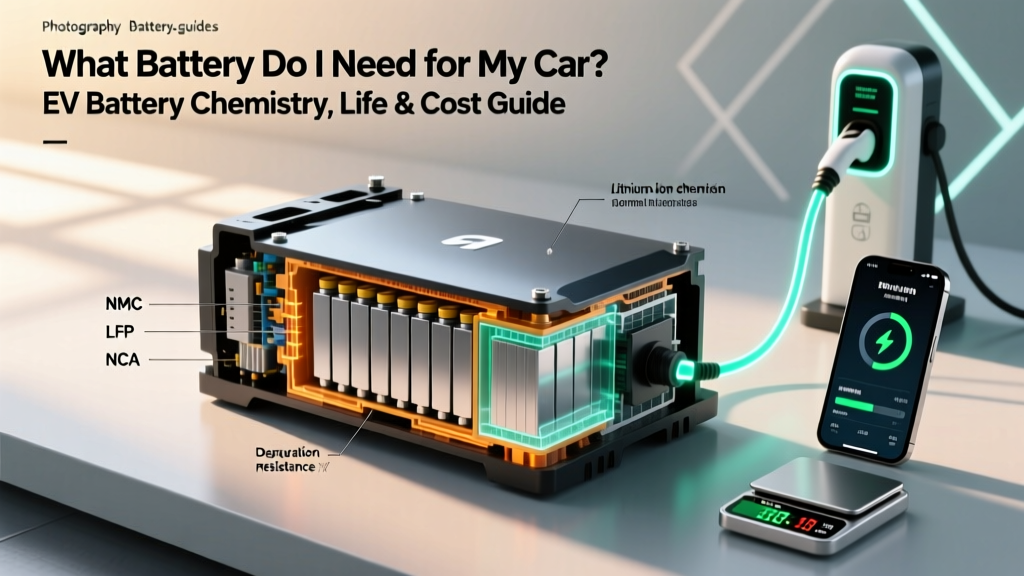
LFP vs NMC vs NCA: Which Battery Chemistry Is in Your EV?
Not all EV batteries are the same. The cathode chemistry determines energy density, cycle life, cold-weather behavior, and cost. As of 2026, three chemistries dominate the US market:
- NMC (Nickel Manganese Cobalt) — Found in most long-range EVs (Hyundai Ioniq 5, Ford Mustang Mach-E Extended Range, VW ID.4). High energy density, moderate cycle life.
- NCA (Nickel Cobalt Aluminum) — Tesla's primary chemistry for Long Range and Performance trims. Similar profile to NMC with slightly higher energy density.
- LFP (Lithium Iron Phosphate) — Used in Tesla Model 3/Y Standard Range, Ford Mustang Mach-E Select (2025+), and several entry-level EVs. Lower energy density but significantly longer cycle life and lower cost.
| Attribute | LFP | NMC | NCA |
|---|---|---|---|
| Energy Density | Lower (~160 Wh/kg cell-level) | Higher (~220-260 Wh/kg) | Highest (~260-280 Wh/kg) |
| Cycle Life (to 80% SoH) | 3,000-5,000+ cycles | 1,000-2,000 cycles | 1,000-1,500 cycles |
| Cold-Weather Performance | Weaker — more range loss below freezing | Better — heat pump systems mitigate loss | Better — similar to NMC |
| Cost per kWh | Lower ($100-$115/kWh pack-level, 2025-2026) | Higher ($125-$145/kWh) | Higher ($130-$150/kWh) |
| Recommended Charge Habit | Can charge to 100% daily | Best kept 20-80% daily; 100% for trips | Best kept 20-80% daily; 100% for trips |
| Thermal Stability | Excellent — less prone to thermal runaway | Good — requires active thermal management | Good — requires active thermal management |
| Cobalt Content | None | Yes (reduced in newer formulations) | Yes (reduced) |
Which is better? If you prioritize maximum range per charge and don't mind an 80% daily charge limit, NMC/NCA delivers. If you want a battery that can tolerate daily 100% charges, longer overall lifespan, and a lower upfront price — and can accept 15-25 fewer miles of EPA range — LFP is the stronger long-term play. For most commuters who charge at home nightly, LFP's cycle-life advantage translates to a battery that may outlast the vehicle itself.
How Long Do EV Batteries Actually Last? Degradation Data
EV batteries don't "die" suddenly. They lose capacity gradually. Industry standard defines end-of-life as the point when a battery falls below 70-80% of its original capacity — and most modern EV batteries take well over a decade to reach that threshold.
- Tesla fleet data (2024 Impact Report): Model 3/Y batteries retain approximately 85% capacity after 200,000 miles — meaning 15% loss over the typical life of the vehicle.
- Geotab fleet study (2024, 10,000+ EVs): Average annual degradation across all brands is approximately 1.8% per year, meaning ~82% retained capacity after 10 years under typical use.
- Recurrent Auto data (2025): LFP-equipped vehicles show measurably slower degradation curves than NMC equivalents in the same model line — roughly 1.0-1.2% per year vs 1.8-2.2%.
- Nissan Leaf (early air-cooled generations, 2011-2017): A cautionary tale — passive air cooling led to 20-30% degradation in hot climates within 5-7 years. Modern liquid-cooled packs have largely solved this.
The degradation curve is not linear. Most EV batteries experience a steeper drop in the first 1-2 years (roughly 2-4% as the SEI layer stabilizes), then settle into a slow, near-linear decline of ~1-2% per year for the next decade or more.
Real-world translation: A 2026 Hyundai Ioniq 5 Long Range with an EPA-rated 320 miles and a 77.4 kWh NMC battery might realistically deliver ~275 miles of range at year 10, assuming average driving and charging habits. That's still highly usable for most owners.
What Does the EV Battery Warranty Actually Cover?
Federal law mandates that EV batteries carry a minimum warranty of 8 years or 100,000 miles (10 years/150,000 miles in CARB states like California, New York, and others). Most manufacturers meet or exceed this baseline. Here's what the warranties look like across major brands in 2026:
| Manufacturer | Warranty Term | Capacity Retention Threshold | Notes |
|---|---|---|---|
| Tesla (Model 3/Y LFP) | 8 yr / 120,000 mi | 70% | Higher mileage threshold for LFP trims |
| Tesla (Model 3/Y Long Range) | 8 yr / 120,000 mi | 70% | NMC/NCA pack |
| Hyundai / Kia | 10 yr / 100,000 mi | 70% | Among the longest term in the industry |
| Ford (Mach-E, F-150 Lightning) | 8 yr / 100,000 mi | 70% | Covers LFP and NMC packs |
| Volkswagen (ID.4) | 8 yr / 100,000 mi | 70% | Transferable to second owner |
| Chevrolet (Equinox EV, Blazer EV) | 8 yr / 100,000 mi | 60% (some trims 70%) | Verify threshold by trim — GM has varied |
| BMW (i4, iX) | 8 yr / 100,000 mi | 70% | Includes battery management system |
What triggers a warranty claim? If your battery's State of Health (SoH) drops below the stated threshold (typically 70%) within the warranty period, the manufacturer must repair or replace the battery at no cost. In practice, most manufacturers replace individual modules or cell groups rather than the entire pack, which is faster and less costly. A full pack replacement under warranty is rare but covered.
What's NOT covered: Physical damage from accidents, flooding, or improper modifications. Gradual capacity loss above the threshold (e.g., dropping to 72% in year 9) is considered normal wear, not a defect.
EV Battery Replacement Cost: What You'd Actually Pay
This is the number that generates the most anxiety — and the most misinformation. Let's ground it in data.
| Vehicle / Pack Size | Battery kWh | Estimated Replacement Cost | Typical When Needed |
|---|---|---|---|
| Tesla Model 3 Standard Range (LFP) | ~60 kWh | $8,000 – $12,000 | 200,000+ mi / 15+ years (if ever) |
| Hyundai Ioniq 5 Long Range (NMC) | 77.4 kWh | $12,000 – $16,000 | 200,000+ mi / 15+ years |
| Ford F-150 Lightning Extended Range | 131 kWh | $18,000 – $25,000 | 200,000+ mi / 15+ years |
| Chevrolet Equinox EV (Ultium) | 85 kWh | $11,000 – $15,000 | 200,000+ mi / 15+ years |
| BMW iX xDrive50 | 111.5 kWh | $17,000 – $22,000 | 200,000+ mi / 15+ years |
Context that matters: Battery pack prices have fallen roughly 10-14% per year over the past decade. By the time a 2026 EV actually needs an out-of-warranty replacement (likely 2038-2042), replacement pack costs will be substantially lower — potentially 40-60% below today's figures based on current trajectory. Additionally, most EVs are scrapped or sold for parts before their batteries reach true end-of-life. Data from Geotab's fleet analysis shows that the majority of EV batteries outlive the useful life of the vehicle they're installed in.
Module-level repair: Many modern packs (Hyundai E-GMP, GM Ultium, Tesla structural packs) allow individual module replacement. A single failed module might cost $1,500-$4,000 to replace rather than the full pack — a significant cost reduction that most owners will never learn about from headlines.
5 Factors That Accelerate (or Slow) Battery Degradation
Your habits directly affect how quickly your battery loses capacity. Here are the five factors with the largest measurable impact:
- Avoid chronic DC fast charging. Occasional road-trip fast charging is fine. But using 150+ kW DC fast chargers as your daily charging method accelerates degradation. Studies show exclusively fast-charged batteries degrade 1.5-2x faster than those primarily charged on Level 2. Use Level 2 at home for daily needs.
- Manage your State of Charge (SoC) range. For NMC/NCA batteries, keep daily charging between 20-80%. Charging to 100% and leaving the car sitting for days stresses the cathode. LFP batteries are the exception — manufacturers recommend periodic 100% charges for cell balancing, and daily 100% is acceptable.
- Minimize extreme temperature exposure. Batteries degrade faster when repeatedly exposed to sustained heat above 95°F or extreme cold below 0°F without preconditioning. Garage parking in hot climates measurably extends battery life. Most modern EVs have active thermal management that mitigates this, but it's not a force field.
- Use preconditioning before fast charging. Most EVs (Tesla, Hyundai, Ford) precondition the battery when you navigate to a DC fast charger. This warms the cells to the optimal temperature for accepting charge, reducing lithium plating risk. Always use the car's built-in navigation to route to chargers when possible.
- Don't store at 0% or 100% for extended periods. If leaving your EV for a week or more (vacation, travel), set the charge limit to 50-60% and leave it plugged in on Level 1 or Level 2. The battery management system (BMS) will maintain optimal SoC.
Following these five practices, real-world data suggests you can keep degradation closer to 1% per year rather than 2%+ per year — a meaningful difference over a decade of ownership.
How to Check Your EV Battery's State of Health (SoH)
State of Health (SoH) is the percentage of your battery's original capacity that remains. A new EV has 100% SoH; a battery at 85% SoH holds 85% of its original kWh. Here's how to monitor it:
- In-car displays: Tesla shows battery health in the service menu (or via the Tesla app in recent updates). Hyundai/Kia provides SoH readouts through the dealer diagnostic tool — request it during service visits. BMW and Ford display estimated range that adjusts with degradation, but don't always show a direct SoH percentage.
- OBD-II tools: Third-party apps like OBDeleven, LeafSpy (Nissan), and Scan My Tesla can read SoH directly from the BMS. These cost $20-$60 for the adapter plus a free or low-cost app.
- Dealer diagnostic reports: Any authorized dealer can pull a full battery health report during a service visit. Request this proactively, especially before a warranty expiration date.
- Telematics services: Companies like Recurrent Auto offer free battery health monitoring by connecting to your EV's telematics. They provide SoH tracking over time and compare your pack to a fleet average for your model.
When to be concerned: If your SoH drops more than 3-4% in a single year, or if you notice sudden range drops that don't correlate with temperature changes, schedule a diagnostic. Occasional 1-2% annual loss is normal and expected.
Emerging Battery Tech: Solid-State and Silicon Anodes
Next-generation battery technologies are in active development, but none are commercially available in US-market consumer EVs as of 2026. Here's a realistic timeline:
- Silicon anode batteries: Companies like Sila Nanotechnologies and Group14 are producing silicon-dominant anode materials that boost energy density by 20-40%. Limited production vehicles (Mercedes G-Class EV prototype, 2025) have demonstrated the technology. Expect broader availability in premium EVs by 2028-2029, with mainstream adoption by 2030-2032.
- Semi-solid-state batteries: Toyota, Samsung SDI, and QuantumScape have demonstrated prototypes with 400-500+ mile range potential and 10-minute fast charging. Toyota has announced a 2027-2028 target for limited production, but volume availability for US consumers is more realistically 2029-2031.
- True solid-state batteries: Full solid-state electrolyte cells remain in lab and pilot-line stages. While they promise step-change improvements in energy density, safety, and charge speed, mass production at automotive scale faces significant manufacturing challenges. Realistic consumer availability: 2032+ at the earliest.
What this means for today's buyers: Waiting for solid-state is not a rational purchase strategy. Current lithium-ion batteries (LFP and NMC) are mature, well-warrantied, and proven to last 15+ years with proper care. The next technology wave will benefit future buyers, but today's EVs are not "obsolete" by comparison — much like a 2020 smartphone still functions well despite newer chips existing.
Frequently Asked Questions
How long do EV batteries last in years and miles?
Most modern liquid-cooled EV batteries retain 80-85% of their original capacity after 10 years or 150,000-200,000 miles. Tesla's fleet data shows approximately 85% retention at 200,000 miles. LFP batteries are tracking toward even longer lifespans — potentially 90%+ retention at 200,000 miles based on early data. The battery is typically the longest-lasting component in an EV.
How much does an EV battery cost to replace out of warranty?
As of 2026, full pack replacement ranges from approximately $8,000 for smaller LFP packs (Tesla Model 3 Standard Range) to $25,000 for large packs (F-150 Lightning Extended Range). However, most batteries never need replacement during the vehicle's useful life, and module-level repairs cost $1,500-$4,000. Pack prices are declining 10-14% annually, meaning replacements in the 2030s will cost significantly less.
What does the federal battery warranty mandate require?
US federal law requires a minimum 8-year/100,000-mile warranty on EV batteries, with CARB states requiring 10 years/150,000 miles. The warranty covers defects and capacity loss below a stated threshold (typically 70% SoH). If your battery drops below this threshold within the warranty period, the manufacturer must repair or replace it at no cost. Verify specific terms for your model at fueleconomy.gov or your manufacturer's warranty documentation.
Is LFP better than NMC for long-term ownership?
For owners who plan to keep their EV 8+ years and charge at home daily, LFP offers measurable advantages: longer cycle life (3,000-5,000+ cycles vs 1,000-2,000), tolerance for daily 100% charging, lower cost, and better thermal stability. The trade-off is lower energy density (meaning slightly less range in the same pack size) and weaker cold-weather performance. If you need maximum range for frequent road trips or live in a very cold climate, NMC/NCA remains the stronger choice.
Does fast charging damage my EV battery?
Occasional DC fast charging (road trips, a few times per month) has a negligible impact on modern batteries with active thermal management. However, using 150+ kW DC fast charging as your primary daily method can accelerate degradation by 1.5-2x compared to Level 2 charging. The heat generated during high-power charging stresses cells over time. Best practice: Level 2 at home for daily use, DC fast charging for road trips.
Can I check my battery health myself without going to the dealer?
Yes. OBD-II adapters ($20-$60) paired with apps like Scan My Tesla or OBDeleven can read SoH directly from the battery management system. Third-party services like Recurrent Auto offer free telematics-based health monitoring. Some manufacturers (Tesla) provide SoH data in the app or service menu. For a formal diagnostic report, request one at your next dealer service visit.