What Battery Expansion Means for Your EV
When EV owners and engineers talk about battery expansion, they're referring to a physical and electrochemical reality: lithium-ion cells swell slightly as they age. Every charge-discharge cycle causes the electrode materials to expand and contract at the microscopic level. Over years and tens of thousands of miles, cumulative expansion contributes to capacity loss, increased internal resistance, and — in rare cases — module-level failures that trigger warranty claims.
This isn't a defect. It's a fundamental characteristic of lithium-ion chemistry. But understanding how expansion, degradation, and battery chemistry interact is the single most important factor in predicting how long your EV's traction battery will last, what it will cost to replace, and whether you should choose an LFP or NMC pack when you buy.
This guide covers the hard data on degradation curves, real replacement costs, warranty thresholds, and the chemistry trade-offs that determine your battery's trajectory over a decade of ownership.
LFP vs NMC/NCA: The Chemistry Decision That Shapes Battery Life
The two dominant cathode chemistries in 2026 EVs — lithium iron phosphate (LFP) and nickel manganese cobalt (NMC) / nickel cobalt aluminum (NCA) — behave very differently when it comes to expansion, degradation, and usable lifespan.
| Attribute | LFP (LiFePO₄) | NMC / NCA |
|---|---|---|
| Energy density | ~160–180 Wh/kg (lower) | ~220–300 Wh/kg (higher) |
| Cycle life | 3,000–5,000+ cycles | 1,000–2,500 cycles |
| Calendar life | 15–20+ years typical | 10–15 years typical |
| Cold-weather performance | Weaker below 32°F; slower charging, ~15–25% range loss | Better cold tolerance; ~10–20% range loss |
| Expansion/swelling rate | Lower — olivine structure is dimensionally stable | Higher — layered oxide cathodes expand more per cycle |
| Optimal daily SoC | Can charge to 100% regularly (recommended by Tesla, BYD) | Best kept 20–80% for longevity |
| Cost per kWh (pack level) | ~$80–$100 | ~$110–$140 |
| Common in (2026 models) | Tesla Model 3 RWD, Model Y RWD, BYD, Ford Mustang Mach-E Select (LFP option) | Hyundai Ioniq 5, Kia EV6, Tesla Long Range, BMW iX, Rivian, Ford F-150 Lightning Extended |
The core trade-off: NMC/NCA gives you more range per kilogram — critical for long-range trims and heavy vehicles like the F-150 Lightning or Rivian R1S. LFP gives you dramatically longer cycle life and less physical expansion over time, which translates to slower degradation and a battery that can realistically outlast the vehicle it's installed in.
If you plan to keep your EV for 10+ years or drive high annual miles (20,000+), LFP's longevity advantage is substantial. If you need maximum range from a smaller, lighter pack — or you regularly drive in sub-freezing climates — NMC/NCA remains the pragmatic choice.
How Long Do EV Batteries Actually Last? Degradation Data
The fear that EV batteries need replacement every 5–8 years is not supported by fleet data. Most modern packs are engineered for the life of the vehicle. But degradation is real, measurable, and nonlinear.
- Year 1 (~12,000 mi): 2–4% capacity loss (initial formation loss)
- Year 3 (~36,000 mi): 6–9% total loss
- Year 5 (~60,000 mi): 9–13% total loss
- Year 8 (~96,000 mi): 12–18% total loss
- Year 10 (~120,000 mi): 15–22% total loss
Sources: Geotab fleet battery health study, Recurrent Auto battery degradation data (2024–2025).
LFP packs typically degrade 30–50% slower than comparable NMC packs under the same usage patterns. Tesla's own data, reported in their 2024 Impact Report, showed Model 3/Y batteries retaining approximately 85% capacity at 200,000 miles — and LFP-equipped standard-range models tracking even better.
An EV with a 300-mile EPA range and an 82 kWh usable NMC battery that has degraded 15% after 8 years will show approximately 255 miles of range at full charge. For most daily commutes, this is still entirely adequate — but it matters for road-trip planning and resale value.
What Does the EV Battery Warranty Actually Cover?
Federal law mandates a minimum 8-year/100,000-mile warranty on EV battery packs for emissions-related compliance, and most manufacturers exceed this. But the details matter enormously.
| Manufacturer | Warranty Term | Capacity Retention Threshold | Notes |
|---|---|---|---|
| Tesla (Model 3/Y RWD — LFP) | 8 yr / 100,000 mi | 70% | Standard range; LFP chemistry |
| Tesla (Model 3/Y LR/AWD) | 8 yr / 120,000 mi | 70% | NMC/NCA; higher mile coverage |
| Hyundai / Kia | 10 yr / 100,000 mi | 70% | Among the longest terms in the industry |
| Ford (Mustang Mach-E, F-150 Lightning) | 8 yr / 100,000 mi | 70% | Covers battery and hybrid/electric components |
| BMW | 8 yr / 100,000 mi | 70% | Includes i4, iX, i7 |
| Rivian | 8 yr / 175,000 mi | 70% | Highest mileage threshold among mainstream OEMs |
| GM (Ultium-based: Equinox EV, Blazer EV, Silverado EV) | 8 yr / 100,000 mi | 70% (60% for some commercial) | Varies by model; check specific warranty booklet |
Critical nuance: The warranty threshold (typically 70% capacity retention) means the manufacturer will repair or replace battery modules — not necessarily the entire pack — if your State of Health (SoH) drops below that level within the term. In practice, very few EVs hit 70% SoH within 8 years under normal use. Recurrent Auto's 2024 analysis of over 15,000 EVs found that fewer than 1.5% of vehicles required a battery warranty claim.
EV Battery Replacement Cost: What Owners Actually Pay
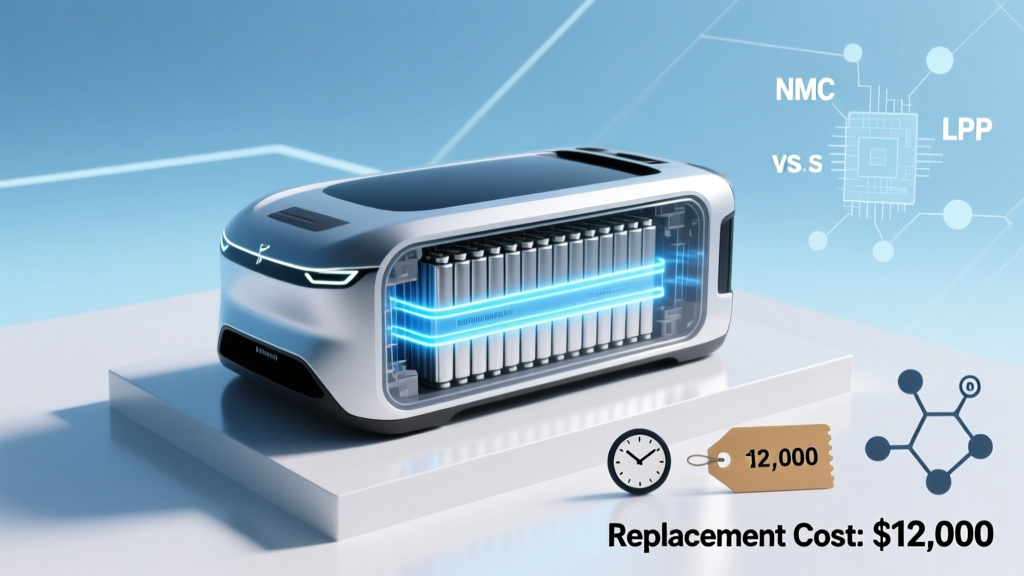
If your battery degrades beyond the warranty threshold — or if you're keeping a vehicle past 15 years and 200,000+ miles — replacement is a real consideration. Costs have dropped substantially but remain the single largest potential repair expense on an EV.
| Vehicle | Battery Size (usable kWh) | Chemistry | Estimated Replacement Cost (parts + labor) |
|---|---|---|---|
| Tesla Model 3 RWD | ~57 kWh | LFP | $5,000–$8,000 |
| Tesla Model Y Long Range | ~75 kWh | NMC | $8,000–$12,000 |
| Hyundai Ioniq 5 (Long Range) | ~77.4 kWh | NMC | $9,000–$14,000 |
| Ford Mustang Mach-E Extended | ~91 kWh | NMC | $12,000–$18,000 |
| Ford F-150 Lightning Extended | ~131 kWh | NMC | $18,000–$28,000 |
| Chevrolet Silverado EV (Max Range) | ~200 kWh | NMC (Ultium) | $25,000–$40,000 |
When is replacement typically needed? For most owners, it isn't. Data from Consumer Reports and fleet operators suggests that fewer than 5% of EVs need a full battery replacement within the first 15 years. Module-level repairs (replacing individual cell groups rather than the entire pack) are increasingly common and cost $1,500–$5,000 depending on the vehicle.
As of 2026, third-party battery refurbishment services are emerging in major metro areas, offering remanufactured packs at 40–60% of OEM pricing. This market is still maturing but provides an option for out-of-warranty vehicles.
Factors That Accelerate Battery Degradation (and What You Can Control)
Battery expansion and capacity loss aren't purely a function of time. Your habits measurably influence the degradation curve.
- Avoid sustained 100% SoC (NMC/NCA only): Store between 20–80% for daily use. Charge to 100% only when you'll drive immediately. LFP owners can charge to 100% regularly — this actually helps the BMS calibrate.
- Limit DC fast charging to road trips: Frequent use of 150+ kW DC fast charging accelerates electrolyte decomposition. For daily charging, Level 2 at 7–11 kW is ideal. Studies show exclusive DCFC use can add 1–3% additional degradation over 5 years.
- Precondition before fast charging: Battery preconditioning (available on Tesla, Hyundai E-GMP, BMW, and others) heats or cools the pack to optimal temperature (~86–104°F / 30–40°C) before high-power charging. This reduces lithium plating risk and preserves charge speed.
- Avoid extreme SoC in extreme heat: Parking at 100% SoC in 100°F+ ambient temperatures accelerates calendar degradation. If storing in summer heat, target 50–60% SoC.
- Don't baby it excessively: The difference between careful and normal use is typically 2–5% capacity over 10 years. Drive your EV normally — the BMS is designed to protect the pack within safe limits.
How to Check and Monitor Your Battery's State of Health (SoH)
State of Health (SoH) is the percentage of original capacity your battery retains. A new EV has 100% SoH; a battery at 85% SoH holds 85% of its original kWh.
How to check SoH by brand (2026 models):
- Tesla: The in-car "Battery Health" screen (added via OTA in 2023–2024) shows estimated SoH percentage. Third-party tools like Tessie or TeslaFi log this data over time.
- Hyundai / Kia (E-GMP): The infotainment system's EV diagnostics menu displays battery condition. Some model years show a percentage; others use a bar graph. The OBD-II port can be read with apps like Car Scanner or ABRP-linked tools for more precise data.
- Ford: The FordPass app shows estimated battery health. For detailed SoH, a dealer diagnostic scan or OBD-II reader (e.g., OBDLink MX+ with FORScan) provides cell-level voltage data.
- BMW: The iDrive system includes a battery health indicator. BMW's "Battery Certificate" available from dealers provides a formal SoH report useful for resale.
- Universal option: Services like Recurrent connect to your vehicle's telematics and provide ongoing SoH tracking, degradation projections, and warranty-risk alerts at no cost to the owner.
When to be concerned: If your SoH drops more than 3–4% per year after the first year, or if you notice sudden range drops of 10%+ between charges (not explained by temperature), schedule a dealer diagnostic. This can indicate a failing module rather than normal degradation.
Emerging Battery Tech: Solid-State, Silicon Anodes, and Realistic Timelines
Next-generation battery technologies promise to address expansion, degradation, and energy density simultaneously — but timelines matter.
Solid-state batteries: Replace the liquid electrolyte with a solid ceramic, sulfide, or polymer layer. Benefits include near-zero swelling, higher energy density (~400–500 Wh/kg projected), faster charging, and reduced fire risk. Toyota has announced limited production for 2027–2028, and QuantumScape is in pilot production with Volkswagen. However, solid-state batteries are not available in any 2026 consumer vehicle. Realistic mass-market availability is 2029–2032, with initial deployment likely in premium models above $80,000 MSRP.
Silicon-dominant anodes: Companies like Sila Nanotechnologies and Group14 are replacing graphite anodes with silicon composites, boosting energy density 20–40%. These are beginning to appear in limited 2025–2026 production (e.g., Mercedes-Benz G-Class EV prototype, select consumer electronics). The challenge: silicon anodes expand up to 300% during lithiation, requiring novel nanostructures to manage. Expect broader EV adoption by 2027–2029.
Sodium-ion batteries: CATL and BYD have begun deploying sodium-ion packs in Chinese-market vehicles (2024–2025). These offer lower cost, excellent cycle life, and strong cold-weather performance — but significantly lower energy density (~120–160 Wh/kg). They're suited for urban EVs and stationary storage, not long-range vehicles. US-market availability is projected for 2027+ in budget-oriented models.
For buyers in 2026: today's LFP and NMC chemistries, paired with modern thermal management and BMS software, already deliver batteries that last 150,000–300,000 miles with manageable degradation. Waiting for solid-state means waiting 3–6 years and paying a significant premium at launch.
Frequently Asked Questions
How long do EV batteries last in years and miles?
Most modern EV batteries (2022+) are engineered to last 15–20 years or 150,000–300,000 miles before degrading to 70–80% of original capacity. LFP chemistry packs tend toward the upper end of this range. Fleet data from Geotab and Recurrent shows median annual degradation of 1.5–2.5% for NMC and 1.0–1.8% for LFP under mixed driving conditions.
How much does it cost to replace an EV battery?
Full pack replacement ranges from approximately $5,000 (Tesla Model 3 RWD, LFP) to $28,000+ (Ford F-150 Lightning Extended Range, NMC). However, fewer than 5% of EVs require full replacement within 15 years. Module-level repairs cost $1,500–$5,000. Third-party refurbished packs are increasingly available at 40–60% of OEM pricing.
What does the battery warranty cover?
Federal law requires at minimum 8 years / 100,000 miles of battery coverage. Most manufacturers warrant that the battery will retain at least 70% of its original capacity during this period. If SoH drops below the threshold, the manufacturer repairs or replaces modules to bring capacity back above the line. Hyundai/Kia offer 10-year coverage; Rivian covers up to 175,000 miles.
How do I check my EV's battery health?
Most 2024+ EVs display battery health information in the infotainment system or companion app. Tesla shows SoH percentage directly. For detailed cell-level data, use an OBD-II reader (OBDLink MX+, FORScan for Ford, Car Scanner for Hyundai/Kia). Free services like Recurrent provide ongoing SoH tracking via telematics.
LFP vs NMC — which battery chemistry is better for me?
Choose LFP if you prioritize longevity, lower cost, plan to keep the vehicle 10+ years, drive mostly in moderate climates, and can accept slightly less range per kWh. Choose NMC/NCA if you need maximum range, regularly drive in cold weather, need fast DC charging performance in winter, or are buying a heavier vehicle (truck, large SUV) where energy density matters. Neither is universally "better" — the right choice depends on your ownership horizon and climate.