If you are preparing to service an electric vehicle, store one long-term, or simply want to understand what happens when the high-voltage traction battery is isolated, the disconnecting battery order matters enormously. Unlike a conventional 12V car battery, an EV's traction pack operates at 400V to 900V and stores 50 to 130+ kWh of energy. A mistake in sequence can damage power electronics, trigger fault codes, or create a serious shock hazard. This guide covers the correct isolation procedure, then goes deep on the chemistry, degradation, warranty, and replacement-cost realities every EV owner should know in 2026.
Why Disconnecting Battery Order Matters in an EV
The high-voltage (HV) traction battery is the most expensive and most dangerous component in your vehicle. Before any service — whether you're replacing a coolant hose, pulling an inverter, or storing the car for months — you must follow a strict power-down sequence. This is distinct from the 12V auxiliary battery that runs lights, infotainment, and the battery management system (BMS) itself.
The Correct Disconnect Sequence
- Power off the vehicle completely — remove the key fob or phone-as-key from proximity range (at least 15 feet) to prevent wake-sleep cycling.
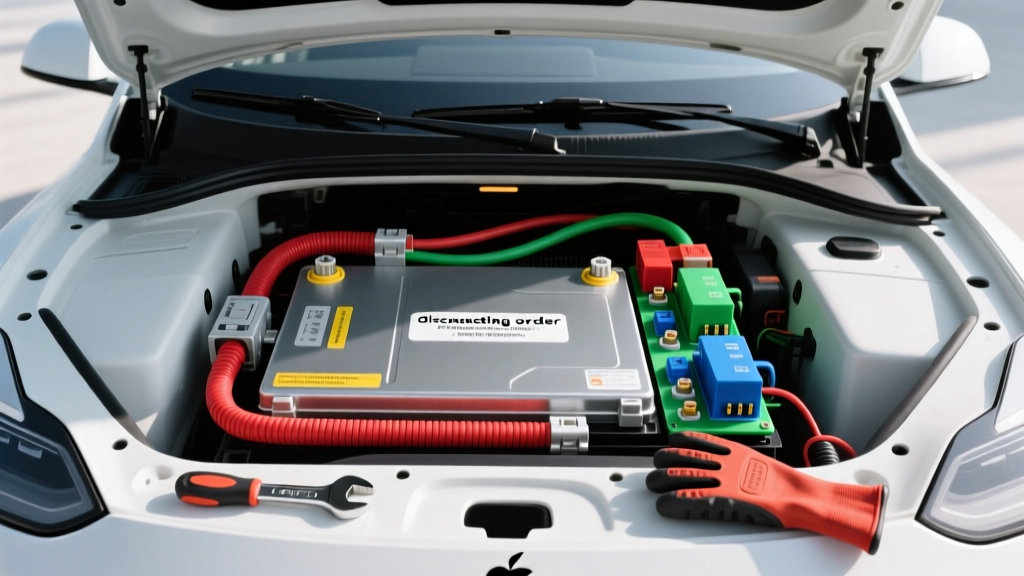
- Disconnect the 12V auxiliary battery negative terminal first — this de-energizes the HV contactors inside the traction pack. Without 12V power, the contactors remain open and the HV bus is isolated.
- Wait the manufacturer-specified capacitor discharge time — typically 5 to 15 minutes (check your service manual; Tesla specifies 15 minutes for Model 3/Y, Hyundai specifies 10 minutes for Ioniq 5/6). This allows the inverter capacitors to bleed off stored energy.
- Verify zero voltage at the HV service disconnect — using a CAT III-rated multimeter (minimum 1000V rating), confirm 0V between the HV positive bus and chassis ground.
- Pull the manual service disconnect (MSD) or service plug — this physically breaks the HV circuit inside the battery pack, splitting it into two lower-voltage halves for added safety.
- Only then proceed with HV component work — wearing Class 0 insulated gloves (rated to 1000V AC) inspected within the past 6 months.
Reconnection Order (Reverse)
Reconnect the MSD/service plug first, then reconnect the 12V negative terminal last. Power on the vehicle and allow the BMS to run a self-check cycle (usually 30–60 seconds) before driving. Clear any stored fault codes with an OBD-II scanner capable of HV system access.
LFP vs NMC: Which Battery Chemistry Is in Your EV?
The two dominant lithium-ion chemistries in 2026 EVs are LFP (lithium iron phosphate) and NMC (nickel manganese cobalt), with NCA (nickel cobalt aluminum) used by Tesla in some long-range applications. Your chemistry affects range, longevity, cold-weather behavior, and how you should manage state of charge.
| Attribute | LFP (LiFePO₄) | NMC / NCA |
|---|---|---|
| Energy Density | 160–180 Wh/kg (cell level) | 230–300 Wh/kg (cell level) |
| Cycle Life | 3,000–5,000+ cycles to 80% SoH | 1,000–2,500 cycles to 80% SoH |
| Cold Performance | Weaker — 25–35% range loss below 20°F; slower charge acceptance | Better — 15–25% range loss below 20°F |
| Recommended Daily SoC | 100% is fine (BMS calibration benefits) | 80% daily; 100% only for trips |
| Cost per kWh (2026) | $90–$110 (pack level) | $120–$150 (pack level) |
| Common Vehicles (2026) | Tesla Model 3/Y RWD, Ford Mustang Mach-E Select, BYD models, Rivian Standard | Tesla Model 3/Y Long Range, Hyundai Ioniq 5/6, BMW i4/iX, GM Ultium vehicles |
| Thermal Stability | Excellent — higher thermal runaway threshold (~270°C) | Good — lower threshold (~210°C), requires more active cooling |
The takeaway: LFP wins on longevity, safety, and cost but sacrifices energy density and cold-weather performance. NMC/NCA delivers more range per kilogram and handles cold better. Neither is universally "better" — it depends on your climate, driving patterns, and how long you plan to keep the vehicle. If you live in the Sun Belt and plan to keep your EV for 10+ years, LFP's cycle-life advantage is significant. If you regularly drive in sub-freezing winters and need maximum range, NMC is the stronger choice.
How Long Do EV Batteries Actually Last?
The short answer: almost certainly longer than you think. Real-world fleet data from 2024–2026 shows most modern EV batteries retain 85–92% of their original capacity after 100,000 miles, and the vast majority of packs will outlast the vehicle's useful life.
Real-World Degradation Data
Based on aggregated fleet data from Recurrent Auto and manufacturer-reported figures:
- Tesla Model 3/Y (NMC, 2021–2025): ~5% loss at 50,000 miles; ~8–10% loss at 100,000 miles; projected ~12–15% loss at 200,000 miles.
- Hyundai Ioniq 5 (NMC, 77.4 kWh, 2022–2025): ~4% loss at 50,000 miles; ~7–9% at 100,000 miles.
- Tesla Model 3 RWD (LFP, 2022–2025): ~3–4% loss at 50,000 miles; ~6–8% at 100,000 miles. LFP packs show slower early-life degradation but can exhibit a slightly steeper drop after ~200,000 miles depending on usage.
- Chevrolet Bolt EV/EUV (NMC, 65 kWh, 2020–2025): Earlier Bolt packs (pre-2020 recall) showed higher degradation; post-recall replacement packs show ~5–7% loss at 80,000 miles.
- Ford Mustang Mach-E Extended Range (NMC, 91 kWh usable, 2021–2025): ~6–8% loss at 60,000 miles per fleet averages.
Most degradation occurs in the first 10,000–20,000 miles (the "break-in" period where the solid electrolyte interphase layer stabilizes), then the curve flattens significantly. A pack that has lost 8% after 80,000 miles might lose only another 4–6% over the next 80,000 miles.
What Does the Battery Warranty Actually Cover?
Federal law mandates a minimum 8-year/100,000-mile warranty on EV battery packs for emissions-related compliance, and every major automaker meets or exceeds this. However, the details — particularly the capacity retention threshold and what qualifies as a "defect" versus "normal degradation" — vary meaningfully.
| Manufacturer | Coverage Period | Capacity Threshold | Notes |
|---|---|---|---|
| Tesla | 8 yr / 120,000 mi (Model 3/Y LR); 8 yr / 100,000 mi (RWD) | 70% retention | Covers defects and degradation below threshold |
| Hyundai / Kia | 10 yr / 100,000 mi | 70% retention | Among the longest coverage; includes Ioniq 5/6, EV6, EV9 |
| General Motors (Ultium) | 8 yr / 100,000 mi | 70% retention (60% for commercial) | Covers Equinox EV, Blazer EV, Silverado EV, Cadillac Lyriq |
| Ford | 8 yr / 100,000 mi | 70% retention | Mach-E, F-150 Lightning |
| Rivian | 8 yr / 175,000 mi | 70% retention | Highest mileage threshold in the market |
| BMW | 8 yr / 100,000 mi | 70% retention | i4, iX, i7 |
Key distinction: A warranty replacement is triggered only when measured capacity drops below the stated threshold (typically 70%) within the warranty window. A pack at 72% at 95,000 miles would not qualify — even though you've lost 28% of your range. In practice, very few owners hit the threshold during the warranty period based on current degradation data.
EV Battery Replacement Cost: What to Expect in 2026
Battery prices have fallen dramatically — from over $1,000/kWh in 2010 to roughly $100–$140/kWh at the pack level in 2026 — but a full replacement is still a major expense. The good news: it is rarely needed during the vehicle's normal lifespan.
| Vehicle | Battery Size | Chemistry | Est. Replacement Cost |
|---|---|---|---|
| Tesla Model 3 RWD | 60 kWh | LFP | $7,000–$10,000 |
| Tesla Model Y Long Range | 75 kWh (usable) | NMC/NCA | $10,000–$14,000 |
| Hyundai Ioniq 5 | 77.4 kWh | NMC | $11,000–$15,000 |
| Ford F-150 Lightning Ext. Range | 131 kWh | NMC | $18,000–$25,000 |
| Chevrolet Equinox EV | 85 kWh | NMC (Ultium) | $12,000–$16,000 |
| BMW iX xDrive50 | 111.5 kWh (usable) | NMC | $20,000–$28,000 |
These figures include the battery pack and dealer labor but exclude potential ancillary costs like new coolant, thermal interface material, or BMS recalibration. Independent EV shops and remanufactured packs can reduce costs by 20–35%. Module-level repair — replacing only the degraded modules within the pack rather than the entire assembly — is increasingly available and can cost $2,000–$6,000 depending on the number of modules replaced.
According to data from fueleconomy.gov and industry tracking, fewer than 2% of EVs sold since 2018 have required a battery replacement outside of warranty, and most of those were due to manufacturing defects or physical damage, not age-related degradation.
Factors That Accelerate (or Slow) Battery Degradation
Your daily habits have a measurable impact on how quickly your pack loses capacity. Here are the factors ranked by impact, based on data from fleet telematics and battery research:
High-Impact Factors
- Sustained high state of charge: Storing an NMC battery at 100% SoC for extended periods (weeks) accelerates electrolyte decomposition. For NMC, aim for 80% daily and only charge to 100% when you'll drive within a few hours. LFP is more tolerant of 100% storage and actually benefits from periodic full charges for BMS cell-balancing calibration.
- Extreme heat exposure: Ambient temperatures above 95°F combined with high SoC create the worst-case degradation scenario. Parking in shade or a garage matters more than most owners realize. Battery thermal management systems mitigate this but consume energy and can't fully eliminate heat soak.
- Frequent DC fast charging at high power: Daily use of 150+ kW DC fast charging generates internal cell heat and lithium plating risk. Occasional road-trip fast charging is perfectly fine — it's the daily pattern that adds up. Idaho National Laboratory research found that vehicles charged primarily via DC fast charging showed roughly 2–4% additional degradation over 100,000 miles compared to Level 2 charging.
Moderate-Impact Factors
- Deep discharge cycles: Regularly driving below 10% SoC stresses cells. The BMS maintains a bottom buffer (typically 3–5 kWh that you can't access), but repeatedly hitting 0% displayed still accelerates wear.
- Cold-weather fast charging without preconditioning: Charging a cold NMC pack at high power can cause lithium plating on the anode — a permanent, irreversible capacity loss. Always use your vehicle's navigation-based preconditioning (e.g., navigating to a Supercharger or charger in the Tesla/Hyundai/Ford app) to warm the pack before fast charging in cold weather.
Low-Impact Factors
- Total mileage alone: Calendar aging (time) often matters more than miles. A 5-year-old EV with 30,000 miles may show similar degradation to one with 70,000 miles if both were stored at high SoC in hot climates.
- Regenerative braking intensity: The charge currents from regen are well within the cell's safe C-rate and do not meaningfully affect longevity.
How to Check and Monitor Battery Health (SoH)
State of Health (SoH) is the percentage of your battery's original capacity that remains usable. A new pack is 100% SoH; a pack that held 77.4 kWh when new and now holds 70 kWh is at ~90.4% SoH.
Methods to Check SoH
- In-app reporting: Tesla provides a battery health percentage in the Service menu (added in 2024 software updates). Hyundai/Kia offers a similar readout via the infotainment diagnostics screen on 2024+ models.
- OBD-II scanner with EV capability: Tools like the OBDLink MX+ paired with apps such as EVNotify, Car Scanner, or ABRP can read the BMS-reported SoH directly. This works on most brands including Hyundai, Kia, GM, Ford, VW, and BMW.
- Dealer diagnostic report: Any authorized service center can pull a full battery health report showing individual module voltages, internal resistance, and overall SoH. Request this during routine service or before purchasing a used EV.
- Manual calculation: Charge to 100% (or a known SoC), note the displayed range, and compare it to the original EPA-rated range at the same SoC. This is imprecise (displayed range varies with temperature and recent driving) but gives a rough estimate.
Battery Care Best Practices
- Set your daily charge limit to 80% for NMC, 100% for LFP
- Use Level 2 (7–11 kW) home charging as your primary method
- Enable preconditioning when navigating to DC fast chargers in cold weather
- Avoid leaving the vehicle at 100% SoC for more than 24 hours (NMC)
- Park in shade or a garage during hot summer months
- Don't stress about occasional 100% charges for road trips — the impact of a few dozen full cycles per year is negligible
What's Next: Solid-State and Silicon-Anode Batteries
The next major leap in battery technology is solid-state batteries, which replace the liquid electrolyte with a solid ceramic, polymer, or sulfide material. The promised benefits are substantial: 40–50% higher energy density, faster charging (potentially 10–80% in under 10 minutes), improved safety (no flammable electrolyte), and longer cycle life.
However, as of early 2026, solid-state batteries remain in limited pilot production. Toyota has announced a solid-state battery for a 2027–2028 production vehicle, and Samsung SDI is targeting 2027 for mass production. These timelines have slipped repeatedly, and initial deployment will likely be in low-volume, premium vehicles at significant cost premiums.
Silicon-anode batteries are closer to market. Companies like Sila Nanotechnologies and Group14 Technologies are supplying silicon-dominant anode materials that boost energy density by 15–25% over conventional graphite anodes. Mercedes-Benz's upcoming G-Class EV (expected 2026) uses a silicon-anode pack from Sila. This is an incremental improvement, not a revolution, but it's available now in select applications.
For buyers in 2026: current LFP and NMC batteries are mature, well-understood, and proven to last 150,000–200,000+ miles with proper care. There is no compelling reason to wait for solid-state unless you're shopping for a luxury vehicle in the 2028+ timeframe.
Frequently Asked Questions
How long do EV batteries last in years and miles?
Most modern EV batteries (2020 and newer) are designed to last 15–20 years or 150,000–200,000+ miles before dropping below 70–80% of original capacity. Fleet data from Tesla, Hyundai, and GM shows average degradation of 1–2% per year under normal use. The battery will typically outlast other major vehicle components like suspension, interior, and body panels.
How much does an EV battery cost to replace in 2026?
Replacement costs range from roughly $7,000 for a smaller LFP pack (Tesla Model 3 RWD, 60 kWh) to $25,000+ for large packs (F-150 Lightning Extended Range, 131 kWh). Most vehicles fall in the $10,000–$16,000 range. Module-level repairs can reduce this to $2,000–$6,000. However, fewer than 2% of EVs have needed out-of-warranty replacements.
What does the battery warranty cover?
All major manufacturers warrant the battery for at least 8 years/100,000 miles against defects and degradation below a stated capacity threshold (typically 70% of original capacity). Hyundai/Kia and Rivian offer longer coverage (10 yr/100,000 mi and 8 yr/175,000 mi respectively). The warranty covers the full pack replacement or repair if capacity drops below the threshold within the warranty window.
How do I check my EV's battery health?
Use your vehicle's built-in diagnostics (Tesla Service menu, Hyundai infotainment), an OBD-II scanner with EV capability (OBDLink MX+ with EVNotify or Car Scanner app), or request a dealer diagnostic report. SoH is expressed as a percentage of original capacity.
LFP vs NMC — which is better for my situation?
Choose LFP if you want maximum cycle life, lower cost, can charge to 100% daily, and live in a moderate-to-warm climate. Choose NMC if you need maximum range per charge, regularly drive in freezing temperatures, or want faster cold-weather charging. Both chemistries will outlast most ownership periods with proper care.
Is disconnecting the EV battery safe to do at home?
Disconnecting the 12V auxiliary battery (which opens the HV contactors) is safe for basic tasks like resetting electronics. However, physically disconnecting the high-voltage traction battery or pulling the manual service disconnect requires HV safety training, insulated tools, a CAT III multimeter, and Class 0 gloves. This work should be left to certified EV technicians unless you have specific training.