The Mechanics of EV Battery Degradation: A Data-Driven Overview
Electric vehicle (EV) battery degradation remains one of the most heavily debated topics among prospective buyers and current owners. Unlike internal combustion engines that suffer from mechanical wear and tear, EV batteries undergo complex electrochemical changes over time. To truly understand how long an EV battery will last, we must move beyond anecdotal evidence and examine the hard data surrounding battery chemistry, thermal dynamics, and charging behaviors.
At a fundamental level, battery degradation is categorized into two distinct phenomena: calendar aging and cycle aging. Calendar aging occurs simply as a function of time, driven by the slow, continuous growth of the Solid Electrolyte Interphase (SEI) layer on the anode. This layer consumes active lithium ions, gradually reducing the battery's total capacity. Cycle aging, on the other hand, is the physical wear caused by the repeated insertion and extraction of lithium ions during charging and discharging. According to the U.S. Department of Energy's Alternative Fuels Data Center, modern EV batteries are engineered to mitigate both forms of aging, but the rate at which they degrade depends heavily on the specific chemical makeup of the cells and the environmental conditions they endure.
Chemistry Showdown: NMC vs. LFP Degradation Data
The two dominant lithium-ion chemistries in today's EV market are Nickel Manganese Cobalt (NMC) / Nickel Cobalt Aluminum (NCA) and Lithium Iron Phosphate (LFP). These chemistries behave vastly differently when subjected to high states of charge (SoC) and deep discharges.
NMC and NCA batteries, found in vehicles like the Ford Mustang Mach-E, Chevrolet Bolt EV, and Tesla Long Range models, offer high energy density, translating to longer range in a lighter package. However, they are more susceptible to degradation when held at 100% SoC for extended periods. Conversely, LFP batteries, increasingly used in standard-range vehicles like the Tesla Model 3 RWD and various BYD models, feature a lower energy density but boast a significantly longer cycle life and superior thermal stability.
| Metric | NMC / NCA Chemistry | LFP Chemistry |
|---|---|---|
| Average Cycle Life (to 80% Health) | 1,000 - 2,000 cycles | 3,000 - 5,000+ cycles |
| Optimal Daily Charge Limit | 80% - 90% | 100% (Regular calibration required) |
| Thermal Runaway Threshold | ~210°C (410°F) | ~270°C (518°F) |
| Energy Density | High (200-260 Wh/kg) | Moderate (140-180 Wh/kg) |
| Degradation at High SoC | Accelerated (Oxygen release risk) | Minimal (Stable olivine structure) |
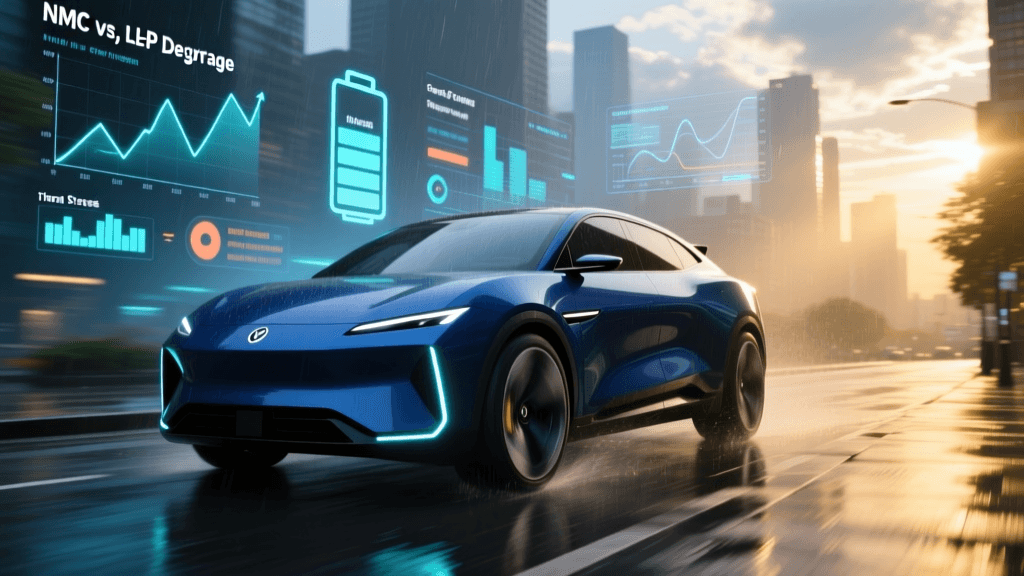
Data compiled from fleet management and long-term ownership studies highlights this divergence. Recurrent Auto's real-world battery degradation research demonstrates that while NMC batteries may show a slightly steeper initial degradation curve (often dropping 2-3% in the first year as the SEI layer stabilizes), they plateau and maintain steady health for years. LFP batteries, meanwhile, exhibit a flatter, more linear degradation curve, often outlasting the chassis of the vehicle itself before dropping below 80% capacity.
The Impact of Temperature on Battery Health
Temperature is arguably the most critical environmental factor influencing EV battery lifespan. Lithium-ion cells operate optimally between 20°C and 25°C (68°F to 77°F). Deviations from this range trigger adverse chemical reactions.
High-Temperature Degradation: Heat accelerates the parasitic reactions inside the cell. According to the Arrhenius equation, the rate of chemical degradation roughly doubles for every 10°C (18°F) increase in temperature. Vehicles parked outdoors in extreme summer climates (e.g., Arizona or Texas) without active thermal management will experience faster calendar aging. The electrolyte breaks down faster, and the SEI layer thickens prematurely, leading to increased internal resistance and reduced range.
Cold-Temperature Risks: While cold weather temporarily reduces range due to increased internal resistance and the energy required to heat the cabin, the real danger to battery health is lithium plating. If an EV is charged at high speeds while the battery core is below freezing, lithium ions can plate onto the surface of the anode as metallic lithium rather than intercalating into it. This permanently removes lithium from the active cycle and can create dendrites that risk internal short circuits. Modern EVs combat this with battery preconditioning, which uses grid or battery power to warm the cells before charging begins.
DC Fast Charging vs. Level 2: What the Fleet Data Shows
A common myth suggests that frequent use of DC Fast Chargers (DCFC) will rapidly destroy an EV battery. While high-amperage DC charging does generate significant heat, modern liquid-cooled thermal management systems are highly effective at shedding this heat. Geotab's comprehensive study on EV battery health, which analyzed data from over 6,300 fleet and personal EVs, provides clarity on this topic.
Geotab's data revealed that EVs that utilized DC fast charging more than three times a week in hot climates did experience a marginally faster degradation rate compared to those that relied exclusively on Level 2 charging. However, the difference was statistically small—often less than a 1-2% divergence in overall State of Health (SoH) over several years. In temperate climates, the difference between DCFC and Level 2 charging was virtually negligible. The data proves that while Level 2 charging is ideal for daily use, the convenience of DC road-trip charging does not pose a catastrophic threat to modern, thermally managed battery packs.
Actionable Strategies to Maximize Battery Lifespan
Based on the electrochemical data and real-world fleet analysis, owners can adopt specific, data-backed habits to minimize both calendar and cycle aging. Here is a structured guide to optimizing your EV's battery health based on its chemistry:
For NMC / NCA Battery Owners (e.g., Tesla Long Range, Chevy Bolt, Hyundai Ioniq 5)
- Set a Daily Charge Limit of 80%: Keeping the battery below 80% SoC prevents excessive stress on the cathode structure and slows SEI layer growth. Only charge to 100% immediately before a long road trip.
- Avoid Deep Discharges: Try not to let the battery drop below 15-20%. Deep discharges increase the depth of discharge (DoD) per cycle, which mathematically reduces the total cycle life of NMC cells.
- Precondition in Winter: Always use your vehicle's app to schedule departure times or manually precondition the battery while plugged in before utilizing DC Fast Chargers in cold weather to prevent lithium plating.
For LFP Battery Owners (e.g., Tesla Model 3 RWD, BYD Atto 3)
- Charge to 100% Regularly: LFP chemistry has a very flat voltage curve, making it difficult for the Battery Management System (BMS) to accurately guess the SoC. Manufacturers recommend charging to 100% at least once a week to calibrate the BMS and prevent unexpected range drop-offs.
- Embrace the Cycle Life: Because LFP cells can handle 3,000 to 5,000+ cycles, you do not need to baby the battery. You can confidently use 100% to 10% DoD cycles without significantly impacting the battery's multi-decade lifespan.
Universal Best Practices for All EV Owners
- Minimize Prolonged High-SoC Storage: If you are leaving for a two-week vacation, do not leave your EV plugged in at 100%. Set the charge limit to 50% and leave it unplugged, or use a smart charger that maintains a 50% SoC. Storing a battery at 100% SoC in a hot garage is the fastest way to induce severe calendar aging.
- Utilize Scheduled Charging: If you charge at home overnight, schedule the charging to finish right before you leave for work. This minimizes the time the battery sits at a high state of charge, directly reducing calendar degradation.
- Monitor SoH Data: Use built-in vehicle telemetry or third-party OBD-II dongles to track your battery's State of Health (SoH) over time. Establishing a baseline in the first 10,000 miles helps you identify abnormal degradation curves early, allowing you to claim warranty coverage if the battery falls below the manufacturer's guaranteed threshold (typically 70% retention over 8 years or 100,000 miles).
By understanding the underlying chemistry and respecting the thermal and electrical limits of your specific EV, you can ensure that your battery outlasts the vehicle's mechanical components, providing reliable, data-verified range for hundreds of thousands of miles.