When a battery icon lights up on your dashboard, it's natural to feel a spike of anxiety. Unlike a gas car's check-engine light, an EV battery warning could relate to the high-voltage traction battery — the single most expensive component in your vehicle. But before you panic, it helps to understand exactly what your EV battery is, how long it actually lasts, and what that warning light really means in practice.
This guide breaks down the chemistry, degradation data, warranty terms, replacement costs, and daily habits that determine your EV battery's lifespan — backed by real numbers, not marketing claims.
What the Battery on Dashboard Warning Actually Means
First, a critical distinction: your EV has two batteries. The high-voltage traction battery (typically 40–100+ kWh) powers the electric motor and determines your range. The 12V auxiliary battery runs lights, infotainment, door locks, and the computers that manage the car — just like in a gas vehicle.
Dashboard battery warnings fall into a few categories:
- 12V battery warning: Usually a standard battery icon. This means the small auxiliary battery is low or failing — a $150–$300 fix at any shop. This is the most common battery-related dashboard alert and is not an emergency for the traction system.
- High-voltage battery warning: Often displayed as a car-with-battery icon, a temperature warning, or a specific "traction battery" message. This relates to the main pack and should be taken seriously — schedule a service visit.
- Reduced power / "turtle mode": The car limits acceleration and speed to protect the battery. This can occur in extreme cold, at very low state of charge (SoC), or if the battery management system (BMS) detects a fault.
- State of charge (SoC) indicator: Not a warning — just your remaining range and battery percentage, similar to a fuel gauge.
If the warning specifically mentions the traction battery or shows a high-voltage symbol, pull over safely and contact your dealer or roadside assistance. For a standard 12V icon, you have time to diagnose — but don't ignore it, as a dead 12V battery can prevent the car from starting even with a full traction pack.
How Long Do EV Batteries Last? Real-World Degradation Data
The short answer: most modern EV traction batteries are designed to outlast the useful life of the vehicle. But they do lose capacity over time — just like a phone battery. Here's what the data actually shows.
Based on aggregated fleet data from sources like Recurrent Auto and manufacturer warranty commitments, typical degradation follows a curve: an initial drop in the first 1–2 years, followed by a long, slow decline.
| Age / Mileage | Avg. Capacity Retained | What It Means (300-mi EPA pack) |
|---|---|---|
| Year 1 / 15,000 mi | ~95–97% | ~285–291 mi usable range |
| Year 3 / 45,000 mi | ~91–94% | ~273–282 mi usable range |
| Year 5 / 75,000 mi | ~88–92% | ~264–276 mi usable range |
| Year 8 / 120,000 mi | ~83–88% | ~249–264 mi usable range |
| Year 10 / 150,000 mi | ~80–85% | ~240–255 mi usable range |
Note: LFP (lithium iron phosphate) batteries generally show even slower degradation, often retaining 90%+ at Year 8. Real-world results vary by climate, charging habits, and specific pack design.
The key takeaway: a 10-year-old EV with 150,000 miles will likely still have 80–85% of its original range. For a car that started at 300 miles EPA, that's still 240+ miles — more than adequate for most daily driving.
LFP vs. NMC: Which Battery Chemistry Is Better for You?
Not all EV batteries are the same. The two dominant chemistries in 2026 passenger EVs are NMC (nickel manganese cobalt) and LFP (lithium iron phosphate). Each has distinct trade-offs, and the "better" choice depends on your driving pattern.
| Factor | LFP (Lithium Iron Phosphate) | NMC/NCA (Nickel-based) |
|---|---|---|
| Energy density | Lower (~150–180 Wh/kg cell-level) | Higher (~220–300 Wh/kg cell-level) |
| Range per kWh | Heavier pack for same range | Lighter pack, more range in same volume |
| Cycle life | 3,000–5,000+ cycles | 1,000–2,000 cycles typical |
| Degradation rate | Slower; tolerates 100% SoC daily | Faster; 80% daily SoC recommended |
| Cold-weather performance | Weaker in extreme cold (<14°F / -10°C) | Better cold-weather discharge capability |
| DC fast charging | Generally slower peak kW | Higher peak kW rates (200–350 kW) |
| Cost | ~20–30% cheaper per kWh | More expensive (cobalt, nickel costs) |
| Thermal stability | More stable; lower thermal runaway risk | Requires more robust BMS and cooling |
| Common in | Tesla Model 3/Y RWD, standard-range BYD, some base trims | Long-range and performance trims, most luxury EVs |
The practical decision: If you charge at home daily, drive under 200 miles per day, and live in a moderate climate, LFP is arguably the better choice — it lasts longer, costs less, and you can charge to 100% without worry. If you need maximum range, tow frequently, road-trip in cold weather, or rely heavily on DC fast charging, NMC packs offer the energy density and charge speed you need.
What Does the EV Battery Warranty Actually Cover?
Federal law mandates a minimum battery warranty of 8 years / 100,000 miles for EVs sold in the United States. In California and states that follow CARB (California Air Resources Board) emissions rules, the mandate extends to 10 years / 150,000 miles. Most manufacturers meet or exceed these minimums.
| Manufacturer | Warranty Term | Capacity Threshold | Notes |
|---|---|---|---|
| Tesla (Model 3/Y RWD — LFP) | 8 yr / 100,000 mi | 70% retention | Long Range/Performance: 8 yr / 120,000 mi |
| Hyundai / Kia | 10 yr / 100,000 mi | 70% retention | Among the longest coverage in the industry |
| Ford (Mustang Mach-E, F-150 Lightning) | 8 yr / 100,000 mi | 70% retention | Covers battery and hybrid/electric components |
| Chevrolet (Equinox EV, Blazer EV) | 8 yr / 100,000 mi | 60–70% retention (varies) | Verify specific model terms with dealer |
| BMW / Mercedes-Benz | 8 yr / 100,000 mi | 70% retention | Some models offer extended battery certificates |
| Rivian | 8 yr / 175,000 mi | 70% retention | Higher mileage cap benefits high-mileage drivers |
Source: Manufacturer warranty documentation. Always verify current terms at purchase — warranties can change by model year. See fueleconomy.gov for model-specific details.
What "70% retention" means: If your battery drops below 70% of its original capacity within the warranty period, the manufacturer will repair or replace it at no cost. Normal degradation above 70% is considered expected wear and is not covered. A battery at 72% capacity at 90,000 miles is functioning within spec — it won't trigger a warranty claim.
What IS covered: Defects in materials or workmanship, cell failures, BMS malfunctions, and capacity loss beyond the threshold. What is NOT covered: Damage from accidents, flooding, improper modifications, or using non-approved charging equipment.
How Much Does an EV Battery Replacement Cost?
This is the question that drives the most fear — and the most misinformation. Let's ground it in actual numbers.
| Vehicle Category | Battery Size (kWh) | Replacement Cost Range | Typical When Needed |
|---|---|---|---|
| Compact EV (e.g., Chevy Bolt, Nissan LEAF) | 40–65 kWh | $6,500–$12,000 | Rarely within 15 years at current degradation rates |
| Midsize EV (e.g., Tesla Model 3, Hyundai Ioniq 5) | 60–84 kWh | $10,000–$16,000 | Rarely within 15 years |
| Large / Long-range EV (e.g., Ford F-150 Lightning, Rivian R1T) | 98–149 kWh | $15,000–$25,000 | Rarely within 12–15 years |
| Luxury EV (e.g., Mercedes EQS, BMW iX) | 90–120 kWh | $18,000–$30,000+ | Rarely within 12–15 years |
The critical context: Full traction battery replacements are extremely rare under normal ownership. The vast majority of EV batteries retain 80%+ capacity at 150,000 miles. When replacements do occur, they are overwhelmingly covered under warranty. Out-of-pocket replacements typically only happen on older, high-mileage vehicles well past the warranty period — and by that point, battery costs per kWh have continued to decline.
Also worth noting: many battery issues involve a single faulty module or cell group, not the entire pack. Module-level repairs can cost $1,500–$4,000 rather than a full replacement. Always get a diagnostic before accepting a full-pack quote.
5 Factors That Affect Your EV Battery's Lifespan
Battery degradation isn't purely a function of time. Your habits and environment play a measurable role. Here's what matters most, ranked by impact:
1. State of Charge (SoC) Habits
For NMC/NCA batteries, sitting at 100% SoC for extended periods accelerates degradation. The sweet spot for daily use is 20–80%. Charge to 100% only when you need the full range for a trip. LFP batteries are an exception — manufacturers like Tesla recommend charging LFP packs to 100% at least once a week to keep the BMS calibrated.
2. Extreme Temperatures
Batteries prefer the same temperatures humans do: roughly 60–80°F (15–27°C). Prolonged exposure to heat above 95°F accelerates chemical degradation. Extreme cold (below 14°F) temporarily reduces range by 20–40% and slows charging speeds, but doesn't cause permanent damage unless you fast-charge a cold-soaked pack without preconditioning. Garage parking in hot climates meaningfully extends battery life.
3. DC Fast Charging Frequency
Occasional DC fast charging is fine. But if you rely exclusively on 150–350 kW fast chargers daily, you'll see measurably faster degradation compared to Level 2 home charging. Data from fleet studies suggests that vehicles fast-charging more than 3 times per week show ~1–3% additional capacity loss over 5 years compared to primarily Level 2 charging. The heat generated during high-power charging is the primary driver.
4. Preconditioning Discipline
Preconditioning — warming the battery before fast charging or hard driving in cold weather — is one of the most underused battery-care practices. Most EVs allow you to set a departure time or navigate to a charger, which triggers the thermal management system to warm the pack. This reduces charging time and prevents lithium plating on the anode, a degradation mechanism that occurs when charging a cold battery at high power.
5. Driving Style and Regenerative Braking
Aggressive acceleration and frequent hard braking generate more heat in the battery pack. Using moderate regen settings and smooth driving inputs reduces thermal stress. This is a minor factor compared to SoC habits and temperature, but it adds up over 100,000+ miles.
Battery Care Checklist for Maximum Longevity
- ✅ Set daily charge limit to 80% (NMC/NCA) or 100% (LFP, per manufacturer guidance)
- ✅ Use Level 2 home charging as your primary charging method
- ✅ Precondition the battery before DC fast charging in cold weather
- ✅ Park in a garage or shade when possible, especially in hot climates
- ✅ Avoid letting SoC drop below 10% for extended periods
- ✅ If storing the vehicle for weeks, leave SoC at ~50% and plugged in if possible
- ✅ Limit DC fast charging to road trips and occasions when needed
- ✅ Keep up with software updates — BMS improvements are delivered OTA
How to Check and Monitor Your Battery's State of Health (SoH)
State of Health (SoH) is a percentage representing your battery's current maximum capacity compared to when it was new. A SoH of 92% means your battery can hold 92% of its original kWh capacity.
Here's how to check it:
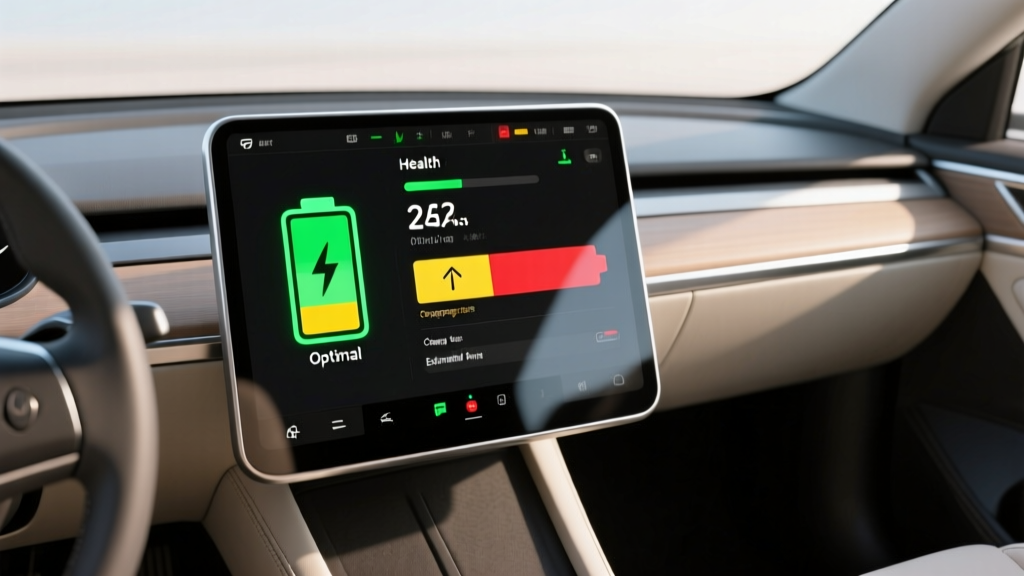
- In-car displays: Some EVs (notably certain Hyundai/Kia and BMW models) show SoH or battery health directly in the infotainment system or driver display. Tesla does not natively display SoH but provides range estimates that reflect degradation.
- OBD-II diagnostic apps: Tools like LeafSpy (Nissan LEAF), Scan My Tesla, or Car Scanner ELM OBD2 can read SoH data from the BMS via the OBD-II port. These range from free to ~$20 for the app, plus a $15–$50 OBD-II Bluetooth dongle.
- Dealer diagnostic check: Request a battery health report during routine service. Dealerships can pull detailed cell-voltage data and SoH readings. Some manufacturers include periodic battery checks in scheduled maintenance.
- Third-party services: Companies like Recurrent provide battery health reports based on connected-car data, often available to owners who opt in.
When to be concerned: If your SoH drops more than 2–3% in a single year (beyond the first year), or if you notice sudden range loss that doesn't correlate with temperature, have the pack inspected. Uneven cell degradation can sometimes be corrected with a BMS rebalance at the dealer.
What's Next? Solid-State and Silicon-Anode Batteries
Looking ahead, two technologies promise significant improvements — but neither is available in mass-production passenger EVs as of 2026.
Solid-state batteries replace the liquid electrolyte with a solid material, offering higher energy density (~400–500 Wh/kg projected), faster charging, and improved safety. Toyota has announced plans for limited solid-state EV production around 2027–2028, but initial availability will likely be restricted to low-volume, high-price models. Widespread, affordable solid-state EVs remain a 2030+ prospect.
Silicon-anode batteries (used in limited applications by companies like Porsche in the Taycan's successor and GM in upcoming Ultium cells) increase energy density by replacing graphite anodes partially or fully with silicon. These are closer to production — expect to see them in select 2027–2028 models — but they remain a refinement of existing lithium-ion architecture rather than a full generational leap.
Neither technology changes the calculus for buying an EV today. Current lithium-ion batteries (both LFP and NMC) are mature, reliable, and backed by data showing 15+ year usable lifespans. Waiting for solid-state means waiting 4–6+ years for mass availability and paying a premium when it arrives.
Frequently Asked Questions
How long do EV batteries last in years and miles?
Most modern EV traction batteries are engineered for 15–20 years and 150,000–200,000+ miles before dropping to 70–80% capacity. Data from fleet operators and Recurrent Auto confirms that the vast majority of EV batteries outlast the vehicles they're installed in. Full replacements within the first 10 years are rare and typically covered by the 8-year/100,000-mile federal minimum warranty.
How much does an EV battery cost to replace?
Full traction battery replacement costs range from roughly $6,500 for a compact EV to $25,000+ for a large or luxury pack. However, most owners never pay this — battery failures within the warranty period are covered, and most batteries retain 80%+ capacity well past 150,000 miles. Module-level repairs (for isolated cell failures) typically cost $1,500–$4,000. Battery costs per kWh continue to decline, so future out-of-warranty replacements will likely cost less than today's estimates.
What does the EV battery warranty cover?
Federal law requires a minimum 8-year/100,000-mile warranty on EV batteries (10 years/150,000 miles in CARB states). The warranty covers defects and capacity loss below a specified threshold — typically 70% of original capacity. It does not cover accident damage, improper use, or normal degradation above the threshold. Always review the specific warranty document for your vehicle, as terms vary by manufacturer and model year. See the IRS clean vehicle credits page for related EV incentive information.
How do I check my EV battery health?
Use your car's built-in battery health display (if available), connect an OBD-II diagnostic app like LeafSpy or Car Scanner, or request a battery health report from your dealer during service. Monitoring State of Health (SoH) once or twice a year is sufficient for most owners. Watch for sudden, unexplained range drops or SoH changes greater than 2–3% per year.
LFP vs NMC — which battery is better?
Neither is universally better. LFP offers longer cycle life, slower degradation, lower cost, and the ability to charge to 100% daily — ideal for home-charging commuters in moderate climates. NMC delivers higher energy density (more range in a lighter pack), faster DC charging, and better cold-weather performance — better for long-range drivers, cold climates, and towing. Check the chemistry of the specific trim you're considering before purchasing.
Why is my EV battery icon showing on the dashboard?
A battery icon on the dashboard most commonly indicates a 12V auxiliary battery issue — the same small battery found in gas cars. If the warning specifically mentions the traction battery or high-voltage system, schedule a service visit. Consult your owner's manual for the exact meaning of each dashboard symbol for your specific model, as icons vary by manufacturer.