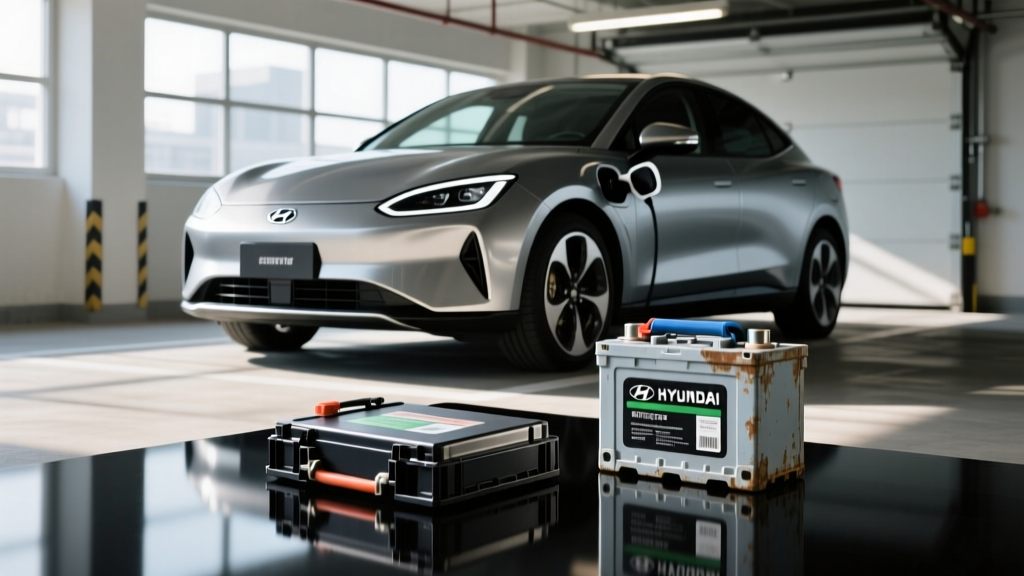
Searches for a 2009 Hyundai Santa Fe battery typically point to a familiar scenario: a 15-year-old internal-combustion SUV that needs a new 12-volt starter battery — a $150–$250 fix at any auto parts store. But that search also surfaces a much bigger question for drivers considering the jump to electric: what happens when an EV's high-voltage traction battery ages?
The short answer is that modern EV traction batteries are engineered to outlast the vehicles they power, with federal warranty mandates and chemistry advances that make catastrophic failure rare. Still, understanding degradation curves, replacement economics, and the difference between LFP and NMC chemistries is essential before you sign a purchase agreement. This guide covers the data you need — whether you're cross-shopping a used EV or planning your next new-electric purchase.
The 2009 Hyundai Santa Fe Battery: A Baseline Comparison
The 2009 Hyundai Santa Fe uses a conventional Group 12V lead-acid (or AGM) battery to crank its 2.7L V6 or 3.3L V6 engine. Typical specs:
- Capacity: ~60 Ah (amp-hours) at 12V — roughly 0.72 kWh of stored energy
- Cost: $130–$240 retail (2026 pricing at major auto parts chains)
- Lifespan: 3–5 years in moderate climates; 2–3 years in extreme heat
- Replacement labor: 10 minutes, DIY-friendly
By contrast, a modern EV traction battery stores 60–100+ kWh — roughly 100× the energy — operates at 400V (or 800V in Hyundai's E-GMP architecture), and is warrantied for 8 years/100,000 miles minimum under federal law. The 12V battery in an EV (yes, EVs still have one for accessory systems) is a separate, inexpensive component — not the traction pack.
LFP vs. NMC/NCA: Choosing Your Battery Chemistry
Not all EV batteries are built the same. The two dominant lithium-ion chemistries in 2026 are LFP (lithium iron phosphate) and NMC/NCA (nickel manganese cobalt / nickel cobalt aluminum). Each has distinct trade-offs that affect range, longevity, cold-weather performance, and price.
| Attribute | LFP (Lithium Iron Phosphate) | NMC / NCA (Nickel-based) |
|---|---|---|
| Energy density | ~160–180 Wh/kg (lower) | ~220–300 Wh/kg (higher) |
| Cycle life | 3,000–5,000+ cycles to 80% SoH | 1,000–2,000 cycles to 80% SoH |
| Cold-weather performance | More range loss below 32°F; slower charging in cold | Better low-temp discharge; faster cold-weather DC charging |
| Cost per kWh | ~$90–$110/kWh (2026 pack-level) | ~$120–$145/kWh (2026 pack-level) |
| Recommended SoC for daily use | 100% daily charging is fine | 80% daily; 100% only for trips |
| Thermal runaway risk | Very low (inherently stable chemistry) | Low, but higher than LFP under abuse |
| Notable 2026 vehicles | Tesla Model 3 RWD, Ford Mustang Mach-E Select (LFP option), BYD models | Hyundai Ioniq 5/6, Tesla Model Y LR/Perf, Rivian R1S/R1T, GM Ultium vehicles |
Which is better? It depends on your use case. If you live in a mild climate, charge at home nightly, and want maximum cycle life, LFP is the longevity champion. If you need maximum range per charge, frequently DC fast-charge in winter, or tow heavy loads, NMC/NCA delivers better energy density and cold-weather usability. Neither chemistry is "bad" — both routinely exceed 200,000 miles with proper care.
How Long Do EV Batteries Last? Degradation Data
The fear of a $20,000 battery swap at 80,000 miles is the single biggest barrier to EV adoption — and it's largely a myth for modern vehicles. Here's what the data actually shows:
- Tesla fleet data (2025 Impact Report): Model 3/Y packs retain ~88% capacity at 200,000 miles — roughly 12% loss over the vehicle's typical first-owner lifespan.
- Hyundai/Kia E-GMP platform (Ioniq 5, EV6): Owner-reported data from EV forums and fueleconomy.gov tracking shows ~90–93% State of Health (SoH) at 60,000 miles for NMC packs with liquid thermal management.
- GM Ultium (2023–2025 Cadillacs, Silverado EV): Early fleet data indicates <5% degradation at 40,000 miles — consistent with GM's cell-level testing claims of 400,000-mile equivalent lab cycles.
- LFP packs (Tesla Model 3 RWD, BYD): Anecdotal fleet data and CATL cell-cycle testing suggest <10% degradation at 300,000+ miles — consistent with LFP's superior cycle-life chemistry.
For context, the average US driver covers ~13,500 miles per year (FHWA data). At that rate, a 200,000-mile battery lifespan represents roughly 15 years of driving — well beyond the median vehicle ownership period of 8.4 years (S&P Global Mobility, 2024).
Most EV batteries will never need replacement during original ownership. When they do degrade, they don't "die" suddenly — they gradually lose capacity, meaning a 300-mile EPA range might become 270 miles at 150,000 miles. Still very usable.
What Does the Battery Warranty Actually Cover?
Federal law mandates that all EV traction batteries carry a minimum warranty of 8 years / 100,000 miles (10 years / 150,000 miles in California and states that have adopted CARB standards). But the details matter — specifically, the capacity retention threshold that triggers a warranty claim.
| Manufacturer | Warranty Period | Capacity Threshold | Notes |
|---|---|---|---|
| Tesla | 8 yr / 120,000 mi (Model 3/Y LR); 8 yr / 100,000 mi (RWD) | 70% retention | Transferable to subsequent owners |
| Hyundai / Kia | 10 yr / 100,000 mi | 70% retention | Among the longest coverage in the industry |
| GM (Chevrolet, Cadillac, GMC) | 8 yr / 100,000 mi | 70% retention (60% on Bolt EV/EUV) | Ultium packs covered; Bolt recall replacements also warrantied |
| Ford | 8 yr / 100,000 mi | 70% retention | Covers F-150 Lightning, Mach-E |
| Rivian | 8 yr / 175,000 mi | 70% retention | Highest mileage threshold among major OEMs |
A 70% threshold means the manufacturer will repair or replace the battery if diagnostic testing confirms it has lost more than 30% of its original usable capacity within the warranty window. In practice, very few packs hit this threshold — the degradation data above shows most retain 85–93% even at high mileage.
EV Battery Replacement Cost: When and How Much
If your battery does fall below the warranty threshold outside the coverage window — or if you're buying a used EV well past 100,000 miles — here's what replacement actually costs in 2026:
| Vehicle / Pack Size | Battery Capacity | Estimated Replacement Cost (2026) | Typical Replacement Trigger |
|---|---|---|---|
| Tesla Model 3 RWD (LFP) | ~60 kWh | $8,000–$12,000 | Rarely needed; LFP cycle life exceeds 300k miles |
| Tesla Model Y Long Range (NMC) | ~75 kWh usable | $12,000–$16,000 | Typically at 200k+ miles if at all |
| Hyundai Ioniq 5 (NMC) | 77.4 kWh | $13,000–$18,000 | Covered to 10 yr/100k mi; rarely out-of-warranty |
| Ford F-150 Lightning Ext. Range | ~131 kWh | $22,000–$30,000 | Large pack = higher cost; fleet use may accelerate wear |
| Chevrolet Bolt EV/EUV | 65 kWh | $14,000–$16,000 | Post-recall replacement packs carry fresh 8-yr warranty |
These figures include the battery pack and dealer labor. Independent EV shops are increasingly offering module-level repairs (replacing only the degraded cell modules rather than the entire pack) for $3,000–$8,000 — a growing option as the EV fleet ages.
For perspective, consider the 2009 Hyundai Santa Fe: over 15 years and 180,000 miles, that vehicle might need 4–5 replacement 12V batteries ($600–$1,200 total), plus alternator replacements ($500–$800), starter motor service ($400–$600), and countless oil changes. The EV's traction battery, by contrast, is a single component designed to last the vehicle's entire life.
Factors That Accelerate (or Preserve) Battery Life
Battery degradation isn't purely a function of time or mileage — how you charge and drive matters significantly. Here's what the electrochemistry data shows:
- Avoid sustained 100% SoC (NMC/NCA only): Storing an NMC pack at full charge accelerates electrolyte decomposition. Set your daily charge limit to 80% and charge to 100% only before long trips. LFP packs are exempt — charge to 100% regularly for best SoC calibration.
- Minimize DC fast-charging frequency: Occasional DCFC is fine, but daily 150–350 kW sessions increase cell stress. Data from Idaho National Laboratory testing showed packs charged exclusively via DCFC degraded ~5% more over 50,000 miles vs. Level 2-only charging. For daily use, Level 2 home charging (7–11 kW) is ideal.
- Precondition before fast charging: Most modern EVs automatically warm the battery when you navigate to a DC fast charger. This enables the pack to accept peak kW rates and reduces lithium plating risk. If your EV has a manual precondition toggle, use it in cold weather.
- Avoid extreme SoC in extreme heat: A pack sitting at 90%+ SoC in 100°F+ ambient temperatures experiences accelerated calendar aging. If you live in the Southwest, park in shade and set charge limits to 80% during summer months.
- Don't baby it too much: Driving the car normally — including using regen braking, accelerating onto highways, and charging to 100% for road trips — causes negligible additional wear. The biggest degradation risk is actually not driving: a pack sitting idle at high SoC for months degrades faster than one in regular use.
How to Check Your EV's Battery Health (State of Health)
State of Health (SoH) is the percentage of original capacity your battery retains. A new pack is 100% SoH; a pack that has degraded to hold only 85% of its original kWh is at 85% SoH. Here's how to check it:
Method 1: In-Vehicle Diagnostics
Most 2023+ EVs display SoH or a battery health indicator in the settings menu. Tesla shows this under Service > Battery Health. Hyundai/Kia provides a battery diagnostics screen accessible through the infotainment system's engineering menu (access varies by model year).
Method 2: OBD-II Scanner + EV App
Plug an OBD-II Bluetooth dongle (e.g., OBDLink SX, ~$40) into your EV's diagnostic port and use apps like LeafSpy (Nissan Leaf), TeslaFi, or Car Scanner ELM to read cell-level voltage data and calculated SoH. This is the method independent EV mechanics use.
Method 3: Dealer Diagnostic Report
Request a battery health report during any service visit. Dealers can run a full pack diagnostic that shows individual module voltages, internal resistance, and calculated SoH. This is also the report needed for any warranty claim.
Method 4: Manual Calculation
Charge to 100%, note the displayed range, and compare it to the original EPA range. If your Ioniq 5 originally showed 303 miles at 100% and now shows 275 miles, your rough SoH is 275/303 = ~91%. This method isn't perfectly precise (temperature and tire condition affect range), but it gives a useful ballpark.
Emerging Battery Tech: Solid-State and Silicon Anodes
The battery landscape is advancing, but it's important to separate lab announcements from production reality:
Solid-state batteries replace the liquid electrolyte with a solid ceramic or polymer, promising higher energy density (~400+ Wh/kg at the cell level), faster charging, and near-zero fire risk. Toyota, Samsung SDI, and QuantumScape have all demonstrated prototype cells, but no mass-production vehicle with a solid-state pack is on sale as of 2026. Toyota has announced a limited 2027–2028 rollout in select models, but volume production at competitive pricing remains 2029+ at the earliest. Expect initial solid-state packs to carry a significant price premium.
Silicon anode technology (used in cells from Sila Nanotechnologies and Group14) replaces graphite anodes with silicon-dominant composites, boosting energy density by 20–40%. These cells are beginning to appear in limited 2025–2026 production vehicles and are expected to become mainstream by 2028. They use existing manufacturing infrastructure, making them more near-term viable than solid-state.
Sodium-ion batteries (CATL, BYD) eliminate lithium entirely, offering lower cost and excellent cold-weather performance at the trade-off of lower energy density. These are appearing in Chinese-market city cars and may reach global markets in budget-oriented EVs by 2027–2028.
For buyers today, current-generation lithium-ion (LFP and NMC) remains the proven, cost-effective choice with extensive real-world longevity data backing it up.
Frequently Asked Questions
How long do EV batteries last in years and miles?
Based on fleet data from Tesla, Hyundai, and GM, modern liquid-cooled EV traction batteries retain 85–93% of original capacity at 100,000–200,000 miles. At the US average of 13,500 miles/year, that translates to 15+ years of usable service. Most packs will outlast the vehicle's body and interior.
How much does it cost to replace an EV battery?
Full pack replacement ranges from ~$8,000 (smaller LFP packs like Tesla Model 3 RWD) to $30,000+ (large packs like the F-150 Lightning Extended Range). However, the vast majority of EVs never need a pack replacement during original ownership, and module-level repairs at independent shops can cost $3,000–$8,000 for partial fixes.
What does the federal battery warranty mandate require?
US federal law requires a minimum 8-year/100,000-mile warranty on EV traction batteries, with California and CARB-adopting states requiring 10 years/150,000 miles. The warranty covers capacity loss below a specified threshold (typically 70% retention), defects, and thermal management system failures. Check IRS.gov for how battery sourcing also affects §30D tax credit eligibility.
Is LFP or NMC better for battery longevity?
LFP chemistry offers significantly longer cycle life (3,000–5,000 cycles vs. 1,000–2,000 for NMC) and can be charged to 100% daily without accelerated degradation. However, NMC offers higher energy density (more range per pound) and better cold-weather performance. For a daily commuter in a mild climate, LFP is the longevity winner. For long-range road-trippers in cold regions, NMC remains the practical choice.
Does fast charging damage my EV battery?
Occasional DC fast charging causes negligible harm. However, Idaho National Laboratory testing found that packs charged exclusively via DCFC degraded approximately 5% more over 50,000 miles compared to Level 2-only charging. The practical recommendation: use Level 2 (7–11 kW home charging) for daily needs and reserve DC fast charging for road trips.
How is an EV traction battery different from a 2009 Hyundai Santa Fe battery?
The 2009 Santa Fe uses a $150–$250 12V lead-acid battery that starts a gasoline engine and lasts 3–5 years. An EV's high-voltage traction battery stores 60–130+ kWh (roughly 100× more energy), costs $8,000–$30,000 to replace, but is designed to last 200,000+ miles with gradual, manageable degradation. EVs also have a separate 12V auxiliary battery for accessories — similar in cost and lifespan to the Santa Fe's battery.