The Real Battery Cost Per Kilowatt Hour: What Owners Actually Pay
For most EV shoppers, the high-voltage traction battery is both the most expensive component and the biggest source of long-term uncertainty. The single metric that cuts through the noise is battery cost per kilowatt hour — the price you pay for each unit of usable energy capacity, whether at the factory gate or at the dealership service bay when a replacement is needed.
As of early 2026, pack-level pricing for replacement batteries in the U.S. aftermarket ranges from roughly $110 to $170 per kWh depending on chemistry, pack architecture, and vehicle model. That translates to real-dollar replacement costs that vary enormously: a 60 kWh LFP pack in a base Tesla Model 3 might cost around $8,000–$10,000 in parts, while a 100+ kWh NMC pack in a luxury SUV like the BMW iX or Mercedes EQS can push past $18,000–$25,000 before labor.
But context matters. The vast majority of EV batteries never need full replacement. According to data from fueleconomy.gov and manufacturer warranty filings, most modern packs retain 85–93% of original capacity after 150,000 miles. Understanding what drives cost, what the warranty actually covers, and how chemistry choice affects longevity is essential for any buyer evaluating total ownership cost.
| Vehicle | Battery Size (usable kWh) | Chemistry | Est. Parts Cost | Cost per kWh | Labor (est.) |
|---|---|---|---|---|---|
| Tesla Model 3 RWD | 57.5 kWh | LFP | $7,500–$9,000 | ~$130–$157 | $1,500–$2,500 |
| Chevrolet Equinox EV | 85 kWh | NMC | $11,000–$14,000 | ~$129–$165 | $2,000–$3,000 |
| Hyundai Ioniq 5 Long Range | 77.4 kWh | NMC | $10,500–$13,500 | ~$136–$174 | $2,000–$2,800 |
| Ford F-150 Lightning Ext. Range | 131 kWh | NMC | $18,000–$24,000 | ~$137–$183 | $2,500–$4,000 |
| BMW iX xDrive50 | 105.2 kWh | NMC | $16,000–$21,000 | ~$152–$200 | $3,000–$4,500 |
| Rivian R1T Dual-Motor Max | 149 kWh | NMC (2170 cells) | $20,000–$26,000 | ~$134–$175 | $3,000–$4,500 |
Sources: Manufacturer parts pricing, dealer service estimates, and third-party repair databases. Actual costs vary by region, model year, and warranty status. Labor rates reflect 2026 national averages for EV-certified service centers.
How Long Do EV Batteries Last? Years, Miles, and Degradation Data
The short answer: far longer than most buyers assume. The lithium-ion packs in modern EVs are engineered to outlast the vehicle's economic life in most cases. But "battery life" isn't binary — it's a gradual capacity decline measured in State of Health (SoH), and the curve is not linear.
Typical Degradation Curves
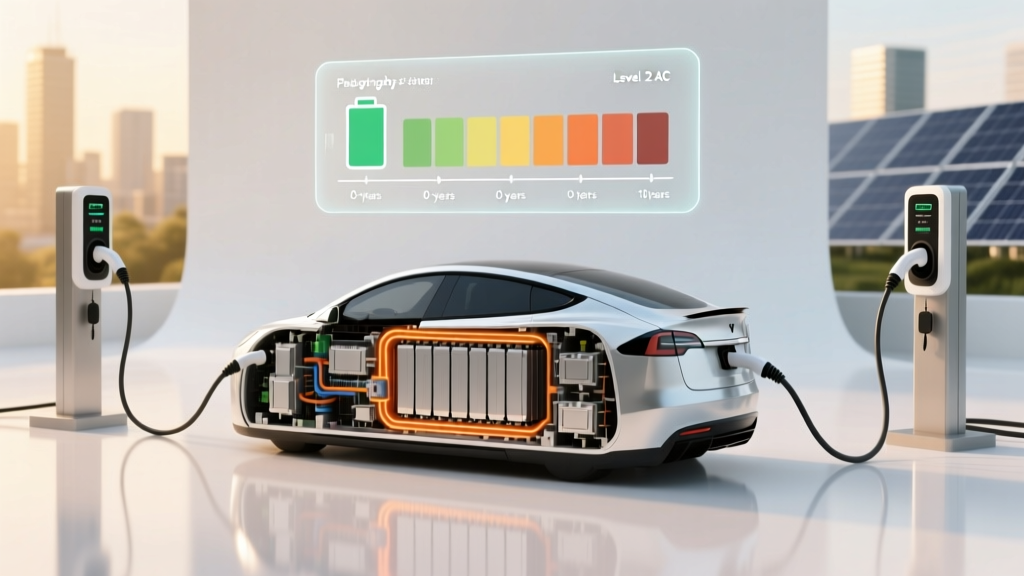
Most EV batteries experience a steeper capacity drop in the first 1–2 years (roughly 2–5% loss as the solid-electrolyte interphase stabilizes), then settle into a slow, linear decline of approximately 1–2% per year under normal use. Real-world fleet data collected by Recurrent Auto and other battery-analytics firms shows the following patterns across major chemistries:
| Mileage | NMC/NCA Avg. SoH | LFP Avg. SoH | Notes |
|---|---|---|---|
| New | 100% | 100% | Baseline |
| 30,000 mi | 95–97% | 96–98% | Initial SEI formation loss |
| 60,000 mi | 92–95% | 94–97% | Linear decline phase begins |
| 100,000 mi | 88–93% | 91–96% | Most still well above warranty threshold |
| 150,000 mi | 85–91% | 88–94% | Noticeable range reduction on smaller packs |
| 200,000 mi | 80–88% | 85–92% | Approaching or at warranty threshold for NMC |
Aggregated from fleet telematics data and manufacturer warranty claim rates. Individual results vary with climate, charging habits, and thermal management system quality.
A 2023 study by Geotab analyzing over 10,000 EVs found an average annual degradation rate of 1.8% per year across all models, with liquid-cooled packs (Tesla, Hyundai E-GMP, GM Ultium) performing measurably better than passively cooled designs. At that rate, a battery would retain roughly 82% capacity after 10 years — still above the 70% threshold that defines a warranty claim for most manufacturers.
When Replacement Is Typically Needed
Full battery replacement is rare and usually occurs only when:
- A manufacturing defect causes cell imbalance or internal short (typically caught within the warranty period)
- Physical damage from a collision compromises the pack enclosure
- The vehicle exceeds 200,000+ miles and capacity falls below a usable threshold (below 70–75% SoH, range becomes impractical for daily needs)
- Water intrusion or corrosion damages modules in older models
Module-level replacement — swapping individual bad cell groups rather than the entire pack — is increasingly common and dramatically cheaper, often $1,500–$4,000 depending on the number of modules affected.
LFP vs NMC: Chemistry Trade-Offs That Affect Cost and Longevity
The two dominant cathode chemistries in 2026 EVs are LFP (lithium iron phosphate) and NMC/NCA (nickel manganese cobalt / nickel cobalt aluminum). The choice between them has direct implications for battery cost per kilowatt hour, cycle life, and real-world usability.
| Attribute | LFP (LiFePO₄) | NMC/NCA |
|---|---|---|
| Energy Density (Wh/kg, cell level) | 160–180 Wh/kg | 230–300 Wh/kg |
| Typical Cycle Life | 3,000–6,000+ cycles | 1,000–2,500 cycles |
| Calendar Life | 15–20+ years | 10–15 years |
| Cold-Weather Performance | Moderate — slower charging below 32°F, ~15–25% range loss in extreme cold | Better — advanced thermal management offsets some loss, ~10–20% range loss |
| Cost (cell-level, 2026) | ~$70–$90/kWh | ~$95–$130/kWh |
| Recommended Daily SoC | Can charge to 100% regularly | Best kept at 80% daily; 100% for trips only |
| Cobalt/Nickel Content | None | Contains cobalt and/or nickel — supply-chain and ethical sourcing considerations |
| Common Vehicles (2026) | Tesla Model 3 RWD, Model Y RWD, Ford Mustang Mach-E Select (LFP option), BYD models | Hyundai Ioniq 5/6, Chevrolet Blazer EV, BMW iX, Rivian R1T/R1S, most long-range AWD trims |
Which Is Better?
Neither is universally superior — the right choice depends on your driving pattern:
Choose LFP if: You charge at home daily, drive under 250 miles between charges, live in a moderate climate, and want maximum cycle life with the option to charge to 100% without degradation anxiety. LFP's lower cost per kWh also makes it the value leader for standard-range trims.
Choose NMC/NCA if: You need maximum range per charge (300+ miles), regularly drive in cold climates where energy density matters, or tow heavy loads. NMC's higher energy density means more kWh in the same physical space, which is critical for larger vehicles and long-range applications.
What Does the Battery Warranty Actually Cover?
Federal law mandates a minimum battery warranty of 8 years / 100,000 miles for all EVs sold in the U.S., and California Air Resources Board (CARB) states require 10 years / 150,000 miles. Most manufacturers meet or exceed these minimums, but the details matter enormously.
| Manufacturer | Warranty Period | Capacity Retention Threshold | Coverage Scope |
|---|---|---|---|
| Tesla (Model 3/Y LFP) | 8 yr / 100,000 mi | 70% | Defects + capacity below threshold |
| Tesla (Model S/X, LR/AWD) | 8 yr / 120,000–150,000 mi | 70% | Defects + capacity below threshold |
| Hyundai / Kia | 10 yr / 100,000 mi | 70% | Defects + capacity below threshold |
| GM (Chevrolet/Cadillac Ultium) | 8 yr / 100,000 mi | 70% (some models 60% for propulsion battery) | Defects + capacity below threshold |
| Ford | 8 yr / 100,000 mi | 70% | Defects + capacity below threshold |
| BMW | 8 yr / 100,000 mi | 70% | Defects + capacity below threshold |
| Rivian | 8 yr / 175,000 mi | 70% | Defects + capacity below threshold |
| Volkswagen (ID.4) | 8 yr / 100,000 mi | 70% | Defects + capacity below threshold |
Note: Warranty covers defects and capacity loss below the stated threshold under normal use. Damage from accidents, modifications, or misuse is excluded. Always review the specific warranty booklet for your model year. Source: Manufacturer warranty documentation, irs.gov for §30D compliance requirements tied to battery sourcing.
The critical fine print: the 70% threshold means your battery must lose more than 30% of its original capacity before a warranty claim is valid. In practice, very few modern EVs hit this threshold within the warranty period under normal conditions. A warranty claim typically results in a replacement pack (new or remanufactured) that restores capacity to at least the threshold level — not necessarily a brand-new battery.
Factors That Accelerate Battery Degradation
While modern battery management systems (BMS) are sophisticated, owner habits and environmental conditions still influence how quickly capacity declines. Here are the primary factors, ranked by impact:
Battery Care Best Practices
- Avoid sustained high SoC on NMC/NCA: Daily charging to 100% accelerates electrolyte oxidation in nickel-based chemistries. Set your charge limit to 80% for daily use and 100% only when you need full range for a trip. (LFP owners can charge to 100% daily without concern.)
- Minimize DC fast charging frequency: Occasional DCFC is fine, but daily use at 150+ kW creates sustained high temperatures inside cells. When possible, rely on Level 2 home charging for daily needs and reserve DCFC for road trips. Preconditioning the battery before a fast-charge session (most EVs do this automatically when a charger is navigated to) reduces thermal stress.
- Extreme heat is worse than extreme cold for longevity: Sustained ambient temperatures above 95°F accelerate calendar degradation. If you live in a hot climate, park in shade or a garage when possible. Active thermal management (liquid cooling) mitigates this significantly — another reason to prefer vehicles with robust cooling systems.
- Don't store at 0% or 100%: If leaving the vehicle unused for weeks, set SoC to 50–60%. Deep discharge during storage can trigger cell damage; full-charge storage accelerates calendar aging.
- Use regenerative braking wisely: Aggressive regen settings don't harm the battery directly, but frequent high-C-rate discharge (hard acceleration) combined with immediate high-rate regen can create thermal cycling. Moderate driving habits extend pack life.
- Keep software updated: OEM firmware updates often refine BMS algorithms, thermal management, and charge-curve optimization. These updates can measurably slow degradation over time.
How to Check and Monitor Your Battery's State of Health
State of Health (SoH) is expressed as a percentage of original capacity. A new battery is 100% SoH; a battery that can now hold 75 kWh of its original 82 kWh is at ~91.5% SoH. Here's how to monitor it:
Built-In Vehicle Tools
- Tesla: The mobile app and in-car service menu show estimated range at 100% SoC, which you can compare to the original EPA figure. Third-party apps like Tessie or Stats provide more granular SoH estimates based on charge-log data.
- Hyundai/Kia: The EV-specific menu in the infotainment system displays battery health percentage on most 2024+ models.
- GM Ultium vehicles: The myChevrolet/myCadillac app includes a battery health indicator.
- BMW: The iDrive system includes a battery health readout under the EV menu; dealers can pull a detailed SoH report.
Third-Party and Dealer Diagnostics
Any EV-certified service center can perform a full capacity test — essentially a controlled discharge/recharge cycle that measures actual kWh throughput. This is the most accurate SoH measurement and typically costs $100–$200 if not covered under a service visit. For used-EV buyers, requesting this test before purchase is strongly recommended.
OBD-II dongles paired with apps like ABRP (A Better Routeplanner), LeafSpy (Nissan Leaf), or Car Scanner can read BMS data including cell voltage variance, pack temperature, and estimated SoH in real time. Cell variance above 0.1V between modules may indicate imbalance that warrants service.
Emerging Battery Technology: Solid-State and Beyond
Several next-generation battery technologies are in active development and pilot production, but none are widely available in consumer vehicles as of 2026. Here's a realistic timeline assessment:
Solid-state batteries: Toyota, Samsung SDI, and QuantumScape have demonstrated prototype cells with energy densities exceeding 400 Wh/kg and faster charge acceptance. Toyota has announced a solid-state-equipped vehicle for limited production around 2027–2028, but mass-market availability at competitive pricing is unlikely before 2030. These cells replace the liquid electrolyte with a solid material, potentially offering 50%+ more range, faster charging, and improved safety (no flammable electrolyte). Cost remains the primary barrier — current prototypes are estimated at $300+/kWh at cell level.
Silicon-dominant anodes: Companies like Sila Nanotechnologies and Group14 are replacing graphite anodes with silicon-based materials, boosting energy density by 20–40%. The Mercedes G-Class 580e (2025+) uses a Group14 silicon-anode battery in limited capacity. Wider adoption is expected in the 2027–2029 timeframe as manufacturing scales.
Sodium-ion batteries: CATL and BYD have begun producing sodium-ion packs for low-cost, short-range EVs in China. Energy density is lower (~120–150 Wh/kg), but raw material costs are dramatically cheaper (no lithium, cobalt, or nickel). U.S. market availability for passenger vehicles is not expected before 2028–2029, and will likely be limited to budget-oriented or urban commuter segments.
These technologies are worth tracking, but current NMC and LFP chemistries remain the practical choice for any vehicle purchased today. The cost-per-kWh trajectory for existing chemistries continues to decline — Bloomberg NEF reported average pack prices falling to approximately $115/kWh at the pack level in late 2025, with further reductions expected through manufacturing scale and process improvements.
Frequently Asked Questions
How much does it cost to replace an EV battery in 2026?
Full replacement costs range from approximately $7,500 for a small LFP pack (Tesla Model 3 RWD, ~57.5 kWh) to $25,000+ for a large NMC pack (Ford F-150 Lightning Extended Range, 131 kWh), including labor. The battery cost per kilowatt hour at the replacement level averages $110–$170/kWh depending on chemistry and vehicle. However, module-level repairs — replacing individual defective cell groups — often cost $1,500–$4,000 and resolve most issues without a full pack swap.
Do EV batteries need to be replaced regularly?
No. Unlike a 12V lead-acid auxiliary battery (which typically lasts 3–5 years), the high-voltage traction battery is designed to last the life of the vehicle. Fleet data shows most packs retain 85%+ capacity at 150,000 miles. Full replacement before 200,000 miles is uncommon and usually tied to a defect (covered by warranty) or physical damage.
Is LFP better than NMC for battery longevity?
For pure cycle life and calendar life, yes — LFP cells typically endure 3,000–6,000+ cycles versus 1,000–2,500 for NMC, and can be charged to 100% daily without accelerated degradation. However, NMC offers significantly higher energy density (230–300 Wh/kg vs 160–180 Wh/kg), meaning more range in the same pack size. For buyers who prioritize maximum range or live in cold climates, NMC remains the better choice. For buyers who charge at home daily and want maximum longevity, LFP is the clear winner.
Does fast charging damage the battery?
Occasional DC fast charging does not meaningfully accelerate degradation in modern EVs with active thermal management. However, daily DCFC — especially at 150+ kW without preconditioning — does create sustained high cell temperatures that shorten lifespan over time. Studies show vehicles that rely exclusively on DCFC may see 1–2% additional capacity loss over 100,000 miles compared to Level 2-only charging. The practical recommendation: use Level 2 at home for daily needs, and DCFC for road trips.
What voids an EV battery warranty?
Common exclusions include: physical damage from collisions or road debris, water submersion, unauthorized modifications to the battery or BMS, use of non-OEM charging equipment that causes damage, and failure to follow recommended maintenance (such as coolant flushes for the thermal management system). Normal degradation below the 70% threshold within the warranty period is covered. Check your specific warranty booklet for model-year exclusions.
How do I know if my battery needs service?
Warning signs include: a sudden drop in estimated range that doesn't correlate with weather or driving habits, the vehicle's battery-warning indicator illuminating, noticeably slower DC fast-charge speeds (suggesting cell imbalance), or a discrepancy of more than 5% between the dashboard SoC reading and the actual charge accepted during a known-capacity charging session. If you notice these, schedule a diagnostic at an EV-certified service center.
Will battery replacement costs continue to fall?
Yes. Pack-level pricing has declined from over $1,000/kWh in 2010 to approximately $115–$135/kWh at the manufacturing level in 2025–2026 (per Bloomberg NEF). Replacement pricing at the dealer level includes markup, logistics, and labor, but the underlying trend is downward. As second-life and remanufactured packs become more available, out-of-warranty replacement costs are expected to decrease further through the late 2020s.