The high-voltage traction pack is the single most expensive component in any electric vehicle — and the one buyers worry about most. Yet most of the anxiety stems from a lack of concrete data. This guide breaks down exactly what sits inside the battery core of a modern EV, how different chemistries behave in the real world, what degradation actually looks like at 100,000 miles, and what you will pay if a replacement is ever needed.
What the Battery Core Actually Is
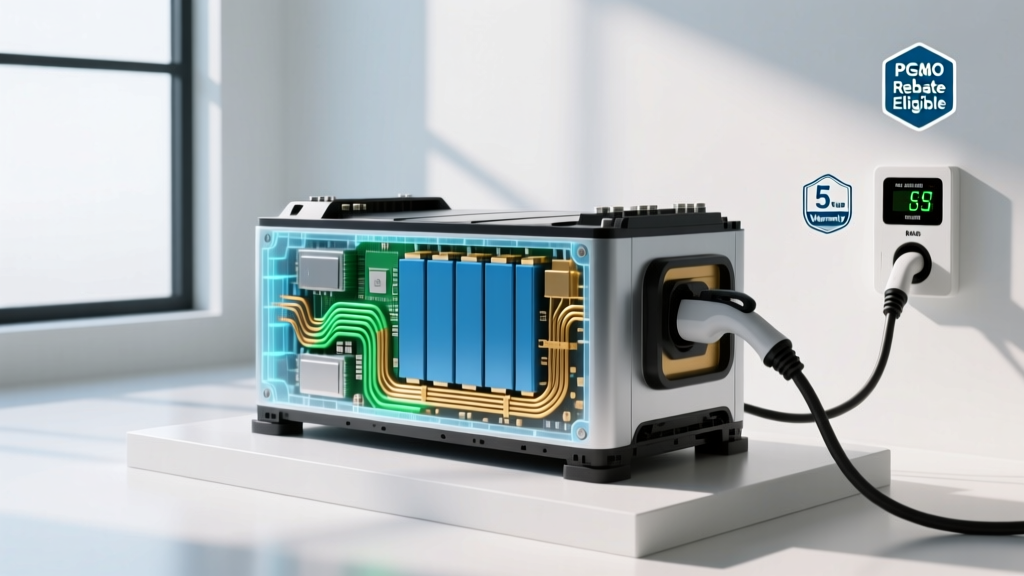
When engineers refer to the battery core, they mean the high-voltage traction battery pack — the assembly of lithium-ion cells, thermal management hardware, battery management system (BMS), and structural housing that stores and delivers energy to the drive motors. This is fundamentally different from the 12V auxiliary battery that powers lights, infotainment, and computers. The traction pack typically operates between 350V and 800V depending on the platform, and its capacity is measured in kilowatt-hours (kWh) — the total energy it can store.
A 2025 Tesla Model Y Long Range, for example, carries roughly 75 kWh of usable capacity in an NMC pack, while a base 2025 Tesla Model 3 RWD uses a ~57 kWh LFP pack. The chemistry inside those cells determines everything from range and charging speed to how the pack ages over a decade of use.
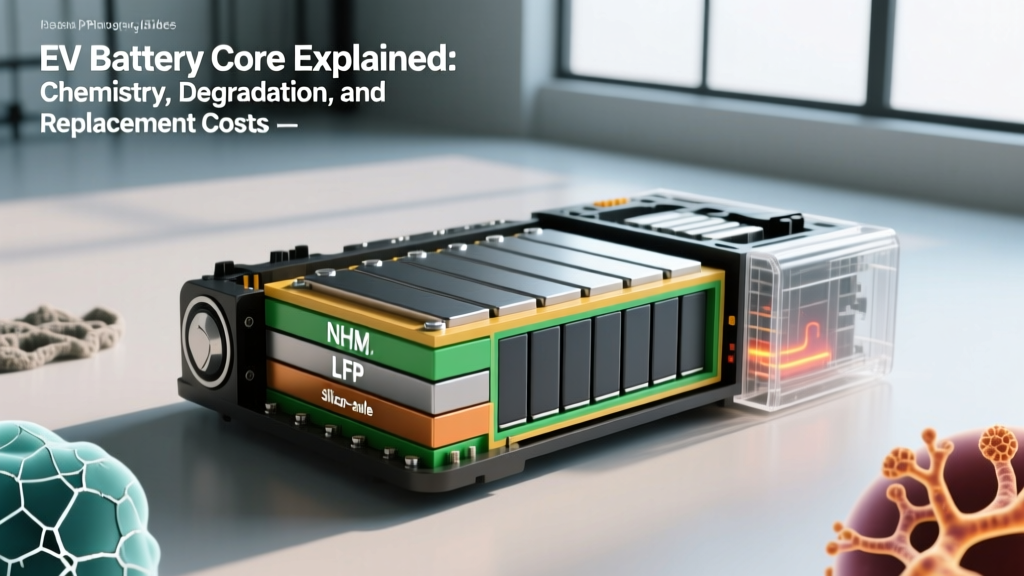
LFP vs NMC/NCA: Chemistry Trade-Offs That Matter
Two dominant cell chemistries power nearly every EV sold in the US today. Understanding the difference is essential before you buy, because chemistry affects daily charging habits, cold-weather performance, and long-term durability.
| Attribute | LFP (Lithium Iron Phosphate) | NMC / NCA (Nickel Manganese Cobalt / Nickel Cobalt Aluminum) |
|---|---|---|
| Energy density | Lower (~160-180 Wh/kg cell-level) | Higher (~220-260 Wh/kg cell-level) |
| Typical vehicle use | Standard-range / base trims (Tesla Model 3 RWD, Ford Mustang Mach-E Select SR) | Long-range / performance trims (Model Y LR, Hyundai Ioniq 5 LR, Rivian R1T) |
| Cycle life | 3,000-5,000+ cycles to 80% SoH | 1,000-2,000 cycles to 80% SoH |
| Daily charging recommendation | Can charge to 100% daily without significant harm | Best kept at 80% daily; 100% for trips only |
| Cold-weather performance | Weaker — greater range loss below freezing (~35-40% loss) | Better — still loses ~25-30% below freezing but recovers faster |
| DC fast-charge speed | Generally slower peak kW; flatter curve | Higher peak kW (up to 350 kW on 800V platforms) |
| Cost per kWh | ~$90-110/kWh (cell-level, 2025 pricing) | ~$120-145/kWh (cell-level, 2025 pricing) |
| Cobalt content | Zero — no cobalt, no nickel | Contains cobalt and nickel (sourcing concerns) |
Which is better? There is no universal winner. If you drive a predictable daily commute, have home charging, and rarely road-trip in winter, LFP offers exceptional longevity and the simplicity of charging to 100% every night. If you need maximum range per charge, frequently DC fast-charge on road trips, or live in a cold climate, NMC/NCA delivers better real-world performance. The trade-off is a more conservative daily charging habit and a somewhat shorter cycle life — though even NMC packs routinely exceed 200,000 miles before hitting the 70% capacity threshold.
Real-World Degradation: What the Data Shows
EV batteries do not suddenly fail. They gradually lose capacity over time and charge cycles, measured as State of Health (SoH) — where 100% is the original capacity and 70-80% is the typical warranty threshold.
Typical degradation trajectory (compiled from fleet data and owner reports):
- Year 1 / 15,000 mi: 2-4% loss (initial formation loss, most pronounced in NMC)
- Year 3 / 45,000 mi: 5-8% total loss
- Year 5 / 75,000 mi: 7-12% total loss
- Year 8 / 120,000 mi: 10-17% total loss (most packs remain above 80% SoH)
- Year 10+ / 150,000+ mi: 12-22% total loss (varies heavily by chemistry, climate, and charging habits)
Data from Recurrent Auto's 2024 fleet study of over 15,000 EVs showed that the median Tesla Model 3 Long Range (NMC) retained approximately 87% of original range at 100,000 miles. Chevrolet Bolt EV owners (LG NMC cells) showed a wider spread, with some early 2017-2018 packs affected by the manufacturing-defect recall, but post-recall replacement packs holding up well. LFP-equipped Tesla Model 3 RWD vehicles have shown even slower degradation, with many exceeding 90% SoH at 60,000 miles.
The key insight: degradation is front-loaded. The steepest drop occurs in the first 20,000 miles, then the curve flattens considerably. This is why most batteries will outlast the vehicle's economic life.
Battery Warranty Coverage: What You're Protected Against
Federal law effectively mandates that EV manufacturers provide a minimum battery warranty of 8 years or 100,000 miles (whichever comes first), though the specific capacity-retention threshold varies by brand. California and states that follow CARB rules may require 10 years/150,000 miles for certain emissions-related components, though traction battery rules differ.
| Manufacturer | Warranty Period | Capacity Retention Threshold | Notes |
|---|---|---|---|
| Tesla (Model 3/Y LR) | 8 yr / 120,000 mi | 70% | NMC pack; covers defects + capacity loss |
| Tesla (Model 3 RWD / LFP) | 8 yr / 100,000 mi | 70% | LFP pack; same threshold |
| Hyundai / Kia (E-GMP) | 10 yr / 100,000 mi | 70% | Among the longest coverage periods |
| Ford (Mach-E / F-150 Lightning) | 8 yr / 100,000 mi | 70% | Applies to both LFP and NMC trims |
| GM (Ultium platform) | 8 yr / 100,000 mi | 70% | Covers battery and electric propulsion components |
| Rivian | 8 yr / 175,000 mi | 70% | Higher mileage cap reflects truck use case |
| BMW (iX / i4) | 8 yr / 100,000 mi | 70% | Includes thermal management system |
What the warranty covers: Manufacturing defects, cell failures, BMS faults, and capacity loss below the stated threshold under normal use. It does not cover damage from accidents, flooding, improper modifications, or use outside manufacturer guidelines. If your pack drops below 70% SoH within the warranty window, the manufacturer will repair or replace it — typically with a refurbished pack of equivalent or better capacity, not necessarily a brand-new unit.
EV Battery Replacement Cost: The Real Numbers
This is the question that generates the most fear — and the most misinformation. Let's ground it in data.
| Vehicle / Pack Size | Chemistry | Full Pack Replacement Cost | Module-Level Repair |
|---|---|---|---|
| Tesla Model 3 RWD (~57 kWh) | LFP | $12,000 - $15,000 | $2,000 - $4,500 per module |
| Tesla Model Y LR (~75 kWh) | NMC | $14,000 - $18,000 | $2,500 - $5,000 per module |
| Hyundai Ioniq 5 LR (~77 kWh) | NMC | $14,000 - $20,000 | $2,000 - $4,000 per module |
| Ford F-150 Lightning Ext. Range (~131 kWh) | NMC | $22,000 - $32,000 | $3,500 - $6,000 per module |
| Chevrolet Equinox EV (~85 kWh) | NMC (Ultium) | $15,000 - $22,000 | Module data still emerging |
| Rivian R1T Large Pack (~135 kWh) | NMC | $22,000 - $30,000 | $3,000 - $5,500 per module |
When is replacement actually needed? Full pack replacement due to degradation alone is rare within the first 150,000 miles. Most out-of-warranty replacements occur because of physical damage (collision, ground strike), coolant intrusion, or isolated manufacturing defects in older models. Module-level repair — replacing only the degraded or failed cell modules rather than the entire pack — is increasingly common and dramatically reduces cost. Many independent EV shops now offer module-level diagnostics and repair.
For context, the average American keeps a vehicle for about 8.5 years and drives roughly 14,000 miles per year, totaling ~119,000 miles. The vast majority of EVs will never need a battery replacement during a single ownership period, and the cost of replacement continues to decline as cell prices fall and the refurbishment market matures.
What Degrades a Battery Core — and What Doesn't
Not all miles are equal. How you charge, drive, and store your EV has a measurable impact on how quickly the battery core loses capacity.
Factors That Accelerate Degradation
- Frequent DC fast charging above 150 kW: Occasional road-trip fast charging is fine, but daily reliance on 250-350 kW DCFC generates sustained heat that stresses cells. Studies show packs fast-charged more than 3x per week degrade 2-5% faster over 5 years.
- Sustained high State of Charge in NMC packs: Storing an NMC battery at 100% SoC for days or weeks accelerates electrolyte decomposition. Charge to 80% daily; reserve 100% for departure day.
- Deep discharges below 10%: Regularly running the pack to near-zero stresses the anode. Try to keep SoC above 15-20% for daily use.
- Extreme heat exposure: Parking in sustained 100°F+ ambient heat without thermal management active accelerates calendar aging. Garage parking helps significantly in hot climates.
- Aggressive driving in extreme cold: Drawing maximum current from a cold-soaked pack (below 20°F) without preconditioning causes lithium plating on the anode — a form of permanent damage.
Factors That Have Minimal Impact
- Level 2 home charging: Charging at 7-11 kW (Level 2) generates very little heat and is ideal for daily use. This is the equivalent of "slow charging" and is gentle on cells.
- Regenerative braking: Regen sends energy back into the pack at moderate rates and does not meaningfully accelerate degradation.
- Mileage alone: A pack driven 150,000 highway miles with moderate charging habits will typically show less degradation than one driven 80,000 miles with daily 250 kW fast charging and 100% storage.
Monitoring Your Battery's State of Health
You do not need to guess about your pack's condition. Multiple tools exist for checking State of Health (SoH):
- In-vehicle displays: Tesla's app shows estimated range at 100% charge, which you can compare to the original EPA rating. Hyundai/Kia's infotainment includes an EV battery health screen showing SoH percentage. Ford's SYNC system provides battery health status in the EV settings menu.
- OBD-II diagnostic apps: Devices like the OBDLink MX+ paired with apps such as EV Bat Mon (for select models) or Car Scanner can read BMS-reported SoH, cell voltage variance, and pack temperature data directly.
- Third-party services: Companies like Recurrent Auto offer free battery health reports by connecting to your vehicle's telematics data. Their fleet-level analytics provide a SoH score compared to similar vehicles.
- Dealer diagnostics: Any authorized service center can perform a full battery health check that reads individual module voltages, internal resistance, and capacity estimates. Request this before buying a used EV.
A healthy pack should show cell voltage variance of less than 20-30 mV between the highest and lowest module at rest. Larger variance suggests an imbalanced or degrading module that may warrant service.
Looking Ahead: Solid-State, Silicon Anode, and What's Real
Next-generation battery technologies are frequently hyped, so it is worth separating what is in production from what remains in the lab.
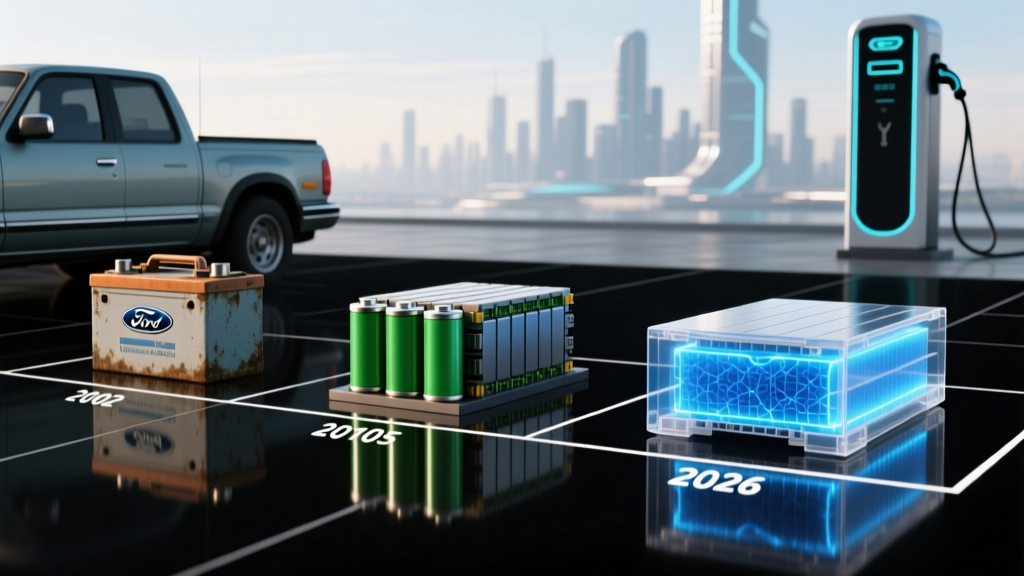
Silicon-dominant anodes: Companies like Sila Nanotechnologies and Group14 are already shipping silicon-carbon composite anode materials to cell manufacturers. These increase energy density by 15-25% over graphite anodes and are beginning to appear in limited production cells as of 2025. Expect broader adoption in 2026-2028 model-year vehicles, particularly in performance-oriented packs where energy density matters most.
Solid-state batteries: Toyota, Samsung SDI, and QuantumScape have demonstrated solid-state prototype cells with impressive energy density (potentially 400+ Wh/kg) and fast-charge capability. However, manufacturing yield, cost, and scale remain significant barriers. Toyota has announced a limited production target for 2027-2028, but widespread availability in affordable consumer EVs is realistically a 2030+ proposition. Any vehicle currently on sale in the US uses liquid-electrolyte lithium-ion cells.
Sodium-ion batteries: CATL has begun producing sodium-ion cells for low-cost, short-range EVs in China. These use no lithium, cobalt, or nickel, and perform well in cold weather, but have significantly lower energy density (~120-140 Wh/kg). They may appear in US-market entry-level EVs or as range-extender buffer packs by the late 2020s.
For buyers shopping today, current LFP and NMC chemistries are mature, well-understood, and backed by extensive warranty coverage. Waiting for solid-state means waiting years — and paying a premium when it first arrives.
Frequently Asked Questions
How long do EV batteries last in years and miles?
Based on fleet data, most modern EV battery packs retain 80-90% of original capacity at 100,000 miles and remain functional well past 150,000-200,000 miles. In calendar years, expect 12-20 years of usable service life before capacity drops below the 70% threshold. LFP packs typically outlast NMC packs in cycle life, though NMC retains an advantage in energy density and cold-weather performance. The battery will almost certainly outlive the rest of the vehicle's mechanical and economic lifespan.
How much does an EV battery cost to replace?
Full pack replacement costs range from approximately $12,000 for a smaller LFP pack (Tesla Model 3 RWD) to $32,000 for a large NMC pack (Ford F-150 Lightning Extended Range). However, most failures can be addressed at the module level for $2,000-$6,000, and full replacements due to degradation alone are rare within 150,000 miles. Costs continue to decline as cell prices fall and the refurbished pack market grows.
What does the EV battery warranty actually cover?
Federal minimum coverage is 8 years/100,000 miles with a capacity retention threshold of 70% for most manufacturers (some extend to 10 years). The warranty covers manufacturing defects, cell failures, thermal management system faults, and capacity loss below the threshold under normal use. It does not cover accident damage, flooding, or modifications. Warranty service typically involves a refurbished replacement pack, not a new one.
How do I check my EV battery health?
Use your vehicle's built-in battery health display (available on most 2022+ EVs), connect an OBD-II reader with EV-compatible software, or sign up for a free telematics-based report from a service like Recurrent Auto. For a pre-purchase inspection on a used EV, request a dealer diagnostic that reads individual module voltages and internal resistance.
Is LFP or NMC better for my situation?
Choose LFP if you have reliable home charging, drive a moderate daily commute (under 100 miles), want to charge to 100% without worry, and prioritize maximum cycle life. Choose NMC if you need the longest possible range per charge, frequently take road trips requiring DC fast charging, live in a cold climate, or need the lightest possible pack for performance. Both chemistries are proven and will comfortably last 150,000+ miles with reasonable care.
The battery core of a modern EV is a remarkably durable component — far more so than the public perception suggests. With degradation rates of 1-2% per year under typical use, warranty coverage extending to 8-10 years, and replacement costs declining steadily, the battery is no longer the financial time bomb that early EV skeptics predicted. The smartest move is to understand your chemistry, follow basic charging best practices, and let the data — not the fear — guide your decision.