Search forums or browse EV accessories and you'll eventually encounter the term battery conditioner. In the world of 12-volt lead-acid car batteries, a conditioner (or smart maintainer) is a well-understood device that pulses current to prevent sulfation and extend shelf life. But when it comes to the high-voltage lithium-ion traction battery powering a modern electric vehicle, the concept shifts dramatically — and a lot of misinformation fills the gap.
This guide cuts through the noise. We'll explain what battery conditioning actually means for an EV, how your car's Battery Management System (BMS) already handles most of what a "conditioner" promises, and what you genuinely need to know about chemistry, degradation, warranty coverage, and replacement costs to keep your EV's pack healthy for 200,000 miles and beyond.
What a "Battery Conditioner" Actually Means for an EV
In a conventional gasoline car, a battery conditioner is an external device you clamp onto the 12V battery terminals to maintain charge and desulfate plates during storage. That concept does not translate to an EV's traction battery for several reasons:
- Voltage and architecture: EV traction batteries operate at 400V (or 800V in platforms like Hyundai's E-GMP and Porsche's Taycan). No consumer-grade external device can or should interface with these systems.
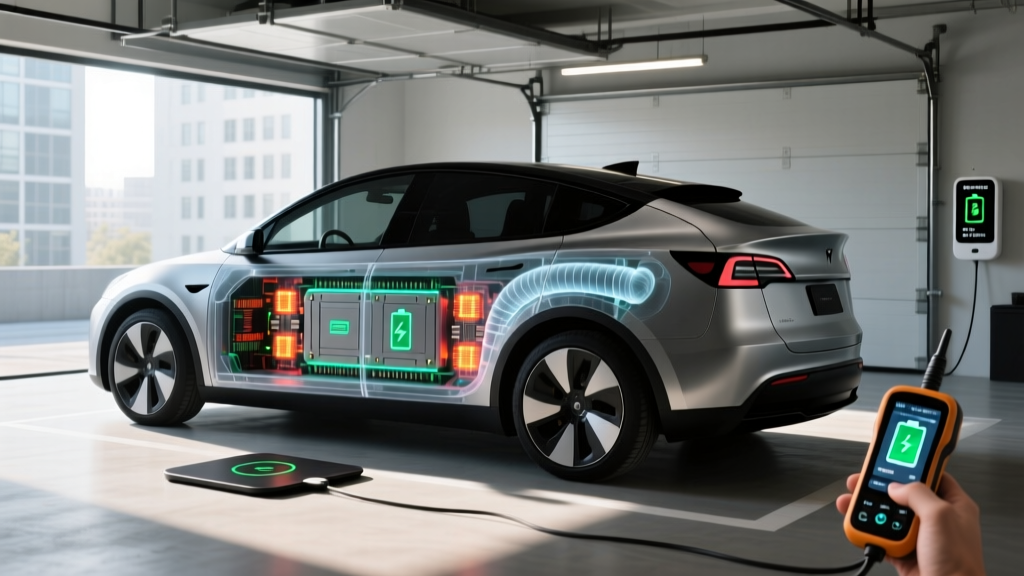
- Integrated BMS: Every EV has a sophisticated Battery Management System that monitors individual cell voltages, temperatures, and state of charge (SoC) hundreds of times per second. It performs cell balancing, thermal regulation, and charge-limiting internally — functions a standalone "conditioner" would attempt externally on a simpler battery.
- Software-defined conditioning: Many EVs offer a scheduled departure or preconditioning feature that warms or cools the battery to an optimal temperature before driving or charging. Tesla, Ford, BMW, and Hyundai all include this. This is your battery conditioner — it's built into the car.
Some third-party OBD-II dongles and apps (like Tessie for Tesla or LeafSpy for Nissan) can read detailed battery health metrics and log degradation over time. These are diagnostic tools, not conditioners. They help you monitor health, but they don't alter the BMS's behavior or physically condition cells.
LFP vs. NMC/NCA: Choosing Your Battery Chemistry
The single most important factor in long-term battery health is the chemistry inside the cells. As of 2026, virtually all mass-market EVs use one of two lithium-ion chemistries: LFP (lithium iron phosphate) or NMC/NCA (nickel manganese cobalt / nickel cobalt aluminum). Each has distinct trade-offs.
| Attribute | LFP (Lithium Iron Phosphate) | NMC / NCA (Nickel-based) |
|---|---|---|
| Energy density | Lower (~160–180 Wh/kg cell-level) | Higher (~220–260 Wh/kg cell-level) |
| Cycle life | 3,000–5,000+ cycles to 80% capacity | 1,000–2,000 cycles to 80% capacity |
| Cold-weather performance | Weaker — more range loss below 32°F | Better low-temp discharge and charge acceptance |
| Recommended daily SoC | 100% (periodic full charges help BMS balancing) | 80% daily; 100% only for trips |
| Cost per kWh | Lower — no cobalt or nickel | Higher — commodity-priced metals |
| Thermal stability | Excellent — very low thermal runaway risk | Good but requires more active thermal management |
| Common in (2026 models) | Tesla Model 3/Y RWD, Ford Mustang Mach-E Select, BYD, Rivian Standard | Tesla Long Range, Hyundai Ioniq 5/6, Chevy Equinox EV, BMW iX, Porsche Taycan |
Which is better? It depends on your use case. If you prioritize maximum range per charge and live in a cold climate, NMC/NCA's higher energy density and better cold performance make it the stronger pick. If you plan to own the vehicle for 10+ years, charge at home daily, and value longevity over peak range, LFP's superior cycle life and 100% daily-charge tolerance make it the more durable choice. Neither chemistry is universally "better" — they optimize for different ownership patterns.
How Long Do EV Batteries Actually Last? Degradation Data
This is the question that drives most "battery conditioner" searches. The short answer: far longer than most buyers fear. Data aggregated from fleet operators, owner surveys, and manufacturer reports consistently shows that modern EV batteries lose roughly 1–2% of total capacity per year under normal use, with the steepest drop occurring in the first year or two (typically 2–5%) before the curve flattens considerably.
- Year 1 / 15,000 mi: ~3–5% loss (initial formation period)
- Year 3 / 45,000 mi: ~7–9% total loss
- Year 5 / 75,000 mi: ~9–12% total loss
- Year 8 / 120,000 mi: ~12–16% total loss
- Year 10 / 150,000 mi: ~14–20% total loss
Source: Geotab fleet battery health study (aggregated data from 10,000+ EVs). Individual results vary by climate, charging habits, and chemistry. LFP packs generally show slower degradation in the 3–10% range over the same period.
To put this in practical terms: a 2026 Tesla Model Y Long Range with an EPA-rated 320 miles and an NMC pack might deliver ~270–280 real-world miles after 8 years of typical use. That's still enough for the vast majority of daily driving, and it's why most EV batteries will outlast the vehicle's body, suspension, and interior before they become functionally inadequate.
Battery Warranty Terms: What's Actually Covered
Federal law mandates that EV batteries carry a minimum warranty of 8 years or 100,000 miles (whichever comes first). In California and states that follow CARB emissions rules, that extends to 10 years / 150,000 miles. Most major automakers meet or exceed these minimums.
| Manufacturer / Model | Warranty Period | Capacity Retention Threshold | Chemistry |
|---|---|---|---|
| Tesla Model 3/Y Long Range | 8 yr / 120,000 mi | 70% | NMC |
| Tesla Model 3/Y RWD | 8 yr / 100,000 mi | 70% | LFP |
| Hyundai Ioniq 5 / Ioniq 6 | 10 yr / 100,000 mi | 70% | NMC |
| Ford Mustang Mach-E | 8 yr / 100,000 mi | 70% | NMC (LFP on Select) |
| Chevrolet Equinox EV / Blazer EV | 8 yr / 100,000 mi | 70% (60% for fleet) | NMC |
| Rivian R1T / R1S | 8 yr / 175,000 mi | 70% | NMC (LFP on Standard) |
| BMW i4 / iX | 8 yr / 100,000 mi | 70% | NMC |
What triggers a warranty claim? If your battery's usable capacity drops below the stated threshold (typically 70% of original) within the warranty period, the manufacturer must repair or replace it at no cost. Note that the warranty covers capacity degradation beyond the threshold and defects — it does not cover damage from accidents, flooding, or unauthorized modifications. Always check the specific language in your owner's manual, as terms like "usable capacity" vs. "gross capacity" can affect the math. For official warranty requirements, see the EPA's EV battery guidance.
EV Battery Replacement Costs: The Real Numbers
The fear of a $20,000+ battery replacement is the single biggest psychological barrier to EV adoption. Let's ground this in actual data.
| Vehicle / Pack Size | Battery Capacity | Estimated Replacement Cost | Notes |
|---|---|---|---|
| Tesla Model 3 RWD | ~60 kWh (LFP) | $8,000 – $12,000 | LFP packs cheaper; module-level repair sometimes possible |
| Tesla Model Y Long Range | ~75 kWh (NMC) | $12,000 – $16,000 | Structural pack; full replacement more common |
| Hyundai Ioniq 5 | 77.4 kWh (NMC) | $14,000 – $18,000 | 800V architecture; specialized service required |
| Ford F-150 Lightning (Extended) | ~131 kWh (NMC) | $20,000 – $28,000 | Largest consumer pack; highest absolute cost |
| Chevrolet Bolt EV/EUV | 65 kWh (NMC) | $9,000 – $14,000 | Recall-replaced packs now use updated modules |
| Porsche Taycan | 93.4 kWh (NMC) | $22,000 – $30,000 | Premium labor rates; module-level repair available |
Critical context: These are worst-case, out-of-warranty, full-pack-replacement numbers. In practice:
- Most replacements happen under warranty at zero cost to the owner.
- Module-level repair is increasingly common. A technician can replace individual failed modules within a pack for $2,000–$5,000 rather than swapping the entire assembly.
- Battery prices continue falling. Pack-level costs have dropped below $130/kWh at the factory level (per BloombergNEF), and this trend continues. A replacement in 2034 will cost substantially less than one today.
- Catastrophic battery failure is rare. According to data from Consumer Reports' EV reliability surveys, fewer than 5% of EVs require battery replacement outside of warranty coverage over the vehicle's lifetime.
Five Factors That Actually Affect Your Battery's Lifespan
Since no external "battery conditioner" can override the physics of lithium-ion cells, your best strategy is managing the factors you can control:
Battery Health Optimization Checklist
1. Avoid sustained high State of Charge (SoC) — for NMC packs.
Storing an NMC battery at 100% SoC for days or weeks accelerates calendar degradation. Set your daily charge limit to 80% and only charge to 100% when you'll be driving a long distance within hours. LFP owners: charge to 100% regularly — your BMS needs full-charge events for accurate cell balancing.
2. Minimize DC fast charging frequency.
Occasional DC fast charging (1–2 sessions per week) has negligible long-term impact, per Geotab's fleet data. But daily reliance on 150+ kW DCFC — especially in hot weather without preconditioning — does measurably increase degradation. If you have Level 2 home charging, use it as your primary method and reserve DCFC for road trips.
3. Use battery preconditioning before fast charging.
Navigating to a Supercharger or Electrify America station with your car's built-in navigation triggers battery preconditioning — warming the pack to ~95°F for optimal charge acceptance. This reduces charging time and stress on cells. If your car doesn't auto-precondition, manually activate it 15–20 minutes before plugging in.
4. Park in temperature-moderate environments when possible.
Extreme heat (sustained 100°F+ ambient) accelerates calendar degradation more than extreme cold. A garage or shaded parking spot in summer materially helps. Cold weather reduces range temporarily but does not cause permanent damage — the battery recovers capacity when it warms up.
5. Don't let the pack sit at very low SoC for extended periods.
Storing an EV at 0–5% SoC for weeks risks cell damage from copper dissolution. If storing for more than a week, leave the car plugged in with a 50% charge limit, or at minimum at 30–50% SoC.
How to Monitor Your Battery's State of Health (SoH)
State of Health (SoH) is the percentage of your battery's current maximum capacity compared to its original capacity when new. A brand-new pack is 100% SoH; a pack that can now store only 65 kWh of its original 75 kWh is at ~87% SoH.
How to check SoH by brand:
- Tesla: The in-car battery health screen (added in 2023 software updates) shows a degradation graph. Third-party apps like Tessie or Stats for Tesla pull more granular data via the vehicle API.
- Hyundai / Kia: The infotainment system's EV menu shows battery health percentage. The Caristo / Kia Connect app also displays SoC trends.
- Ford: The FordPass app shows estimated range trends. For detailed SoH, a dealer can pull the Battery Health Report via the diagnostic port.
- Nissan Leaf: The dashboard "battery bars" (out of 12) give a rough SoH estimate. LeafSpy Pro (via an OBD-II dongle) provides exact SoH percentage, cell voltage spread, and Hx (internal resistance) values — the gold standard for Leaf monitoring.
- BMW / Porsche / Mercedes: Dealer diagnostic tools provide the most accurate SoH readouts. Some models surface a health percentage in the infotainment EV menu.
When to be concerned: If your SoH drops more than 3–4% in a single year (after the initial break-in period), or if you notice sudden range drops, uneven cell voltages, or frequent charge interruptions, schedule a dealer diagnostic. These can indicate a failing module rather than normal degradation — and module-level repair may be covered under warranty.
Emerging Battery Tech: Solid-State and Silicon Anodes
Next-generation battery technologies are advancing, but realistic timelines matter. Here's where things stand as of 2026:
- Solid-state batteries: Toyota has announced limited production of solid-state-equipped vehicles for 2027–2028, targeting ~450-mile range and 10-minute fast charging. Samsung SDI and QuantumScape are also in advanced pilot production. However, solid-state packs remain significantly more expensive than current lithium-ion and will debut in low-volume, premium applications before reaching mass-market pricing. Widespread availability across multiple price segments is realistically a 2030+ proposition.
- Silicon-dominant anodes: Companies like Sila Nanotechnologies and Group14 are supplying silicon-composite anode materials to automakers including Mercedes-Benz and Porsche. These boost energy density by 10–20% over graphite anodes and are entering production in select 2026–2027 models. This is an incremental improvement, not a revolution — but it does mean future packs will store more energy in the same physical space.
- Sodium-ion batteries: CATL and BYD have begun producing sodium-ion packs for lower-cost, shorter-range EVs (primarily in the Chinese market). Sodium-ion offers lower energy density but dramatically lower material cost and excellent cycle life. U.S. availability remains limited and is expected to arrive first in commercial/fleet applications.
None of these technologies are currently available in vehicles you can buy today in the U.S. market. If you're shopping now, current-generation LFP and NMC packs — with proper care — will serve you well for the life of the vehicle.
Frequently Asked Questions
Do I need to buy a battery conditioner for my EV?
No. Your EV's integrated Battery Management System (BMS) and thermal management system handle cell balancing, temperature regulation, and charge optimization automatically. No external consumer device can or should interface with the 400V–800V traction battery. A 12V battery maintainer is useful for the auxiliary battery if the car sits unused for weeks, but it does nothing for the main pack.
How long do EV batteries last in years and miles?
Based on fleet data from Geotab and manufacturer reports, most modern liquid-cooled EV batteries retain 80–85% of original capacity after 10 years or 150,000 miles of typical use. Many will outlast the vehicle itself. Catastrophic failure requiring full replacement is uncommon — fewer than 5% of EVs need an out-of-warranty pack swap, per Consumer Reports data.
How much does it cost to replace an EV battery?
Full pack replacement costs range from roughly $8,000 (smaller LFP packs like the Tesla Model 3 RWD) to $28,000+ (large packs like the F-150 Lightning Extended Range). However, most replacements occur under the 8-year/100,000-mile federal warranty at no cost. Module-level repairs, when possible, cost $2,000–$5,000. Prices are declining as pack-level costs fall below $130/kWh.
What does the EV battery warranty actually cover?
Federal law requires a minimum 8-year/100,000-mile warranty (10 years/150,000 miles in CARB states). Coverage applies if the battery's usable capacity degrades below the manufacturer's stated threshold — typically 70% of original capacity. It covers defects and abnormal degradation but not damage from accidents, flooding, or unauthorized modifications. Always read your specific warranty booklet for exact terms.
LFP or NMC — which battery chemistry should I choose?
Choose LFP if you want maximum cycle life, can charge to 100% daily without worry, prioritize lower cost, and don't need absolute maximum range. Choose NMC/NCA if you need the longest single-charge range, live in a consistently cold climate, or value higher energy density in a smaller/lighter pack. Both chemistries will last the life of the vehicle with proper care.
Does fast charging damage my EV battery?
Occasional DC fast charging has minimal impact on long-term battery health, according to Geotab's analysis of over 10,000 EVs. However, daily DCFC use — especially without battery preconditioning and in hot weather — does measurably increase degradation over time. Use Level 2 home charging as your primary method and save DCFC for road trips.
How do I check my EV's battery State of Health?
Most modern EVs display battery health or degradation data in the infotainment system or companion app. Tesla shows a degradation graph in-car; Hyundai/Kia show health percentage in the EV menu; Nissan Leaf owners can use LeafSpy Pro with an OBD-II dongle for detailed cell-level data. For the most accurate readout, a dealer diagnostic scan provides a certified SoH report.