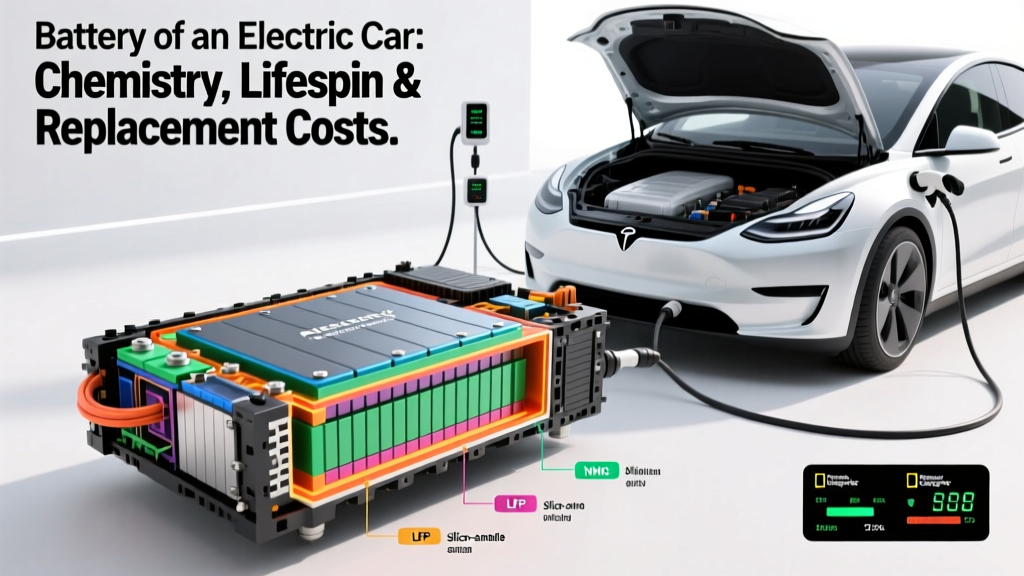
The battery of an electric car is its single most expensive component and the part that generates the most buyer anxiety. Yet data from millions of miles of real-world operation shows that modern EV batteries are lasting far longer than early skeptics predicted — with most outliving the vehicles they power. This guide breaks down exactly what's inside your EV's battery pack, how chemistry choices affect daily driving, what degradation actually looks like in numbers, and what you'd pay if a replacement ever becomes necessary.
LFP vs NMC/NCA: Choosing the Right Chemistry for Your Driving
Every EV battery pack uses lithium-ion cells, but the cathode chemistry varies significantly — and it matters more than most buyers realize. Two families dominate the 2026 market: NMC/NCA (nickel manganese cobalt / nickel cobalt aluminum) and LFP (lithium iron phosphate). Understanding the trade-offs helps you choose the right car for your driving pattern.
NMC/NCA batteries offer higher energy density, meaning more range in a lighter, more compact pack. They perform better in cold weather and deliver stronger peak power for acceleration. Tesla's Model Y Long Range, Hyundai Ioniq 5, and most premium EVs use NMC/NCA chemistry. The trade-off: they degrade slightly faster under high-heat conditions, carry ethical concerns around cobalt sourcing, and cost more per kWh to manufacture.
LFP batteries sacrifice roughly 15-25% in energy density for dramatically longer cycle life — often exceeding 3,000-5,000 full charge cycles versus 1,000-2,000 for NMC. They're cheaper to produce, contain no cobalt or nickel, and tolerate daily 100% charging without accelerated wear. Tesla's Model 3 Standard Range, Rivian's standard pack, and many Chinese-market EVs use LFP. The downsides: reduced cold-weather range (expect 30-40% loss below freezing vs. 20-30% for NMC) and lower energy density means heavier packs for equivalent range.
| Attribute | NMC / NCA | LFP |
|---|---|---|
| Energy Density | 220–300 Wh/kg (cell level) | 160–200 Wh/kg (cell level) |
| Typical Cycle Life | 1,000–2,000 full cycles | 3,000–5,000+ full cycles |
| Cold-Weather Range Loss | ~20–30% below 32°F | ~30–40% below 32°F |
| 100% SoC Daily Charging | Not recommended (accelerates wear) | Recommended (LFP needs full charge for BMS calibration) |
| Cost per kWh (pack level) | $130–$160 | $90–$120 |
| Thermal Stability | Good (requires active cooling) | Excellent (inherently more stable) |
| Common In 2026 Models | Tesla Model Y LR, Ioniq 5, F-150 Lightning Extended | Tesla Model 3 RWD, Rivian R1S Standard, BYD Seal |
Which is better? If you need maximum range, tow frequently, or live in a cold climate, NMC/NCA is the stronger choice. If you charge at home daily, commute moderate distances, and want a battery virtually guaranteed to outlast the car, LFP's longevity and lower cost are compelling.
How Long Do EV Batteries Actually Last?
The short answer: longer than most owners will keep the car. A typical modern EV battery is engineered for 1,500–3,000+ full charge-discharge cycles before reaching 70-80% of original capacity. For a vehicle with 300 miles of EPA range, that translates to 450,000–900,000 miles of theoretical use.
Real-world data paints a reassuring picture. According to fleet data analyzed by Recurrent Auto, the average EV battery loses roughly 5-8% of its capacity in the first two years (the initial "break-in" degradation curve), then settles into a slow linear decline of about 1-2% per year afterward. Here's what that looks like in practice:
| Vehicle Age | Typical Capacity Retained | Range Impact (on 300-mi EPA pack) |
|---|---|---|
| Year 1 | 95–97% | ~285–291 miles |
| Year 3 | 92–95% | ~276–285 miles |
| Year 5 | 89–93% | ~267–279 miles |
| Year 8 | 85–90% | ~255–270 miles |
| Year 10 | 82–88% | ~246–264 miles |
| Year 15 | 75–84% | ~225–252 miles |
These figures represent averages across temperate climates with mixed charging habits. Hot-climate owners (Arizona, Texas) who DC fast-charge daily may see the higher end of degradation; mild-climate owners who charge slowly at home often beat these numbers.
Tesla's own 2024 Impact Report showed that Model S/X batteries retained an average of 88% capacity at 200,000 miles — a figure consistent with independent testing by Recurrent and data from high-mileage fleet operators. The Chevrolet Bolt EV, despite its older NMC chemistry, has shown remarkably low degradation in Recurrent's dataset, with most 2017-2022 packs still above 90% capacity at five years.
What the Battery Warranty Actually Covers
Federal law mandates a minimum 8-year/100,000-mile warranty on EV battery packs for emissions-related compliance, but most manufacturers exceed this baseline. The warranty covers defects and excessive capacity loss — typically defined as falling below 70% of original usable capacity.
| Manufacturer (2026 Models) | Warranty Period | Capacity Threshold | Notes |
|---|---|---|---|
| Tesla (Model 3/Y) | 8 yr / 120,000 mi (LR) • 8 yr / 100,000 mi (RWD) | 70% | Transferable to subsequent owners |
| Hyundai / Kia | 10 yr / 100,000 mi | 70% | Among the longest coverage; first-owner only for 10yr term in some states |
| Ford (F-150 Lightning, Mach-E) | 8 yr / 100,000 mi | 70% | Covers battery and electric drive components |
| GM (Ultium-based: Equinox EV, Blazer EV, Silverado EV) | 8 yr / 100,000 mi | 70% | Some commercial fleet models carry extended terms |
| Rivian | 8 yr / 175,000 mi | 70% | Highest mileage threshold in the segment |
| BMW (i4, iX, i5) | 8 yr / 100,000 mi | 70% | Preconditioning compliance required for full coverage |
Key warranty caveats: Most warranties require you to follow the manufacturer's charging guidelines — routinely DC fast-charging to 100% or ignoring thermal warnings could theoretically void coverage, though enforcement is rare. The warranty covers the battery pack itself, not range loss from tire wear, aerodynamic changes, or climate-control usage. If a single module fails, manufacturers typically replace just that module rather than the full pack, which is a faster, less invasive repair.
EV Battery Replacement Cost: What You'd Actually Pay
This is the question that keeps prospective buyers up at night. The honest answer: the vast majority of EV owners will never need a battery replacement. But if you do — whether from a manufacturing defect outside the warranty window, physical damage, or extreme degradation — here's the current landscape.
| Vehicle / Pack Size | Battery Replacement Cost (2026) | When Typically Needed |
|---|---|---|
| Tesla Model 3 RWD (~60 kWh LFP) | $8,000–$12,000 | Rarely; LFP degradation is minimal even at 300k+ miles |
| Tesla Model Y Long Range (~75 kWh NMC) | $12,000–$16,000 | Beyond 200,000 mi or post-warranty defect |
| Hyundai Ioniq 5 (~77 kWh NMC) | $11,000–$15,000 | Rare; 10-year warranty covers most ownership periods |
| Ford F-150 Lightning Extended (~131 kWh NMC) | $18,000–$28,000 | Very rare; largest packs cost most but degrade proportionally less |
| Chevrolet Equinox EV (~85 kWh NMC) | $10,000–$14,000 | Rare; Ultium modular design allows partial replacement |
| Nissan Leaf (40–62 kWh, older packs) | $6,500–$9,000 | Most common replacement candidate; passive cooling accelerates degradation in hot climates |
Several factors work in the owner's favor. Pack prices have fallen roughly 90% since 2010, dropping from over $1,200/kWh to approximately $130-$160/kWh at the pack level in 2026. Modular architectures (GM's Ultium, VW's MEB) allow technicians to replace individual modules rather than the entire pack, often cutting costs by 50-70%. A growing aftermarket and refurbished-battery market is emerging, offering remanufactured packs at 40-60% of new-pack pricing.
For context: the average American keeps a car for 8.4 years. At typical degradation rates, an EV battery will still hold 85-90% of its original capacity at that point — well above any threshold that would justify a five-figure replacement.
What Kills an EV Battery (and What Doesn't)
Not all miles and charges are created equal. Battery degradation is driven by chemistry-level stress factors, and understanding them lets you maximize your pack's lifespan.
Factors That Accelerate Degradation
- Repeated DC fast charging above 80% SoC: The charge curve tapers significantly past 80% because the battery management system (BMS) restricts current to protect cells. Forcing frequent top-offs to 100% at high power generates excess heat. Occasional fast charging is fine; daily 50 kW+ sessions to full SoC will compound wear.
- Prolonged exposure to extreme heat: Battery chemistry degrades fastest above 95°F ambient. Vehicles parked outdoors in Phoenix or Houston summers without thermal management active will age faster. Most modern EVs run cooling loops even when parked — don't disable this feature.
- Storing at 100% or 0% SoC for extended periods: Lithium-ion cells experience the most stress at the extremes of their charge window. If you're leaving the car for a week or more, target 50-60% SoC.
- Deep discharges to near-zero: Running the pack below 10% regularly stresses cells. The BMS maintains a hidden buffer (typically 2-5 kWh below the displayed 0%), but habitually arriving at zero is unnecessary wear.
- Track use / sustained high-power discharge: Repeated hard acceleration and high-speed driving generates sustained heat that passive cooling can't fully manage.
Factors That Have Minimal Impact
- Level 2 home charging (7-11 kW): This is the ideal daily charging method. Slow, steady charging generates minimal heat and is what the battery was designed for.
- Regenerative braking: Regen sends current back into the pack, but at low amperage. It does not meaningfully accelerate degradation.
- Calendar aging: All batteries lose some capacity over time regardless of use, but modern chemistries lose only ~1-2% per year from calendar effects alone.
How to Monitor Your Battery's State of Health
State of Health (SoH) is the percentage of original capacity your battery can still hold. A new pack sits at 100% SoH; a pack that held 75 kWh when new but now holds 67.5 kWh sits at 90% SoH. Here's how to check it:
In-vehicle displays: Many 2026 models include a battery health screen. Tesla owners can access SoH via the service menu (or third-party apps like Tessie). Hyundai/Kia provides SoH readouts in the EV settings menu on Ioniq 5/6 and EV6/EV9 models. BMW's iDrive includes a battery health indicator under the EV menu.
OBD-II diagnostic tools: Devices like the OBDLink MX+ paired with apps such as ABRP (A Better Route Planner) or Leaf Spy (for Nissan Leaf) can read the BMS-reported SoH directly from the vehicle's CAN bus. This method works on nearly every EV and provides the most granular data — including individual cell voltage variance, which flags early module imbalance.
Charging-based estimation: If your car doesn't report SoH natively, you can estimate it by charging from a known low SoC (say 10%) to a known high SoC (say 90%) on a metered Level 2 charger and comparing the kWh delivered (minus ~5% charging losses) to the pack's original usable capacity. For example, if a 77 kWh pack accepts only 60 kWh from 10% to 90% (an 80% window = 61.6 kWh when new), your SoH is approximately 97%.
Manufacturer service centers: Any dealership or service center can pull a full battery health report during routine service. Request this at your annual inspection — it's typically free and provides the most authoritative reading.
What's Next: Solid-State and Silicon-Anode Batteries
Two technologies dominate the forward-looking battery conversation, and both deserve grounded timelines rather than hype.
Solid-state batteries replace the liquid electrolyte in current lithium-ion cells with a solid material (ceramic, sulfide, or polymer). The promised benefits are substantial: 2-3x energy density (potentially 500+ mile packs in compact vehicles), faster charging (10-80% in under 10 minutes), and inherent fire resistance. Toyota has announced solid-state production for 2027-2028, initially in limited-run vehicles. Samsung SDI and QuantumScape are targeting similar timelines. However, manufacturing scale-up remains the critical bottleneck — lab results and pilot-line production are not the same as millions of affordable packs rolling off a gigafactory line. Realistically, solid-state batteries will appear in premium models by 2028-2029 and reach mainstream pricing by 2032-2035.
Silicon-anode batteries are closer to market. Replacing the graphite anode with silicon (or a silicon-carbon composite) increases energy density by 20-40% without requiring entirely new manufacturing infrastructure. Companies like Sila Nanotechnologies and Group14 Technologies are already supplying silicon-anode materials to battery manufacturers. Expect to see silicon-anode cells in production EVs by 2026-2027, with gradual adoption across model lines through 2030. This is an incremental improvement, not a revolution — but it meaningfully extends range without increasing pack size or weight.
Neither technology changes the buying decision today. Current NMC and LFP batteries are mature, reliable, and backed by extensive warranties. Waiting for next-generation chemistry is almost never financially rational given the depreciation and missed savings of delaying an EV purchase.
Frequently Asked Questions
How long do EV batteries last in years and miles?
Modern EV batteries are designed to last 15-20 years or 200,000-500,000 miles before degrading below 70-80% of original capacity. Fleet data from Tesla, Recurrent Auto, and high-mileage owners consistently shows 85-92% capacity retention at 100,000-150,000 miles. Most batteries will outlast the vehicle's body, suspension, and interior.
How much does it cost to replace an EV battery?
Full pack replacement costs range from $6,500 (Nissan Leaf 40 kWh) to $28,000 (F-150 Lightning Extended Range 131 kWh) in 2026. However, modular pack designs increasingly allow individual module replacement at 40-60% lower cost. The vast majority of EV owners will never need a replacement — degradation data shows most packs retain 80%+ capacity well beyond 150,000 miles.
What does the EV battery warranty cover?
Federal law mandates at minimum 8 years/100,000 miles of battery coverage. Most manufacturers warrant the pack against defects and capacity loss below 70% of original usable capacity. Hyundai/Kia leads with 10 years/100,000 miles. Rivian covers 8 years/175,000 miles. Warranties are typically transferable to second owners, though some brands limit the extended term to first owners only.
Should I charge my EV to 100% every day?
It depends on chemistry. For NMC/NCA batteries, daily charging to 80% is recommended to minimize stress — set your charge limit to 80-85% for routine use and 100% only for long trips. For LFP batteries, manufacturers actually recommend charging to 100% at least weekly to keep the BMS calibrated, because LFP's voltage curve is too flat for accurate SoC estimation at partial charge. Check your owner's manual for chemistry-specific guidance.
Does DC fast charging damage the battery?
Occasional DC fast charging has minimal impact on battery health. The concern is frequent, repeated fast charging — especially in hot weather and especially above 80% SoC, where the charge curve tapers and heat generation increases. Modern BMS and liquid cooling systems actively manage thermal loads during fast charging. If you fast-charge 2-3 times per week and primarily charge at Level 2 at home, the long-term degradation difference is negligible — typically 1-3% more loss over 100,000 miles compared to exclusive Level 2 charging.
LFP vs NMC — which battery is better for me?
Choose NMC/NCA if you need maximum range (300+ miles), regularly drive in cold climates (below 32°F), tow heavy loads, or want the lightest possible pack. Choose LFP if you charge at home daily, want the longest possible battery lifespan (3,000-5,000+ cycles), prefer lower upfront cost, and don't mind slightly less range or more cold-weather loss. For most commuters who home-charge, LFP is the more pragmatic long-term choice.