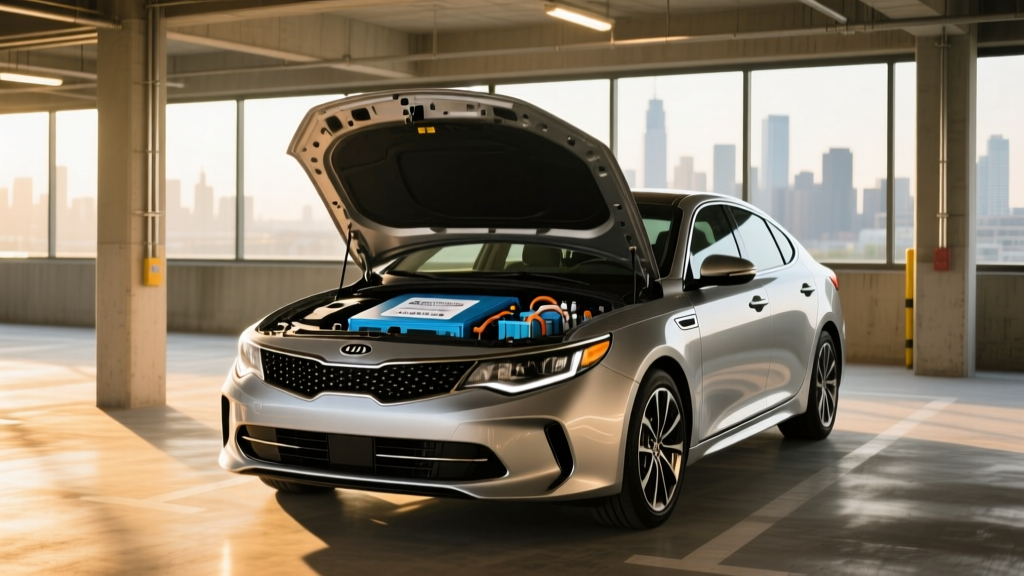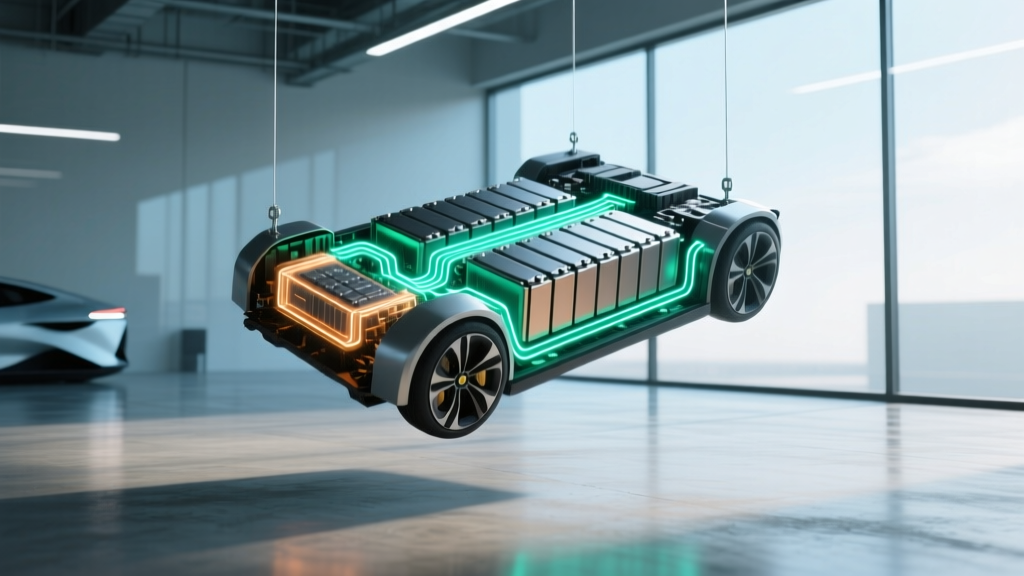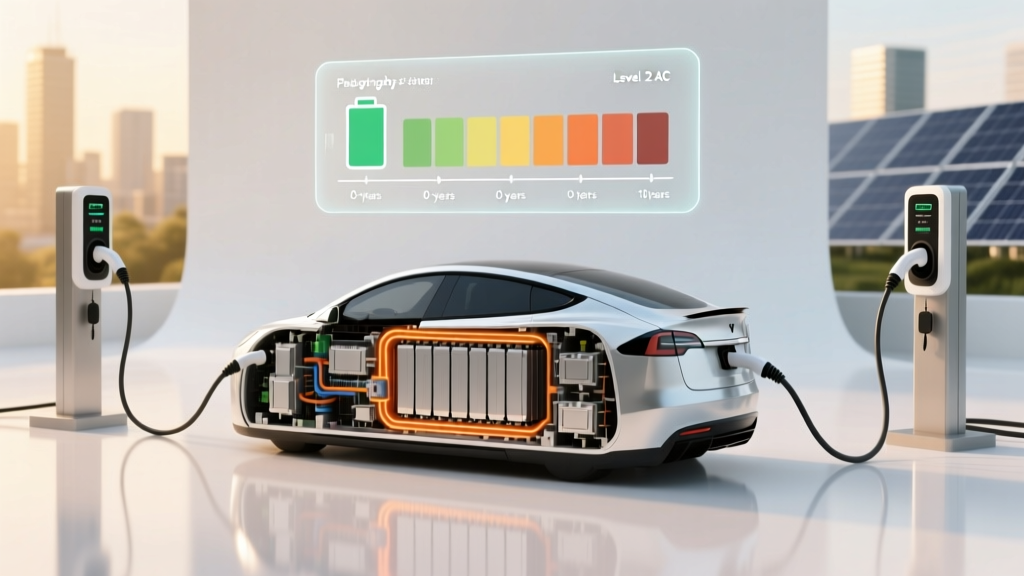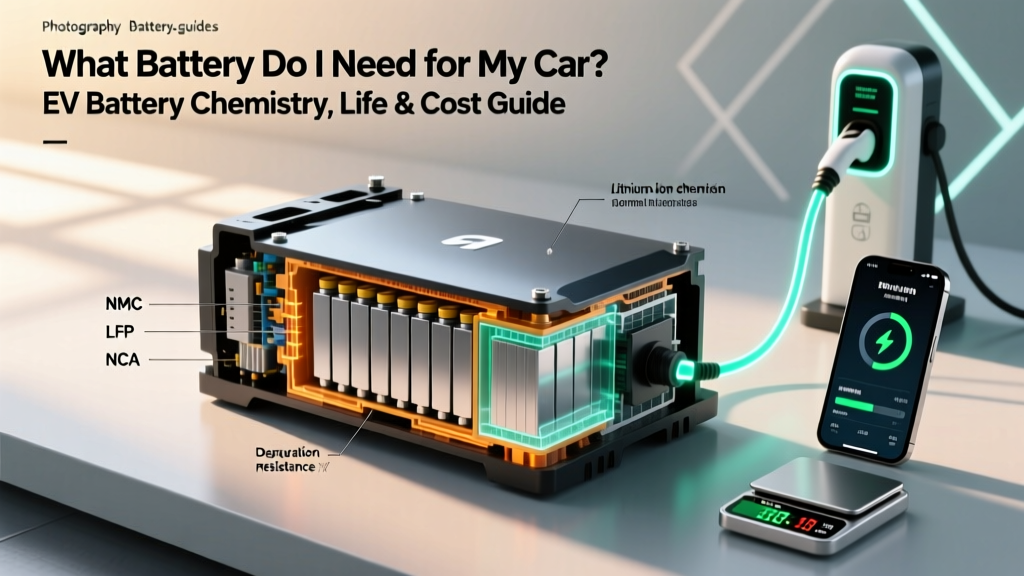
If you're shopping for an electric vehicle — or already own one — the single most expensive component in your car isn't the motor, the infotainment screen, or the suspension. It's the high-voltage traction battery. And unlike the 12V auxiliary battery that powers your lights and accessories (which you still have and should replace every 3–5 years like any car), the traction battery is what actually propels your EV and determines your range, charging speed, and long-term ownership cost.
So when buyers ask, "what battery do I need for my car?" the real questions underneath are: Which chemistry is best for my driving habits? How long will it last? What happens when it degrades? And what does replacement actually cost?
This guide answers all of those with real data — no marketing fluff, no fear-mongering.
LFP vs NMC vs NCA: Which EV Battery Chemistry Fits Your Driving?
As of 2026, nearly every EV on the US market uses one of three lithium-ion cathode chemistries: LFP (lithium iron phosphate), NMC (nickel manganese cobalt), or NCA (nickel cobalt aluminum). Tesla uses NCA in some Long Range models and LFP in Standard Range. Most other automakers — Hyundai, Kia, Ford, GM, Rivian — lean heavily on NMC. LFP adoption has surged since 2023, with BYD, Tesla, and Ford all offering LFP-equipped models.
Each chemistry carries distinct trade-offs. Here's how they compare on the metrics that actually matter to owners:
| Factor | LFP (Lithium Iron Phosphate) | NMC (Nickel Manganese Cobalt) | NCA (Nickel Cobalt Aluminum) |
|---|---|---|---|
| Energy density | Lower (~160–180 Wh/kg cell-level) | Higher (~220–260 Wh/kg) | Highest (~250–280 Wh/kg) |
| Typical range in same-size pack | ~10–15% less than NMC | Baseline for comparison | Slightly above NMC |
| Cycle life (full cycles to 80% SoH) | 3,000–5,000+ | 1,000–2,000 | 1,000–1,500 |
| Cold-weather performance | Weaker — more range loss below 32°F | Better low-temp conductivity | Similar to NMC |
| Fast-charge tolerance | Excellent — handles frequent DCFC well | Moderate — heat management critical | Moderate — similar to NMC |
| Can charge to 100% daily? | Yes — manufacturers recommend it | No — 80% daily, 100% for trips only | No — same as NMC |
| Cost (cell-level) | ~$80–100/kWh (2026) | ~$110–140/kWh | ~$120–150/kWh |
| Critical mineral dependency | No cobalt, no nickel | Cobalt + nickel (supply chain risk) | Cobalt + nickel |
| Common in (2026 US models) | Tesla Model 3/Y RWD, Ford Mustang Mach-E Select (some), BYD | Hyundai Ioniq 5/6, Kia EV6/EV9, Ford Mach-E GT, GM Ultium vehicles, Rivian | Tesla Model 3/Y Long Range, some Panasonic-supplied packs |
So which is better?
There's no universal winner — it depends on your driving pattern:
Choose LFP if: You commute daily, can charge at home every night to 100%, don't need maximum range, and want the longest possible calendar life with minimal degradation anxiety. LFP is the durability champion.
Choose NMC/NCA if: You need maximum range per charge, regularly drive in cold climates, take frequent road trips where pack energy density matters, or need the fastest possible DC fast-charge times on a single session. NMC/NCA is the range and performance pick.
How Long Do EV Batteries Actually Last? Real Degradation Data
The short answer: far longer than most buyers fear. Data from fleet operators, manufacturer warranty claims, and independent testing consistently shows that modern EV batteries lose capacity gradually — and most will outlast the vehicle they're installed in.
Here's what the data actually shows on degradation rates:
| Source / Dataset | Timeframe / Mileage | Average Capacity Loss | Notes |
|---|---|---|---|
| Geotab fleet study (6,300+ EVs) | Year 1 | ~2.3% | Across multiple brands, mixed use |
| Geotab fleet study | After 5–6 years (~65,000 mi avg) | ~10–12% total | Average annual loss slows after year 1 |
| Tesla Impact Report (2024 data) | At 200,000 miles | ~12–15% average | Model S/X and Model 3/Y combined |
| Recurrent Auto (15,000+ EVs tracked) | 3 years / ~35,000 mi | ~5–8% | LFP packs showed lower loss than NMC |
| Nissan Leaf (passive-cooled, older gen) | 5 years / 60,000 mi | ~15–20%+ | Older chemistry + no active thermal mgmt |
Key patterns from this data:
- Year 1 sees the steepest drop (typically 1.5–3%), then the curve flattens significantly.
- Active thermal management matters enormously. Vehicles with liquid-cooled/heated battery packs (Tesla, Hyundai E-GMP, GM Ultium, Ford) degrade far more slowly than passively-cooled packs (older Nissan Leaf, early Fiat 500e).
- LFP packs degrade slower in calendar life and cycle life than NMC, though they start with less total energy.
- Average annual loss after year 1 is ~1.5–2%, meaning at 10 years you might see 15–20% total loss — still leaving 80%+ of original range.
Real-world translation: A 2026 Hyundai Ioniq 5 with a 77.4 kWh NMC pack and 303 miles EPA range will likely still deliver ~250–260 miles of real-world range at year 8. That's still very livable for most drivers.
What Does the EV Battery Warranty Actually Cover?
Federal law (EPA emissions warranty requirements) effectively mandates that automakers warranty EV batteries for at least 8 years / 100,000 miles. In California Air Resources Board (CARB) states — which include CA, NY, WA, OR, CO, and others — that extends to 10 years / 150,000 miles. Most manufacturers meet or exceed these minimums nationwide.
| Manufacturer | Warranty Term | Capacity Retention Threshold | What Triggers a Claim |
|---|---|---|---|
| Tesla (Model 3/Y LFP) | 8 yr / 120,000 mi | 70% | SoH drops below 70% as measured by Tesla diagnostics |
| Tesla (Model 3/Y LR, S, X) | 8 yr / 120,000 mi (S/X: 150,000 mi) | 70% | Same threshold |
| Hyundai / Kia | 10 yr / 100,000 mi | 70% | Below 70% capacity via dealer diagnostic |
| GM (Ultium) | 8 yr / 100,000 mi | 70% | Below 70% measured capacity |
| Ford | 8 yr / 100,000 mi | 70% | Below 70% as determined by Ford |
| Rivian | 8 yr / 175,000 mi | 70% | Below 70% SoH |
| Volkswagen (ID.4) | 8 yr / 100,000 mi | 70% | Below 70% net capacity |
Critical details most buyers miss:
- The threshold is typically 70% of original capacity — not a specific range number. A 300-mile EPA vehicle at 70% SoH still has ~210 miles. That's still functional, just reduced.
- Warranty covers defects AND excessive degradation. If your pack drops to 68% at year 4, that's a valid claim even though the time/mileage limit hasn't been reached.
- Warranty replacement may use a refurbished pack — not necessarily brand-new. The replacement must meet the capacity threshold, but it may not restore 100% original capacity.
- Physical damage, flooding, and unauthorized modifications are excluded. Hitting a curb and cracking the battery casing? That's collision insurance, not warranty.
For detailed federal warranty requirements, see the EPA's EV battery warranty guidance.
How Much Does an EV Battery Replacement Cost? (2026 Data)
This is the question that generates the most anxiety — and the most misinformation. Let's put real numbers to it.
| Vehicle / Pack Size | Battery kWh | Replacement Cost (Parts + Labor) | Context |
|---|---|---|---|
| Tesla Model 3 RWD (LFP) | ~60 kWh | $8,000–$12,000 | LFP cells cheaper; Tesla service network |
| Tesla Model Y Long Range | ~75 kWh | $12,000–$16,000 | NCA pack, more complex |
| Hyundai Ioniq 5 | 77.4 kWh | $11,000–$15,000 | E-GMP platform, widely available |
| Ford F-150 Lightning (Extended) | ~131 kWh | $18,000–$28,000 | Largest consumer pack on market |
| Chevrolet Equinox EV | ~85 kWh | $12,000–$16,000 | Ultium platform, modular design |
| Nissan Leaf (older, 40 kWh) | 40 kWh | $5,000–$8,000 | Smaller pack, simpler pack design |
| Rivian R1T / R1S (Large Pack) | ~135 kWh | $20,000–$28,000 | Large pack, limited service centers |
| BMW iX xDrive50 | ~111.5 kWh | $18,000–$24,000 | Premium brand labor rates |
Important context that changes how you should think about these numbers:
- Most EV batteries never need full replacement. Data from Recurrent Auto shows that fewer than 5% of EVs have needed battery replacement as of 2025 — and most of those were covered under warranty.
- Cell-level prices continue falling. BloombergNEF reports average lithium-ion pack prices at roughly $115/kWh in 2025, down from $140/kWh in 2023. By the time your battery might need replacement in 2035–2040, costs could be 30–50% lower than today's figures.
- Modular repair is increasingly possible. GM's Ultium platform and some Hyundai/Kia packs allow individual module replacement rather than full-pack swaps, reducing costs to $2,000–$5,000 for a partial repair.
- The battery will almost certainly outlast the rest of the car. At 1.5–2% annual degradation, a 15-year-old EV battery at 75% SoH still has 200+ miles of range in most current models. Most vehicles are scrapped for other reasons (collision, rust, electronics failure) before the battery dies.
What Kills an EV Battery? 6 Factors That Accelerate Degradation
Not all miles are created equal. The same battery can degrade 5% or 20% over five years depending on how you treat it. Here are the factors that matter most, ranked by impact:
1. Extreme State of Charge (SoC) Habits
Sitting at 100% SoC for extended periods is the single worst thing you can do to an NMC/NCA battery. Lithium plating accelerates above 90%, and calendar degradation roughly doubles when stored at 100% vs 50%. Daily charge target: 80% for NMC/NCA, 100% is fine for LFP.
2. Frequent DC Fast Charging
DC fast charging at 150+ kW generates significant heat. While modern thermal management systems mitigate this, daily DCFC use (common for ride-share drivers) can add 1–3% extra degradation over 5 years compared to Level 2 home charging. Occasional road-trip fast charging is negligible — it's the daily pattern that matters.
3. Extreme Heat Exposure
Battery chemistry degrades faster above 95°F ambient, especially if the vehicle sits parked at high SoC in hot climates (Phoenix, Las Vegas, Houston). Vehicles with active thermal management handle this far better. If you live in a hot climate, garage parking and preconditioning make a measurable difference.
4. Extreme Cold (Charging Without Preconditioning)
Charging a cold battery below 32°F at high power can cause lithium plating — permanent damage that reduces capacity. Most modern EVs precondition the battery when you navigate to a charger. Always use the car's built-in navigation to route to a DC fast charger in cold weather — this triggers automatic preconditioning.
5. Deep Discharge Cycles
Regularly draining to 0% stresses the battery. The buffer (typically 3–5 kWh reserved below the displayed 0%) protects against total depletion, but habitually arriving at 0% still accelerates wear. Keep your daily floor around 15–20%.
6. High Mileage Alone
Simply put, more cycles = more wear. But this is the smallest factor per mile. A 200,000-mile EV charged at home on Level 2 with 80% daily limits will typically show less degradation than a 60,000-mile EV that's been DC fast-charged daily and stored at 100%.
- Set daily charge limit to 80% (NMC/NCA) or 100% (LFP)
- Charge to 100% only when leaving for a road trip — and drive off shortly after
- Use Level 2 home charging as your primary method
- Limit DC fast charging to road trips and occasional need
- In cold weather, always navigate to chargers (triggers preconditioning)
- Avoid parking at high SoC in extreme heat — if storing for weeks, set to ~50%
- Don't habitually drain below 15–20%
- Install and use your car's app to monitor SoH trends monthly
How to Check Your EV Battery Health (State of Health / SoH)
State of Health (SoH) is the percentage of your battery's original usable capacity that remains. A new battery starts at 100% SoH. At 70% SoH, you still have a functional car — just with ~30% less range.
Here's how to monitor it:
In-Car Displays
Some vehicles show SoH directly. Tesla's service menu (accessible via the software screen) includes a battery health test. Hyundai/Kia models with recent OTA updates show estimated range at 100% SoC, which you can compare to the original EPA figure to estimate SoH. The Chevrolet Bolt EUV displays a battery capacity estimate under the energy info menu.
Manufacturer Apps
The Tesla app, Hyundai Bluelink, Kia Connect, FordPass, and myChevrolet apps all provide battery status information. Some (Tesla, Ford) show a more direct SoH percentage. Others show estimated range at full charge, from which you can calculate SoH manually:
SoH % = (Current estimated full-charge range ÷ Original EPA range) × 100
Third-Party Tools
For deeper analysis, OBD-II dongles like the OBDLink SX paired with apps like Scan My Tesla or Leaf Spy Pro (for Nissan Leaf) read raw battery management system (BMS) data including individual cell voltages, pack impedance, and precise SoH. Services like Recurrent offer free battery health reports by connecting to your vehicle's telematics.
Dealer Diagnostics
Any authorized dealer can run a full battery health report. Request one at every service visit — it's typically free and takes 15–30 minutes. This is especially important before a warranty claim, as it creates a documented record.
What's Next? Solid-State and Silicon Anode Batteries (Realistic Timeline)
If you're reading this and thinking, "Should I wait for better battery tech?" — here's an honest assessment of what's coming and when.
Solid-State Batteries
Solid-state batteries replace the liquid electrolyte with a solid material, promising higher energy density (~400+ Wh/kg), faster charging, and improved safety (no flammable electrolyte). Toyota has announced solid-state production for 2027–2028, initially in limited-run vehicles. Samsung SDI and QuantumScape are targeting 2028–2030 for broader commercial availability. Realistic mass-market timeline: 2030–2033. These will debut in premium vehicles at significant cost premiums before reaching mainstream models.
Silicon Anode Batteries
Replacing graphite anodes with silicon can boost energy density by 20–40%. Sila Nanotechnologies and Group14 are already in production with partial-silicon anodes (used in the Mercedes G-Class EV and some consumer electronics). Timeline: available now in limited applications, broader adoption 2027–2029. This is an incremental improvement, not a revolution — but it meaningfully extends range without changing pack size.
Sodium-Ion Batteries
CATL and BYD are producing sodium-ion packs for lower-cost, shorter-range EVs in China. These use no lithium, cobalt, or nickel, dramatically reducing cost and supply-chain risk. US market availability: 2028–2030 at earliest, likely in entry-level models with 150–200 miles of range.
The practical takeaway: None of these technologies are available in a car you can buy today. Current LFP and NMC batteries are mature, well-understood, and backed by real-world degradation data. Waiting 5–8 years for solid-state means driving a gas car in the meantime — and the fuel cost difference over those years often exceeds any future battery advantage.
Frequently Asked Questions
How long do EV batteries last in years and miles?
Based on fleet data from Geotab and Recurrent Auto, most modern liquid-cooled EV batteries retain 80–85% of original capacity after 8–10 years and 100,000–150,000 miles. Many Tesla, Hyundai, and GM packs are projected to last 200,000+ miles before hitting the 70% warranty threshold. LFP chemistry may extend this further due to superior cycle life.
How much does an EV battery cost to replace in 2026?
Full replacement costs range from roughly $5,000 for a small pack (Nissan Leaf 40 kWh) to $28,000 for a large pack (Ford F-150 Lightning Extended Range, Rivian R1T). Most mainstream mid-size EVs (Tesla Model 3, Hyundai Ioniq 5, Chevrolet Equinox EV) fall in the $10,000–$16,000 range including labor. However, fewer than 5% of EVs have required out-of-warranty battery replacement as of 2025, and cell costs continue declining annually.
What does the EV battery warranty actually cover?
Federal minimum is 8 years / 100,000 miles (10 years / 150,000 miles in CARB states). Coverage includes manufacturing defects and capacity loss below ~70% of original. The warranty does not cover physical damage (collision, flooding), unauthorized modifications, or normal wear that stays above the threshold. Always review your specific manufacturer's warranty booklet for exact terms.
How do I check and maximize my EV battery health?
Check SoH through your vehicle's app, in-car battery info screen, OBD-II diagnostic tools, or dealer service visits. Maximize longevity by: charging to 80% daily (100% for LFP), using Level 2 home charging as primary, avoiding frequent DC fast charging, preconditioning before cold-weather charging, and not storing at high SoC in extreme heat. See our battery care checklist above for the full protocol.
LFP vs NMC — which battery chemistry is better for me?
LFP wins on longevity, cost, and daily convenience (100% charging is safe). NMC/NCA wins on range per kWh, cold-weather performance, and energy density. If you commute under 60 miles daily with home charging, LFP is arguably the smarter choice. If you need 300+ miles of range, regularly road-trip, or live in a cold climate, NMC/NCA remains the better fit. Neither is wrong — they're optimized for different use cases.
Should I buy an extended battery warranty?
Generally no. The factory battery warranty (8 yr / 100,000 mi minimum) is already one of the longest warranties on any vehicle component. Third-party extended warranties for EV batteries are expensive ($2,000–$4,000), often have exclusions, and the statistical likelihood of needing a claim is low. Put that money toward a home Level 2 charger instead — it'll do more for your battery's longevity than any warranty extension.