EV Battery Lifespan: What the Data Actually Shows
The most common question from prospective EV buyers isn't about range or charging speed — it's about longevity. Will the battery last? What does replacement cost? The short answer, backed by a decade of real-world fleet data, is that modern lithium-ion traction batteries routinely outlive the vehicles they power. Most EVs sold today will see their original battery pack retain 85–90% of its original capacity after 150,000 miles, and many packs are projected to reach 300,000+ miles before falling below the 70% capacity threshold that triggers warranty coverage.
But "EV battery" is not a monolith. The chemistry inside your pack — whether lithium iron phosphate (LFP) or nickel-manganese-cobalt (NMC/NCA) — fundamentally shapes how your battery ages, how it performs in cold weather, and how much energy it stores per kilogram. Understanding these trade-offs is the single most important thing you can do before signing a purchase agreement.
LFP vs NMC/NCA: The Chemistry Decision That Matters Most
Every EV on the US market in 2026 uses one of two dominant cathode chemistries. Your choice between them affects range, charging habits, cold-weather usability, and long-term degradation.
| Attribute | LFP (Lithium Iron Phosphate) | NMC / NCA (Nickel-Manganese-Cobalt / Nickel-Cobalt-Aluminum) |
|---|---|---|
| Energy Density | Lower (~160 Wh/kg cell-level). Heavier pack for same kWh. | Higher (~250–300 Wh/kg). More range in less weight. |
| Cycle Life | 3,000–5,000+ full cycles before 80% SoH | 1,000–2,000 full cycles before 80% SoH |
| Recommended Daily SoC | 100% daily charging is fine — manufacturers recommend it | 80% daily limit; 100% only before long trips |
| Cold-Weather Performance | More range loss in freezing temps (~30–40% at 20°F) | Moderate cold loss (~20–30% at 20°F), better with heat pump |
| DC Fast Charge Speed | Generally slower peak kW; sustained curve more linear | Higher peak kW (250–350 kW); sharper taper above 80% |
| Cost | Lower raw-material cost (no cobalt or nickel) | Higher cost due to nickel/cobalt supply chain |
| Thermal Stability | Superior — far less prone to thermal runaway | Good with active thermal management, but inherently less stable |
| Common 2026 Vehicles | Tesla Model 3/Y RWD, Ford Mustang Mach-E Select, base Hyundai Ioniq 5, Rivian Standard pack | Tesla Long Range, Chevy Equinox EV, Hyundai Ioniq 5 Long Range, BMW iX, Lucid Air |
Which is better? Neither is universally superior — it depends on your use case. If you charge at home nightly, drive under 40 miles daily, and live in a mild climate, LFP's superior cycle life and 100% daily charging convenience make it the pragmatic choice. If you need maximum range for road trips, regularly drive in sub-freezing conditions, or prioritize fast-charging speed, NMC/NCA packs deliver higher energy density and better cold performance. According to fueleconomy.gov, NMC-equipped long-range variants typically achieve 300–400+ EPA miles, while LFP standard-range models cluster in the 240–270 mile range.
Real-World Degradation: What Owners Actually Experience
Battery degradation is not linear. Most lithium-ion packs experience a steeper capacity drop in the first 1–2 years (roughly 2–5%), then settle into a very gradual decline of about 1–2% per year under normal use. Here's what the data shows across major platforms:
- Tesla Model 3/Y (NMC Long Range): ~5% loss at 50,000 miles; ~8–10% loss at 150,000 miles. Tesla's 2025 Impact Report states average fleet data shows ~12% degradation at 200,000 miles.
- Tesla Model 3 RWD (LFP): ~3% loss at 50,000 miles; ~5–7% loss at 150,000 miles. LFP's flatter degradation curve is consistently borne out by owner telemetry.
- Hyundai Ioniq 5 (NMC 77.4 kWh): ~4% loss at 40,000 miles based on owner reports; projected ~10% at 150,000 miles.
- Chevrolet Bolt EV/EUV (NMC 65 kWh): Post-recall replacement packs show ~2–3% loss at 30,000 miles. Original pre-recall packs had wider variance.
- Ford Mustang Mach-E (NMC Extended Range 91 kWh): ~5% loss at 50,000 miles; early 2021–2022 models showed slightly higher variance tied to thermal management software updates.
- Nissan LEAF (passively cooled NMC): Historically higher degradation — 10–15% at 60,000 miles for older generations. The 2026 LEAF with active liquid cooling is projected to perform in line with industry norms, but long-term data is pending.
A critical nuance: usable capacity differs from gross capacity. Manufacturers build in a buffer (typically 3–8 kWh) at the top and bottom of the pack to prevent the cells from reaching true 0% or 100%, which accelerates degradation. When your dashboard shows "100%," the cells are actually at roughly 95–97% true SoC. This buffer is why a "77.4 kWh" pack might only display 74 kWh when full — and why early degradation sometimes appears to plateau: you're consuming the buffer first.
Battery Warranty Terms: What's Actually Covered
Federal law mandates a minimum 8-year/100,000-mile warranty on EV battery packs for emissions-related compliance, but most manufacturers exceed this baseline. The critical metric is the capacity retention threshold — the percentage of original capacity below which the manufacturer must repair or replace the pack.
| Manufacturer | Warranty Period | Capacity Threshold | Notes |
|---|---|---|---|
| Tesla | 8 yr / 120,000 mi (Model 3/Y RWD); 8 yr / 150,000 mi (Long Range/Performance) | 70% | Covers defects and capacity below threshold |
| Hyundai / Kia | 10 yr / 100,000 mi | 70% | Among the longest coverage periods in the industry |
| Ford | 8 yr / 100,000 mi | 70% | Covers battery and electric drivetrain components |
| General Motors (Chevy/Cadillac) | 8 yr / 100,000 mi | 70% (some Ultium models: 65% for specific conditions) | Ultium platform warranty details vary by model year |
| BMW | 8 yr / 100,000 mi | 70% | Includes high-voltage battery and related control units |
| Rivian | 8 yr / 175,000 mi (R1T/R1S) | 70% | Higher mileage cap reflects truck/SUV use case |
Important caveats: warranty coverage applies to defects and abnormal degradation, not gradual wear that stays above the threshold. If your pack retains 72% at year 9, you're outside coverage even though you've lost 28% of range. Also, warranties typically void if the pack is physically damaged (flooding, collision, unauthorized modification) or if the vehicle's title is branded salvage. Always read the specific warranty booklet for your model year — terms shift, sometimes significantly, between model years.
EV Battery Replacement Cost: Numbers and Context
This is where fear-mongering runs rampant, so let's anchor the discussion in actual transaction data and realistic timelines.
| Vehicle / Pack Size | Battery Chemistry | Estimated Replacement Cost (2026) | Typical Replacement Trigger |
|---|---|---|---|
| Tesla Model 3 RWD (60 kWh LFP) | LFP | $8,000–$12,000 | Rare before 300,000+ mi; LFP cycle life is extremely long |
| Tesla Model Y Long Range (82 kWh NMC) | NMC | $12,000–$16,000 | 200,000–300,000 mi under normal use |
| Hyundai Ioniq 5 (77.4 kWh NMC) | NMC | $10,000–$15,000 | 200,000+ mi projected |
| Ford F-150 Lightning Extended (131 kWh NMC) | NMC | $18,000–$22,000+ | Large pack = higher cost; 200,000+ mi projected |
| Chevrolet Equinox EV (85 kWh NMC) | NMC (Ultium) | $10,000–$14,000 | 200,000+ mi projected |
| Nissan LEAF (62 kWh, liquid-cooled) | NMC | $7,000–$10,000 | Older passively cooled LEAFs needed replacement sooner; 2026 models TBD |
Context that matters: The vast majority of EV owners will never pay for a battery replacement. According to data from Recurrent Auto and other fleet-analysis firms, fewer than 2% of EVs have required out-of-warranty battery replacements as of 2025. Most packs are designed to outlast the vehicle's economic life — meaning the car's suspension, interior, and electronics will likely need attention long before the pack fails. When replacement is needed, it's increasingly common for shops to perform module-level repairs (replacing individual cell modules rather than the entire pack) for $2,000–$5,000, a fraction of full-pack cost.
Factors That Accelerate (or Slow) Battery Degradation
Your daily habits have a measurable impact on how quickly your pack loses capacity. Here's what the science says, ranked roughly by impact magnitude:
- Limit DC fast charging to road trips. Frequent 150+ kW DC sessions generate sustained heat that accelerates electrolyte breakdown. Occasional fast charging (1–2x/week) shows negligible impact; daily fast charging can add 1–3% extra degradation over 5 years vs. Level 2 home charging.
- Avoid parking at extreme SoC in heat. Sitting at 100% SoC in 95°F+ ambient temperatures is the single worst thing for lithium-ion cells. If you must charge to 100%, drive soon after. In hot climates, target 60–80% for daily parking.
- Use scheduled charging and preconditioning. Most EVs let you schedule charging to finish just before departure. This keeps the pack at a moderate SoC for the shortest possible time and preconditions the battery for efficient driving and regen.
- Don't obsess over 80% vs 85% vs 75%. The difference between a 75% and 85% daily limit is negligible over a vehicle's lifetime. The big wins are avoiding sustained 100% (for NMC) and avoiding frequent DC fast charging.
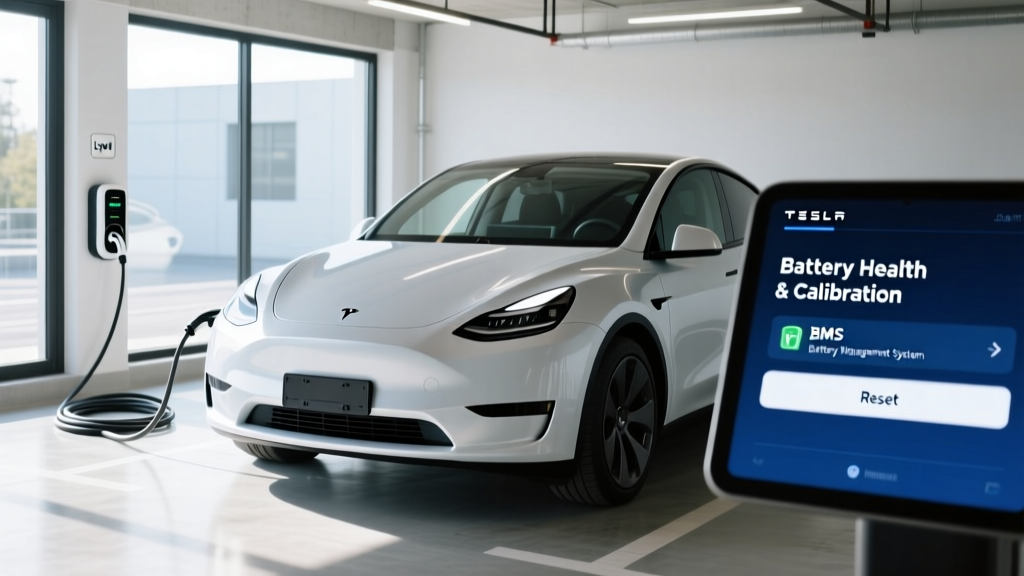
- LFP owners: charge to 100% at least weekly. LFP cells have a very flat voltage curve, making SoC estimation difficult for the BMS. Regular 100% charges allow the system to recalibrate, preventing range-display drift.
- In extreme cold, precondition before charging. Cold lithium-ion cells accept charge poorly and can experience lithium plating if charged at high rates below freezing. Use your car's preconditioning feature or plug in and let the thermal management system warm the pack before a fast-charge session.
Monitoring Your Battery's State of Health (SoH)
State of Health (SoH) is the percentage of your battery's original usable capacity that remains. A new pack is 100% SoH; a pack that originally held 75 kWh but now holds 67.5 kWh is at 90% SoH. Here's how to track it:
Native vehicle tools: Tesla's app displays estimated range at 100% — comparing this to the original EPA figure (adjusted for the buffer) gives a rough SoH estimate. Hyundai/Kia's infotainment includes an EV battery health screen showing SoH percentage directly on some model years. BMW's iDrive surfaces battery health in the service menu.
OBD-II third-party apps: Devices like the OBDLink CX or vLinker FS paired with apps such as Scan My Tesla, Car Scanner ELM OBD2, or LeafSpy (for Nissan LEAF) can read the BMS-reported SoH, cell voltage variance, and pack energy in kWh. This is the most accurate owner-accessible method and takes about 5 minutes.
Dealer diagnostic reports: Any authorized service center can pull a full battery health report. Request one at each annual service visit and keep records — they're valuable for resale and for establishing a warranty claim if degradation accelerates.
What to watch for: Cell voltage variance above 0.1V between modules can indicate a weak cell group that may need module-level service. A sudden drop in SoH (more than 2–3% in a single month) warrants a dealer visit, as it may signal a defective module rather than normal wear.
What's Next: Solid-State, Silicon Anodes, and Realistic Timelines
The battery landscape is evolving, but it's critical to separate laboratory milestones from production reality.
Silicon-dominant anodes are the nearest-term improvement. Companies like Sila Nanotechnologies and Group14 are supplying silicon-composite anode materials that boost energy density by 10–20% without changing the cathode. These are appearing in limited production as of 2025–2026 (e.g., in select Mercedes-Benz and Panasonic-backed applications). Expect broader adoption by 2028.
Solid-state batteries — which replace the liquid electrolyte with a solid conductor — promise higher energy density (~400+ Wh/kg), faster charging, and improved safety. Toyota has announced a 2027–2028 production target for solid-state EVs with ~750 km (WLTP) range and 10-minute 10–80% charging. Samsung SDI and QuantumScape are targeting similar timelines. However, no solid-state EV is available for purchase in 2026, and early production will likely be limited to premium, low-volume models. Mass-market solid-state EVs at competitive pricing are realistically a 2030+ proposition.
Sodium-ion batteries are emerging as a low-cost alternative for entry-level EVs and stationary storage. CATL has begun production in China, but US-market vehicles using sodium-ion packs are not expected before 2028. Energy density is significantly lower than LFP, limiting range, but the cost advantage could make sub-$25,000 EVs viable.
Frequently Asked Questions
How long do EV batteries actually last in years and miles?
Based on fleet data through 2025, modern liquid-cooled EV battery packs routinely reach 200,000–300,000 miles before falling below 70% of original capacity. In calendar years, that translates to 15–20+ years for average drivers (13,500 miles/year per the EPA). LFP packs, with their superior cycle life, are projected to exceed 300,000 miles under normal conditions. The vehicle's body, suspension, and electronics will likely reach end-of-life before the battery does.
How much does it cost to replace an EV battery in 2026?
Full pack replacement ranges from roughly $7,000 for smaller packs (Nissan LEAF, base Model 3 LFP) to $22,000+ for large truck packs (F-150 Lightning Extended Range). However, module-level repairs — replacing only degraded cell groups — cost $2,000–$5,000 and are increasingly common. Fewer than 2% of EVs have needed out-of-warranty battery replacement as of 2025, and battery costs continue to decline year-over-year.
What does the EV battery warranty actually cover?
Most manufacturers warrant the high-voltage battery for 8 years/100,000 miles (Hyundai/Kia extend this to 10 years/100,000 miles) against defects and capacity loss below a stated threshold — typically 70% of original capacity. The warranty does not cover gradual degradation above the threshold, physical damage, or vehicles with salvage titles. Review your specific model-year warranty booklet, as terms can change. The IRS §30D credit for new EVs is separate from warranty coverage and has its own MSRP, income, and battery-sourcing requirements.
How do I check my EV's battery health at home?
Three methods: (1) Check your vehicle's native battery health display in the infotainment or app — Tesla shows estimated range at 100%, Hyundai shows SoH percentage directly on some models. (2) Use an OBD-II adapter ($30–$60) with apps like Scan My Tesla, Car Scanner, or LeafSpy to read BMS-reported SoH, cell voltages, and pack energy. (3) Request a dealer diagnostic report at each service visit. Track SoH quarterly and note any sudden drops exceeding 2–3% per month.
LFP or NMC — which battery chemistry should I choose?
Choose LFP if: you charge at home, drive under 50 miles daily, want maximum cycle life, prefer the convenience of 100% daily charging, and live in a mild-to-moderate climate. LFP offers 3,000–5,000+ cycles, lower cost, and superior thermal safety. Choose NMC/NCA if: you need 300+ miles of EPA range, regularly road-trip and need faster DC charging, live in a cold climate where NMC's better low-temperature performance matters, or need maximum towing range. NMC offers higher energy density and better cold-weather efficiency at the cost of a lower cycle count and an 80% daily charging recommendation.
Does frequent DC fast charging damage my battery?
Frequent DC fast charging (150+ kW) generates sustained heat that accelerates electrolyte and separator degradation. Data from fleet studies shows that daily DC fast charging can add 1–3% additional capacity loss over 5 years compared to exclusive Level 2 home charging. However, occasional fast charging (1–3 sessions per week, typical for road trips) has a negligible effect. Modern thermal management systems actively cool the pack during fast charging, mitigating much of the heat stress. The practical advice: use Level 2 for daily charging and reserve DC fast charging for road trips.