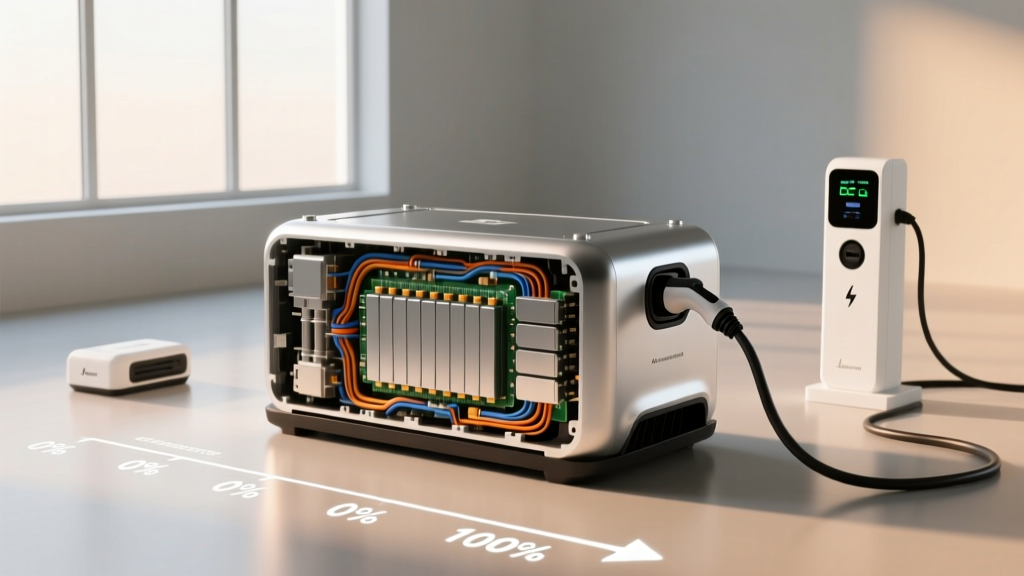
If you've ever searched for guidance on charging car batteries with a charger, you've likely found a tangle of advice written for 12V lead-acid batteries under the hood of a gas car. Electric vehicles flip that script entirely. The high-voltage traction battery in a modern EV — typically 58 to 100+ kWh of lithium-ion cells — is managed by sophisticated onboard software and thermal systems that make aftermarket trickle chargers irrelevant. What does matter is how you charge daily, what chemistry your pack uses, and how degradation tracks over years and miles.
This guide breaks down EV battery longevity with real data points, chemistry trade-offs, warranty specifics, and the habits that actually move the needle on State of Health (SoH).
How Long Do EV Batteries Actually Last?
The short answer: far longer than most buyers fear. Data from fleet operators and long-term owners consistently shows modern lithium-ion traction batteries retaining 85–92% of original capacity after 100,000 miles. Tesla's 2024 Impact Report noted their fleet averaged roughly 12% degradation at 200,000 miles. Hyundai/Kia's E-GMP platform vehicles (Ioniq 5, EV6) have shown similar curves in owner-tracked data, typically losing 6–10% over the first three years before the curve flattens.
Typical Degradation Curve (NMC Chemistry, Liquid-Cooled Pack):
- Year 1 / 15,000 mi: ~3–5% loss (initial settling)
- Year 3 / 45,000 mi: ~7–10% loss
- Year 5 / 75,000 mi: ~10–13% loss
- Year 8 / 120,000 mi: ~13–18% loss
- Year 10+ / 150,000+ mi: ~18–22% loss (highly variable by climate and charging habits)
Sources: Tesla Impact Report, Geotab fleet battery health data, Recurrent Auto battery studies.
LFP (lithium iron phosphate) packs — found in standard-range Tesla Model 3/Y, some BYD models, and the base Ford Mustang Mach-E Select — degrade even more slowly, often showing only 5–8% loss at 100,000 miles thanks to superior cycle life. The trade-off is lower energy density and reduced cold-weather range, which we'll unpack below.
The practical takeaway: for most owners driving 12,000–15,000 miles per year, the traction battery will outlast the vehicle's economic life. Catastrophic failure (sudden cell death, not gradual degradation) is rare — well under 1% of packs according to warranty claim data from major OEMs.
LFP vs NMC/NCA: Chemistry Trade-Offs Explained
Not all lithium-ion batteries are identical. The cathode chemistry determines energy density, cycle life, thermal stability, and cost. Here's how the two dominant chemistries in 2026 model-year EVs compare:
| Attribute | LFP (Lithium Iron Phosphate) | NMC / NCA (Nickel Manganese Cobalt / Nickel Cobalt Aluminum) |
|---|---|---|
| Energy Density | Lower (~160 Wh/kg cell-level) | Higher (~250–300 Wh/kg cell-level) |
| Typical Cycle Life | 3,000–5,000+ cycles to 80% SoH | 1,000–2,000 cycles to 80% SoH |
| Cold-Weather Performance | Weaker; expect 30–40% range loss below 20°F | Better; expect 20–30% range loss below 20°F |
| Thermal Stability | Excellent; very low thermal runaway risk | Good; requires robust thermal management |
| Cost per kWh | Lower (~$90–110/kWh pack-level, 2025–2026) | Higher (~$120–150/kWh pack-level) |
| Recommended Daily SoC | Can charge to 100% daily without harm | Best kept at 80% daily; 100% for trips only |
| Common Vehicles (2026) | Tesla Model 3/Y RWD, BYD Seal, base Mach-E Select | Model 3/Y Long Range, Ioniq 5/6, EV6, Rivian, F-150 Lightning Extended |
Which is better? It depends on your use case. If you commute 30–50 miles daily, can charge at home every night, and live in a mild climate, LFP is arguably superior — cheaper, longer-lasting, and you can charge to 100% without guilt. If you need maximum range for road trips, tow frequently, or live where winters are brutal, NMC/NCA's higher energy density and better cold performance justify the slightly faster degradation curve.
What Does the EV Battery Warranty Actually Cover?
Federal law mandates a minimum 8-year / 100,000-mile warranty on EV traction batteries for emissions-related compliance, but most manufacturers exceed this baseline. The critical number isn't just years and miles — it's the capacity retention threshold, the minimum State of Health the manufacturer guarantees.
| Manufacturer | Warranty Term | Capacity Retention Threshold | Notes |
|---|---|---|---|
| Tesla | 8 yr / 120,000 mi (Long Range); 8 yr / 100,000 mi (RWD) | 70% | LFP packs on RWD models still covered at 70% |
| Hyundai / Kia (E-GMP) | 10 yr / 100,000 mi | 70% | Among the longest terms in the US market |
| Ford (Mach-E, F-150 Lightning) | 8 yr / 100,000 mi | 70% | Covers battery components and capacity loss |
| GM (Ultium platform) | 8 yr / 100,000 mi | 70% (most models); 60% (Hummer EV) | Varies by model — check owner's manual |
| Rivian | 8 yr / 175,000 mi (R1T/R1S Max Pack) | 70% | Higher mileage cap on larger packs |
| BMW | 8 yr / 100,000 mi | 70% | Applies to i4, i5, i7, iX |
What triggers a warranty claim? If your battery's usable capacity drops below the threshold (typically 70% of original) within the warranty period, the manufacturer will repair or replace modules — or the full pack — at no cost. Note that this covers degradation beyond the threshold, not normal gradual loss. A battery at 78% SoH at year 7 is functioning normally and wouldn't trigger a claim.
Warranties typically exclude damage from collisions, flooding, improper modifications, or use of non-OEM charging equipment that causes electrical damage. Standard DC fast charging does not void the warranty, despite persistent internet myths.
EV Battery Replacement Cost: What to Expect
This is the question that keeps potential EV buyers up at night — but context matters enormously. The vast majority of EV batteries never need full replacement. When they do, it's usually outside the warranty window on high-mileage vehicles (150,000+ miles) or due to physical damage.
| Vehicle / Pack Size | Battery Capacity | Estimated Replacement Cost (2025–2026) | Typical Replacement Trigger |
|---|---|---|---|
| Tesla Model 3 RWD (LFP) | ~60 kWh | $10,000–$13,000 | Rare before 200k+ mi; LFP cycle life is exceptional |
| Tesla Model Y Long Range (NMC) | ~75 kWh | $13,000–$16,000 | Typically 180k–250k mi if needed |
| Hyundai Ioniq 5 (NMC) | 77.4 kWh | $14,000–$18,000 | Module-level repair often possible, reducing cost |
| Ford F-150 Lightning Extended | ~131 kWh | $22,000–$30,000 | Largest consumer packs; module repair preferred |
| Chevrolet Equinox EV | ~85 kWh (Ultium) | $14,000–$17,000 | GM's modular Ultium design allows partial replacement |
| Rivian R1T Max Pack | ~149 kWh | $25,000–$35,000 | Large pack; module-level service available |
Key nuance: many modern packs are modular. Hyundai's E-GMP, GM's Ultium, and Rivian's skateboard platform allow technicians to replace individual modules (a few kWh each) rather than the entire pack, dramatically reducing out-of-warranty costs. A single module swap might run $2,000–$5,000 instead of a full pack replacement.
Prices have been trending downward. Pack-level costs fell from roughly $190/kWh in 2022 to approximately $110–140/kWh in 2025–2026, per BloombergNEF data. As LFP adoption grows and recycling infrastructure scales, expect continued cost reduction through the end of the decade.
Factors That Accelerate (or Slow) Battery Degradation
When people search for how to properly charge car batteries with a charger in the EV context, what they're really asking is: what charging habits preserve battery health? The physics of lithium-ion cells gives us clear answers.
Habits That Maximize Battery Longevity:
- Charge to 80% daily (NMC/NCA): Sustained high SoC stresses cathode material. Set your charge limit to 80% for daily driving and bump to 100% only before road trips. LFP owners can ignore this — charge to 100% freely.
- Prefer Level 2 home charging over DC fast charging: A Level 2 charger at 7–11 kW adds roughly 25–44 miles of range per hour and generates far less heat than a 150–350 kW DC fast charger. Heat is the primary degradation accelerant.
- Limit DC fast charging to road trips: Occasional fast charging is fine. Daily fast charging, especially without preconditioning, adds cumulative stress. Tesla's own data shows vehicles that primarily fast-charge show ~2–3% more degradation at 100k miles vs. primarily L2-charged vehicles.
- Precondition before fast charging: Modern EVs warm the battery to optimal temperature (typically 95–105°F) before accepting a DC fast charge. Navigate to a charger using the car's built-in routing (Tesla, Hyundai, Ford all do this automatically), and the vehicle will precondition en route. Arriving at a charger with a cold pack means slower speeds and more stress.
- Avoid prolonged storage at extreme SoC: If leaving the car for weeks, store at ~50% SoC. Sitting at 100% or below 10% for extended periods accelerates calendar aging.
- Park in shade or a garage in hot climates: Sustained battery temperatures above 95°F (ambient, not just driving) accelerate degradation. Phoenix and Las Vegas owners see measurably faster capacity loss than Seattle owners, all else being equal.
- Don't obsess over the 20–80% rule: While the 20–80% window is the lowest-stress zone, the difference between charging to 80% vs 90% daily is marginal — perhaps 1–2% additional SoH over five years. Don't sacrifice daily usability for negligible gain.
How to Check and Monitor Battery Health (SoH)
State of Health (SoH) is the percentage of original usable capacity your battery retains. A new EV has 100% SoH; one that's lost 12% of capacity sits at 88% SoH. Monitoring this number helps you track degradation trends and plan for any warranty claims before expiration.
Built-in methods:
- Tesla: The service menu (accessible via the software screen) shows a battery health test result. You can also track range at 100% SoC over time — if your Model Y Long Range showed 310 miles at 100% when new and now shows 278 miles, that's roughly 90% SoH.
- Hyundai/Kia: The EV-specific menu in the infotainment system displays battery health percentage on most 2024+ E-GMP models. The Bluelink/Kia Connect app also reports SoH.
- Ford: The FordPass app and in-vehicle diagnostics report battery health status. For a precise number, a dealer can pull the SoH via the Ford diagnostic tool.
- GM (Ultium): The myChevrolet/myCadillac app includes a battery health indicator. OnStar diagnostics can provide a more granular readout.
Third-party methods:
- OBD-II dongles + apps: Tools like the OBDeleven (VW/Audi/Hyundai/Kia) or Scan My Tesla (Tesla-specific) can read battery management system (BMS) data including SoH, cell voltage variance, and pack temperature history.
- Recurrent Auto: This service (free for owners) tracks your battery data over time and provides a degradation report benchmarked against similar vehicles. It's one of the best tools for spotting abnormal degradation early.
- Dealer diagnostic: Any authorized service center can pull a full BMS report. Request this during routine service visits, especially as you approach the warranty mileage threshold.
What Charging Car Batteries with a Charger Means for EVs
Let's address the keyword directly: if you've landed here wondering about charging car batteries with a charger in the context of an electric vehicle, here's the definitive answer.
You do not use a standalone aftermarket charger on an EV traction battery. Unlike a 12V lead-acid battery that you might jump or trickle-charge with a $40 NOCO unit, the high-voltage traction pack (typically 350–800V nominal) is charged exclusively through the vehicle's onboard charge port and managed by the car's battery management system. There are no user-accessible terminals, no jumper posts, and no scenario where clamping a charger to the traction battery is safe or possible.
What you do use:
- Level 1 (120V AC): The mobile connector included with most EVs. Plugs into a standard household outlet. Delivers ~1.0–1.4 kW, adding roughly 3–5 miles of range per hour. Fine for PHEVs or overnight top-ups on low-mileage days.
- Level 2 (240V AC): A home wall connector or public Level 2 station. Delivers 7.2–11.5 kW (sometimes up to 19.2 kW on commercial units), adding 25–55 miles per hour. This is the primary charging method for most EV owners and the gentlest on battery health.
- DC Fast Charging (Level 3): Public stations delivering 50–350 kW DC directly to the battery (bypassing the onboard charger). Adds 150–300+ miles in 15–30 minutes depending on pack size and charge curve. Use for road trips; minimize daily reliance.
The 12V auxiliary battery in an EV (which powers lights, infotainment, and the contactors that connect the traction battery) can be charged with a standard 12V charger if it dies — but this is a separate system. Many 2025+ EVs have switched to 12V lithium-ion auxiliary batteries that rarely need attention. If your EV won't "start" and the 12V is dead, consult your owner's manual before connecting any external charger.
Emerging Battery Tech: Solid-State and Beyond
The next frontier in EV battery technology is solid-state batteries, which replace the liquid electrolyte with a solid material (ceramic, sulfide, or polymer). The promised advantages are significant: higher energy density (potentially 400+ Wh/kg at the cell level), faster charging (10–80% in under 10 minutes), improved safety (no flammable electrolyte), and longer cycle life.
However, solid-state batteries are not yet available in any production vehicle sold in the US as of 2026. Toyota has announced a solid-state battery targeting limited production in 2027–2028, initially in small volumes for select models. Samsung SDI and QuantumScape are in advanced prototype and pilot-production phases, with commercial availability projected for 2028–2030 at meaningful scale.
Silicon anode technology is closer to market. Companies like Sila Nanotechnologies and Group14 are supplying silicon-dominant anode materials that boost energy density by 20–40% over conventional graphite anodes. The Mercedes-Benz G-Class electric (2025) was among the first to use silicon-anode cells, and expect broader adoption across 2027–2028 model-year vehicles.
For buyers today: current lithium-ion technology (both LFP and NMC) is mature, reliable, and well-supported by warranty infrastructure. Waiting for solid-state means waiting at least 2–4 years for limited availability at premium price points. The batteries in 2026 model-year EVs are the best they've ever been — and more than adequate for 150,000+ miles of service.
Frequently Asked Questions
How long do EV batteries last in years and miles?
Most modern EV traction batteries retain 80–88% of original capacity at 150,000 miles (roughly 10–12 years at average driving). LFP chemistry packs often exceed 90% retention at the same mileage. Catastrophic failure is rare — well under 1% of packs. The battery will typically outlast the vehicle's economic value.
How much does it cost to replace an EV battery?
Full pack replacement ranges from roughly $10,000 for a 60 kWh LFP pack (Tesla Model 3 RWD) to $30,000+ for a 131–149 kWh pack (F-150 Lightning Extended, Rivian Max Pack). However, most modern packs support module-level repair at $2,000–$5,000 per module. Under warranty (typically 8 years / 100,000 miles), replacement is free if capacity drops below 70%.
Does fast charging damage the battery?
Occasional DC fast charging causes negligible additional degradation. Daily fast charging without preconditioning adds measurable stress — roughly 2–3% more capacity loss over 100,000 miles compared to primarily Level 2 charging, per Tesla fleet data. Modern thermal management systems mitigate most of the heat damage, but physics still favors slower, cooler charging for long-term health.
LFP vs NMC — which battery chemistry should I choose?
Choose LFP if you want maximum cycle life, lower cost, the ability to charge to 100% daily, and you don't need maximum range or extreme cold-weather performance. Choose NMC/NCA if you need 300+ miles of EPA range, tow frequently, or regularly drive in sub-freezing temperatures. Both chemistries will comfortably exceed 150,000 miles with proper care.
How do I check my EV's battery health?
Most 2024+ EVs display battery health (SoH) in the infotainment system or companion app. Third-party services like Recurrent Auto provide free degradation tracking and fleet benchmarking. OBD-II tools (Scan My Tesla, OBDeleven) can pull detailed BMS data. Request a dealer diagnostic report as you approach the warranty mileage threshold to document capacity for any potential claim.
Will my EV battery need replacing before the car wears out?
Statistically, no. Fleet data from Tesla, Geotab, and Recurrent Auto shows that the vast majority of EV batteries retain sufficient capacity (above 70–75% SoH) through 200,000+ miles. The more common end-of-life scenario for an EV is that suspension, interior, and electronics age out — not the battery. If a battery does require service, module-level repair is increasingly available at a fraction of full-pack cost.