Every electric vehicle lives and dies by its high-voltage traction battery. It's the single most expensive component in the car, the primary determinant of real-world range, and the part most buyers worry about — often more than they need to. The good news, backed by a growing body of fleet and owner data, is that modern EV batteries routinely outlast 150,000 miles with manageable capacity loss. The nuance is that how you charge, what chemistry your pack uses, and the climate you drive in all shift that outcome by meaningful margins.
This guide breaks down the physics, the data, and the ownership economics of automobile battery charging and longevity — from LFP versus NMC trade-offs to real degradation curves, warranty fine print, and replacement costs.
LFP vs. NMC/NCA: The Chemistry Decision You're Making at Purchase
Not all lithium-ion batteries are the same. The cathode chemistry determines energy density, cycle life, thermal stability, cold-weather behavior, and cost. In 2026, two families dominate the passenger EV market:
- LFP (Lithium Iron Phosphate): Used in Tesla Model 3/Y Standard Range, Ford Mustang Mach-E Select (base), many BYD models, and an expanding list of affordable trims.
- NMC (Nickel Manganese Cobalt) / NCA (Nickel Cobalt Aluminum): Found in most long-range and performance trims — Tesla Long Range, Hyundai Ioniq 5/6, Kia EV6/EV9, Rivian, Lucid, BMW iX, and most premium EVs.
| Attribute | LFP | NMC / NCA |
|---|---|---|
| Energy Density (cell-level) | ~160–180 Wh/kg | ~230–300 Wh/kg |
| Typical Cycle Life | 3,000–5,000+ cycles | 1,000–2,000 cycles |
| Cold-Weather Range Loss (0°F vs 70°F) | ~30–40% reduction | ~20–30% reduction |
| Recommended Daily SoC | 100% (periodic full charge helps BMS calibration) | 80% for daily; 100% only for trips |
| Thermal Runaway Risk | Very low | Low (but higher than LFP) |
| Cost per kWh (pack-level, est.) | ~$100–$120 | ~$130–$160 |
| DC Fast Charge Tolerance | Excellent (frequent 100% DCFC acceptable) | Moderate (repeated 100% DCFC accelerates wear) |
| Best For | Daily commuters, fleet/ride-share, warm climates, budget trims | Long-range travel, cold climates, performance models |
The bottom line: If you drive under 60 miles daily, live in a mild climate, and want maximum battery longevity with minimal babysitting, LFP is the pragmatic choice. If you need 300+ miles of EPA range, regularly drive in sub-freezing temperatures, or prioritize performance, NMC/NCA remains the better fit — with slightly more care required around charging habits.
How Long Do EV Batteries Actually Last? Degradation Data
Battery degradation is non-linear. Most packs lose capacity faster in the first 1–2 years (an initial "break-in" drop), then settle into a slow, nearly linear decline. Here's what real-world fleet data and manufacturer disclosures show:
| Milestone | NMC/NCA (Avg. Retention) | LFP (Avg. Retention) | Source / Context |
|---|---|---|---|
| 1 year / ~15,000 mi | ~95–97% | ~97–99% | Recurrent Auto fleet data, Tesla Impact Reports |
| 3 years / ~45,000 mi | ~90–93% | ~94–97% | Geotab fleet study (5,000+ vehicles) |
| 5 years / ~75,000 mi | ~85–90% | ~91–95% | Recurrent, owner surveys, manufacturer warranty thresholds |
| 8 years / ~120,000 mi | ~78–85% | ~87–93% | Warranty floor is typically 70%; most packs exceed it |
| 10+ years / 150,000+ mi | ~72–82% | ~82–90% | Early Tesla Model S/X fleet data; high-mileage ride-share vehicles |
For context, a 2026 Tesla Model Y Long Range with an 82 kWh (usable ~75 kWh) NMC pack rated at 310 miles EPA would still deliver roughly 250–265 EPA-equivalent miles at the 8-year mark under typical ownership patterns. An LFP-equipped Model 3 Rear-Wheel Drive (60 kWh usable, 272 mi EPA) could retain 235–250 miles in the same timeframe.
According to Recurrent Auto's analysis of over 15,000 EVs, the median battery replacement rate before 150,000 miles is under 5%. Catastrophic failures (sudden cell or module defects) are rare and typically surface under warranty in the first 2–3 years.
What Does the Battery Warranty Actually Cover?
Federal law (via EPA and CARB-influenced requirements) effectively mandates that manufacturers provide a minimum 8-year / 100,000-mile warranty on EV battery packs, with California-emissions states requiring 10 years / 150,000 miles. Here's how major manufacturers structure coverage in 2026:
| Manufacturer | Duration | Mileage | Capacity Retention Threshold | Notes |
|---|---|---|---|---|
| Tesla (Model 3/Y RWD, LFP) | 8 years | 100,000 mi | 70% | Long Range/Performance: 8 yr / 120,000 mi |
| Hyundai / Kia | 10 years | 100,000 mi | 70% | Among the most generous terms in the market |
| Ford (Mach-E, F-150 Lightning) | 8 years | 100,000 mi | 70% | Covers components and capacity |
| GM (Ultium platform) | 8 years | 100,000 mi | 70% (some trims 60%) | Verify trim-specific terms at purchase |
| BMW | 8 years | 100,000 mi | 70% | Transferable to second owner |
| Rivian | 8 years | 175,000 mi | 70% | Higher mileage cap reflects adventure-use positioning |
Critical fine print: The warranty covers the battery falling below the stated retention threshold — not gradual degradation above it. A pack at 72% capacity at year 7 is functioning within spec, even though you've lost nearly a third of your original range. Warranties also exclude damage from accidents, flooding, improper modifications, or using non-approved charging equipment. Always read the specific warranty booklet for your model year.
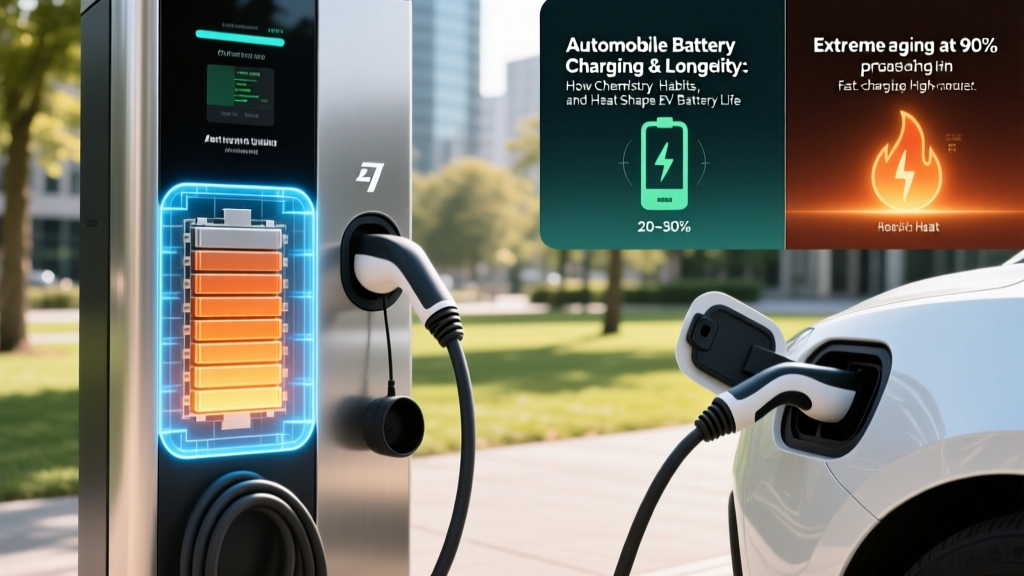
Automobile Battery Charging Habits That Accelerate (or Preserve) Battery Life
Not all electrons enter your battery equally. The chemistry and physics of lithium-ion cells mean that charging speed, temperature, and state-of-charge range all influence degradation rates. Here are the five factors with the largest measurable impact:
1. DC Fast Charging Frequency
Occasional DC fast charging (1–2 sessions per week) has a modest effect on long-term health. Daily reliance on 150–350 kW DCFC, however, can add 1–3% additional capacity loss over 5 years compared to predominantly Level 2 home charging. The heat generated during high-C-rate charging stresses cell internals. LFP packs tolerate frequent DCFC better than NMC due to their more stable chemistry, but the thermal management system still has to work harder.
2. State of Charge (SoC) Extremes
For NMC/NCA batteries, routinely sitting at 100% SoC accelerates calendar degradation — the electrolyte oxidizes faster at high voltage. The practical rule: set your daily charge limit to 80% and only charge to 100% when you're about to drive a long trip. LFP batteries are the exception — they actually benefit from periodic 100% charges for BMS (battery management system) calibration and don't suffer the same high-SoC stress.
3. Extreme Temperatures
Charging in sub-freezing conditions without preconditioning can cause lithium plating — metallic lithium deposits on the anode that permanently reduce capacity and, in severe cases, create internal shorts. Most 2026 EVs have battery preconditioning that warms the pack before charging (activated automatically when you navigate to a charger in the Tesla, Hyundai, or Ford systems). In extreme heat (above 100°F ambient), the thermal management system runs the cooling loop harder, which is effective but adds parasitic energy draw.
4. Prolonged Storage at Low or High SoC
Leaving an EV unplugged at 5% SoC for weeks risks the pack dipping below its minimum safe voltage, potentially bricking cells. Storing at 100% for extended periods accelerates calendar aging. The ideal storage SoC is 40–60%. If you're leaving the car for a week or more, plug it in and set the charge limit to 50%.
5. Regenerative Braking Settings
Aggressive regen (one-pedal driving) sends high-current pulses back into the battery during deceleration. While modern BMS systems manage this well, consistently high regen currents in cold weather — before the pack is warmed — can contribute to lithium plating. In winter, consider reducing regen intensity until the battery reaches operating temperature.
Battery Care Checklist for Maximum Longevity
- ✅ Set daily charge limit to 80% (NMC/NCA) or 100% (LFP)
- ✅ Use Level 2 home charging as your primary method
- ✅ Precondition the battery before DC fast charging (enable nav-to-charger)
- ✅ Avoid leaving the car at 100% SoC for more than a few hours
- ✅ Store at ~50% SoC if parked for more than a week
- ✅ Limit DCFC to road trips; don't rely on it as your daily charge source
- ✅ In winter, plug in whenever possible so the car can manage pack temperature from grid power
- ✅ Monitor State of Health (SoH) quarterly via your vehicle's app or a third-party tool
How Much Does an EV Battery Replacement Cost?
This is the question that keeps prospective EV buyers up at night — and it's the one most likely to be misrepresented. Here are the facts:
Most EV batteries do not need replacement during typical ownership. The data from Recurrent Auto, Geotab, and manufacturer warranty claims shows that fewer than 5% of packs require full replacement before 150,000 miles. When replacement is needed, it's usually due to a manufacturing defect caught under warranty, not end-of-life degradation.
That said, if you're buying a used EV out of warranty or planning to keep a vehicle past 200,000 miles, here's what replacement costs look like in 2026:
| Vehicle / Battery Size | Battery Capacity | Chemistry | Replacement Cost (Parts + Labor) |
|---|---|---|---|
| Tesla Model 3 RWD | ~60 kWh | LFP | $8,000–$12,000 |
| Tesla Model Y Long Range | ~82 kWh | NMC | $12,000–$16,000 |
| Hyundai Ioniq 5 (Long Range) | ~77.4 kWh | NMC | $11,000–$15,000 |
| Ford F-150 Lightning (Extended) | ~131 kWh | NMC | $18,000–$25,000 |
| Chevrolet Equinox EV | ~85 kWh | NMC (Ultium) | $12,000–$17,000 |
| Rivian R1S (Max Pack) | ~149 kWh | NMC | $22,000–$30,000 |
Several trends are working in buyers' favor: pack-level costs have declined roughly 10–15% since 2023 due to manufacturing scale and LFP adoption. Third-party EV repair shops are increasingly capable of module-level replacement (swapping only degraded modules rather than the entire pack) for 40–60% less than a full pack swap. And the IRS §30D credit doesn't directly cover battery replacement, but some state programs and manufacturer extended warranties can offset costs.
For comparison, a conventional vehicle's transmission replacement or engine rebuild often costs $4,000–$8,000 and occurs more frequently than EV battery replacements. The total-cost-of-ownership math still favors EVs for most drivers.
Monitoring Your Battery's State of Health (SoH)
State of Health (SoH) is the percentage of original capacity your battery can currently hold. A new pack is 100% SoH; a pack that holds 65 kWh of its original 75 kWh is at ~87% SoH.
Here's how to check it on popular 2026 platforms:
- Tesla: Navigate to Service Mode (tap the car icon → Software → hold model name for 3 seconds → enter "service" code). Battery Health shows SoH percentage and estimated range at 100%.
- Hyundai / Kia: The infotainment system's EV menu shows battery health as a percentage. The Bluelink/Uvo connected app also provides periodic SoH reports.
- Ford: The FordPass app displays battery health under the vehicle status tab.
- Third-party OBD-II tools: Apps like EV Health, Leaf Spy (Nissan), or Scan My Tesla read the BMS directly via an OBD-II dongle and often provide more granular data than the OEM interface — including individual cell voltage imbalance and internal resistance trends.
When to be concerned: If your SoH drops more than 3% in a single year (after the initial break-in period), or if you notice sudden range drops that don't correlate with temperature, schedule a diagnostic. Cell imbalance — where one module degrades faster than others — can sometimes be corrected with a BMS recalibration or module replacement rather than a full pack swap.
Emerging Battery Technology: What's Realistic and When
The battery landscape is evolving rapidly, but separating laboratory promises from production reality matters for today's buyers:
Solid-State Batteries
Solid-state cells replace the liquid electrolyte with a solid conductor, promising higher energy density (potentially 400+ Wh/kg), faster charging, and improved safety. Toyota has announced limited solid-state production for select models by 2027–2028, and QuantumScape is supplying prototype cells to Volkswagen. However, manufacturing yield, cost, and scalability remain significant hurdles. Realistic mass-market availability: 2029–2031 at the earliest.
Silicon-Anode Batteries
Replacing graphite anodes with silicon can increase energy density by 20–40%. Sila Nanotechnologies and Group14 are already shipping silicon-dominant anode materials to manufacturers like Mercedes-Benz and Panasonic. Expect incremental adoption in premium models starting 2026–2027, with broader availability by 2028. This is the most commercially mature next-gen technology.
Sodium-Ion Batteries
Sodium-ion cells use abundant, cheap materials and perform well in cold weather, but have lower energy density (~120–150 Wh/kg). CATL and BYD are deploying them in Chinese-market city cars and energy storage. They may appear in US-market budget EVs or as range-extender supplements by 2028, but won't replace lithium-ion in long-range vehicles.
What this means for today's buyer: Don't delay a purchase waiting for solid-state. Current LFP and NMC chemistries are mature, well-understood, and backed by warranties that protect against the unlikely event of premature failure. The EV you buy today will serve you well through 2035 and beyond.
Frequently Asked Questions
How long do EV batteries last in years and miles?
Based on fleet data from Recurrent Auto and Geotab, the median EV battery retains 80–90% of its original capacity at 8 years / 100,000 miles. Most packs reach 150,000–200,000 miles before dropping to the 70% warranty threshold. LFP chemistries tend to outlast NMC by a modest margin. Catastrophic failures requiring out-of-warranty replacement occur in fewer than 5% of vehicles before 150,000 miles.
How much does an EV battery cost to replace?
Full pack replacement costs range from roughly $8,000 for a 60 kWh LFP pack (Tesla Model 3 RWD) to $25,000–$30,000 for a 130–150 kWh pack (F-150 Lightning Extended, Rivian Max Pack). However, most replacements never happen during typical ownership. Module-level repairs at independent EV shops can reduce costs by 40–60%. Prices have been declining and are expected to continue trending downward.
What does the EV battery warranty cover?
Federal requirements mandate a minimum 8-year / 100,000-mile battery warranty (10 years / 150,000 miles in CARB states). Coverage applies when the battery falls below a stated capacity retention threshold — typically 70% of original capacity. The warranty covers defects and abnormal degradation but excludes accident damage, flooding, unauthorized modifications, and damage from improper charging equipment. Always review the specific warranty booklet for your model year and trim.
How do I check and maximize my EV battery health?
Check State of Health via your vehicle's infotainment system, connected app, or an OBD-II scanner app like Scan My Tesla or EV Health. To maximize longevity: use Level 2 home charging as your primary method, set daily SoC limits to 80% for NMC/NCA (100% for LFP), precondition before DC fast charging, avoid prolonged storage at extreme SoC levels, and monitor SoH quarterly.
LFP vs. NMC — which battery chemistry is better for me?
LFP is better if you want maximum cycle life, can charge to 100% daily without worry, live in a mild climate, and don't need 300+ miles of range. It's the pragmatic choice for daily commuters and fleet drivers. NMC/NCA is better if you need long range (300–400+ miles EPA), drive frequently in cold weather (better cold-weather performance), or prioritize acceleration and performance. Both chemistries are proven and reliable — the "better" choice depends on your driving profile.
Does frequent DC fast charging damage my battery?
Occasional DC fast charging (a few times per week) has a small, measurable impact — perhaps 1–2% additional degradation over 5 years compared to exclusive Level 2 charging. Daily DCFC reliance can add 2–4% additional loss. The bigger risk is fast charging in extreme cold without preconditioning, which can cause lithium plating. Modern EVs mitigate this with thermal management, but using Level 2 at home as your baseline and reserving DCFC for road trips is the optimal strategy for long-term health.