Electric vehicle batteries are the single most expensive component in your car, and how you charge them directly determines how long they last, how much range they retain, and ultimately what you'll pay in ownership costs. Yet most EV owners treat charging as a simple plug-in-and-forget task, missing opportunities to extend battery life by years.
This guide breaks down the science of EV battery charging — from the chemistry inside your pack to the daily habits that preserve capacity — with real data points, not marketing claims.
LFP vs NMC: Understanding Your Battery Chemistry
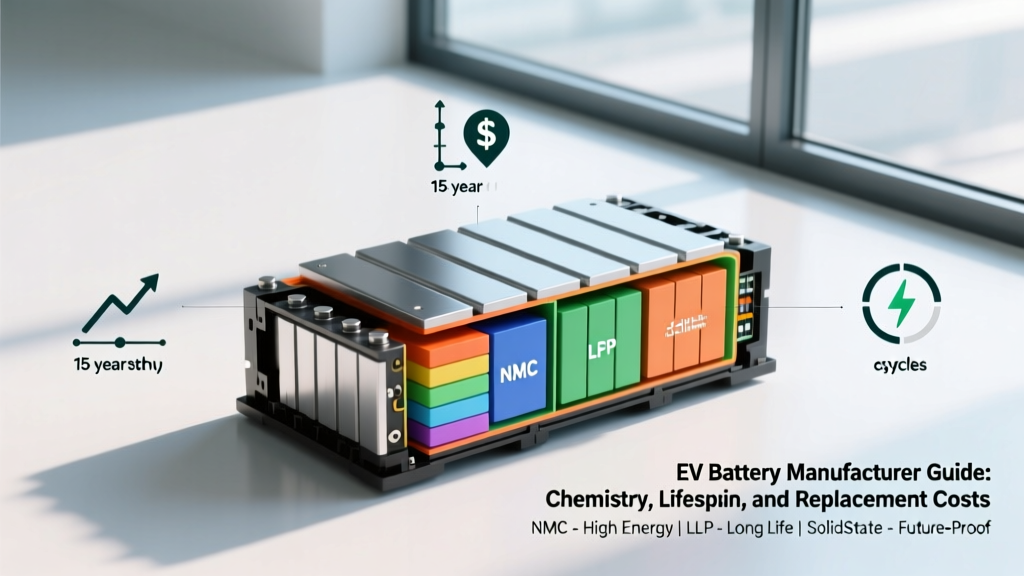
Before you can optimize how you charge your EV's battery, you need to know what's inside it. Virtually all modern EVs use one of two lithium-ion chemistries: NMC/NCA (nickel manganese cobalt / nickel cobalt aluminum) or LFP (lithium iron phosphate). The differences are significant and affect everything from daily charging habits to cold-weather range.
| Attribute | LFP (Lithium Iron Phosphate) | NMC/NCA (Nickel-Based) |
|---|---|---|
| Energy Density | Lower (~160-180 Wh/kg cell-level) | Higher (~220-260 Wh/kg cell-level) |
| Cycle Life | 3,000-5,000+ cycles to 80% capacity | 1,000-2,000 cycles to 80% capacity |
| Cold Performance | Moderate — more range loss below 32°F | Better — retains more capacity in cold |
| Charging Recommendation | Can charge to 100% daily; periodic full charges help BMS calibration | Best kept 20-80% daily; 100% for trips only |
| Cost | Lower — no cobalt or nickel | Higher — commodity-sensitive materials |
| Typical Vehicles (2025-2026) | Tesla Model 3 RWD, base Model Y, Ford Mustang Mach-E Select (LFP option), BYD models | Most long-range/premium trims: Tesla LR, Hyundai Ioniq 5/6, Ford F-150 Lightning Extended, Rivian, BMW iX |
| Thermal Stability | Higher — less prone to thermal runaway | Lower — requires more active cooling |
The practical takeaway: If your EV has an LFP pack, you can — and should — charge to 100% regularly. Tesla and Ford explicitly recommend this for LFP vehicles because the flat voltage curve makes state-of-charge estimation difficult; periodic full charges recalibrate the battery management system (BMS). NMC/NCA owners should set daily charge limits to 80% and reserve 100% charges for road trips.
How Long Do EV Batteries Actually Last?
The short answer: far longer than most buyers fear. Data from fleet operators, manufacturer reports, and independent testing consistently shows that modern EV batteries lose roughly 5-10% of total capacity over the first 100,000 miles, then degrade at a much slower linear rate.
According to fueleconomy.gov, most EV batteries are engineered to retain at least 70-80% of original capacity after 8 years or 100,000 miles. Real-world fleet data often exceeds this:
- Tesla's 2024 Impact Report showed Model S/X batteries retained approximately 88% capacity at 150,000 miles and roughly 85% at 200,000 miles.
- Geotab fleet data (covering 10,000+ EVs) found average annual degradation of approximately 1.8-2.3% per year across all brands, meaning a typical EV retains ~82-85% capacity after 8 years.
- Recurrent Auto analysis of 15,000 EVs showed median range retention of 90-95% at 3 years for most 2022+ models with active thermal management.
Typical Degradation Curve (NMC Pack with Active Thermal Management):
- Year 1 / ~12,000 mi: ~2-3% loss (initial formation loss)
- Year 3 / ~36,000 mi: ~5-7% total loss
- Year 5 / ~60,000 mi: ~8-10% total loss
- Year 8 / ~96,000 mi: ~12-15% total loss
- Year 12 / ~144,000 mi: ~16-20% total loss (estimated, linear extrapolation)
Note: Degradation is non-linear — the steepest loss occurs in the first 12-18 months, then flattens significantly. LFP packs typically show even slower long-term degradation.
What Does the EV Battery Warranty Cover?
Federal law in the United States mandates that EV battery warranties cover a minimum of 8 years or 100,000 miles (whichever comes first). California Air Resources Board (CARB) states — including California, New York, Massachusetts, and others adopting CARB standards — require 10 years or 150,000 miles for battery coverage.
| Manufacturer | Warranty Period | Capacity Retention Threshold | Notes |
|---|---|---|---|
| Tesla (Model 3/Y RWD — LFP) | 8 yr / 100,000 mi | 70% | Standard range models |
| Tesla (Model 3/Y LR, Model S/X) | 8 yr / 120,000 mi (S/X: 150,000 mi) | 70% | Long-range NMC packs |
| Hyundai / Kia | 10 yr / 100,000 mi | 70% | Among the longest coverage |
| Ford (F-150 Lightning, Mach-E) | 8 yr / 100,000 mi | 70% | Covers battery + electric drivetrain components |
| General Motors (Ultium platform) | 8 yr / 100,000 mi | 70% (some models 60%) | Verify specific model terms — Bolt EV was 8yr/100k at 60% |
| BMW | 8 yr / 100,000 mi | 70% | Includes i4, iX, i7 |
| Rivian | 8 yr / 175,000 mi (R1T/R1S) | 70% | Higher mileage cap than most competitors |
Critical detail: The warranty threshold matters enormously. A 70% retention threshold means the manufacturer will replace or repair the battery only if it drops below 70% of original capacity during the warranty period. If your 300-mile EPA-rated EV degrades to 215 miles of range at year 7, that's 71.7% — still above threshold and not covered, even though you've lost 85 miles of range. Most owners never hit the threshold, which is actually good news: it means catastrophic failure is rare.
How Much Does an EV Battery Cost to Replace?
Battery replacement is the nightmare scenario most prospective EV buyers fixate on. Here's the honest picture with real numbers:
| Vehicle | Battery Capacity | Estimated Replacement Cost | Notes |
|---|---|---|---|
| Tesla Model 3 Standard Range (LFP) | ~60 kWh | $8,000 - $12,000 | Costs declining as LFP cell prices drop |
| Tesla Model Y Long Range | ~75 kWh | $12,000 - $16,000 | 4680 cell packs may differ in cost |
| Hyundai Ioniq 5 | 77.4 kWh | $14,000 - $18,000 | E-GMP platform battery |
| Ford F-150 Lightning Extended Range | ~131 kWh | $20,000 - $28,000 | Largest consumer EV pack currently sold |
| Chevrolet Equinox EV | ~85 kWh | $13,000 - $17,000 | Ultium module-based — partial replacement possible |
| BMW iX xDrive50 | ~105 kWh usable | $18,000 - $25,000 | Premium brand labor + parts markup |
When is replacement typically needed? In practice, almost never during normal ownership. The vast majority of EV batteries outlast the vehicle's economic life. When replacements do occur, they're usually due to:
- Manufacturing defects (covered under warranty — free to owner): typically manifests in the first 1-3 years
- Physical damage from collisions or road debris: covered by insurance
- Gradual degradation beyond useful capacity: typically 15+ years / 200,000+ miles — well beyond average vehicle lifespan
One cost-saving development: several manufacturers (GM with Ultium, Hyundai with E-GMP) use modular battery packs where individual modules can be replaced rather than the entire pack. A single failed module might cost $1,500-$3,000 to swap versus $15,000+ for a full pack.
Factors That Affect EV Battery Life
Not all miles are created equal when it comes to battery wear. Research from NREL (National Renewable Energy Laboratory) and fleet data from Geotab identify these key factors:
Battery Care Best Practices
- Minimize DC fast charging when possible. Frequent use of 150+ kW DC fast charging accelerates degradation compared to Level 2 home charging. A 2023 study by Recurrent Auto found that EVs fast-charging more than 3 times per week showed approximately 0.5-1% additional annual degradation versus those primarily using Level 2. Not catastrophic, but measurable over 5+ years.
- Avoid extreme states of charge. For NMC/NCA packs, storing the battery at 100% SoC for extended periods (days to weeks) accelerates calendar aging. The ideal storage SoC is 40-60%. Daily driving between 20-80% is the sweet spot.
- Precondition before fast charging. Battery preconditioning (warming the pack to ~30-35°C / 86-95°F) before DC fast charging reduces stress on cells and enables faster charging. Tesla, Hyundai, and Ford vehicles do this automatically when you navigate to a Supercharger or fast-charging station. If your EV doesn't auto-precondition, plug in and initiate charging immediately after driving while the pack is already warm.
- Park in shade or garages in extreme heat. Sustained ambient temperatures above 95°F (35°C) accelerate calendar degradation, especially at high SoC. Active thermal management mitigates this, but the pack still works harder.
- Don't baby it too much. Obsessively keeping SoC between 45-55% yields diminishing returns. The biggest gains come from simply avoiding prolonged 100% sits and excessive fast charging. Normal use — driving, charging overnight on Level 2, occasional road-trip fast charging — is what these batteries are designed for.
The Charging Curve Reality
Understanding the charge curve helps you charge smarter. DC fast charging follows a tapering pattern: peak kW rates (e.g., 250 kW on a Tesla V3 Supercharger) are only sustained at low states of charge, typically 10-40%. Above 60% SoC, charge rates drop significantly; above 80%, they slow to a trickle.
This means charging from 10-80% at a 250 kW station might take 18-22 minutes, but going from 80-100% could add another 20-30 minutes while putting disproportionate stress on cells. For daily driving, stopping at 80% saves time and preserves battery health — which is why most EVs let you set a charge limit.
How to Check and Monitor Battery Health (SoH)
State of Health (SoH) represents your battery's current maximum capacity as a percentage of its original capacity. A new battery sits at 100% SoH; one that has degraded to hold only 90% of its original energy shows 90% SoH.
Methods for Checking SoH
- In-vehicle displays: Some EVs (notably Tesla via the service menu, and Hyundai/Kia via the infotainment system) show estimated battery health or degradation percentage. Tesla owners can access this through the "Service" menu or by requesting a battery health test via the app.
- OBD-II diagnostic tools: Devices like the OBDLink SX/MX paired with apps such as EVNotify, LeafSpy (for Nissan Leaf), or Scan My Tesla can read the BMS-reported SoH directly. This is the most accurate consumer-accessible method.
- Third-party services: Companies like Recurrent Auto offer free battery health reports by connecting to your vehicle's telematics data, comparing your degradation curve against a fleet of identical vehicles.
- Manual calculation: Fully charge your EV to 100% (on an NMC car, do this occasionally for calibration), note the displayed range, and compare to the original EPA-rated range adjusted for the vehicle's efficiency. This is imprecise (displayed range varies with temperature and driving style) but gives a rough SoH estimate.
When to be concerned: If your SoH drops more than 3-4% in a single year after the initial break-in period, or if you notice sudden range drops of 10+ miles that don't correlate with temperature changes, contact your dealer's service department. Sudden drops can indicate a cell imbalance or module failure, both typically covered under warranty.
Emerging Battery Technologies: What's Coming
Several next-generation battery technologies are in development, but none are commercially available in consumer EVs as of 2026. Here's a realistic timeline assessment:
- Solid-state batteries: Replace the liquid electrolyte with a solid material, promising higher energy density (potentially 400+ Wh/kg), faster charging, and improved safety. Toyota has announced a solid-state battery targeting 2027-2028 production, initially in limited-run vehicles. Samsung SDI and QuantumScape are also pursuing solid-state, but mass-market availability is realistically 2029-2032. Expect initial deployment in premium models at significant price premiums.
- Silicon anode batteries: Replace graphite anodes with silicon, increasing energy density by 20-40%. Companies like Sila Nanotechnologies and Group14 are supplying early production cells. Some 2025-2026 models may incorporate partial silicon anodes. This is the most likely near-term improvement, incrementally boosting range without requiring entirely new pack architectures.
- Sodium-ion batteries: Use abundant sodium instead of lithium, dramatically reducing cost. CATL has begun production in China for small EVs. Energy density is significantly lower than LFP, making sodium-ion suitable for city cars and budget EVs but not long-range vehicles. US-market availability is uncertain and likely 2027+.
- Lithium-sulfur (Li-S): Theoretically offers 5x the energy density of current lithium-ion, but cycle life remains a fundamental challenge. Still in laboratory and early prototype stages — 2030+ at the earliest for any automotive application.
For buyers today: don't wait for solid-state. Current LFP and NMC batteries are proven, well-warrantied, and improving incrementally every model year. The best EV is the one that fits your needs now.
Frequently Asked Questions
How long do EV batteries last in years and miles?
Modern EV batteries with active thermal management typically last 15-20 years or 200,000+ miles before degrading to 70-80% of original capacity. Fleet data from Tesla, Hyundai, and others shows most packs retain 85-90% capacity at 100,000 miles. Many EV batteries will outlast the vehicle's body, interior, and suspension components.
How much does an EV battery cost to replace?
Full battery pack replacement costs range from approximately $8,000 for smaller LFP packs (Tesla Model 3 RWD) to $20,000-$28,000 for large packs (Ford F-150 Lightning Extended Range, ~131 kWh). However, most owners never need a replacement — degradation is gradual, and catastrophic failure is rare. Under-warranty replacements are free if capacity drops below the manufacturer's threshold (typically 70%).
What does the EV battery warranty cover?
EV battery warranties cover capacity loss below a specified threshold (typically 70% of original capacity) and defects in materials or workmanship for 8 years/100,000 miles (federal minimum) or 10 years/150,000 miles in CARB states. The warranty does not cover damage from accidents, misuse, or unauthorized modifications. Check your specific vehicle's warranty documentation for exact terms, as thresholds vary by manufacturer and model.
How do I check my EV battery's State of Health?
The most reliable consumer methods are: (1) using your vehicle's built-in battery health display if available (Tesla service menu, Hyundai/Kia infotainment), (2) connecting an OBD-II diagnostic tool with EV-compatible software like Scan My Tesla or LeafSpy, or (3) signing up for a free service like Recurrent Auto that reads telematics data. Manual range comparison after a full charge gives a rough estimate but is affected by temperature and driving conditions.
LFP vs NMC — which battery chemistry is better?
Neither is universally "better" — it depends on your priorities. LFP is better if you want maximum cycle life, lower cost, the ability to charge to 100% daily without concern, and superior thermal safety. It's ideal for daily commuters and owners who charge at home every night. NMC/NCA is better if you need maximum range in a single charge (long road trips), better cold-weather performance, and don't mind managing charge limits. Most long-range and performance EV trims use NMC/NCA for its higher energy density.
Does fast charging damage my EV battery?
Frequent DC fast charging (150+ kW) accelerates degradation slightly compared to Level 2 charging, but the effect is modest — roughly 0.5-1% additional annual loss for heavy fast-charging users versus primarily Level 2 users. Modern thermal management systems actively cool the pack during fast charging to minimize damage. Occasional fast charging on road trips is perfectly fine; daily reliance on it is where measurable extra wear accumulates. For daily use, Level 2 home charging at 7-11 kW is ideal.
Should I charge my EV to 100% every night?
It depends on your battery chemistry. LFP owners: yes, charge to 100% regularly — manufacturers recommend it for BMS calibration. NMC/NCA owners: no, set your daily charge limit to 80% and only charge to 100% when you need the full range for a trip. Storing an NMC pack at 100% SoC for extended periods accelerates calendar degradation. The 20-80% daily window is the longevity sweet spot for NMC chemistry.