If you're shopping for an electric vehicle, two battery questions dominate the research process: how long does a battery take to charge on a road trip, and how many years will that battery actually last before needing replacement? The answers depend heavily on battery chemistry, charging habits, and the specific model you choose. This guide covers the exact numbers — charge times by charger type, real-world degradation data, warranty coverage, replacement costs, and the chemistry trade-offs between LFP and NMC/NCA packs — so you can buy with confidence.
How Long Does an EV Battery Take to Charge?
Charge time depends on three variables: the charger's power output (measured in kW, or kilowatts — the rate of energy flow), the battery's capacity (measured in kWh, or kilowatt-hours — the total energy stored), and the vehicle's charge curve (how fast the battery accepts power at different states of charge). A 75 kWh battery charging at a sustained 7.5 kW takes roughly 10 hours from empty to full. But real-world charging is never linear — DC fast charging tapers significantly above 80% state of charge to protect battery health.
| Level | Power (kW) | Miles Added/Hour | 10–80% Time (typical) | Use Case |
|---|---|---|---|---|
| Level 1 (120V) | 1.0–1.4 kW | 3–5 mi/hr | 40–70+ hours | Emergency / overnight trickle |
| Level 2 (240V) | 7.2–19.2 kW | 20–60 mi/hr | 5–12 hours | Home daily charging, workplace |
| DC Fast (CCS/NACS) | 50–350 kW | 150–1,200+ mi/hr | 15–45 minutes | Road trips, highway corridors |
Most EV owners charge at home on Level 2, which refills the battery overnight in 6–10 hours depending on battery size and amperage. DC fast charging is reserved for road trips. Here's where the charge curve matters: a Hyundai Ioniq 5 with its 800V architecture can accept a peak 240 kW and reach 10–80% in roughly 18 minutes at a compatible 350 kW charger. But that peak rate only holds between roughly 10–55% SoC; above 80%, the rate tapers to under 50 kW. This is why manufacturers quote 10–80% times rather than 0–100% — charging the final 20% on DC fast can take as long as the first 70%.
Preconditioning is critical for fast charge speed. Vehicles like Teslas and the Porsche Taycan warm the battery to its optimal temperature (typically 30–40°C / 86–104°F) before you arrive at the charger. Without preconditioning — especially in cold weather — you may see peak rates cut by 30–50%.
LFP vs NMC/NCA: Which Battery Chemistry Is Right for You?
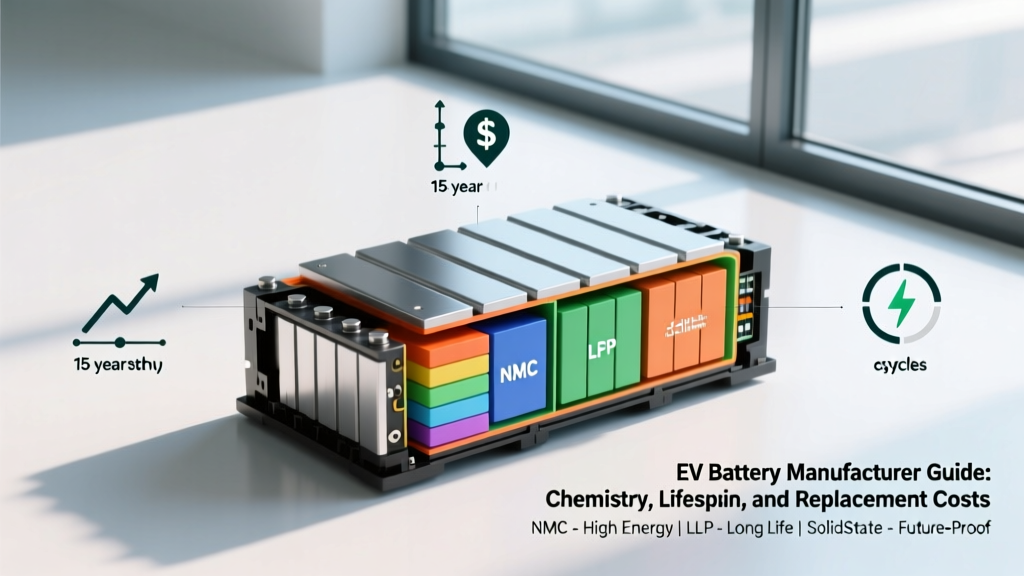
Not all EV batteries are the same. The two dominant lithium-ion chemistries in 2026 passenger EVs are LFP (lithium iron phosphate) and NMC/NCA (nickel manganese cobalt / nickel cobalt aluminum). Each has distinct trade-offs that affect range, longevity, cold-weather performance, and price.
| Attribute | LFP (Lithium Iron Phosphate) | NMC / NCA (Nickel-based) |
|---|---|---|
| Energy Density | Lower (~160–180 Wh/kg cell-level) | Higher (~220–300 Wh/kg cell-level) |
| Typical Range Impact | Slightly less range per kWh of pack weight | More range for same pack weight |
| Cycle Life | 3,000–5,000+ cycles to 80% SoH | 1,000–2,500 cycles to 80% SoH |
| Cold-Weather Performance | More range loss in freezing temps (15–30%) | Better cold performance (10–20% loss) |
| Charging to 100% | Recommended regularly; no degradation penalty | Better to stay 20–80% daily; 100% for trips only |
| Cost | Lower — no cobalt or nickel | Higher — commodity-sensitive metals |
| Safety / Thermal Runaway | More stable, higher ignition threshold | Good, but lower thermal runaway threshold |
| Common In (2026) | Tesla Model 3/Y RWD, Ford Mustang Mach-E Select, BYD models | Tesla Long Range, Hyundai Ioniq 5/6, Rivian, BMW iX, most premium EVs |
The bottom line: If you prioritize longevity, can charge at home daily to 100%, and don't need maximum range, LFP is excellent. Tesla's standard-range Model 3 and Model Y use LFP and explicitly recommend charging to 100% at least once a week for accurate state-of-charge calibration. If you need maximum range, tow frequently, or live in a very cold climate where every percentage of range matters, NMC/NCA remains the better choice — but you should set daily charge limits to 80% to minimize degradation.
How Long Do EV Batteries Actually Last?
The short answer: longer than most buyers assume. Modern EV traction batteries are engineered to outlast the vehicle's economic life. Data from fleet operators, manufacturer reports, and independent studies consistently show that most EV batteries retain 85–95% of their original capacity after 100,000 miles.
Here's what real-world degradation data looks like across major platforms:
- Tesla Model 3/Y (NMC and LFP): Tesla's 2025 Impact Report states that Model 3/Y batteries retain approximately 85% capacity after 200,000 miles. Early Model S/X data showed similar results, with median degradation around 12% at 150,000 miles.
- Nissan Leaf (older air-cooled packs): Earlier-generation Leafs (2011–2017) with passive air cooling showed steeper degradation — some losing 20–30% capacity over 8–10 years in hot climates. The 2018+ Leaf with improved thermal management performs significantly better.
- Chevrolet Bolt EV/EUV: GM's LG-sourced NMC packs have shown strong longevity, with owner-reported data indicating roughly 6–10% loss over 100,000 miles. The post-recall replacement packs carry an updated 8-year/100,000-mile warranty.
- Hyundai/Kia E-GMP platform (Ioniq 5, EV6): Limited long-term data (platform launched 2022), but early indicators and Hyundai's testing suggest under 10% degradation at 100,000 miles with typical use.
Typical degradation curve: Expect roughly 2–5% loss in the first year (initial formation), then a slower linear decline of about 0.5–1.5% per year or per 12,000–15,000 miles. A battery reaching 70–80% of original capacity — the threshold where range loss becomes noticeable in daily driving — typically takes 15–20 years or 200,000+ miles under normal conditions.
What Does the EV Battery Warranty Cover?
Federal law mandates that all EV batteries carry a minimum warranty of 8 years / 100,000 miles. In California Air Resources Board (CARB) states, that extends to 10 years / 150,000 miles. Most manufacturers exceed these minimums with capacity-retention guarantees.
| Manufacturer | Warranty Term | Capacity Threshold | Notes |
|---|---|---|---|
| Tesla (Model 3/Y) | 8 yr / 100,000–120,000 mi | 70% retention | Varies by trim (RWD vs Long Range) |
| Hyundai / Kia | 10 yr / 100,000 mi | 70% retention | Among the longest coverage in the industry |
| Ford (Mach-E, F-150 Lightning) | 8 yr / 100,000 mi | 70% retention | Transferable to second owner |
| GM (Chevy, Cadillac) | 8 yr / 100,000 mi | 70% retention (60% on Bolt pre-recall) | Updated post-Bolt recall terms |
| BMW | 8 yr / 100,000 mi | 70% retention | Includes i4, iX, i7 |
| Rivian | 8 yr / 175,000 mi | 70% retention | Higher mileage cap — strong for high-mileage drivers |
What triggers a warranty claim: The warranty covers defects in materials and workmanship, plus capacity loss below the stated threshold under normal use. It does not cover damage from accidents, flooding, or modifications. If your battery drops below 70% capacity within the warranty period, the manufacturer will repair or replace modules (or the full pack) to bring it back above that threshold — not necessarily to 100%.
How Much Does an EV Battery Cost to Replace?
This is the question that generates the most anxiety — and the most misinformation. Out-of-warranty battery replacement is expensive, but it's also rare. The vast majority of EV batteries never need full replacement during the vehicle's usable life.
| Vehicle | Battery Size (kWh) | Estimated Replacement Cost | Notes |
|---|---|---|---|
| Tesla Model 3 (LFP) | ~60 kWh | $10,000–$14,000 | Module-level repair often possible for less |
| Tesla Model Y Long Range | ~75 kWh | $13,000–$18,000 | Full pack replacement; module repair varies |
| Hyundai Ioniq 5 | ~77.4 kWh | $14,000–$20,000 | Labor-intensive removal; module replacement cheaper |
| Ford F-150 Lightning (Extended) | ~131 kWh | $25,000–$35,000 | Largest consumer pack; significant labor |
| Chevrolet Bolt EV | ~65 kWh | $14,000–$16,000 | Post-recall pack pricing |
| BMW iX xDrive50 | ~111.5 kWh | $22,000–$30,000 | Premium segment pricing |
Context matters here. A $15,000 battery replacement at 200,000 miles means you paid roughly 7.5 cents per mile for battery "wear" — far less than the cumulative cost of gasoline, oil changes, and transmission maintenance on a comparable ICE vehicle over the same distance. And battery prices continue to decline: BloombergNEF data shows pack-level prices falling from over $1,200/kWh in 2010 to roughly $115/kWh in 2025, with further declines expected.
Most owners will sell or trade the vehicle before a full pack replacement is needed. If you do face an out-of-warranty replacement, independent EV shops increasingly offer module-level repairs (replacing only the degraded cells) for $3,000–$8,000, depending on the pack architecture.
Factors That Affect EV Battery Lifespan
Battery degradation isn't just about age — it's about how you use and store the vehicle. The biggest factors:
- Fast-charging frequency: Occasional DC fast charging has minimal impact. But daily use of 150+ kW chargers, especially without preconditioning, accelerates degradation by 1–3% over the pack's life compared to Level 2-only charging. Tesla data shows that vehicles charged primarily on Superchargers vs. Level 2 had only marginally higher degradation after 150,000 miles — but the effect compounds over time.
- State of charge habits: For NMC/NCA batteries, regularly sitting at 100% SoC or below 10% SoC stresses the cells. The 20–80% daily window is the sweet spot. LFP batteries are more tolerant of 100% SoC and actually benefit from periodic full charges for BMS calibration.
- Extreme temperatures: Sustained exposure to high ambient heat (above 95°F / 35°C) accelerates chemical degradation more than cold does. Vehicles with active liquid thermal management (Tesla, Hyundai E-GMP, Ford, BMW) handle this far better than passively cooled packs. Cold weather temporarily reduces range but does not cause permanent degradation.
- Calendar aging: Even a parked EV battery degrades slowly over time. A vehicle stored at 50% SoC in moderate temperatures will lose roughly 1–2% capacity per year from calendar aging alone.
- Depth of discharge: Shallow cycles (e.g., charging from 40% to 70%) are gentler than deep cycles (10% to 95%). This is why daily partial charging is better than infrequent full charges for NMC/NCA packs.
How to Check and Maximize Your EV Battery Health
Monitoring your battery's State of Health (SoH) — the percentage of original capacity remaining — helps you track degradation and plan for warranty claims if needed.
How to Check Battery SoH
- In-vehicle displays: Some manufacturers (BMW, Mercedes, Hyundai) provide a battery health or SoH percentage directly in the infotainment system or service menu.
- OBD-II diagnostic tools: Apps like LeafSpy (Nissan), Scan My Tesla, or ABRP-compatible OBD dongles can read the battery management system (BMS) data, including SoH, cell voltage variance, and cycle count.
- Dealer diagnostic reports: Request a battery health report during scheduled service. Most dealerships can pull a detailed SoH printout.
- Manual calculation: Track your vehicle's actual range at a consistent SoC over time. If your 80%-to-20% range was 220 miles when new and is now 200 miles, that's roughly 9% degradation.
Battery Care Checklist
- Set daily charge limit to 80% for NMC/NCA; 100% is fine for LFP
- Use Level 2 home charging as your primary method
- Enable battery preconditioning before DC fast charging (automatic in most EVs when navigating to a charger)
- Avoid leaving the vehicle at 100% SoC for extended periods (more than 24 hours) in hot weather
- In extreme cold, plug in when parked to let the thermal management system maintain battery temperature using grid power
- Don't let the battery sit below 10% SoC for days at a time
- Check tire pressure regularly — underinflated tires increase energy consumption and indirectly increase charge cycles
What's Next: Solid-State and Silicon-Anode Batteries
Several next-generation battery technologies promise step-change improvements in energy density, charge speed, and longevity — but none are yet available in mass-market consumer EVs as of 2026.
Solid-state batteries replace the liquid electrolyte with a solid material, enabling higher energy density (potentially 400+ Wh/kg at the cell level), faster charging, and improved safety. Toyota has announced a solid-state battery targeting 2027–2028 production in limited models, while Samsung SDI and QuantumScape are supplying prototypes to OEMs. Realistic mass-market availability is 2029–2032. Expect initial deployment in premium vehicles with price premiums.
Silicon-anode batteries (from companies like Sila Nanotechnologies and Group14) replace the graphite anode with silicon, boosting energy density by 20–40%. Mercedes-Benz's next-generation EQ models and select startups have announced silicon-anode partnerships. Early production vehicles are expected in 2026–2027, with broader availability by 2028–2029.
Sodium-ion batteries are emerging as a low-cost alternative for entry-level EVs and stationary storage. CATL and BYD have begun limited production. Energy density is lower than LFP, making them best suited for shorter-range city vehicles.
None of these technologies should delay a current EV purchase. Today's lithium-ion batteries — both LFP and NMC — already deliver 200,000+ mile lifespans with manageable degradation. The improvements coming are incremental for most buyers, not transformational enough to justify waiting.
Frequently Asked Questions
How long does a battery take to charge at home?
On a Level 2 home charger (typically 7.2–11.5 kW), a full charge from near-empty takes 6–12 hours depending on battery size. A 75 kWh battery at 11.5 kW takes about 6.5 hours. Most owners plug in nightly and never charge from truly empty — adding 20–40 kWh overnight is sufficient for daily driving of 80–150 miles.
Is it bad to charge my EV to 100% every day?
For NMC/NCA batteries, yes — daily 100% charges accelerate degradation. Set your limit to 80% for daily use and charge to 100% only before long trips. For LFP batteries, charging to 100% regularly is recommended by Tesla and other manufacturers, as LFP chemistry handles full SoC well and needs it for accurate range estimation.
Does fast charging damage my EV battery?
Occasional DC fast charging has a negligible impact. Studies show that exclusive fast-charging vs. exclusive Level 2 charging results in only 1–3% additional capacity loss over 150,000 miles. The bigger risk is frequent fast charging without preconditioning in extreme temperatures. Modern battery management systems actively limit charge rates to protect the pack.
Will my EV battery need to be replaced?
Statistically, probably not. The vast majority of EV batteries retain 75–90% capacity at 150,000–200,000 miles. If your vehicle is still under the 8-year/100,000-mile federal battery warranty (or 10/150,000 in CARB states), a capacity drop below 70% would be covered. Out-of-warranty replacements are rare and declining in cost as battery prices fall.
How does cold weather affect my EV battery?
Cold temperatures temporarily reduce range by 15–30% at freezing (32°F / 0°C) and up to 40% below 0°F (−18°C), due to increased battery internal resistance and cabin heating demand. This is not permanent degradation — range returns when temperatures rise. Using a heat pump (standard on most 2024+ EVs) and preconditioning while plugged in significantly reduces cold-weather range loss.
Sources: EPA fuel economy data via fueleconomy.gov; manufacturer warranty documentation; IRS §30D clean vehicle credit guidelines; Tesla Impact Report; BloombergNEF battery price surveys.